First Light Productions

investigative journalism

Posts from the “NEWS” Category

Sloth hubris

Posted on September 26, 2013

A few weeks ago in Panama, a group of Texans, including a representative from the Dallas World Aquarium, landed in a private jet intending to airlift out of the country roughly 10% of the entire wild population of one of the most endangered animals on the planet. When caught, they explained they had a plan to establish a breeding population…return some to the wild, etc, etc.

OLYMPUS DIGITAL CAMERA

Pygmy sloth released back on Isla Escudo de Veraguas. (Photo: Shannon Thomas / the Sea Turtle Conservancy)

The pygmy three-toed sloth (Bradypus pygmaeus) is found on a single island–Isla Escudo de Veraguas–in Panama, and nowhere else in the world. A recent survey found fewer than 100 of the animals extant.

The secretive mission might have succeeded if suspicious bystanders hadn’t noticed a number of crates containing what appeared to be animals being loaded on the plane. Questions were asked. A large impromptu crowd formed vigorously insisting that the sloths be returned to the wild.

The Texans were forced to relinquish the animals and they were returned to the island the next day.


Source: Mongabay.

Pygmy Joe

Posted on September 22, 2013

The recent mass poisoning of elephants in Africa is a reminder that such mindless brutality is anything but rare.
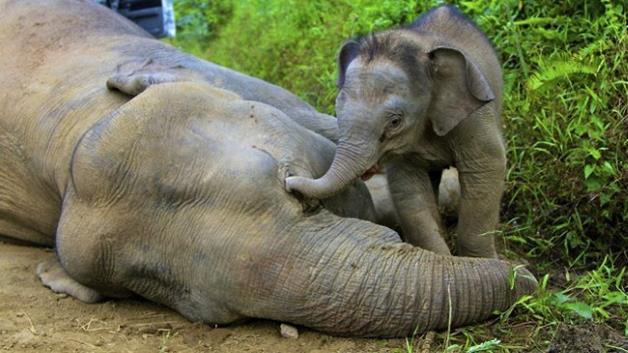
Borneo orphan. (Photo:EPA)

Last January, rangers of the Gunung Rara Forest Reserve in Northeastern Borneo came upon a baby pygmy elephant, nudging his dead mother, trying to get her to rise and feed him. Four other members of his herd lay on the ground nearby.

The rotting carcasses of six other members of the herd had been found earlier that month.  Four more were found in the days to come. Initial autopsies revealed they were all suffering from severe bleeding and gastrointestinal ulcers, indicating they had been poisoned.

Unlike elephants poached for their tusks, these animals were killed because they posed problems for palm oil plantations which are gobbling up many of the country’s forests.

Poisoning of elephants in Borneo has become routine. Every year, at least a dozen elephants are found either poisoned or shot dead across Sabah’s elephant home ranges, particularly in districts where forests have been fragmented by large scale agriculture activities and plantations.

The herd had been staying at the edge of a rainforest reserve, close to a logging camp and oil palm plantations, land controlled by Yayasan Sabah, the state wood and palm oil group. The elephant family’s territory covers around 400 square kilometers and is being taken away from them.

Like orangutans, elephants love to eat palm tree fruits, which puts them in continual conflict with plantation workers.

Later chemical analysis of the elephants’ remains confirmed that their bodies contained high levels of heavy metals: arsenic, cadmium, iron and chromium. These metals are usually found around mining, smelting or waste disposal operations. As there is no such activity in the area, wildlife officials to believe the toxic substances were deliberately placed near the elephants’ feeding ground with the intention to kill them.

Borneo orphan. (Photo:EPA)

The baby was taken in by the Lok Kawi Wildlife Park. Now named “Kejora” or “Joe” for short, the calf appears to be healthy. He has gained weight and is now socializing with other elephants at the park..

Policymakers in Malaysia are in the process of clearing the last remaining rainforest areas in the states of Sarawak and Sabah for more plantations, as the country continues to rely on the export of tropical timber and palm oil.

The deforestation is being driven by Sabah Chief Minister Musa Aman, who personally grants permits for the clearing of the rainforest and for the establishment of palm oil plantations. Aman is also Chairman of the Board of Trustees of the state-owned Yayasan Sabah Group, which is scouring tens of thousands of hectares of rainforest for the new palm oil plantations.

The World Wildlife Fund estimates there are fewer than 1,500 Borneo pygmy elephants. Known for their babyish faces, large ears and long tails, they live mainly in Sabah and grow to about 8ft tall, shorter than mainland Asian elephants..

The future for Sabah’s elephants remains a question mark because 75 per cent of their territory lies in unprotected forest.

There have been no arrests in the poisoning of the 14 elephants.

Lions and tigers

Posted on September 20, 2013

If you want to shoot a lion or a tiger and save money in the process go to South Africa.

South Africa

The price of killing a wild lion shot on a safari in Tanzania may cost $70,000. In South Africa you can shoot a trophy size specimen for a fraction of that.

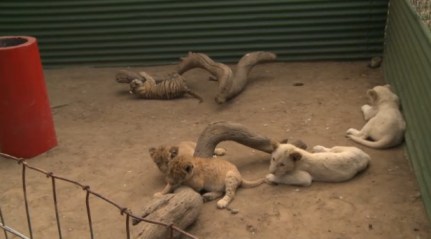
Hunting in South Africa also takes the strain out of the hunt as you are not only guaranteed a trophy, but the farm-raised, habituated animals are released for your pleasure inside a fenced area, just a few hours prior to your arrival, so there is no need to go driving and hiking all over the place and wearing yourself out.

The entrepreneurial spirit is strong in South Africa, which has more than 160 lion-breeding farms holding up to 5,000 lions, far exceeding the population of 2,000 or so remaining in the wild, hanging by a thread living off-limits behind fences in national parks and private nature reserves.

As an added bonus some South African game ranches also have tigers on offer, which they market with flair, pitching them “wink wink” as one ranch does using a photo showing a “Hunt trophy” with a specimen “taken from the wild.” An interesting turn of phrase as tigers are not native to Africa.

South Africa.

If you don’t want to shoot a tiger you can buy a cub–lion or tiger. Cubs are big business there as well.

South Africa.

The South African wild cat trade is multi-faceted: lions, tigers, cubs…. The game farms make extra money selling them either alive or as parts to clients in Asia who grind up the bones for use in traditional medicine.

Demand for cats in the canned hunting industry is such—in the five years to 2011, the country exported 4,062 lion trophies, the vast majority captive-bred animals—that a substantial business has developed in neighboring Botswana capturing lions and selling them to South African game ranchers to supplement demand that can’t be met for farmed cats.


A look at big game hunting in South Africa can be found here.

“Poor bees, poor birds…”

Posted on September 16, 2013

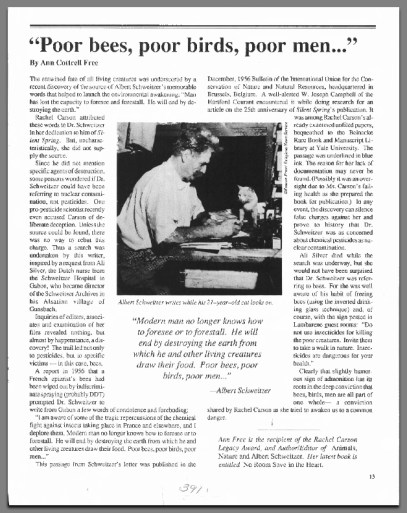
Upon learning of the destruction of a French apiarist’s honeybees due to indiscriminate spraying of new post World War ll chemical insecticides, Dr. Albert Schweitzer wrote to a bee keeper:

Animal Welfare Institute Quarterly, 1989.

“I am aware of some of the tragic repercussions of the chemical fight against insects taking place in France and elsewhere, and I deplore them. Modern man no longer knows how to foresee and to forestall. He will end by destroying the earth from which he and other living creatures draw their food. Poor bees, poor birds, poor men.”


Source: Animal Welfare Institute Quarterly 1989.

More turtle bycatch

Posted on September 13, 2013

Mirroring the reports of turtle deaths on Mexico’s Baja California Peninsula we reported yesterday, further down the Pacific Coast in Guatemala, the Wildlife Rescue and Conservation Association (ARCAS) recently reported the stranding of eighty dead sea turtles on the black volcanic sand beaches of La Barrona, Las Lisas, Chapeton and Hawaii.

Doctors Alfaro and Perez of Protortugas initiating a necropsy. (Photo: Wildlife Rescue and Conservation Association)

    Among the stranded turtles were leatherbacks (Dermochelys coriacea) which are listed as Critically Endangered by the IUCN Red List, and the olive ridley (Lepidochelys olivacea) which is listed as Vulnerable. The entire Guatemalan coast has historically been a significant nesting area for both species.

    The turtles forage in the estuaries and mangrove waterways along the 250 kilometers of the country’s Pacific coast which is divided by 14 river mouths and peppered with mangrove wetlands and lagoons.

    As in Mexico, one of the main threats to sea turtles here is fisheries by-catch. Researchers report that the appearance of shrimp trawlers always coincides with the appearance of dead turtles on the beaches.

    Guatemala is currently working on instituting a ban on bottom trawling, such as has been done in Belize, Costa Rica, Ecuador and El Salvador, where trawlers must stay at least 3 miles from shore.

    Guatemalan trawlers are required to use turtle excluder devices but enforcement is difficult and fines are very light


    Source: Mongabay

Loggerheads update

Posted on September 12, 2013

Mexico appears to be doing little or nothing to enforce changes in its Gulf of Ulloa fishery to protect the loggerhead sea turtles that migrate from their nesting grounds in Japan across the Pacific Ocean to the Baja California Peninsula.

LoggerheadSeaTurtle. (Photo: DamienDuToit/WikiCommons)

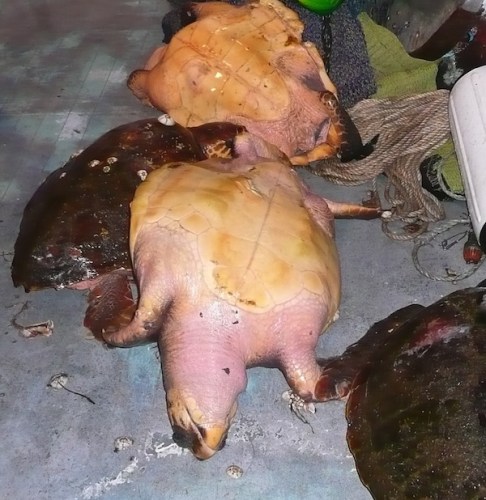
    The loggerheads stay in Baja for decades as they grow and mature, feeding primarily on red crabs. In the last few years the crabs have become a huge fishery and thousands of gillnets are now stretched across Baja’s Pacific coastal waters; “walls of death” that are snaring and drowning  vast numbers of turtles.

    Mexican government officials last week reported that so far this year 705 loggerheads have stranded dead along a 30-mile shoreline in Baja California’s Gulf of Ulloa. Last year, scientists estimate over 2,000 loggerheads were killed there in gillnets.

 Last summer in the Gulf saw a 600% increase in turtle deaths. Needless to say, the enormous bycatch is jeopardizing the turtles’ survival.

    Dead sea turtles bycatch on-board a Baja gillnet vessel.

    Nets have been developed that can solve the bycatch problem but Mexico has shown an unwillingness to act to insure that the fishery utilizes these measures.

      Rather than embrace a solution, the Mexican government has chosen to appease the fishing industry by ignoring and misrepresenting the findings of its own scientists who have pointed to bycatch as the leading cause of the deaths.

      Conservation groups are proposing that the United States consider a ban on the import of fish and other wildlife products from Mexico under trade agreements that authorize sanctions against countries that allow excessive bycatch of U.S.-protected species, like loggerhead sea turtles.


      Shout out: Center for Biological Diversity.

Fighting for animals

Posted on August 28, 2013

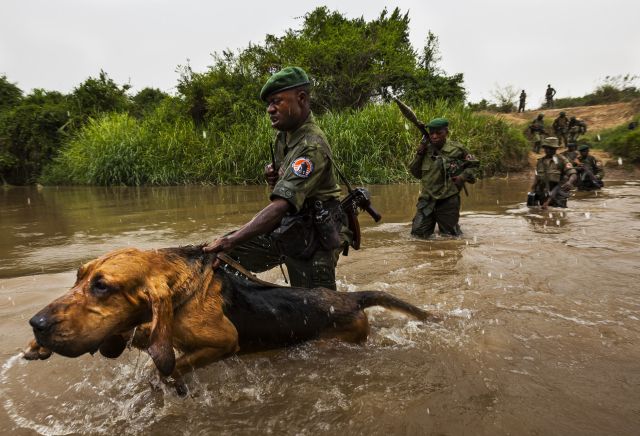
July 31st was World Ranger Day in honor of the men and women around the world who risk their lives to protect the planet’s endangered plants and animals.

Rangers from Virunga National Park’s canine unit in search of elephant poachers. (Photo: Virunga Nat Park)


Source: Virunga National Park, DR Congo.

Plateau animals

Posted on August 27, 2013

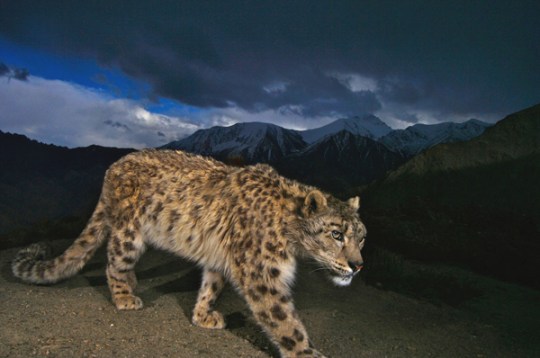
Wildlife across North Central Asia

Snow leopard. (Photo: Panthera)

is being driven to the margins of survival by huge increases in the numbers of cashmere goats being set loose on wild grazing lands.

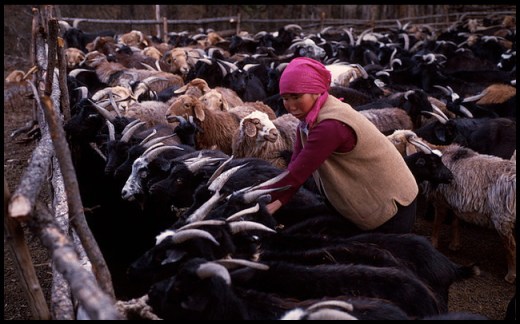
Cashmere goats in Mongolia. (Photo: Juho Korhonen / CC BY-NC-ND 2.0)

The goat herds  — a dramatic three-fold increase over the last two decades – are eating up the grass that previously supported antelopes, wild asses, yaks, camels, and other native wildlife. Loss of these prey species in turn affects the survival of predators, such as snow leopards, Asiatic leopards, bears and wolves living on the brink of extinction.

A study

published in the journal Conservation Biology, shows that 95% of all the forage across the Tibetan plateau, Mongolia and northern India was consumed by goats, sheep and other livestock, leaving just 5% for wild animals. The study concludes that expansion of the goat herds is most likely causing the decline of eight core species.

Zero sum game

Pressed for food the big cats and wolves attack livestock and are killed in retaliation by herders or their dogs. With the increase in domestic animals also comes disease to which the wild species are extremely vulnerable.

Mixed herd of Pashmina, other goats and sheep in predator-proof corral, implemented through Snow Leopard Conservancy program in Ladakh, India. (Photo: Chinch Gryniewicz)

A solution

may lie in creating a sustainable market for cashmere. Giving rewards to goat herders who protect wildlife. Livestock farmers might be compensated for vaccinating their animals to limit the spread of disease, and for housing goats in protective enclosures. Cashmere sourced from these farmers could then be marketed as eco-friendly; a tactic that worked for the “dolphin safe” tuna fishery.

In Mongolia alone, numbers of domestic goats have grown from 5 million in 1990 to almost 14 million in 2010. Ninety percent of the world’s cashmere comes from China and Mongolia.

Lakshmi

Posted on August 22, 2013

In an eleven hour operation carried out in the dark of the night, a team of about 20 officers from the Forest Department, Police and Wildlife SOS/India, rescued an 18 year old ailing elephant named Lakshmi, from a property where she had been concealed by her owners in an attempt to evade law enforcement agencies.

Safe.

    The operation involved walking the elephant to a safe location 5 kms distant from where she had been held, to a point where she could be easily loaded onto a truck. Lakshmi was unable to get on the truck herself due to her health problems, so Wildlife SOS rented a hydraulic crane to lift her onto the truck bed.

    She was given a light sedative to keep her calm during the rescue.

    Her owners had used Lakshmi for street begging in violation of the law. They paid no attention to her health and she has become extremely obese and is suffering severe joint pains making her prone to acute arthritis and other ailments. Her companion, Bijlee, owned by the same people could not be rescued in time and died a month ago in pain, due to severe neglect.

    Lakshmi has been relocated to the Wildlife SOS Elephant Rescue Center in Mathura.


    Source: Wildlife SOS/India. Wildlife SOS is a registered Non Profit Charity in India, USA and UK.

Dead

Posted on August 19, 2013

from a lack of sea ice on which to hunt seals.

Polar Bear starved to death due to climate change, Svalbard, Norway. (Photo: Ashley Cooper/Global Warming Images)

The assessment of Dr Ian Stirling, with the Canadian Wildlife Service who has studied polar bears for almost 40 years.


Source: Damian Carrington.

Old Habits

Posted on July 31, 2013

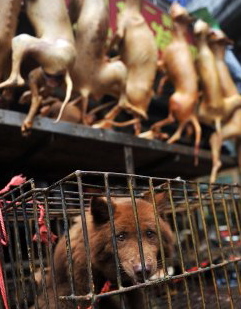
The 4th China Companion Animal Symposium held in Changsha, in Hunan Province earlier this month, where animal welfare organizations came  together to find ways to curtain the dog and cat meat industry, coincided with the annual Yulin summer solstice dog-eating festival in Guangxi, Yulin province.

Dogs, Yulin City, China (Photo: Imaginechina)

Every year in Asia an estimated 5 million dogs are slaughtered for human consumption. The number of cats consumed yearly in China is estimated at 4 million.

Truckload of cats, China. (Photo: Animals Asia)

The practice of cat eating in China has historically been largely confined to Guangdong Province where cat meat is part of a famous traditional dish called “Tiger.”

Dog meat production has evolved from small-scale household businesses to a multi-million dollar industry of illicit dog traders. The World Health Organization recently cited the dog meat trade as a contributing factor in recent outbreaks of trichinellosis, rabies in Indonesia and cholera in Vietnam.

The problem is illustrated by recent news out of the Qijiang District of Chongqing in China, where activists stopped a truck carrying 900 dogs to slaughter. The dogs were a wide array of pedigree and mixed breeds, many still had tags or collars, meaning they were likely stolen from their homes. They are believed to have been on route to Zhanjiang in Guangdong province to be slaughtered.

Truck load of dogs stopped by activists in China. (Photo: Animals Asia)

In Vietnam dogs are an essential part of cuisine marking the end of the lunar month for traditionalists, and a heavy trade in canines has developed there supplying dogs from Thailand, Cambodia and Laos.

Whereas dogs used to be eaten for reasons of poverty, increasingly dog meat has become a delicacy, and often consumed for its perceived medicinal properties.


Source: Animals Asia.

Freedom…

Posted on July 26, 2013

Taiwan’s National Museum of Marine Biology and Aquarium ‘released’ a whale shark into the wild that it had held in captivity for 8 years.

Whale shark stranded twice shortly after it was abandoned into the sea. (Photo: Environment and Animal Society of Taiwan)

    The animal had been kept in a tank so small it was forced to spend those years swimming slowly in one direction. The long and brutal confinement in such close quarters had resulted in severe and permanent damage to the animal’s tail .
    It was released into the sea close to the shore where it continued to swim in a similar pattern. Obviously confused it stranded twice on the shore.
    The coast guard, local fishermen and conservation workers managed to re-float it but it became badly injured in the process.

The giant fish was last seen being towed out to sea by a boat. It was not tagged to enable scientists to track the animal in an effort to help it survive.

          Video of the rescue effort here

                      .

          Source: Wildlife Extra.

          Acoustic wolves

          Posted on July 23, 2013

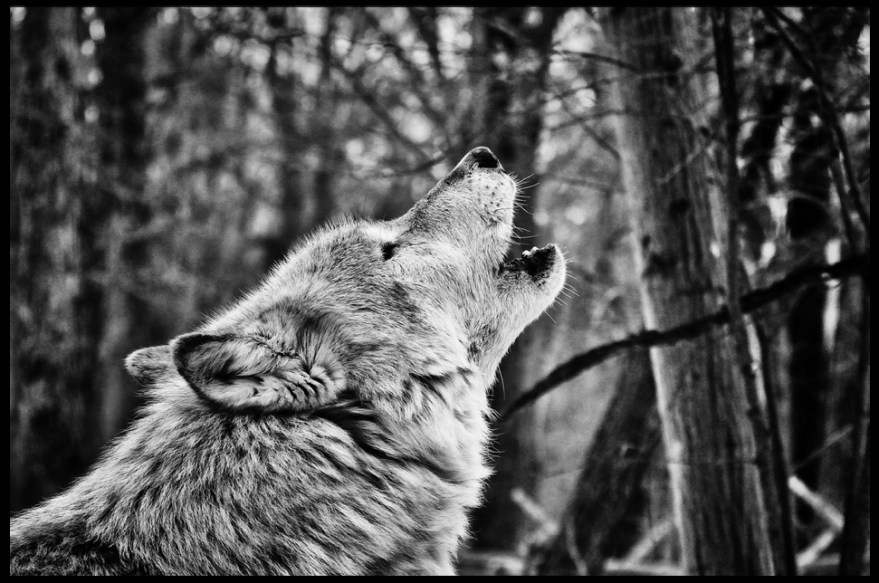
          Researchers in the U.K. have designed a computer program that can read the howls of individual wolves with amazing accuracy.

          (Photo: CC By-NC-ND)

            With the new program, the researchers catalogued 67 archived calls made by 10 wolves, and were able to identify the solo howls with 100 percent accuracy. In recordings where wolves howled together in groups, the program identified the source of each howl with a success rate of 97 percent.

            The method of identification measures both the pitch of a wolf’s howl and the volume. This gives conservationists a way of tracking the animals as they move with less hassle than using GPS. The system is said to be particularly useful for counting individual pack members.

            In the course of their research the team also deduced that wolves from specific areas may have regional accents.


            Get more detail here.

            Read the full study.

          Winking Out

          Posted on July 22, 2013

          Decimated by overpopulation, pollution, boat traffic, massive dam-building, illegal electro-fishing, and habitat loss, the Yangtze River ecosystem has lost its ability to support marine life.

          Baiji. (Photo: Stephen LEatherwood)

          Six years ago, China’s most revered river animal, the baiji dolphin, a beautiful slender creature long celebrated in stories and legend as the reincarnation of a drowned princess, was declared “functionally extinct.”

          The baiji

          was usually found in pairs, but also in social groups of 10 to 16. They fed on small, freshwater fish, using their long, slightly upturned beak to probe the muddy river bottom.

          It was long known the animal was in trouble. In the 1950’s the Yangtze supported an estimated 5,000 baiji. The population shrank to 300 in the 1980’s. Surveys in the late 1990’s found only 13 individuals. Urgent appeals for effective international action to help save the dolphin were made time and again. But what could be done…

          Winked out

          Meanwhile, a single male named Qi Qi survived at the Institute of Hydrobiology for more than 22 years. When Qi Qi died in 2002 he was the last of his species.

          Baiji, Qi Qi. (Photo: Xiaoqiang Wang. IUCN)

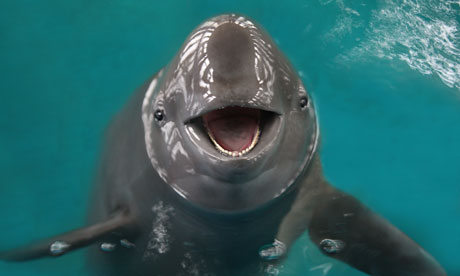
          Now the river is about to snuff out the Yangtze finless porpoise (Neophocaena asiaeorientalis asiaeorientalis).

          Finless porpoise in the aquarium of a conservation centre in Wuhan, Hubei province, China. (Photo: Yangtze Finless Porpoise Conservation Society)

          Known as jiangzhu or “river pig”

          and not least for its mischievous smile, the porpoise is reported to have a level of intelligence comparable to that of a gorilla.

          Where the baiji was difficult to get close to, conservationists say the porpoise likes to interact, to chat and play.

          Thirty years ago the population was estimated at 2,000. A survey last year counted only 1,000. A spike in deaths this year is causing experts renewed anxiety. At least two of the deaths were attributable to electrofishing.

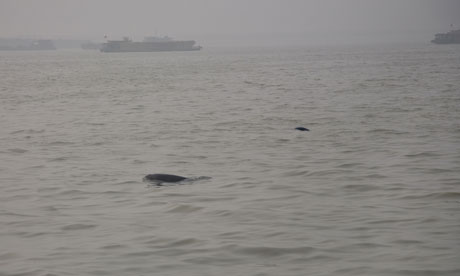
          inless porpoise are seen on the busy Dongting Lake in Hunan province, China

          Undated photograph. Two finless porpoise are seen on busy Dongting Lake in Hunan province, China. (Photo: Yangtze Finless Porpoise Conservation Society)

          The jiangzhu

          is decreasing at a rate that makes it rarer than the giant panda, China’s national treasure. The IUCN Red List has downgraded its status from Endangered to Critically Endangered. Conservationists give the dolphins only 10 to 15 years.

          Annals of Game Management

          Posted on July 19, 2013

          Three years ago, wildlife biologists from the Texas Parks and Wildlife Department drove into the paddock of James Anderton’s Whitetail Ranch hunting reserve. Using rifles mounted on tripods they killed more than 70 of Anderton’s animals, shooting for hours, working the panicked herd back and forth across the paddock, picking them off one by one.….

          A sharpshooter with the Texas Parks and Wildlife Department guns down deer at the Anderton Whitetail Ranch in 2010.

              A white helicopter with what appeared to be a forward-looking infrared camera mounted to its nose flew lazy loops over the ranch, scanning for survivors.

              Texas wildlife officials were concerned that animals in the herd might be carrying a highly transmissible killer of deer known as chronic wasting disease (CWD).

              Anderton said the deer had been bought in Arkansas, a state with no documented cases of the disease so far. But he couldn’t provide evidence of the state of origin for every animal because he was locked in prison for wildlife trafficking. The FBI and Texas Department of Public Safety had evidence that he was trucking deer in from out of state as well as capturing wild deer.

              Because CWD can be diagnosed only through autopsy, the agency concluded there was only one way to insure the animals didn’t present a disease threat: kill the entire herd.

              Max Dream, the Madera Bonita Ranch’s prized buck, is a semen-producing cash deer. (Photo: Mike Wood)

              Raising game for captive shoots

              is big business in Texas. Breeding deer with giant antlers pays off in the sale of semen and fees hunters pay to walk into a compound surrounded by high wire fence and shoot them. The fee for a prize buck ranges from $7,000 to $25,000. Proponents of the industry say it’s a business that’s keeping failing cattle ranches alive.

              The industry is growing. TPW officials say the number of game ranches is increasing along with the number of animals they’ve had to kill for wasting disease testing. In 2011 Texas wildlife agents killed almost 600 deer.

              Chronic wasting disease

              has been detected in wild populations in 22 states and in 50 different breeding farms. Little understood by researchers, the only means of controlling it is quarantine and the preemptive slaughter of deer like Anderton’s

              Test results showed Anderton’s deer were free of the disease.

              Anderton is suing, claiming the agency violated his constitutional rights by depriving him of property without due process. The complaint poses the legal question of whether the deer are considered wildlife, and thus the property of Texas? Or are they livestock belonging to Anderton?

              If TPW is ordered to compensate the him for the deer they shot, it would signal a fundamental shift in the concept of wildlife as an irrevocable public trust.

            Somewhere in Western Queensland

            Posted on July 18, 2013

            An Australian bushman says he has video footage of the night parrot, a bird thought to have disappeared more than a century ago.

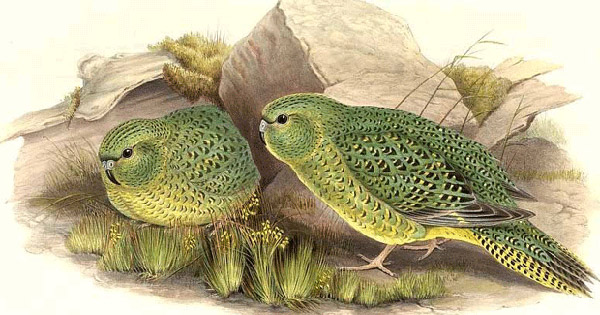
            Night parrot. (Illustration by John Gould)

              The only evidence of the continued existence of the desert-dwelling night parrot, Pezoporus occidentalis, are two dead birds found in 1990 and 2006.

              A senior ecologist at the Anangu Pitjantjatjara Yankunytjatjara Land Management Unit in South Australia, told the Australian Broadcasting Corporation that the finding was a certainty as John Young, who describes himself as a “wildlife detective” has still photos, video and feathers.

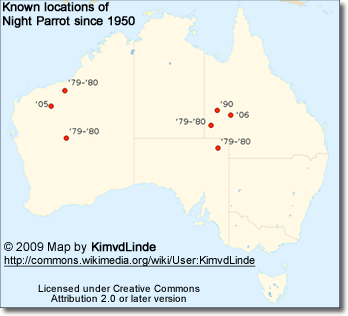
              Night Parrots reported sightings.

              The species fell out of the scientific record in the 20th century until a dead bird was found by a roadside in southwest Queensland in 1990. The discovery sent excited birders into the vast, dry, dusty, inhospitable Australian interior hoping to add it to their life lists. But there were no sightings and the parrot developed a mythological reputation.

                Young, who says he’s been hunting the bird for 15 years, has refused to make public the precise location of the find, somewhere in Western Queensland, in order to preserve the security of the habitat. His photographs and footage were unavailable at this time.


                Source: Mongabay

            Condition X

            Posted on July 17, 2013

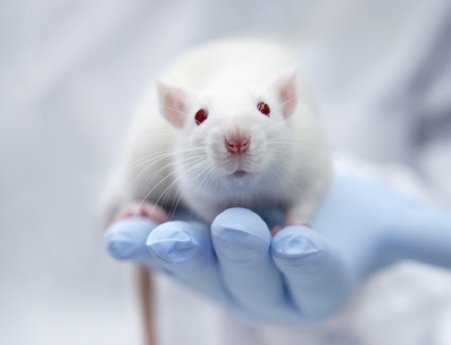
            According to Malcolm Macleod writing in the International Journal Nature, “We are in a golden age of medical research,” where ever more scientists around the world are “spending more money, writing more papers and building more shiny institutes,” searching for new treatments for “Condition X.”

            Many animal studies of neurological disease are often biased, claiming positive results and then failing in human trials. (Photo: Novartis AG)

              The driving engine of this industry is animal research which is used to secure funding for clinical trials using humans.

              Now comes a study from researchers at Stanford University cautioning that animal studies on neurological disorders are subject to considerable bias.

              The study found that a vast number of scientists doing animal research often suppress negative findings and report only the positive, giving the study a better result. This bias helps explain why many treatments that appear to work in animals do not succeed in human patients.

              In addition to a tendency to publish only positive results, the study also found that: animal studies produce many false positives, scientists tend to chose the statistical technique that gives the best result, and that animal studies are not as well planned as clinical trials.

              Among the studies most likely to report an inflated number of significant findings were those with the smallest sample sizes and those that were unbinded (failed to incorporate randomization) which can skew results significantly.

              It was also noted that many biased studies were authored by scientists who reported a financial conflict of interest, that scientists tended to seek out high-profile journals to publish their work, and, even more insidious, was the tendency of journals to publish studies with positive results.

              Underlying the findings is the simple fact that the hugely lucrative animal research industry is running on auto-pilot, reaping such vast rewards for researchers that far too little thought is being given to the ethical implications of wantonly killing vast numbers of living creatures for no good reason.