First Light Productions

investigative journalism

Posts from the “NEWS” Category

Zoo Fail

Posted on July 15, 2013

What did this animal ever do to deserve this?

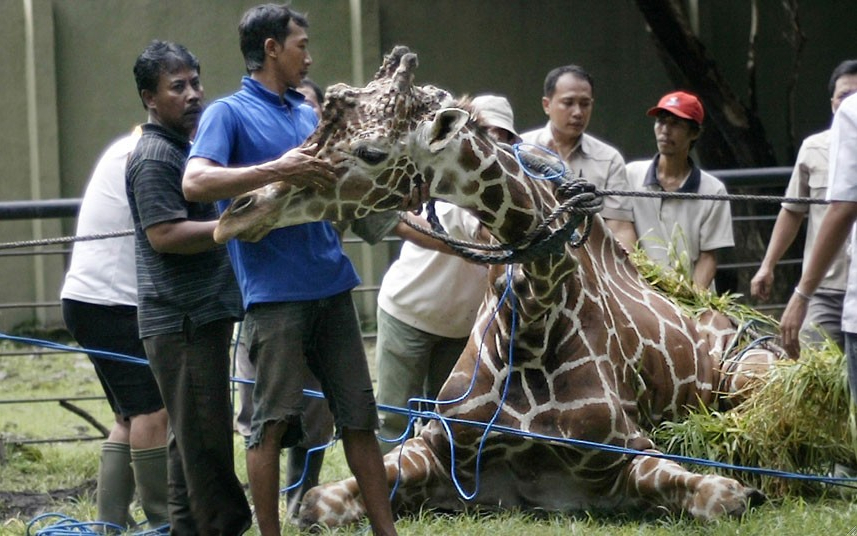
In this photo taken March 1, 2012, Surabaya Zoo staff attend to a 30-year-old ailing giraffe named Kliwon. The last remaining giraffe in the zoo died with 20 kilograms of plastic found in its stomach, the latest in a string of unusual animal deaths at Indonesia’s largest zoo.

The tragic story of the state of affairs at the Surabaya Zoo, In Surabay, Indonesia.

Saving the Desert Porpoise

Posted on July 12, 2013

The Mexican government recently adopted important modifications to their fishing rules in an effort to save the vaquita.

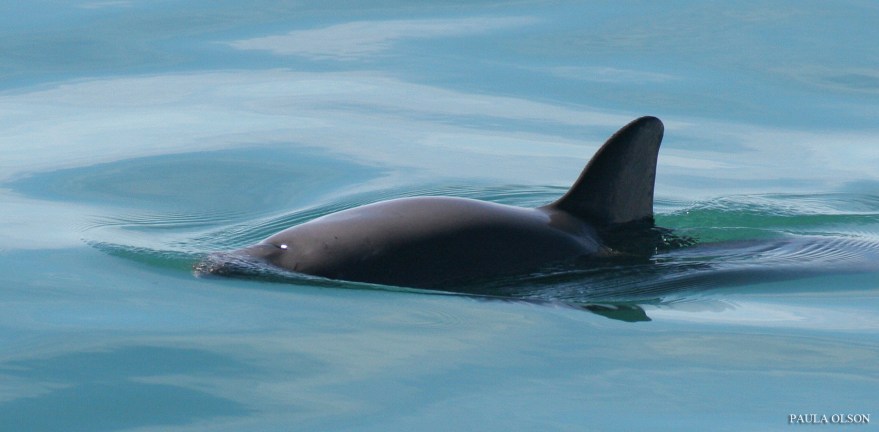
Vaquita. Pictures in the wild are rare. (Photo: Paula Olsen)

The vaquita is the world’s smallest (seldom exceeding four feet in length and 100 pounds) and rarest cetacean with less than 200 left alive. It lives solely in the Sea of Cortex in the upper Gulf of Mexico an area surrounded by desert on three sides.

The main threat to the vaquita is as incidental bycatch in fishing gear, especially gillnets set for shrimp by fishers in the towns of El Golfo de Santa Clara, San Felipe and Puerto Penasco. The majority of shrimp caught in the Sea of Cortez is destined for the U.S. market where it is the nation’s most popular seafood.

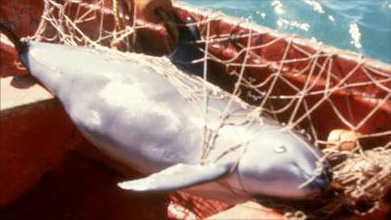
Vaquita bycatch.

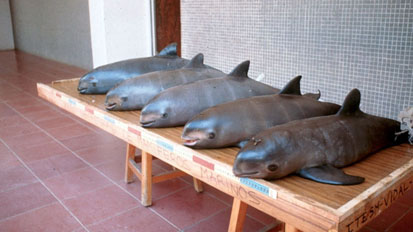
The estimated mortality from gillnet fishing is at least 39 (and maybe as many as 84) vaquitas per year, which is shockingly unsustainable, considering that the total population is only estimated to be 200 or so individuals. The estimated minimum number of vaquita needed to maintain a reproductively fit population is fifty.

Vaquita bycatch.

    The new rules will require a three-year progressive substitution of porpoise safe nets to replace drift gillnets, one of the main fishing gears in which vaquitas die as incidental bycatch.

The new net is a small driftnet adapted so it can be deployed from small, artisanal fishing vessels (“pangas”). It has a number of features that exclude capturing smaller and non-target species, and engineering modifications that include a turtle excluder device and rollers and light weight materials that minimize seabed damage.

Vaquitas, A truly tragic catch. (Photo: Omar Vidal)

    A key to making this conservation measure work is for the Mexican government and other organizations to get buy-in from from local fishermen by providing training in the use of the new light trawls and temporary compensation programs as the fishermen live on their daily sales.

      Bycatch is a problem for cetaceans everywhere. An estimated 300,000 are drowned every year in fishing gear set or drifting lost across the oceans, seas and rivers of the globe. This equates to one cetacean death every two minutes somewhere in the world.
      Go

    here

      to learn more about helping the vaquita.

    Shout Out: Wildlife Extra.

Dear Lord Burns,

Posted on July 11, 2013

A British MP weighs in on the issue of fox hunting.

Fleeing fox in Britain. (Photo: Vibe Images/Alamy/Alamy)

Dear Lord Burns

I refer to my e-mail to you in February. I have delayed writing to you, firstly in order to obtain a copy of my constituent, Richard Matson’s paper described as The hypothetical consequences of closing down a large pack of foxhounds and secondly, because I wished to see the arguments emerging from those who wish to abolish hunting.

I have always lived in the country and have hunted since I was young. I now represent North Shropshire, which is a rural seat with several flourishing packs of hounds: Sir Watkin William Wynn’s , North Shropshire, the Cheshire and the North Staffordshire foxhounds, the Royal Rock beagles and the Border Counties minkhounds. You have received many submissions, including that from the Countryside Alliance, which I support. I will therefore make my comments general and brief.

Fox Welfare

I own a wood of approximately 20 acres. It contains three large earths. Because I hunt, shooting of foxes is forbidden and there is a flourishing and healthy fox population. They are protected for 360 days per years. On two days in the autumn and three days in the winter, they are at risk when the Wynnstay hounds visit. Only the old, sick and weak are generally caught. Hunting is strictly seasonal, so vixens can bring up their cubs in total safety in the spring. In contrast, opponents of hunting propose shooting 365 days a year. The IFAW submission to you, p10, para.2., states night shooting is becoming ever more popular with gamekeepers and is humane. In fact it is indiscriminate; healthy adult foxes and nursing vixens will be just as likely to be shot as older foxes. In all my years of hunting, I have seen numerous foxes which have been wounded by inaccurate shooting. Most farmers own guns; they are not expert shots and shot is not powerful enough to kill a fox. The abolition of hunting would leave many foxes to die long, lingering deaths and I have no doubt that this is significantly more cruel than death by hunting. Farmers in my constituency are adamant that if hunting were stopped, they would eliminate foxes by shooting or snareing.

Animal welfare groups talk about marksmen; however, given the current law and order debate, it is highly unlikely that any Government would wish to see a proliferation of rifles in the countryside. Although I have lived in the country all my life, I have never met a “marksman” and I fear such a proliferation, because most farmers are not highly skilled rifle shots.

If hunting is banned, foxes will have to be culled and every alternative is significantly crueller. The tragedy is that it would lead to the disappearance of the fox in many parts of the country.

Agriculture

Bordering my constituency are several foot packs, some of which kill as many as 250 foxes in a season. The only way to flush out foxes from a large block of forestry on a steep Welsh hillside is to send in a pack of hounds. If large numbers of foxes are allowed to breed unhindered, sheep farmers who come to Oswestry market would see their industry devastated. The IFAW states that hunting is very unpopular with many farmers. A few farmers do ban hounds from their land, but the vast majority welcome them because fox numbers are controlled and will even call on the hunt to deal with particularly troublesome foxes; surely it should be for the individual farmer to decide, not for national politicians.

Another hugely important function of the hunt is the disposal of fallen stock; I have read that 400,000-600,000 animals are taken in by hunt kennels. In the past year, the Wynnstay kennels has disposed of 2,400 calves and the North Shropshire kennels nearly 2,000 calves. The hunts provide a free and humane service and if they did not exist, an enormous state infrastructure would have to be established very rapidly to cope with a problem which could become an environmental and animal welfare disaster, if farmers have to kill and bury stock on their own land.

Horses

The IFAW submission states that very few horses are used solely for hunting. This is incorrect. I own horses which are too slow, too old and too inagile for other activities, such as cross country, showjumping or dressage. In order to get them fit for hunting, recreational riding is undertaken, but their prime purpose is for hunting. They are all by-products of the racing, point to point, cross country and showjumping industries, all having been bred originally for these purposes. It is vital to understand how hunting underpins the market for specialist horses. A good hunter costs £4000-5000; its value in the Belgian meat market would be about £300.

Draghunting would not be an alternative use for such horses as it requires particularly bold, fast jumpers and is not an activity for more elderly people or children. My farming constituents with land suitable for draghunting would not tolerate a large increase of draghunting and the majority of land in my constituency is not suitable for draghunting at all.

Jobs

The local saddler has told me he would close, with the loss of seven jobs. Local vets, blacksmiths, feed merchants and transport suppliers have all told me that they would significantly reduce their workforces.

Conservation

The hunts around here ensure that coverts are well maintained with a mix of undergrowth and mature timber and that not only are hedges maintained, but new ones are laid.

Hunts play a significant part keeping open bridleways and ensuring bridges over brooks are maintained. It would be tragic if this good work were lost.

Social Cohesion

In thinly populated rural areas such as mine, the hunts provide a unique organisation, binding lonely country people together, Throughout the year, there are fundraising events, which re-inforce the community in the best sense of the word. People of every age and an extraordinary diversity of background are brought together by hunting. One of my sons is taken hunting on a quad bike and meets stockbrokers, mechanics, forklift drivers, vets, apprentices and farmers’ sons on level terms. The social dimension of hunting is hugely misunderstood, partly because of the uniform of those who ride horses. The only man I know who wears a top hat to hunt is a window cleaner. Large numbers of people go hunting on foot or bicycle; many of those who do so on a horse can only do so by making great financial sacrifices. These are some of my hardest working constituents and they see no good reason why their pleasure should be taken from them by those who are prejudiced against hunting without understanding it.

Minorities

I acknowledge that a majority of those polled in the country have stated that they are opposed to hunting. I also acknowledge that a majority supports the return of capital punishment, which I oppose. I do not understand how a pluralist democracy can function effectively if substantial minority groups have their traditional rights and freedoms taken from them. I suspect that the polls would be different if they asked such questions as would you like your law-abiding neighbour, who drives forklift trucks to be sent to jail and would you like to pay a significant increase in tax to bear the cost of law enforcement of a ban?

Civil Unrest

The recent debate on policing rural areas has shown that it is inadequate. North Shropshire currently has the lowest ratio of police to population in Western Europe. I am convinced that the police simply do not have the resources to enforce a ban on hunting. In Welsh border areas, where feelings run extremely high, I have been told many times that people will resort to civil disobedience. I believe that a ban would be unenforceable.

No one needs to hunt, but nor does anyone need to eat meat. Protein is available without putting a beast through the trauma of an abattoir. Neither activity does any human being any harm at all. I believe that it is a fundamental freedom to pursue activities, so long as no harm comes through them to other human beings. Hunting is one of those rights.
Duke

Posted on July 10, 2013

A nine-year old bucking horse named Duke was electrically shocked out of the chute and died in front of a grandstand packed with spectators at the 2013 Cowtown Rodeo in New Jersey.

Duke dies a needless and cruel death as public spectacle.

In a post in Psychology Today, Marc Bekoff, Professor Emeritus of Ecology and Evolutionary Biology at the University of Colorado, Boulder, comments on Duke’s death and calls for a ban on rodeos as “entertainment.”

    The animal advocacy group

SHARK

    has cited examples of this practice at several rodeos.

Clear evidence of the use of electric prods, which is apparently widespread throughout the sport, can be seen in the photo below taken last month by a woman at a rodeo in Reno.

Reno rodeo. Man holds a horse’s tail to the side while another man sticks a prod in the horse’s anus. (Photo: Ellie Lopez-Bowlan)

Type of electric prod used on Duke.

Reno Rodeo president John Tipton denied  shocking devices were used.

Released

Posted on July 10, 2013

After weeks of rehabilitation many of the sea lions rescued from Southern California beaches earlier this year have regained their health and are being released back in the ocean.

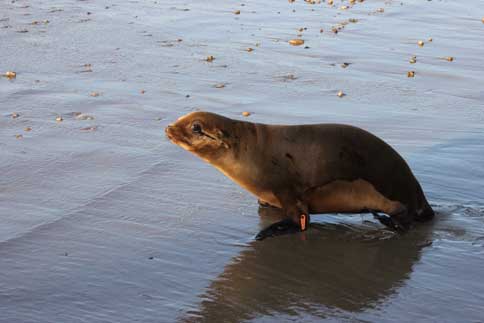
Young sea lion pups return to the sea at Point Reyes, California, April 19, 2013. (Photo: The Marine Mammal Center)

    Between January 1 and March 24, the National Oceanic and Atmospheric Administration declared an “unusual morbidity event” during which more than 900 malnourished and weak sea lions were rescued on the region’s beaches. By early April the Marine Mammal Center was providing medical care and nourishment for 165 seals and sea lions, more rescues than in any previous year in the Center’s history.

    Sharp Scissors, one of the sea lion pups rescued from Southern California beaches, returns to the ocean at Point Reyes, CA.. May 24, 2013. (Photo: The Marine Mammal Center)

    So far there is no evidence that the large number of strandings were due to underlying primary infectious disease or toxic insult.

    Young California sea lions at The Marine Mammal Center in Sausalito, CA. (Photo: © Ingrid Overgard/The Marine Mammal Center)

    A preliminary determination of the causes of the strandings points to a simple lack of food. In particular, extremely lows numbers of sardine and anchovies last year which resulted in female adult sea lions having a difficult time providing their pups enough nourishment.

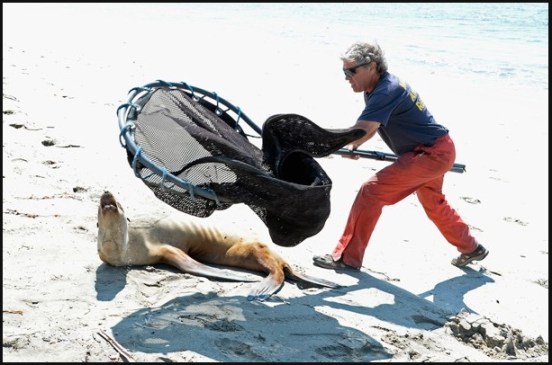
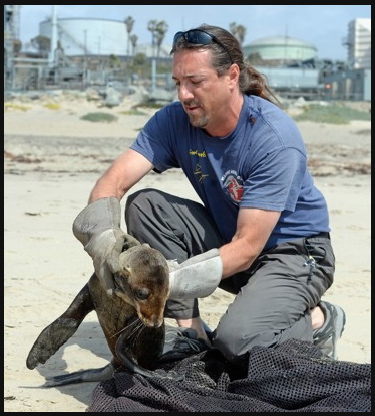
    A stranded and malnourished juvenile sea lion is rescued by Peter Wallerstein, the Marine Animal Rescue director for Friends for Animals. (Photo: Kevork Djansezian / Getty Images)

    The result was a large number of pups either underweight or weaned a month or two early. Those that survived were starving and ended up on the beaches extremely emaciated.

    Mike Remski of Marine Animal Rescue checks for sign of injury after rescuing a malnourished sea lion pup on Dockweiler State Beach in Los Angeles. The pup, was transported to Marine Mammal Care Center at Fort MacArthur for rehabilitation. (Photo: Kevork Djansezian / Getty Images)

    Sea lions are one of the top predators in the ocean. Their suffering is a clear sign something is very wrong with the world’s seas.


    Source: Marine Mammal Center.

Ag-gag Marineland

Posted on July 6, 2013

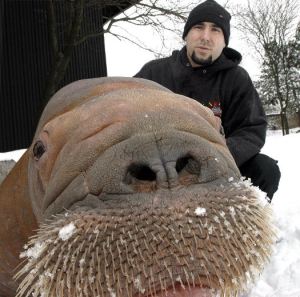
Former Marineland of Canada animal trainer Phil Demers worked at Marineland Ontario for 12 years.

Former Marineland trainer Phil Demers with pacific walrus Smooshi.

    He was one of eight initial whistleblowers—since grown in number to 15—who told the Toronto Star newspaper last August that poor water conditions at the park had caused blindness and other health problems among seals, sea lions and dolphins.

    After speaking out, Demers and fellow-trainer Christine Santos were sued by Marineland owner John Holer for $1.5 million for voicing their concerns for the animals’ well-being.

    In a recent interview Demers describes conditions at Marineland that are essentially torturing the park’s animals.

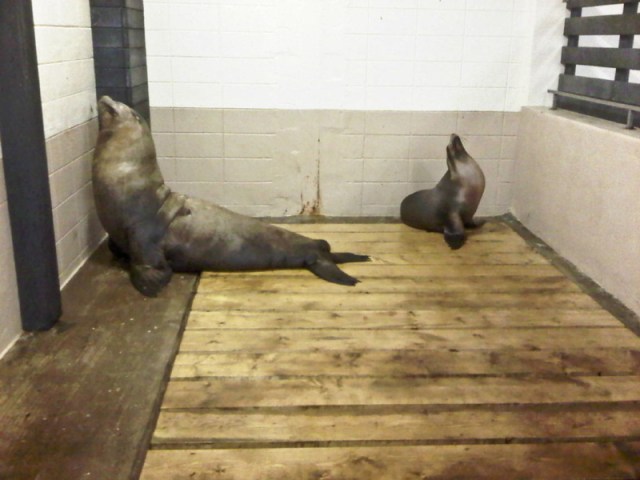
    Sea lion Baker has no lens in his left eye. He had to be pulled repeatedly from the water and confined in a dry cage, in one case for more than two months, to limit further harm to his already damaged eyes.

    Larry, the harbor seal arrived at Marineland about eight years ago and is now a shadow of his former self. After repeated exposure to unhealthy water, he has gone blind.

    February 2012 photo shows sea lions Sandy and Baker (left). The pair had to be pulled repeatedly from the water and confined in dry cages, in one case for more than two months, to limit further harm to their already damaged eyes. Videos shot in 2011 and 2012 show them writhing in pain or plunging their heads into a single bucket of clean water.

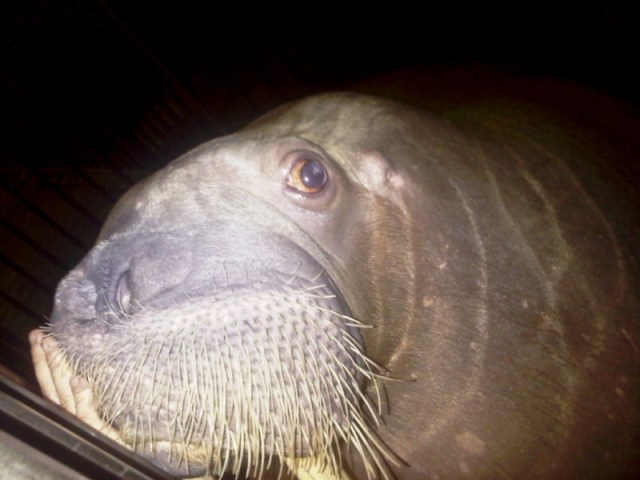
    Sonja, a female walrus show in an April 2012 photo, has suffered eye damage that former trainers blame on poor water conditions at Marineland.


    To follow the story and contribute to the cause of Devers and the other whistlblowers, go to the indiegogo/marineland site, and follow him on twitter @walruswhisperer.

Border Cats

Posted on July 3, 2013

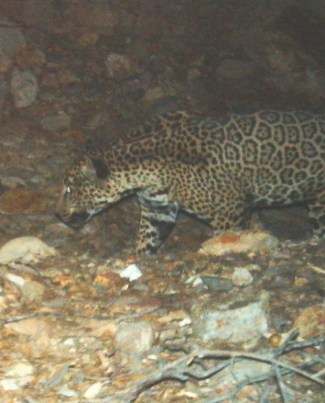
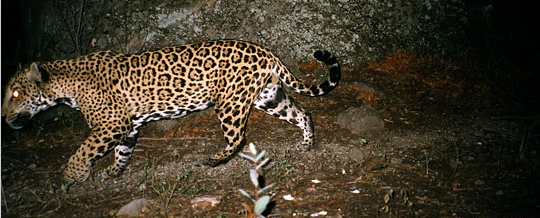
Recently released trail cam photos are evidence that a jaguar has been roaming the eastern flank of the Santa Rita Mountains in southern Arizona for at least nine months.

A jaguar prowls the mountains at night on the eastern flank of the Santa Ritas Mountains, southeast of Tucson. (Photo: USF&W)

    Since October, remote cameras have photographed the cat on seven occasions in five different locations. Three of the photos were taken close to the site of the proposed Rosemont copper mine in the Sky Island wilderness, raising the stakes as to whether the mine will be granted a permit.

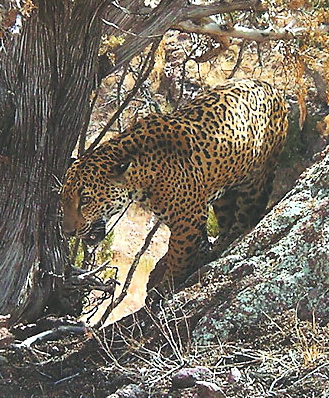
      This is the only jaguar currently known to be extant in the United States. But the cats are no strangers to the area. In February, 2006, in the Animas Mountains, animal guide Warner Glenn photographed a jaguar that his dogs had chased into a big cedar tree. “He did not run,” Glenn said. “He was not afraid of anything.” Later he estimated that the jaguar, by the look of his teeth, was eight or nine years old and weighed nearly 200 pounds. Glenn named the cat Border King.

    Border King in the Animas Mountains, March 7, 1996. (Photo: Warner Glenn)

    Despite photo evidence proving the presence of jaguars in the area, the USF&W dragged its feet developing a recovery plan for the cat as required under the EPA. Indeed, if jaguars were found it would open up the possibility that federal land would have to be put aside as “critical” jaguar habitat, something people in the livestock industry who range their cattle for next to nothing on federal land are dead set against.

    In 1997, the Arizona Fish and Game Department (AFG), with a wink and a nod to the local cattle industry, created the Jaguar Conservation Team (JCT), to “identify” and “protect” jaguar habitat,” believing that no cats would be found, thereby forestalling any usurpation of grazing land.

    Before long, remote cameras identified a cat which the JCT team dubbed Macho B. In an attempt to appear it was actually doing something meaningful, the team made plans to capture it and affix a radio-collar. Conservationists warned of the potential risks and questioned the purpose of such a plan and how it fit into protecting the big cat’s future. Non-intrusive methods of research were available, but the Jaguar team swept both objections and suggestions aside. They were dead set on capturing a jaguar. Yet, as an endangered species, to make capturing a jaguar legal, USF&W first had to issue a permit authorizing such a “take.”

    Macho B. (Photo: AZ Dept Fish and Game)

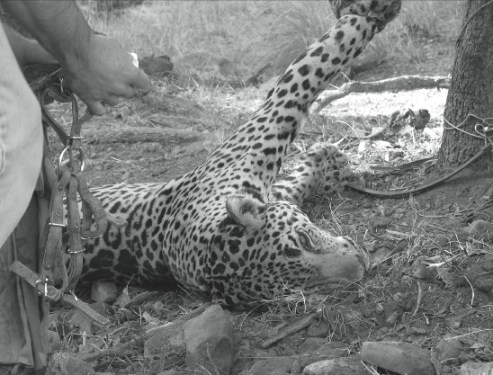
    On February 18, 2009, AFG biologists found Macho B captured in a wire snare. The snare had been set by biologist Emil McCain, who was working as a subcontractor for the department capturing mountain lions and bears for radio-collaring. Ostensibly, snaring a jaguar was a happy accident. The biologists tranquilized, radio-collared and released the cat.

    Twelve days later, after he did not move as far or as frequently as expected following his capture and after he was observed ailing, Macho B was re-captured, diagnosed as terminally ill from kidney failure, and euthanized.

    Macho B snared, Feb. 18, 2009. (Photo: AZ Dept Fish and Game)

    Arizona Fish and Game said the capture was accidental, occurring as part of a bear-lion study. The Center for Biological Diversity called for an independent medical investigation, which revealed that the jaguar’s death was at least in part due to agency mismanagement.

    Investigating Macho B’s death, the Interior Department’s inspector general concluded that AFG did not have a permit for the capture, and stated that skinning the jaguar to preserve the pelt, undertaken instead of a necropsy because a USF&W supervisor was unfamiliar with the word “necropsy,” resulted in loss of information and left doubt as to what had ailed Macho B.

    Although the entire corpse was not made available for a necropsy, some organs were preserved. A veterinary pathologist who examined the jaguar’s kidneys, but whose report was never released, told the Arizona Daily Star that the organs appeared healthy and that Macho B may have just suffered from dehydration.

    Santa-Rita mountains. (Photo: Tom Vezo/Save the Scenic Santa Ritas)

    In May, 2010, Emil McCain admitted in federal court that he deliberately and without a permit captured Macho B by baiting a snare set in a canyon that he knew Macho B traversed and pleaded guilty to a misdemeanor crime: illegal take of an endangered species. (McCain had convinced a female co-worker to plant the bait, and she was sentenced as well.) McCain said he knew there had been recent evidence a jaguar had appeared in the area of the snares as photographs of the cat had been taken near the capture site months earlier. He was sentenced to five years’ probation and fined $1,000.

    Twelve years after it was created, and with little else to show for its efforts, the Jaguar Conservation Team and its powerbroker the Arizona Fish and Game Department, had killed, for scientific purposes but absent the rigor of real science and outside the constraints of federal law, the last known wild jaguar in the United States.

    Now there is another.

    The photos of the new cat were released as USF&W and the Forest Service are wrapping up a draft biological opinion regarding the proposed Rosemont copper mine’s impacts on the jaguar and nine other federally protected species.

    The biological opinion is supposed to examine measures that can ease a project’s impacts on an endangered species. In an earlier biological assessment, the Forest Service wrote that the mine is “likely to adversely affect” the jaguar.

    Despite the cat’s presence the Arizona Fish and Game Department remains opposed to designating the area as jaguar critical habitat, citing lack of evidence of a breeding pair.

    The jaguar’s continued presence in the Santa Ritas and elsewhere in the “Sky Islands” mountain ranges of Southern Arizona shows that jaguars belong in this region and underscores the need to protect their critical habitat, said Sergio Avila, a large cat biologist for the environmentalist Sky Island Alliance.

    Oddly, or perhaps not, the Arizona Daily Star needed a Freedom of Information Act request to obtain the photos.

Shark fins no more

Posted on July 1, 2013

LOS ANGELES — An ancient Asian dining tradition ended today in California when the state ban on the sale or possession of shark fins went into effect.

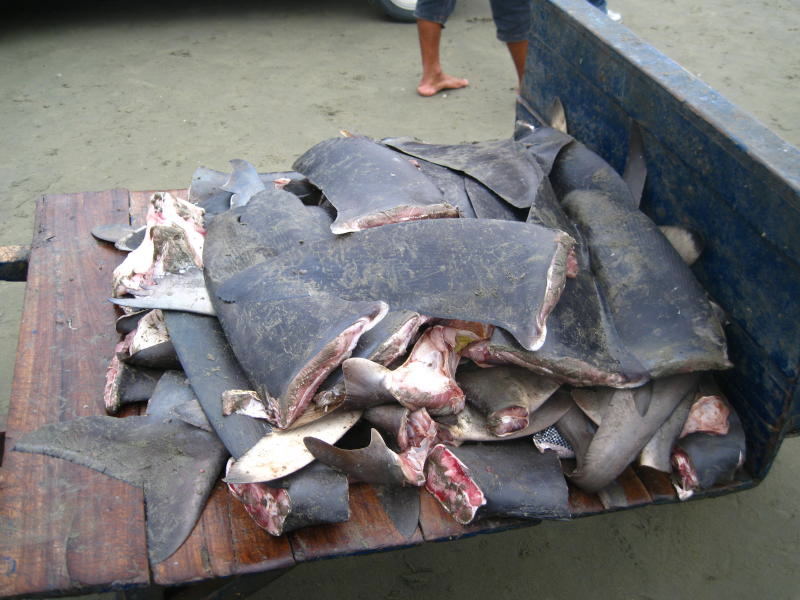
Shark fins on sale at $600 per pound in the Chinatown section of Los Angeles, California. As of today they are illegal. (Photo: Louis Sahagun/MCT)

The delicacy which could be found in many stores in Los Angeles’ Chinatown sold for between $600 to $2,000 a pound.

Serving bowls of shark fin soup to honor guests at birthdays, banquets and weddings is an Asian tradition dating back to the Ming Dynasty, when sharks were the ultimate symbol of yang, or male energy, and serving fin soup was reserved for emperors.

Demand for the delicacy has grown with the growth of China’s middle class. As a way to meet the burgeoning demand for million of fins each year, the fishing industry took to slicing the fins off live sharks and throwing the crippled animals back into the sea to drown. The result was the death of an estimated 73 million sharks killed each year simply for their fins.

The International Union for Conservation of Nature estimates that the populations of some shark species, such as hammerheads, have been reduced by as much as 90 percent.


Shark fins (Photo: Rikke Johanneseen)

So far, Hawaii, Washington, Oregon, Illinois, Maryland and Delaware, and the Pacific territories Guam, American Samoa and the Northern Mariana Islands, have also enacted legislation prohibiting the sale of shark fins. New York is pursuing similar legislation.

Korean Airlines Co. and Cathay Pacific Airways Ltd. have stopped carrying shark fins as cargo.


Source: Mcclatchydc.

There is a law…

Posted on June 26, 2013

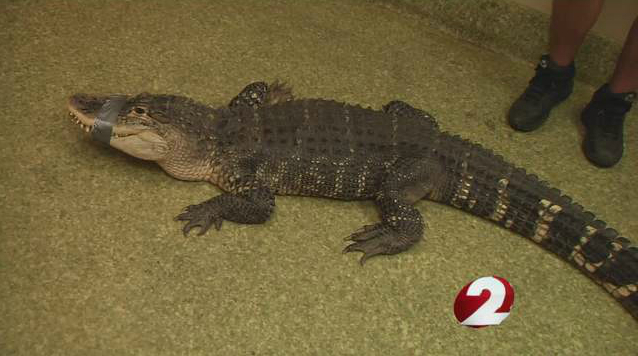
A seven-foot alligator was recently seized by animal control officers in Ohio. Authorities moved in after learning of a video posted on Facebook showing teenagers harassing the animal.

Ohio basement gator1

Ohio basement. (Photo: WDTN)

The video shows a young man laughing as he throws beer on top of the alligator, which jerks back in surprise and bites the small, hard plastic tub where he was kept.

Severely weakened by a lack of nourishment and suffering from a bone disease and loose teeth, caused by a vitamin D deficiency associated with a lack of sunlight, the animal had been confined in a basement for more than 15 years.

Ohio alligator rescue. (Photo: Lisa Powell/AP/Dayton Daily News)

A local veterinary opined that the gator should have been three feet longer but its growth had been stunted by captivity.

    A law recently enacted in Ohio makes it illegal to own exotic animals that are not registered with the state. Unsurprisingly, the alligator was not.

    The law was passed in response to an incident in the state two years ago when the owner of an animal preserve released all his animals then killed himself.

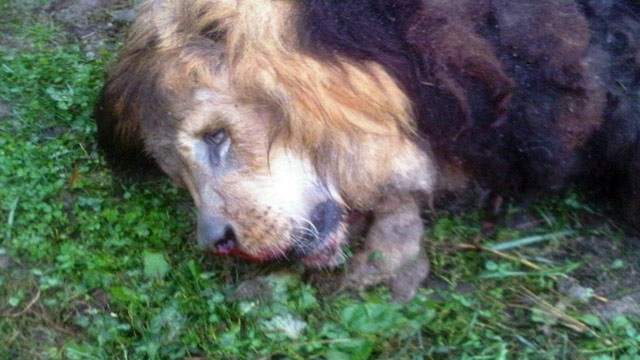
    Dead lion in Terry Thompson’s farm near Zanesville, Ohio, Oct. 18, 2011. (Photo: Fred Polks Jr.)

    During a night of chaos, an escaped lion killed a monkey, and bears and lions were charging at horses kept at the preserve. Fearing the animals would scatter and terrorize the town, officers shot and killed 49 animals, including 18 Bengal tigers, 17 lions, six black bears, a pair of grizzlies, three mountain lions, two wolves and a baboon.

    In regard to the alligator, authorities said that animal cruelty charges may be filed against the animal’s owner and the teenagers.

    After a period of rehabilitation the animal will be transferred to a wildlife sanctuary in Florida. Alligators can live well into their seventies. Thanks to the jerk who kept the animal in the dark for 15 years, it may not have that much life left.


    Source: Daily Dot.

Mortality Signal

Posted on June 24, 2013

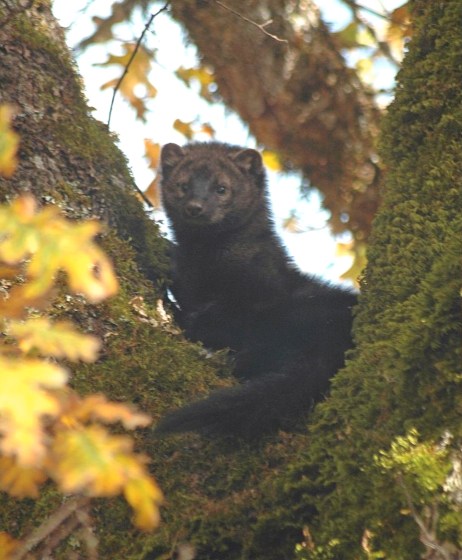
In the spring of 2012, a mortality signal on the radio collar of a Pacific fisher sent Hoopa tribal biologists scrambling to recover the animal quickly so a necropsy could be performed to determine cause of death. The field crew found the animal wasn’t dead but lethargic and lacking coordination, lurching on the ground attempting to seek cover from the approaching biologists. Beyond help the animal was humanely euthanized.

It was the sixth monitored fisher in California to die from rodent poison since 2009.

Fisher in northern California forest. (Photo: J. Mark Higley)

Necropsies and toxicological screenings of 58 fishers recovered on community and public lands in northern California revealed that nearly 80 percent of the animals had been exposed to rodenticide poisons.

Researchers suspected the poisonings were linked to marijuana grow sites hidden in the forest as the necropsied animals were not found near agricultural and urban areas where these types of pesticides are legally used to control pests. Their suspicions were confirmed when law enforcement officers who raided grow sites on public and tribal lands reported that marijuana cultivators routinely place pourable pesticides in open tuna or sardine cans to kill wildlife that damages their plants or raids their food caches.

This indiscriminate use of poisons in the wilderness has led to mass wildlife killings. Officers approaching one grow site discovered a black bear and her cubs seizing and convulsing as they slowly succumbed to the neurological effects of pesticides they’d just ingested.

More troubling, researchers’ data also showed that the fisher mortalities occurred from late April through early June, the prime-time for marijuana seedling planting and likely the period of heaviest toxicant use which is also a key time for female fishers to rear their kits. Several poisoned females left behind kits who died due to den abandonment and starvation.

    A sobering

video

    of a poisoned fisher found by biologists.
    Some of the fishers tested positive for multiple toxic compounds, many of which have been banned for use in the U.S., Canada, and the European Union.

Marijuana crops on private land in Humboldt County, California. (Photo: Jim Wilson/The New York Times)

The environmental effects of the thousands of grow sites scattered across northern Califoria—tearing up of hillsides, grading the mountaintops, diverting whole watersheds and drying out creeks—is catastrophic, further imperiling salmon runs already devastated by water problems caused by logging.

A Google Earth virtual flyover of marijuana plots and the damage they cause can be seen here.


Source: Wildlife Society News.

Hat tip: New York Times.

NO PREVENTIVE PRINCIPLE

Posted on June 21, 2013

A landscaping company sprayed an insecticide on 55 linden trees in the parking lot of a Target big box store in the Oregon town of Wilsonville in the U.S. last Saturday to control for aphids. Within minutes, bumblebees began falling from the trees, twitching on their backs or wandering in tight circles on the asphalt. As this weekend approaches, estimates of the number of dead insects has risen to more than 50,000.

Wilsonville, Oregon, July 2013. (Photo: Oregonian)

The Oregon Department of Agriculture confirmed the bees were killed by an insecticide called Safari whose main ingredient is dinotefuran, belonging to a class of pesticides known as neonicotinoids. There are two main kinds of neonicotinoids. Safari is a member of the nitro-group which research has shown to be generally  more toxic to bees than the other type.

This totally avoidable tragedy is simply another example of the myriad of unregulated poisons that continue to be applied to the earth by people who either don’t have a clue or simply don’t care–you would think a landscaping company would be particularly careful about the poisons they’re spraying. (Target’s concern was aphids dripping their bodily fluids on customers’ cars.)

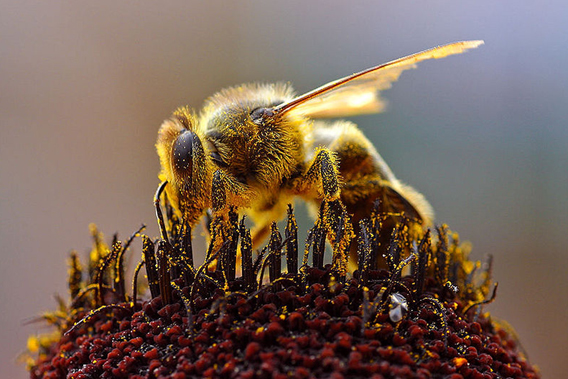
Honey bee (Apis mellifera) collecting pollen. (Photo: Jon Sullivan)

Bees and other insects pollinate three-quarters of the world’s food crops but have suffered steep declines due to habitat loss, disease and pesticide use. In April, the European Union voted to enact a two-year moratorium on the use of neonicotinoid pesticides. Where’s the U.S.? Absent as usual, concerned about stirring the wrath of the chemical industry.

A USDA survey found recently that nearly a third of managed honeybee colonies in America died out or disappeared over the last winter. But in attempting to pinpoint the cause of the bee dieoffs, the USDA has studiously avoided putting any emphasis on the potential role of pesticides.

Brief but VERY cool!

Posted on June 20, 2013

Ursus arctos syriacus


Shout out: Mongabay.com

LIMBAT’S ZOO

Posted on June 15, 2013

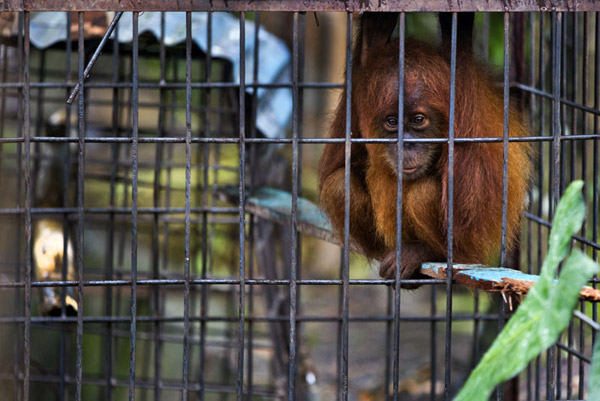
Pangolins, leopard cats, slow lorises — orangutans, two hundred buckstake your pick.

Orangutan at Limbat’s ‘zoo’ in Kadang, Aceh on the island of Sumatra. (Photo: Paul Hilton)


Source: Mongabay.

DOWN TO ONE

Posted on June 13, 2013

A pair of northern bald ibis were released from a breeding site in Palmyra, Syria last spring for their annual migration to the Ethiopian highlands.

Syrian bald ibis. (painting, Waldrapp)

Fitting a satellite tag to a northern bald ibis in Syria in spring 2006. (Photo: G. Serra)

Odeinat, an adult male and father of two just fledged juveniles, was fitted with a tracking tag. The female, Zenobia, was not. Two juveniles from a semi-wild population in Turkey were released concurrently.

Ibis migration.

Researchers tracked the birds via satellite. Odeinat’s tag stopped transmitting in southern Saudi Arabia last July. It has not been possible to search for him, as the last signals did not give an accurate location.

Ibis in Ethiopia. (Photo: G. Serra)

Subsequently, a total of four birds were seen briefly this January at the usual Ethiopian highland wintering site. Researchers have just reported that Zenobia has returned to Syria without Odeinat. There are no signs of any more birds so far returning from their migration to Ethiopia. Zenobia may be the last of her kind.

    The ibis is a legendary bird in the middle east. Given the name “eremita” meaning living like a hermit because it breeds in inaccessible cliffs, its yearly migration south along the peninsula of Saudi Arabia in the direction of Mecca made it a companion of Muslims on their pilgrimage, who came to regard it as a holy bird. In Turkey it was presumed that the ibis carried the souls of the ancestors and was therefore untouchable. Despite its cultural importance the bird’s numbers began plummeting.

The population was believed to have been obliterated starting from 1989 until three breeding pairs were rediscovered in Syria in 2002. Despite all efforts the colony dwindled to a single pair in the past two years and now there appears to be just the one bird.

Ibis range.

According to the International Union for Conservation of Nature (IUCN). Syrian ibises aren’t a distinct species or subspecies, but they are genetically different from their northern African cousins (found chiefly in Morocco) and are the only members of the species to undertake long-range migrations.

Among the hopes for maintaining the eastern population are further releases from the former colony site at Birecik in SE Turkey where a semi-wild population of around 100 individuals are being raised. But the birds are not free-ranging and they don’t migrate. If released they will not know the location of their wintering grounds since this information is believed to be transmitted from bird-to-bird. The only other wild population which is also the subject of dedicated conservation efforts comprises just over 100 breeding pairs at two colonies in Morocco. The Moroccan ibis are also residents birds, they do not migrate.

Last Syrian ibis among bedouin khaimas. (Photo M.S. Abdallah)

The bad news about the birds comes at a time when coordinated conservation efforts are strengthening. A new International Working Group for the Northern bald ibis was held in Jazan, Saudi Arabia last November, sponsored by the Saudi Wildlife Authority and Jazan University.

It is believed there are about 500 wild northern bald ibis remaining in southern Morocco. The bird is listed as Critically Endangered by the IUCN Red List.

VERY BIG CHIMP NEWS

Posted on June 11, 2013

Just in from the New England Anti-Vivisection Society — The U.S. Fish and Wildlife Service announced today a proposal to protect all chimpanzees under the Endangered Species Act – whether free living in Africa or held in a U.S. lab or other captive situations.

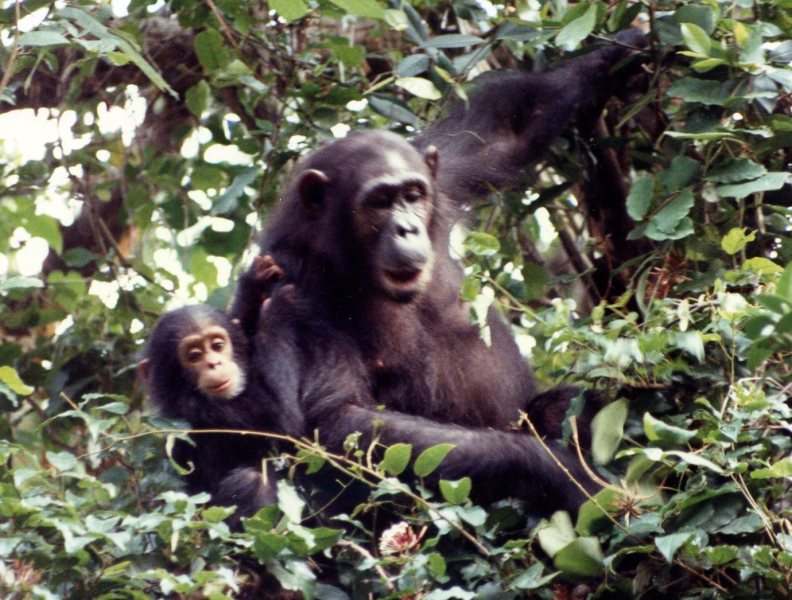
Chimps at Gombe Stream National Park, Tanzania, Africa. (Photo: NEAVS)

Once they are officially listed as endangered, chimpanzees  in U.S. labs will be infinitely closer to being prohibited from indiscriminate use in biomedical research.

LAMENT

Posted on June 9, 2013

“In those days we had never heard of passing up a chance to kill a wolf…. I was young then…. I thought because fewer wolves meant more deer, that no wolves would mean hunter’s paradise…. Since then I have lived to see state after state extirpate its wolves…. I have seen every edible bush and seedling browsed, first to anemic desuetude, and then to death…. I now suspect that just as a deer herd lives I mortal fear of its wolves, so does a mountain live in mortal fear of its deer…. Perhaps this is the hidden meaning in the howl of the wolf, long known among mountains, but seldom perceived among men.”

    –Aldo Leopold, Sand County Almanac.

WELCOME HOME

Posted on June 8, 2013

Just in, Kabang was welcomed home.

Kabang welcomed home in the Philippines, June 8, 2013.

    The family received donations from 45 countries, covering the full cost of the dog’s treatment by a team of veterinarian specialists at the University of California, Davis, in the U.S..

    Veterinary surgeon Anton Lim, who accompanied the dog to the US, said that, despite losing half her face, Kabang can still chew her food using her two remaining molars, and smell well enough to recognise her owner and handlers.

    A parade is planned in her honour in Zamboanga City on Sunday.