First Light Productions

investigative journalism

Posts from the “NEWS” Category

AGAINST THE ODDS

Posted on June 8, 2013

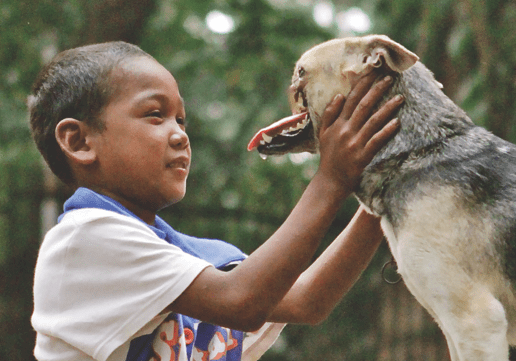
Kabang, the hero dog from the Philippines, was released from the veterinary medical teaching hospital at the University of California, Davis, U.S., last week and cleared to return to her family.

A Bunggal family member plays with Kabang in the Philippines. (Photo: provided by UC Davis)

The diminutive dog saved two young girls from an oncoming motorcycle in December 2011. The crash with the motorcycle literally ripped her face off, leaving her with a horrendous gaping wound.

Her heroism and miraculous survival captured the attention of the news media in the Philippines and hundreds of people around the world, who provided funds through the private organization Care for Kabang for her nearly eight months of treatments.

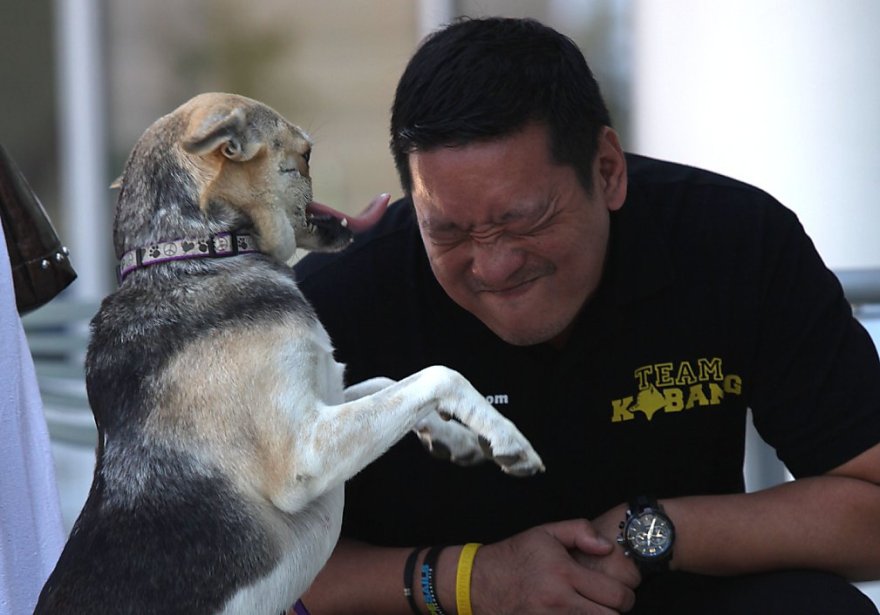
Veterinarian Anton Lim of the Philippines plays with Kabang.

The dog was brought to University of California-Davis in October last year, but university veterinarians discovered she also had heartworm disease and an infectious cancer.

A team of specialized UC Davis veterinarians was formed to coordinate Kabang’s care. Treatment for the cancer and heartworm each had to be successfully completed before dental and surgical procedures could be performed to deal with her facial wound.

Kabang healed at UC Davis.

It was not possible to reconstruct Kabang’s snout and give her a functional upper jaw so she will never look like she did before her accident. But because the facial wound has been closed, she is better protected against infection and prepared for an active life when she returns to her family in the Philippines.


Find out more about  Kabang’s care.

VIDAAR

Posted on June 7, 2013

Vidaar, the male Asiatic black bear rescued from the bear baiting trade reported here in April (“Vidaar and Lucia”), has passed away at the Balkasar sanctuary in Pakistan as a result of long term chronic illness.


Vidaar had been used in baiting for nearly four years and suffered a significant number of injuries. He had been identified by the Pakistan Bioresource Research Centre (PBRC) in 2012 as a priority bear in need of rescue.

Recovering from rope removal.

When when he arrived at the sanctuary he was severely malnourished and fighting chronic disease. His wounds were treated and the rope used to tether him to a post in baiting arenas was removed.

A post mortem showed he had an enlarged gall bladder and other organs showed signs of infection. Despite the expert care of the BRC staff he was too weak to hold on.

He arrived at the center only a few months ago with a female Himalayan brown bear named Lucia, who passed away soon after her rescue.

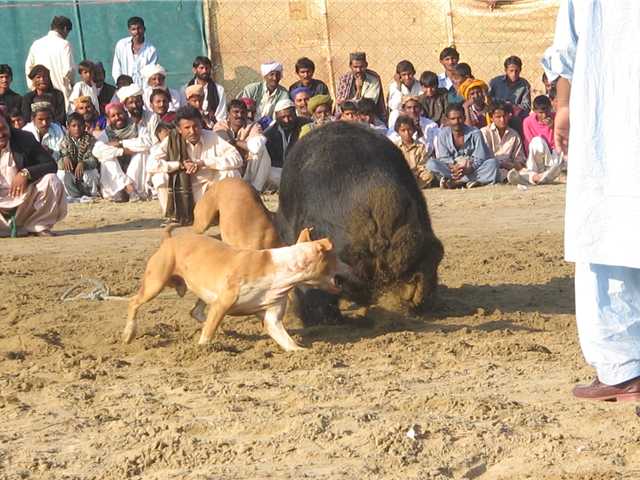
Bear baiting, Pakistan.

Animals used in bear-baiting are subjected to years of chronic stress and malnutrition with no veterinary treatment. They commonly arrive at the sanctuary with weak immune systems, parasites, blindness or impaired vision, and wounds to the muzzle, ears and eyes.

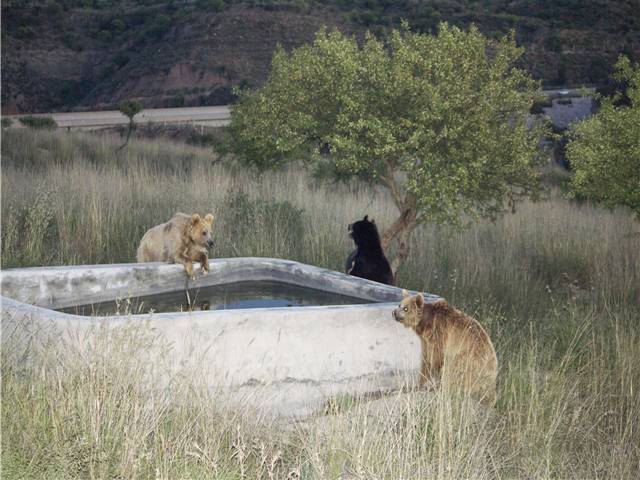
Balkasar Sanctuary for bears rescued from bear baiting.

The Balkasar sanctuary is funded by The World Society for the Protection of Animals and operated in partnership with the PBRC. There are currently 20 rescued bears enjoying the safety of the sanctuary.

Vidaar means “Forest Warrior.”

WHALE WARS ROUND 9

Posted on June 5, 2013

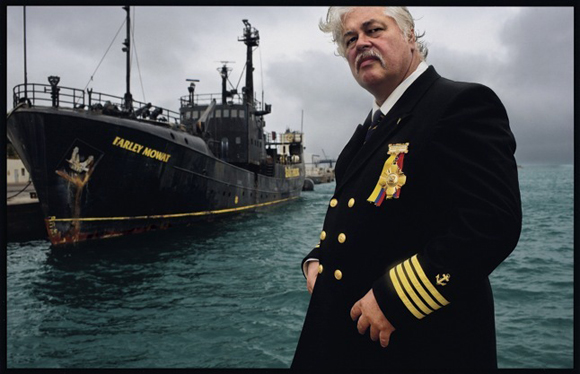
New Yorker reporter at large Raffi Khatchadourian recently interviewed Sea Shepherd Captain Steve Irwin via Skype aboard the Sea Shepherd vessel, the Steve Irwin, off the Antarctic ice shelf.

Paul Watson 2007 (Photo: James Nachtwey/VII)

    Outfitted with four ships, a helicopter, three drones, and a hundred and twenty volunteers from twenty-four different nations, Sea Shepherd is conducting its ninth campaign to prevent the taking of whales by the Japanese “research” fleet.
    In February, Watson released

footage

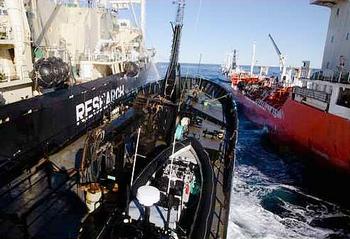
    of Japanese crewmen firing concussion grenades at the Sea Shepherd volunteers, and ramming a vessel.

Nisshin Maru, left, rams the Bob Barker into the refueling tanker Sun Laurel, February 25, 2013.
 (Photo: Glenn Lockitch/Sea Shepherd Australia)

During these encounters, Japanese harpoon ships crossed the bows of the Sea Shepherd ships and shot water cannon down the exhaust vents of the Steve Irwin, Bob Barker, and Sam Simon, attempting to flood their engines.

The same month, Sea Shepherd Australia successfully blocked a third attempt to refuel the Japanese whaling fleet, which must refuel at sea because Australia, which prohibits whaling in Australian territorial waters, no longer allows the whalers to refuel in Australian ports.


Watson is a fugitive stemming from an incident in which he was charged with threatening to sink a Costa Rican long-liner in 2002. He was arrested in Frankfurt and put under house arrest last year on a Costa Rican warrant. Learning that Japan had applied for permission to extradite him, he escaped Europe by boat and made his way to the South Pacific and rejoined his ship on the high seas.

Environmental pirates.

Germany has withdrawn its arrest warrant, but Japan and Costa Rica resubmitted their paperwork to Interpol, which finally accepted them, so Watson remains a fugitive. When asked where he would go after the campaign ended and Sea Shepherd’s ships had returned to port, he said, “Well, I can stay at sea.”


Source: New Yorker blogs.

ZOLUSHKA

Posted on June 4, 2013

Zolushka (Cinderella in English) is an Amur tiger. She was orphaned in the winter of 2012, and we were helping to raise her at the rehabilitation facility in Alekseyevka village, near Vladivostok in Far East Russia. When she was found, she was exhausted and frostbitten. Very often tiger cubs like her suffer frostbite on their tails. Cinderella’s tail was affected too, so the very tip, about 5 to 7 centimeters, had to be amputated. This is the tip that tigers so characteristically curve up.

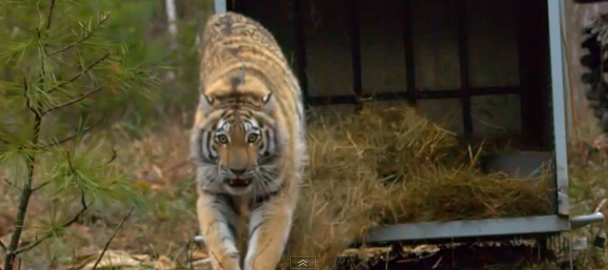
Zolushka (Cinderella) released.

    While living in the rehabilitation center, Cinderella has learned two most important skills: to hunt and to avoid human beings. Both are innate, but her time spent in rehabilitation gave her an opportunity to develop them, and Cinderella rather excels at both.

    Whether Cinderella was ready for release, was decided by many of the world’s Amur tiger experts. After long discussions, the date for the release was set on May 9th.

    Cinderella was immobilized and fitted with a satellite collar.

    The team then moved her into a transportation cage. Our party was riding in four vehicles; one of them towed a trailer with Cinderella.

    The weather was rather cool near Vladivostok, but as we started driving it grew warmer. We put two five-liter blocks of ice in there to keep her cool.

    It was a very long and exhausting car drive. We were going to Bastak Nature Reserve, about 1000 kilometers from Vladivostok, near Birobidzhan.

    Tigers used to live in the area, but eventually people killed them all, and there were no tiger sightings there for many years. However, starting with 2006, one male tiger’s presence is recorded there on a regular basis, and he is still sighted today. So we have far-reaching plans for Cinderella.

    Finally we reached the place of release in the very center of the reserve, where no one ever goes, and even rangers only visit on rare occasions.

    The cage was placed in a way that gave Cinderella a good clearing to jump out and run for cover. A block and tackle system was arranged to lift the cage door from the distance.

    The rope was pulled, the door slid open! Then everything was over in a split second. We heard a roar, and for an instant I saw Cinderella leaping out of the cage right away and, contrary to our expectations, disappearing immediately from our sight, making a sharp right turn.

    I was totally enraptured by that moment, so fluid and graceful she was. Cinderella leaped over one of the cameras, ran a bit to the side, stopped and looked back at us. I thought that for the first time in my life I see a tiger in the wild. And that this was perhaps the last time I would ever see a tiger in our taiga. She made a couple more leaps and sort of dissolved among the trees. Cinderella – disappeared.

    It was a strange feeling, on one side a great joy because our Cinderella was free and back home, and on the other hand a realization that you do not want to cross her path again in the future.

    That was it.


    Today, we already received satellite data showing that Cinderella is moving across the reserve territory, so we know for certain that she is alive.

    Let me say again that all of this became possible only thanks to the joint efforts of many people from a number of organizations: Severtsov Institute of Ecology and Evolution at the Russian Academy of Sciences, Inspection Tiger, WCS, Phoenix Fund, and International Fund for Animal Welfare. But more importantly, this was possible thanks to your contribution. A million thank-you’s to IFAW’s generous supporters for saving Cinderella and giving Amur tigers a new hope for their survival.

    —Anna Fillipova, posted Mon, 06/03/2013. Fillipova is an International Fund for Animal Welfare campaigner working in the IFAW Russia office.


    SOURCE: International Fund for Animal Welfare.

LOGGERHEADS

Posted on June 2, 2013

Sea turtles migrate from their nesting grounds in Japan across the Pacific Ocean to the coast of the Baja California Peninsula in Mexico.

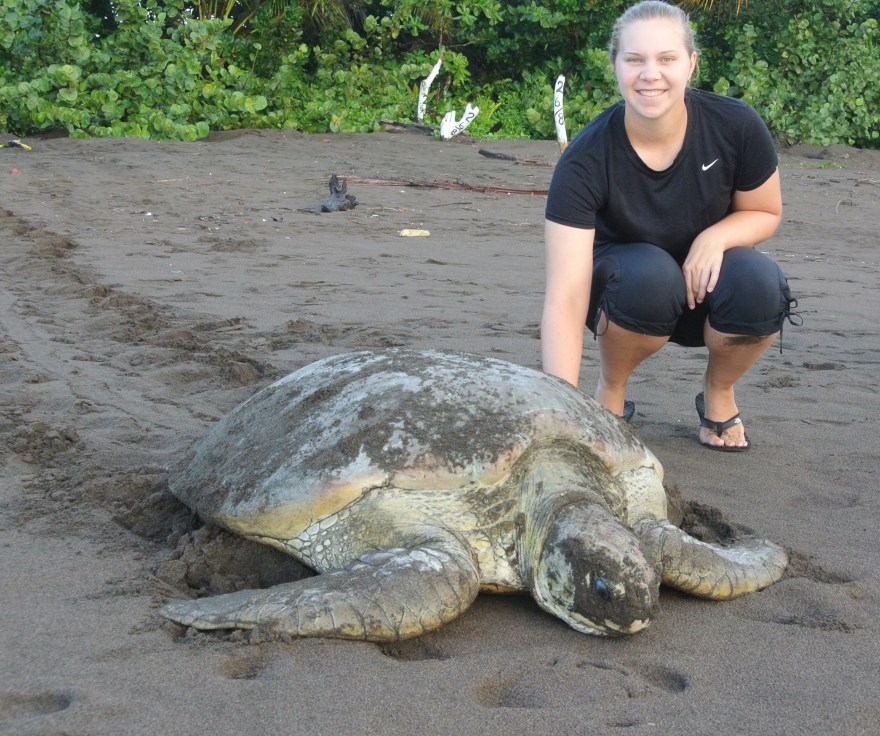
Student Kari Gehrke with Green female nesting turtle, Tortuguero beach, Costa Rica. (Photo: Sea Turtle Restoration Project)

They stay in Baja for decades as they grow and mature, feeding primarily on red crabs. But the environment there is turning increasingly hostile. The growth of the crab fishery has resulted in thousands of gillnets stretched across Baja’s Pacific coastal waters.

Dead sea turtles bycatch on-board a Baja gillnet vessel.

    To the loggerheads the nets are walls of death. Last summer saw a 600% increase in dead sea turtles in the Gulf of Ulloa on the Baja coast, including 483 loggerheads washed up dead on 40 km of shoreline in the month of July alone. Scientists estimate over 2,000 loggerheads were killed there last year in gillnets.

 The enormous bycatch is jeopardizing the turtles’ survival.

Further south on Central American beaches, poaching of sea turtle eggs is having a similar effect. Studies of poaching at different Costa Rican and Honduran beaches, indicates literally every beach experiences a high degree of egg poaching.

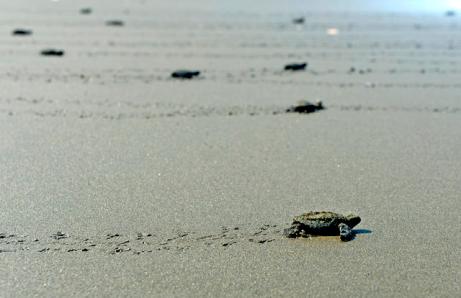
Baby sea turtles, Costa Rica. (Photo: Lindsay Fendt)

    Beach-patrols in Costa Rica are helping to stem the poaching but resistance is fierce. Just a few days ago, Jairo Mora, a 26 year old conservationist who worked at a sanctuary protecting  baby sea turtles on Playa Moín, was found dead with his hands tied behind his back. He was on patrol with a group of other volunteers when the group was attacked and Mora was kidnapped. It was determined he had been beaten and tortured.

“It was him they wanted, because he was the one who was always looking after the nests,” the owner of the turtle sanctuary, Vanessa Lizano, told BBC News.

Sea turtle eggs are considered a delicacy,

    Smugglers can make as much as $300 a day stealing turtle eggs from their buried nests and selling the eggs.

Sources: Sea Turtle Restoration Project/Tico TImes.

FISH OWLS AND BIG CATS

Posted on May 30, 2013

A recent interview with Jonathan Slaght, a conservationist with the Wildlife Conservation Society’s (WCS) Russia Program, details the perilous state of animal protection in Russia’s wildest territory.

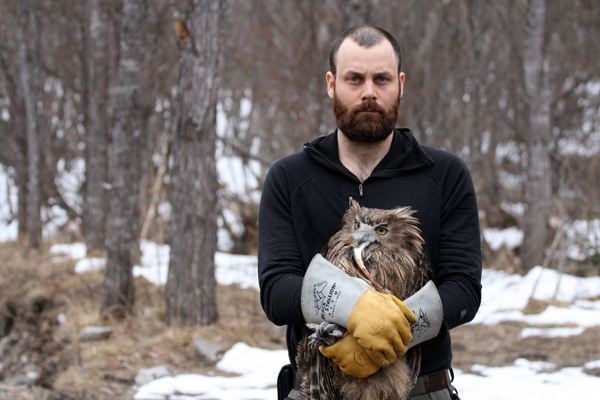
Jonathan Slaght with a Blakiston’s fish owl. (Photo: Sergei Avdeyuk, Amur-Ussuri Center for Avian Bioiversity)

Read the interview with Slaght here.


Source: Mongabay.com.

BACK DOOR TO CHINA

Posted on May 29, 2013

Twelve suspects in three separate incidents have been arrested by Nepalese officials for smuggling rhino horns and pangolin scales into China.

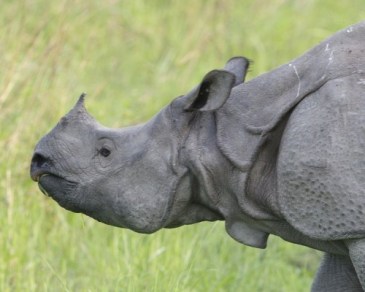
A total of 12 wildlife traffickers were arrested in Nepal in a span of just a few weeks, including seven traders in rhino horn. (Photo: Lip Kee/Wikimedia Commons)

    On April 27th, six traders in rhino horn were arrested in Bardibas, Nepal and turned over to Chitwan National Park (Nepal) officials for prosecution.
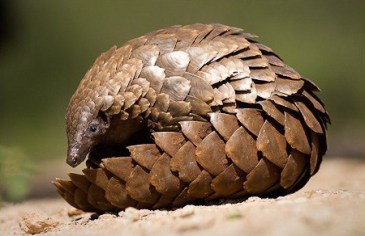
    Ten days later, five people were arrested when police intercepted a bus headed from Kathmandu to the border checkpoint into China at Tatopani, and seized nine kilograms of pangolin scales that the smugglers had attached “to their thighs and other parts of the body with duct tape.

Pangolin.

A week later police raided a hotel in Chandranigahapur, Nepal and arrested another trader with a rhino horn.

    Traders have long used the route through Nepali territory to the custom office in Tatopani, the main northern border check point into China, to smuggle endangered plants and animal parts.

Tatopani border point.

The customs office at Tatopani, Nepal. The main border point for trade between Nepal and China.

It’s believed that custom officials on both sides of the border are deeply complicit in the smuggling. All the Nepalese border points are hubs of concern for wildlife officials.

A FIRST

Posted on May 29, 2013

Amy Meyer has the distinction of being the first person in the country charged under an “ag-gag” law, a new type of legislation passed by several states and being considered by others, designed to silence undercover investigators who expose animal welfare abuses on factory farms.

Amy Meyer.

The scene of the crime was the Dale T. Smith and Sons Meat Packing Co. in Draper City, Utah, where Meyer stood on the road outside the plant and used her cell phone to capture video of what she later described as “piles of horns” and “flesh being spewed from a chute on the side of the building, cows struggling to turn around after they smelled and heard the misery that awaited them inside,” and ”an apparently sick or injured cow being carried away in a tractor.”

While she was recording, a person from the slaughterhouse approached her and said she wasn’t allowed to film the operations. She responded that she was within her rights on public property. The police arrived, questioned her and allowed her to leave without pressing charges.

Nine days later she was charged with a class B misdemeanor for interference with an agricultural operation, which carries a penalty of up to six months in jail. Meyer pleaded not guilty.

Meyer, Amy, Police Report (Redacted) by The Salt Lake Tribune.

Meyer’s attorney, Stewart Gollan, argued that she never crossed into private property and believed that her behavior was constitutionally protected. Gollan also noted that the police report states there was no evidence of interference.

Journalist Will Potter broke the story about Meyer’s arrest on his Greenisthenewred website. Just 24 hours later, the Draper City prosecutor’s office dropped all the charges. More from Potter on this refreshing development can be found here.

Utah passed their ag-gag law in 2012. Nebraska, North Carolina, Pennsylvania, and Vermont are currently considering similar bills. Tennessee just tabled one, but a similar bill is expected to be reintroduced there in the near future.

THANK YOU BOB

Posted on May 28, 2013

SHARK has enlisted the aid of Bob Barker, storied game show host and long time supporter of protections for animals to explain why Pennsylvania voters need to tell their state legislators to support state bill SB510 to stop the unconscionable practice of shooting live pigeons.

COMMENTS

    Ozzie DoLittle. “I don’t do any kind of target shooting as a hobby or sport, but many years ago I tried archery, and I found I love target shooting. What I fail to comprehend is, why do people need LIVE targets, I never felt the need. These blokes know about clay pigeons, so why live ones? To what end? These shooters are displaying a serious psychopathology.”


    1patrat: “This is so beyond BARBARIC,it pisses me off. I’m a sportsman,NRA member and how ironic is this, a financial supporter of SHARK. If those COWARD BASTARDS are gonna shoot birds like that they need to eat every one of them. I only believe in killing what I’m gonna eat. God didn’t create animals to be shot for sport.They where created as a food source if needed and much more. I’m ashamed of the NRA being affiliated with such trash as those MURDERERS are.”

RAPTOR RESCUE

Posted on May 25, 2013

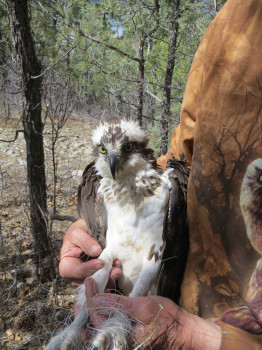
US Fish and Wildlife Migratory Bird specialist Bob Murphy and friend Dale Stahlecher, a wildlife biologist, were preparing for a canoe trip down the Rio Chama River, in New Mexico, when they spotted an Osprey dangling from a pine tree, 60 feet up.

    Other canoeists, park staff, a local utility linesman and others joined in the rescue with contributions of equipment and belaying help for Murphy who climbed the tree and found the bird tangled in fishing wire. Stahlecker shot video while Murphy cut the bird loose.

    They took it to The Wildlife Center in Española where the rehab staff found the wire had cut off circulation to one of the bird’s toes and it had to be amputated.

    Osprey tangled in fishing line. (Photo: Dale Stahlecker)

    It’s unknown how long the bird may have been hanging in the air. Alissa Mundt, on the rehab staff, said “she could use a little bit of fattening up. She’s pretty skinny.” But she’s on the mend. It’s hoped she might be returned to the wild, but ospreys hunt by snatching fish swimming in water and carrying them away, and it’s difficult to know whether she will retain that ability. Mundt added that she thinks the three toes might be enough to help the bird survive on her own.


    Source: Albuquerque Journal.

DUST UP

Posted on May 22, 2013

at the Big Loop Rodeo.

Big Loop Rodeo, Day One. (Photo: SHARK)

SHARK is at it again.

Post rodeo intimidation. Note: the Sheriff’s posse sells food at the rodeo. (Photo: SHARK)

HAUNTED

Posted on May 22, 2013

I  can’t get this image out of my mind.

Orangutan rescue, Borneo. (Video frame: International Animal Rescue)

A female orangutan isolated in the remains of a jungle that had been bulldozed down around her to plant palm oil trees, fleeing desperately from the animal that had been trying to kill her. In this case, her pursuers were there to rescue her from certain death, but experience told her to flee.

Clearing the forest had deprived her of fruit and leaves, reducing her to eating bark and stems and she was weak from hunger. On this occasion, rather than chasing her away or killing her, the palm oil company that had destroyed the forest contacted International Animal Rescue (IAR) so she could be captured and moved to a place of safety.

Starving orangutan rescue, Borneo. (Photo: International Animal Rescue)

A few minutes later  members of IAR’s team in Borneo along with members of the local forestry department, covered her with a net and transported her to undisturbed jungle.

The rescuers determined that she was lactating, which meant she had lost her baby which had probably been killed not long before the rescue team arrived.


Watch the video of her rescue here.
To learn about and contribute to International Animal Rescue.

KILL BUYER INVESTIGATION

Posted on May 21, 2013

sends investigators into the field, to trail livestock trucks and visit markets, collecting stations and slaughterhouses to expose abuses involved in horse slaughter, long distance transport, non-ambulatory animals, and factory farming. Their investigators provide documented reports and video footage to news media as a public service, and share what they find with auction and slaughter plant management, “to encourage positive change in the way farm animals are handled during transportation, at auction, and at slaughter.” (Imagine being a fly on the wall at one of those meetings.)

Check out their investigations here.

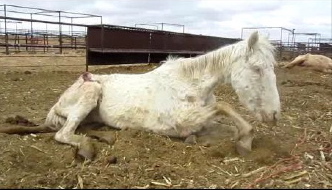
Out of luck animal at Dennis Chavez’s Southwest Livestock Auction & Slaughter Horse Feedlot. March 2012. (Photo: Animals’ Angels)

Last year ANIMAL POST reported on their investigation of a New Mexico facility operated by Dennis Chavez, New Mexico’s largest kill buyer, where investigators found a pitiful scene of corrals strewn with dead and dying horses.

Most recently Animal Angels documented conditions at the Knoxville Livestock Center (the research may not yet be posted, keep checking), one of the largest horse auctions in the Southeast and popular with kill buyers. Locals had complained about the poor treatment of the horses they’d witnessed there.

The investigators saw auction horses being unloaded and crammed into a narrow chutes, then into large, overcrowded pens. Stressed, the horses fought over food and water, the more dominant horses preventing the weaker horses from drinking.


Inspectors found the auction house animals in extremely poor physical condition. Two “resembled walking skeletons.”

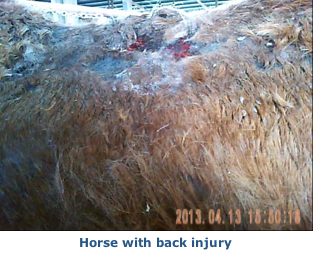
Several horses were observed that were clearly ill or injured. Investigators noted: a horse with an eye infection, a weakened horse who continued to lay down in the pen, a horse with a clubbed foot and lame, a mare in heat with weighted shoes, bandaged and wrapped front legs, perhaps from soring, a horse with a back injury & skin problem, multiple horses with fresh cuts and smaller injuries, multiple horses with overgrown hooves, and multiple emaciated horses.

The severely emaciated horse #5164 was also moved through the sale ring, but no one wanted to buy her.

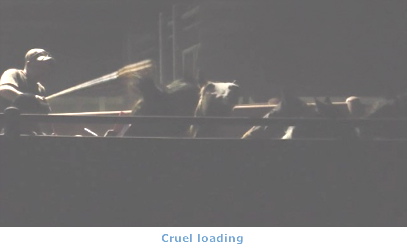
After the auction concluded, the investigators watched one buyer and his assistants load fourteen horses into a trailer whose entrance was too low for the ramp. Every horse that walked up hit its head and panicked. “The workers beat them over the head with ropes, paddles, and sticks, leading to complete mayhem.”

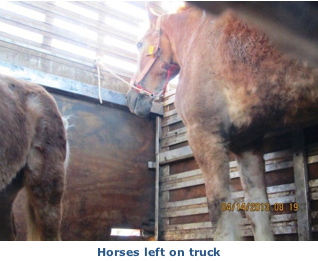
Filled with horses the truck left the auction, drove for hours and parked, leaving the horses inside the trailer overnight without food or water.

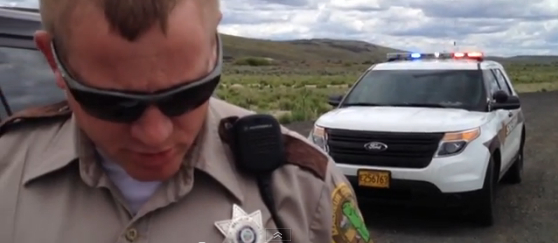
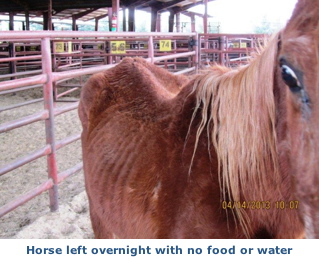
Back at the auction, investigators found an emaciated horse that had been left with no food or water for over a day. The investigators called the Sheriff’s office who sent an officer to questioned the workers. A worker lied, claiming the animal had been sold and given food and water. The investigators provided evidence that showed otherwise. The auction manager called and threatened the officer, informing him that he was not allowed to take any photos. The officer was not intimidated and walked the entire premises with the investigators and ordered that the horse be given food and water immediately.

The investigators shared their photo documentation and the police report with the Tennessee Department of Agriculture, State Veterinarian, and AG Crime Unit Officer. They noted they will continue to monitor the Knoxville Auction and ensure that it is held accountable for how it treats the animals in its care.


What Animals’ Angels investigators do is the opposite of glamorous. And undoubtedly heartbreaking. This particular reports seems fairly typical. It’s a hot, dirty business, documenting awful stuff, dealing with people who could give a shit about animals. But it’s valuable work. The people they’re watching aren’t going to change their behavior willingly.

If you want to support what they do, go here.

TENNESSEE AG-GAG CHOKES

Posted on May 17, 2013

Tennessee Gov. Bill Haslam (R) vetoed a proposed anti-whistleblower “ag-gag” bill that would have made it harder to expose animal abuse.

Tennessee Governor Bill Haslam.

The legislation would have required that evidence of animal abuse be turned over to law enforcement within 48 hours or face criminal charges. The bill’s sponsors said the proposal would ensure animal cruelty was quickly investigated.

Watchdog groups say it was to prevent undercover activists from exposing cruelty to animals on farms and, in the case of the Tennessee walking horse industry, in the show ring.

Thousands of Tennesseans urged the veto, including more than 300 Tennessee clergy, the state Attorney General pronounced it constitutionally suspect, and a number of high profile celebrities added their voices to the protest.

The Tennessean newspaper called it a courageous move by the Governor:

“The legislation was built upon a lie. There is no need even for a revamped version of this bill to see the light of day, because the stated purpose of the bill, to prevent manipulation of animal owners by animal-rights groups, is a fiction. Just ask the prosecutors in the Jackie McConnell horse-soring case. They will tell you the evidence obtained by the Humane Society of the United States could not have been obtained in any other way.

Animal abusers do not advertise their wrongdoing, but the abuse must be stopped.”

DZANGA BAI MASSACRE

Posted on May 17, 2013

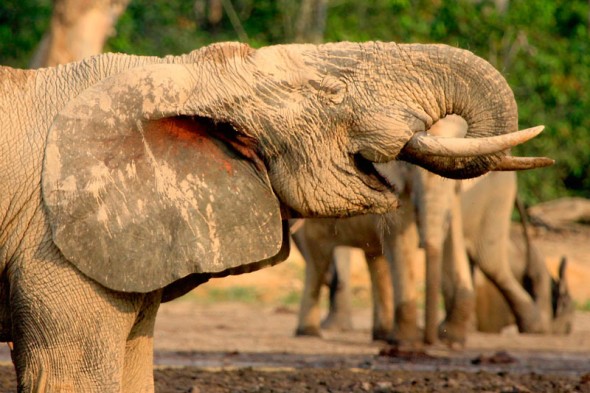
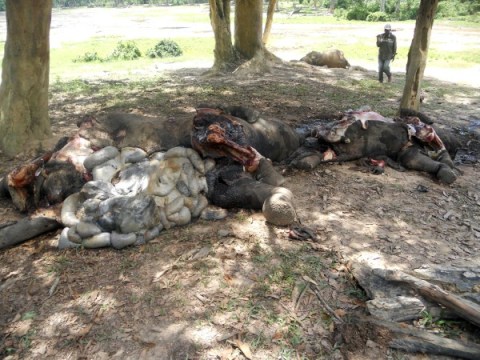
May 6, a group of 17 heavily armed poachers in the Central African Republic (CAR), entered the Dzanga-Ndoki National Park, a World Heritage Site, and killed at least 26 elephants, firing from an observation platform used by scientists and tourists.

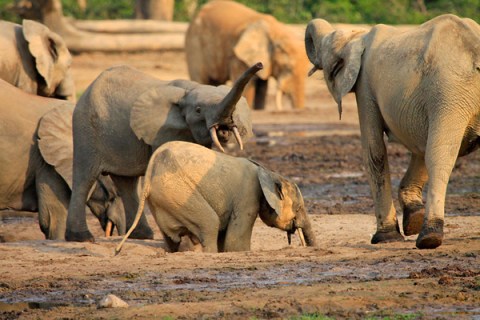
Forest elephant (Loxodonta cyclotis) bull drinking with trunk in mouth, in Dzanga Bai. (Photo: WWF/Carlos Drews)

The poachers left the park by the evening of May 8, their truck fully loaded with ivory. Examination of the carcasses following their retreat revealed 20 adults and six calves. All their tusks had been hacked off. An assessment of additional damage, possibly including other elephant carcasses in the surrounding forest and smaller clearings, is ongoing. The site of the massacre, Dzanga Bai, also known as the “village of elephants,” is a large clearing in the rainforest where between 50 and 150 elephants gather every day to drink at mineral-rich springs. Tourists and scientists have come to the clearing for decades to observe the normally secretive African forest elephant, a different species than the larger savannah elephants found in open country.

Elephants in Dzanga Bai (Photo: Carlos Drew/WWF)

Poachers have sought to enter the clearing for years, but conservationists had always managed to keep them at bay. The identities of these poachers are unclear but they are believed to be of Sudanese origin. They did not speak the local language. It is understood they arrived at the park in a vehicle emblazoned with the name Séléka, the new regime which overthrew CAR President François Bozizé in March. The park has armed ecoguards, but they felt outgunned by the poachers and did not take them on. Chaos has reigned in the area since the government takeover with widespread reports of looting, rapes, killings, and other human rights abuses. Although the poachers have left Dzanga Bai, there are fears the killing of elephants in the CAR may resume. Forest elephants are smaller than other species but their tusks have a pinkish hue which, unfortunately, increases their value.

Elephant slaughter at Dzanga Bai, CAR. (Photo: WWF)

    The carnage has reached eye-popping numbers. Poachers killed over 300 elephants in Bouba N’Djida national park in Cameroon in December. More than 30,000 elephants are being killed in Africa every year to supply the ivory trade fueled by demand in China, Thailand, and Vietnam. Driven increasingly by organized crime syndicates intent on feeding this demand, the population of forest elephants in Central Africa has declined by 62 per cent over the past decade. For the past 30 years World Wildlife Fund, Wildlife Conservation Society, and the CAR government have collaborated on programs within the Dzanga–Sangha protected areas that both protect wildlife and support livelihoods for hundreds of local people. For nearly 25 years, the U.S. Fish and Wildlife Service also has supported efforts in the park, including funding research on the forest elephants that use Dzanga Bai.

    As of May 10, most of the park’s 42 ecoguards are back at their posts—watching and waiting.


    Sources: mongabay/National Geographic.

EYOS

Posted on May 14, 2013

Eyos, a female orangutan at the Sepilok Orangutan Rehabilitation Centre in the Malaysian Sabah District of North Borneo, was recently released into the Tabin Forest Reserve. Her reintroduction was part of a post release monitoring project sponsored by Orangutan Appeal UK, in cooperation with the Sabah Wildlife Department.
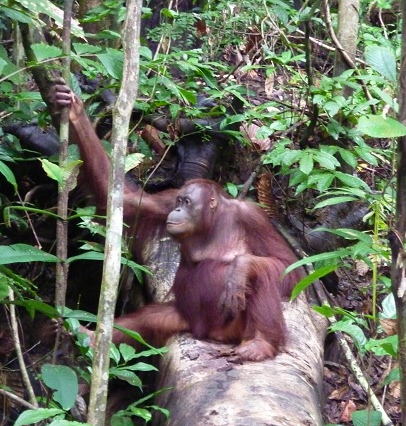
Eyos shortly after release, March 2013. (Photo: Orangutan Appeal UK)

Project Director, primatologist James Robbins, noted that Eyos was getting bullied by many of the other females at Sepilok and clearly needed her own space to live away from other orangutans.

She is the first of six orangutans the team is releasing into Tabin in 2013. All of the apes are implanted with a radio telemetry transmitter so that the team can stay in regular contact with them over the next several years. Wielding antennas, the team follows them 13 hours a day in the forest. The project is the first to use radio-telemetry to track apes in the wild.
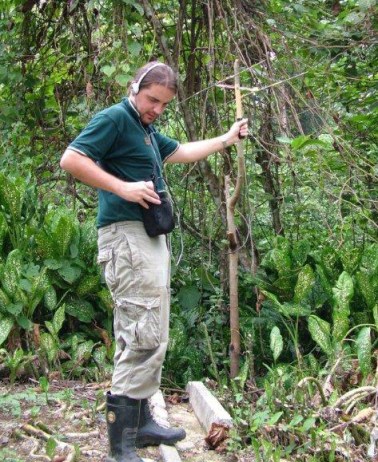
Primatologist James Robins.

The goal of the monitoring project is to obtain data on the behaviour and survival rate of the apes after their release. Orangutans had been released from Sepilok before, but prior to the monitoring project, which began in 2010, no one really knew what happened to them afterward. It was known that many had difficulty adapting to the environment and becoming independent enough to feed themselves as most had been raised by humans since they were rescued as babies.

The Tabin Forest was chosen for releases because it is a large area of protected mixed secondary and primary rainforest with a relatively small orangutan population, yet lots of food and suitable habitat available.

“Eyos is feeding really well so far and has managed to find plenty of fruits on the higher ground in the south of our release site,” Robbins writes. “She has even had some interaction with a wild male orangutan whom she approached last week. After a bit of a standoff that lasted a couple of hours, she got bored and moved on with her day! Eyos is old enough now to be a mother so over the next couple of years, with any luck, we may be reporting news of her getting pregnant with the help of a wild male orangutan!”
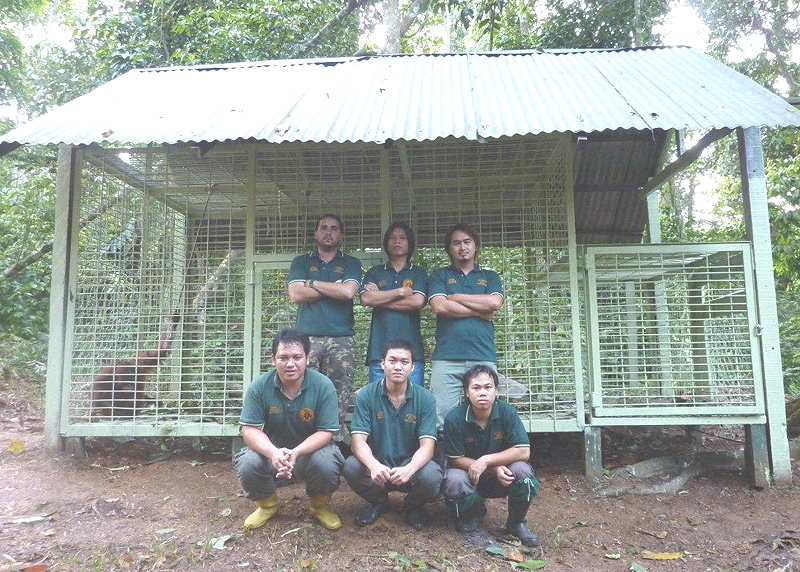
James Robins (top left) and the Tabin team.

Robins is working with the Sepilok Center to formulate a rehabilitation strategy to produce more viable candidates for release. This includes monitoring the rescued apes to ensure they acquire basic survival skills, including a good level of climbing expertise and the ability to make nests in the trees. They also learn how to forage for their food and which plants they can eat and which to be wary of. As their release times approach, they are put into the Kabili Reserve abutting the centre where they are able to visit a feeding platform on the edge of the forest to supplement their diet if they need to.

Robins is looking to compare the behavior of the released orangutans with wild orangutans. If any major deficiencies or abnormalities are noticed, these will be used to advise rehab center managers everywhere on how to most appropriately rehabilitate rescued orphans, so that all of their developmental needs can be met. The ultimate goal is always to release the rescued animals back into the wild.

So far, over a dozen orangs have been released to Tabin. Four have been returned to Sepilok for their inability to adapt. Several released apes have died.

Sepilok Orangutan Rehabilitation Centre occupies a corner of the Kabili-Sepilok rainforest reserve about 25km north of Sandakan, Borneo.

Sepilok Orangutan Rehabilitation Centre is one of only four orangutan sanctuaries in the world. It is located on 43 sq km of protected land at the edge of the Kabili Sepilok Forest Reserve. Around 25 young orphaned orangutans are housed in the nurseries, and 60 to 80 orangutans are living free in the adjacent reserve.

The facility provides medical care for apes orphaned as a result of illegal logging and deforestation, and confiscated orangutans who have been illegally caught and kept as pets. The sanctuary also harbors dozens of other wildlife species, including sun bears, gibbons, Sumatran rhinos and an occasional injured elephant.


The Centre, operated by the Sabah Wildlife Department, has become one of Sabah’s top tourist attractions. Along with its popularity have come problems. At times more than 700 visitors per day can flood the centre, with camera-clicking tourists far outnumbering the primates. Constant contact with humans has exposed the orangutans to diseases, which can make rehabilitation to the wild all but impossible. Expansion plans should solve some of the overcrowding problems.

The sanctuary receives funds from the Sabah Wildlife Department supplemented by an admission fee charged to tourists, who are allowed to visit the centre to witness the feeding times. Funds are limited and, as a result, in past years the Centre has been unable to replace much of its outdated or dilapidated equipment and staffing levels have been at a minimum.

Donations are badly needed.