ChimpHaven
ChimpHaven
Accompanying the recent news that “researchers” at the University of Wisconsin are continuing to conduct obscene animal experiments in the tradition of the demented Harry Harlow, evidence unearthered in a PETA lawsuit reveals that the school has still more secrets in its closet.
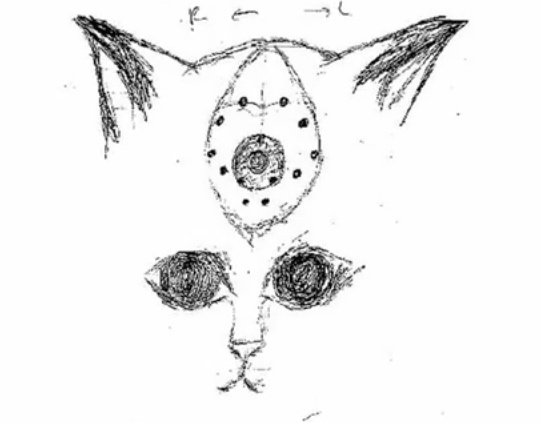
by screwing a steel post into her skull and implanting electrical devices deep inside both her ears. After being deprived of food for several days to coerce her into cooperating in exchange for a morsel of food, they bolted her head into place, restrained her in a nylon bag and forced her to listen to sounds coming from different directions.
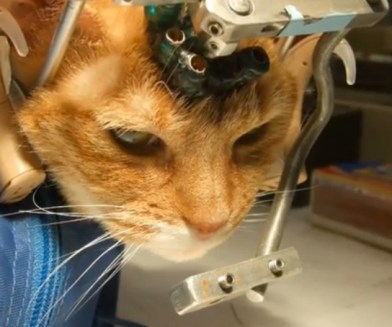
Double Trouble. (Photo: University of Wisconsin)
Records say that she was observed twitching, which the clinical notes indicate was a “neurological sign.” Her face became partially paralyzed and the head wound that experimenters created during surgery never healed.
One of the last entries in her records states that she “appear[ed] … depressed.” In the end, experimenters noted she was too ill to continue and that the device they had implanted did not work, so she was killed and decapitated so her brain could be dissected. A former UW-Madison veterinarian who oversaw the treatment of this cat and others recently issued a letter confirming this abuse, stating that many of the cats “suffered unnecessarily.”
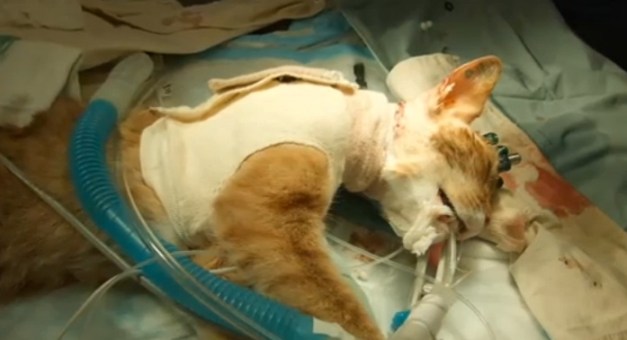
(Photo: University of Wisconsin)
For a more detailed—and gruesome—look at what happened, see this video.
Correspondence between UW experimenters and their collaborators conclude that the experiment was a failure because there was a problem with the cat’s surgery.
This experiment is part of a larger project that has received more than $3 million from the National Institutes of Health (NIH) with the stated purpose of understanding how the brain determines the location of a sound.
Source: PETA
Japan has continued to send its ships to the Antarctic in the autumn or winter each year to catch whales by the hundreds. To prevent the killings, the anti-whaling group Sea Shepherd has been chasing and harassing the Japanese whale fleet in the frigid southern waters for years.
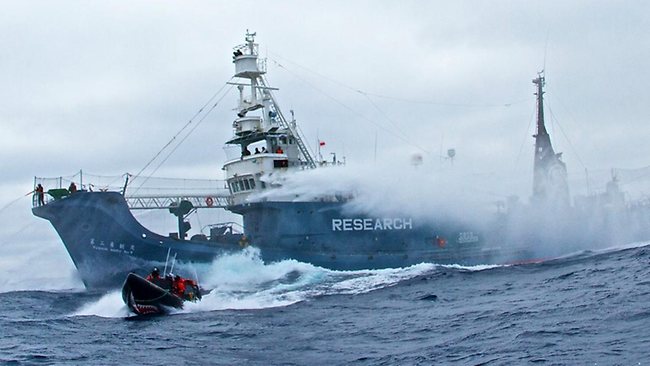
Antarctic whaling confrontation. (Photo: Sea Shepherd)
San Francisco, Monday–a judge of the 9th US Circuit Court of Appeals issued a ruling against Sea Shepherds clearing the way for Japan whaling interests to launch more extensive legal action against the group.
“When you ram ships, hurl glass containers of acid, drag metal-reinforced ropes in the water to damage propellers and rudders, launch smoke bombs and flares with hooks; and point high-powered lasers at other ships, you are, without a doubt, a pirate,” the judge said. “The activities that Cetacean [the Japanese whalers] alleges Sea Shepherd has engaged in are clear instances of violent acts for private ends, the very embodiment of piracy.”

Sea Shepherd boat harassing Japanese whaler. ((Photo: Sea Shepherd)
described the judge’s opinion that he is a “pirate” as one-sided and irrelevant, saying the judge had ignored aggression from the Japanese fleet. “He didn’t mention anything in there about the fact that the Japanese have destroyed one of our ships (the Ady Gil in 2010), they’ve thrown concussion grenades at us, hit us with water cannons and laser beams.” As for the judges accusations. “We don’t throw acid. We throw rotten butter. We haven’t rammed a single Japanese whaling vessel down here in the entire nine years. We’ve been rammed multiple times.”

Robert F. Kennedy, Jr.
was addressed by Robert Kennedy, Jr., senior attorney for the National Resources Defense Council, and President of the Waterkeeper Alliance, at the National Press Club one week ago:
“The organization that brought this lawsuit (against Sea Shepherds), which is the so-called Institute for Cetacean Research, which is an arm of the Japanese government, is really a private organization masquerading as a scientific research group. For may years they’ve obtained permission to kill thousands of whales every year using as a pretense that they weren’t doing this for businesses reasons, which would have been illegal, but that they were killing the whales for scientific research. Since 1986 when they obtained this scientific research exemption they have killed 20,000 whales and they have not produced a single peer-reviewed article in any scientific publication.
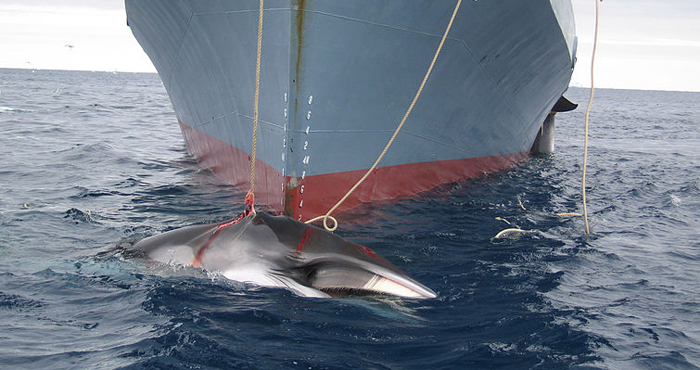
Japanese whaling. (Photo: Sea Shepherd)
“…The Institute for Cetacean Research, (takes) the whale meat back to Japan and they claim that this is a Japanese cultural necessity, but in reality according to a recent study by the International Fund for Animal Welfare, fewer than 2% of people in Japan actually eat that meat, and that number is declining rapidly because of the widespread knowledge now that whale meat is heavily contaminated with neurotoxoic mercury.
“In 2010 (Japanese whalers) sank a Sea Shepherd ship in an act of piracy. The Sea Shepherd ship had the right-of-way, they cut it in two, and almost killed six people, and they sank the ship. Then they arrested the captain of the ship and they charged him, and what was the charge? It was interfering with a business enterprise. Yet they’re telling the world that this is not a business enterprise, it is a scientific enterprise.
“The (whaling) business is completely based upon them receiving enormous subsides from the Japanese government including $30 million in subsidies raised by people in the country and around the world for tsunami relief in Japan, that was handed over last year to the Institute of Cetacean Research.
“So…it’s a pirate industry. The International Whaling Commission has recognized that the scientific research claims are dubious and has imposed a moratorium on whaling, an international moratorium, and the Institute of Cetacean Research is violating that moratorium. In other words, they are today in violation, by sending these ships out. The two harpoon boats and their factory processing ship in the Southern Ocean, they are violating not only Australian law—the Australians and Chileans have chased them out of their territorial waters and forbidden them from coming into those waters and their Antarctic waters—they are in violation of international law.
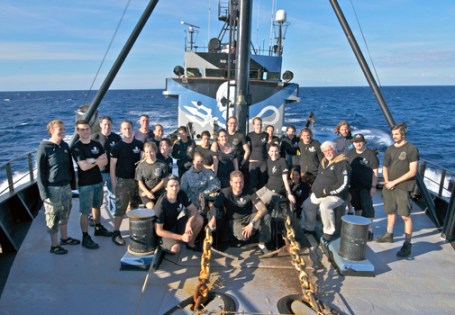
Captain Paul Watson and the crew of the Steve Irwin. (Photo: Sea Shepherd)
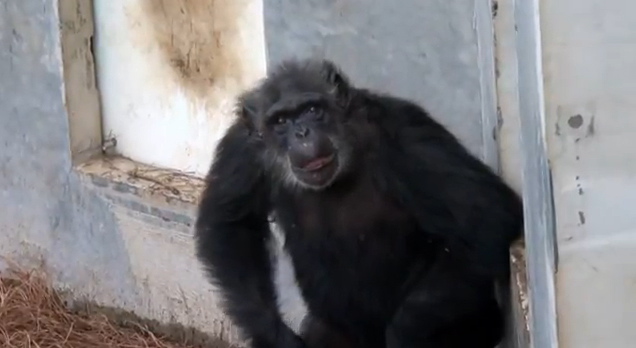
recently arrived at Chimp Haven, the national chimpanzee sanctuary, from the University of Louisiana’s New Iberia Research Center. Over the next few months New Iberia (which has lost its NIH chimp research contract) will send the sanctuary another 102 chimps.

Valentina playing with Mom at Chimp Haven. (Photo: Chimp Haven)
had originally planned to retire only 10 animals to sanctuary, and send New Iberia’s remaining 100 animals to the Texas Biomedical Institute, with the understanding that the animals would be permanently ineligible for further use in biomedical research. The plan was scotched after several animal rights groups objected to sending any of the animals to another research facility.
an NIH “Working Group” report recommended that 90% of the government’s 451 remaining chimps still in laboratories (282 available for research and 169 considered inactive but not permanently retired) be permanently retired from research and moved to sanctuaries. It recommended keeping a small colony of about 50 chimps for the possibility of new research.
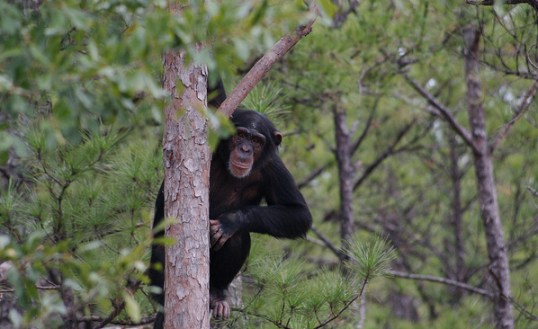
Tracy at Chimp Haven. (Photo: Chimp Haven)
The recommendation is awaiting final agency approval following a 60-day public comment period. If all goes as it should, within the next five years another 300 chimpanzees will be retired to Chimp Haven.
For more information and to leave a comment, go here.
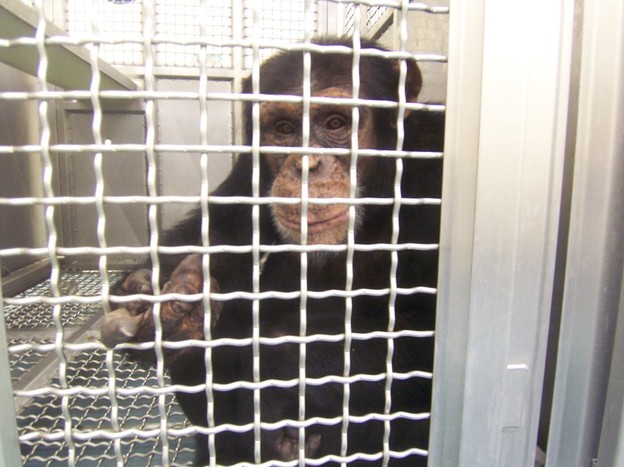
Lab chimp. (Photo: Humane Society of the United States)
It’s a shameful blot on the biomedical industry that these chimps haven’t been moved to sanctuary much sooner. According to a recent study that reviewed autopsy reports on 110 chimpanzees in or from U.S. labs who have died since 2000, 64% suffered from serious chronic illnesses, while 69% had diseases which should have caused them to be retired from research use.
“All chimpanzees suffering chronic or incurable physical or psychological illness should be immediately released to sanctuary,” said study co-author and NEAVS president Theodora Capaldo. “They deserve to spend every minute of their remaining years in the comfort and safety of a healing environment.”
The NIH actions come in the midst of efforts on several fronts to end all experiments on chimps, including a bill to stop experimentation on all great apes, which did not pass in the last Congress, but which proponents hope to reintroduce, and a pending decision by the Fish and Wildlife Service on whether captive chimps should be considered endangered, as wild chimps are.
About 500 chimps remain at private U.S. research facilities.
of a leopard in the Caucasus Wildlife Refuge date from spring 2012, when rangers found foot prints in the snow. They were later identified by experts as typical for a big cat—most probably a leopard.
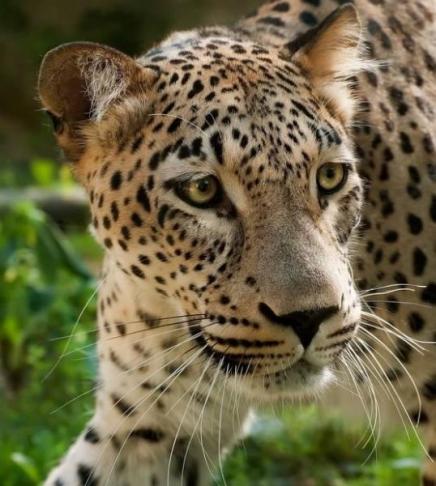
Caucasian/Persian leopard. IUCN Red List status: Endangered. (Photo: World Land Trust)
That summer, experts from the Armenian NGO, Foundation for the Preservation of Wildlife and Cultural Assets (FPWC) started a systematic investigation of all areas of the refuge considered “leopard friendly”. They collected scat and pieces of fur found on thorny shrubs. Though the experts were sure that the samples came from a leopard, final confirmation could only be proved by genetic analysis.
Genetic tests of the samples conducted at the Tisch Family Zoological Gardens in Jerusalem recently confirmed that they are indeed from a rare Caucasian Leopard, also called the Persian Leopard (Panthera pardus saxicolor). The news confirms what field experts have believed but had been unable to prove, that this highly endangered predator still dwells in Armenia.
is found across several different countries including Iran, Armenia, Turkmenistan, Afghanistan and Georgia. There are thought to be less than 1,300 Caucasian Leopards left in the wild and fewer than 15 of the cats left in Armenia.
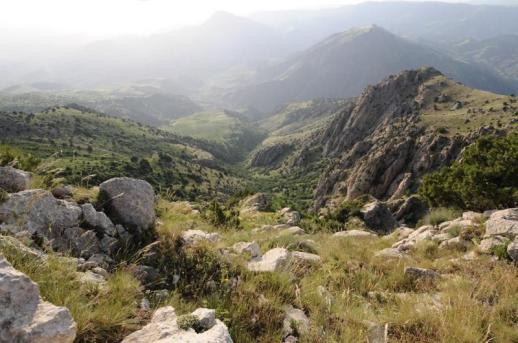
Caucasus, Armenia. (Photo: FPWC)

Caucasus-wildlife-refuge. (Photo: FPWC)
They mainly live in remote, mountainous habitats which can range from dry and arid to forested regions and even extend up into snowy mountain ranges. In recent years, their population has been devastated by uncontrolled hunting and habitat destruction. Leopards don’t know borders. Their migration routes cover not only a corridor through Armenia but also reach out in particular to Iran and Azerbaijan.

Armenia Caucasus Wildlife Refuge. (Map: World Land Trust)
joined with FPWC in 2010 and established the 1,084 acre (439 hectare) Caucasus Wildlife Refuge—next to the 60,000 acre Khosrov National Reserve. A team of rangers stationed in the reserve have successfully reduced illegal hunting in the region, which has increased populations of the leopard’s prey species such as Bezoar goats and Ibex. The confirmed presence of the leopard shows that the refuge is increasingly becoming a safe haven for the big cats.
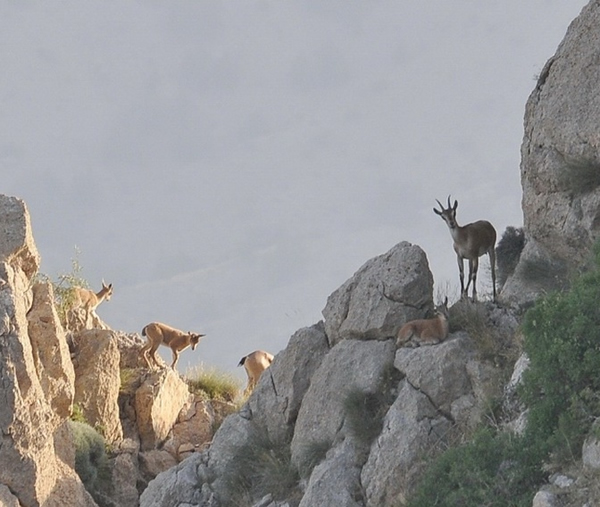
FPWC’s rangers have increased the number of Bezoar Ibex in the area by reducing hunting, this increase in prey is critical to the survival of Caucasian Leopard. (Photo: FPWC)
The remote and mountainous habitats they inhabit makes the big cats extremely vulnerable to habitat fragmentation and a variety of other threats. These include reduction of prey species through poaching, loss of habitat caused by deforestation and over grazing by livestock, conflict with livestock owners, heavy military presence and fortification of borders, and being hunted as trophies or for the fur trade.
As is happening in the Bafq Protected Area in Iran (“Bafq Cats” ANIMAL POST 1/5/13), efforts are underway to strengthen regional cross-border cooperation in order to establish official wildlife corridors for the cats to roam.
A Persian leopard was just recently photographed for the second time in the Bafq Protected Area.
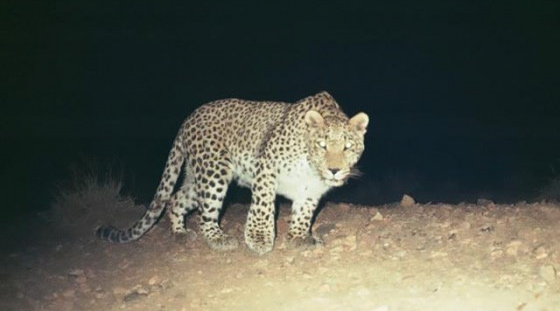
Recent photograph of the old man. (Photo: Iranian Cheetah Society)
The cat was first photographed by a camera trap in 2004. He’s since been spotted by both game wardens and visitors on numerous occasions.
Most cats in the wild rarely live past ten. This dominant male is thought to be up to 14 years old, making him the oldest leopard ever to roam the desolate plains and valleys of this mountainous park—or anywhere in Iran.
Despite a new study that shows there are a total of only eleven leopards in the park, officials at the Bafq Governor’s Office do not believe that the populations warrant continued protection.
Another red wolf was found dead of a gunshot wound January 18, 2013, north of the Town of Fairfield, in Tyrrell County, North Carolina.

Male red wolf (Photo: B. Bartel/USFWS)
A recent change of rules by the local Wildlife Commission to allow night hunting of coyotes is being blamed as red wolves are difficult to tell apart from coyotes, especially at night. With only some 100 red wolves living in the wild, each wolf killed represents 1% of the population. This latest death means that some 8% of the population have been shot in the last few months.
Anyone with information that directly leads to an arrest or a criminal conviction for the suspected unlawful take of this red wolf may be eligible for a reward of up to $2,500. Anyone with information on the death of this red wolf or any others, past or future, is urged to contact Special Agent Sandra Allred at (919) 856-4786, Refuge Officer Frank Simms at (252) 216-7504 or North Carolina Wildlife Resources Commission Officer Robert Wayne at (252) 216-8225.
The red wolf is protected under The Endangered Species Act. The maximum criminal penalties for the unlawful taking of a red wolf are one year imprisonment and $100,000 fine per individual.
are removed from their mothers immediately after birth and kept in total isolation. Deprived of their mothers’ protection and comfort, each infant is exposed to multiple frightening experiences, including a live kingsnake. When the infants are about one year old, they are killed and their brains dissected.

If this sounds like something out of the middle ages, you would be wrong. It is the latest in a long line of similar experiments being conducted at the University of Wisconsin.
Chair Department of Psychiatry at the University of Wisconsin School of Medicine and Public Health, has coauthored approximately 180 published scientific papers most of which have involved experimentation on animals. Go HERE for a short list of some of his studies.
As regards his newest “maternal deprivation” project, “Effects of early experience on the development of anxiety and its neural substrate,” Kalin says that he has gone as far as he can in his study of anxiety in “normal” monkeys. Now, he must study fearfulness in monkeys taken from their mothers almost at birth and compare it to the fearfulness of monkeys allowed to stay with their mothers for a few months.
Kalin will kill 40 male monkeys in his experiment when they are 61 to 70 weeks old. He will cut out parts of their brain and report on any differences he can identify.
Over the past 18 years, Dr. Kalin’s research using monkeys to study the neurobiology of fear has cost taxpayers many millions of dollars. In the past ten years alone, it has cost us $5,075,798. [National Institutes of Health. Grant R01MH046729. Development and Regulation of Emotion in Primates.]
Kalin’s experiment is all the more macabre because it follows in the horrific tradition of tests conducted years ago by the infamous Harry Harlow, a psychology professor–at the same school–who rose to prominence by physically damaging the brains of rhesus monkeys then testing their learning ability.

Harlow “discovered” that infants removed from their mothers quickly developed abnormal behaviors.
Harlow’s maternal deprivation tests consisted of taking baby monkeys from their mothers at birth and putting them in cages with surrogate mothers made of cloth and wire. He concluded what one would assume without any study at all—that social creatures can be destroyed by destroying their social ties.
Many psychologists continue to hold Harlow in esteem as a major figure in experimental psychology.
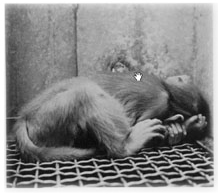
When challenged about the value of his work, Harlow stated: “The only thing I care about is whether a monkey will turn out a property I can publish. I don’t have any love for them. I never have. I don’t really like animals. I despise cats. I hate dogs.”

Well of Despair (top removed).
Harlow’s studies became increasingly pathologically disturbed. In the late 1960s he invented a device he called the Well of Despair, a stainless-steel trough with sides that sloped to a rounded bottom and a covered top, equipped with a food box and a water-bottle holder. Into the box he placed monkeys between the ages of three months and three years, who had bonded with their mothers for up to ten weeks, and left them alone. The aim of the research was to produce an animal model of clinical depression. Unsurprisingly it worked. The monkeys would spend the first day or two trying to climb up the slippery sides. After a few days, they gave up. They stopped moving about and spent most of their time huddled in the bottom. They were found to be psychotic when removed. Most did not recover.
Social isolation and maternal deprivation experiments at UW-Madison continued through the 70s and 80s. These types of experiments have not been used at the University for over twenty years. So one wonders: Did the ethical problems raised by Harlow’s experiments not register with the researchers there at all?
The University of Wisconsin’s Institutional Animal Care and Use Committee (IACUC) and ask them to cease these cruel and unethical experiments.
COMMENT posted by MAGGIE on January 30th, 2013:
I have aggregated all the vet and primate researchers emails into one place to make it easy to email them, and the first address is for the director of the school. This is sickening. You can copy and paste these into your own email program. sandgren@rarc.wisc.edu; kbrunner@primate.wisc.edu; capuano@primate.wisc.edu; jbacon@primate.wisc.edu; cclark@primate.wisc.edu; mharke@primate.wisc.edu; slarson@primate.wisc.edu; welter@rarc.wisc.edu; gaudio@rarc.wisc.edu; shvs@rarc.wisc.edu; newman@rarc.wisc.edu; riley@rarc.wisc.edu; schiffman@rarc.wisc.edu; sjohnson@rarc.wisc.edu; peter@rarc.wisc.edu; sawall@wisc.edu; duchesneau@rarc.wisc.edu; girard@rarc.wisc.edu; bogdanske@rarc.wisc.edu
Add your name to the pledge to withhold all donations to the University of Wisconsin until the institution bans the use of maternal deprivation once and for all.
Source: Animal Legal Defense Fund.
 First Light Productions