Ann Novek( Luure)--With the Sky as the Ceiling and the Heart Outdoors

Photo: Jaymi Heimbuch

View original post 1,254 more words
Ann Novek( Luure)--With the Sky as the Ceiling and the Heart Outdoors

Photo: Jaymi Heimbuch

View original post 1,254 more words
Ann Novek( Luure)--With the Sky as the Ceiling and the Heart Outdoors
By: John Platt
A dolphin caught in a fishing net. (Photo: Oceana)
View original post 356 more words
Thanks to Miles Becker for this summary of an article that touches on a theme we have highlighted in the past–sourced from Bush, E.R. et al. 2014. Global trade in exotic pets 2006-2012. Conservation Biology doi: 10.1111/cobi.12240— at Conservation Magazine‘s website:
Pet stores are filled with colorful critters originating from the wilds of other continents. All the cages and terrariums stay well stocked while many prized species decline in their native habitat. Does the global fascination with exotic pet species hasten their extinction?
One way to find out is to compare the list of traded species with a list of species in trouble. The Convention on International Trade in Endangered Species (CITES) maintains records of reported legal exports from its 180 member countries. The conservation status of species are listed on the red list curated by the International Union for Conservation of Nature and Natural Resources…
View original post 246 more words
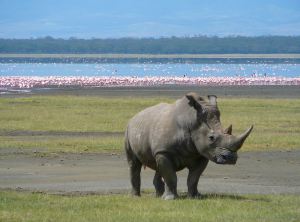
Lake Nakuru National Park has been a protected rhino sanctuary since 1986. Rhinos from Solio Ranch, Nairobi National Park, Lewa Downs and South Africa were translocated to the area in an attempt to give them safety to roam and breed. There is a reinforced high power solar fence enclosing the area, as well as guards/rangers within the park.
Why is Nakuru seeing an increase in rhino poaching?
According to KWS (Kenya Wildlife Service), poachers not only use sophisticated weaponry, they are now using silent poaching methods that are difficult for rangers on patrol to detect.
In parks such as Lake Nakuru, rising water levels have shrunken grazing land for rhinos forcing them to move to park periphery. This makes them an easy target…
View original post 256 more words
Amidst the greatest mass extinction of species since the dinosaurs disappeared 65 million years ago, there is one smallish success

Channel island fox. (Photo: George HH Huey)
The latest update to the IUCN red list added more than 1,000 species, to bring total assessments to 71,500 species, including all mammals, birds and amphibians. More than a third of the species are considered under threat. About half of known reptiles have been assessed and a third of fish, but only a fraction of invertebrates, plants and fungi.
source: Damian Carrington.
Rhino horn, ground into powder, is in strong demand in Vietnam.

Rhino horn powder mixed in drink. (Photo: Justinmott.Photoshelter.com)
It is believed to be a cancer cure and an aphrodisiac for men. Businessmen buy it as a “tribute” to bribe their superiors and “lubricate” business affairs.

Grinding rhino horn to power. (Photo: Justinmott.Photoshelter.com)
Openly advertised in the streets of downtown Hanoi it can be purchased at shops selling traditional medicines at prices approaching $70,000 per kg.

Vietnam. Ad for rhino horn grinding plates. (Photo: Justinmott.Photoshelter.com)
70 % of rhino horn specimens in Vietnam are fake.
The United Nations’ highest court for resolving disputes between nations, the International Court of Justice, has ordered a temporary halt to Japanese whaling in the Antarctic in a lawsuit brought by Australia.

Three dead minke whales on the deck of the Japanese whaling vessel Nisshin Maru in the Southern Ocean. (Photo: Sea Shepherd Australia)
“In light of the fact the [research program] has been going on since 2005, and has involved the killing of about 3,600 minke whales, the scientific output to date appears limited,” said presiding judge Tomka.
The decision will not mean the end of whaling. Japan has another whaling program in the northern Pacific and Iceland and Norway, who rejected a 1986 moratorium on commercial whaling imposed by the International Whaling Commission, continue the practice. Norway set a quota of 1,286 north Atlantic minke whales last year, saying stocks are plentiful.
Iceland and Norway do not claim to be carrying out research, so the ICJ’s ruling has no immediate consequences for them.
The ICJ’s ruling is final and there will be no appeal. Japan issued a statement that it would comply with the decision. Fingers crossed…
Poacher arrested with bush meat.
The Poacher:
The poor man living in a hut with a pregnant wife and 3 skeletal children. One perhaps with a tear running down a sunken cheek, the wife begging the husband to find them enough for a meal. Finally, in exasperation the man reluctantly sets off on a dangerous, one-time mission to take part in killing an elephant or rhino. The few dollars will feed his hungry family for a week (if he makes it back alive).
Is this what you imagine when you think of a poacher?
Think again. Although poverty is one aspect of poaching and can be a reason, it does not account for all of it. In fact, wealth is the driving force behind the most destructive killings: mainly our elephants and rhinos.
There are two types of poachers:
1) Subsistence Poachers – they target small game, have low technology…
View original post 479 more words
Ann Novek( Luure)--With the Sky as the Ceiling and the Heart Outdoors
The Fisheries Agency has decided to increase protection for bluefin tuna amid international concerns about declining stocks, according to major media, including the Yomiuri Shimbun and the Mainichi Shimbun.
Studies have found stocks of bluefin tuna, prized by sushi lovers, have fallen dramatically, with juveniles forming the majority of specimens now being caught, pushing the species closer to extinction.
Last year, an international conference involving Japan agreed to cut each nation’s quota for juvenile bluefin tuna in 2014 by more than 15 percent from the 2002-2004 average, according to Kyodo News.
But Japan, the world’s biggest tuna consumer, has concluded bluefin tuna stocks will not sufficiently increase unless the quota is significantly reduced, the Yomiuri said.
The Japanese plan is aimed at encouraging other nations to adopt bigger cuts in their tuna catch quota, Kyodo said.
Read more at:
View original post 1 more word
Before admiring the “subsistence” lifestyle, think of wolves that the state of Alaska shoots from planes to provide “game” for their hunters…
by Nick Provenza
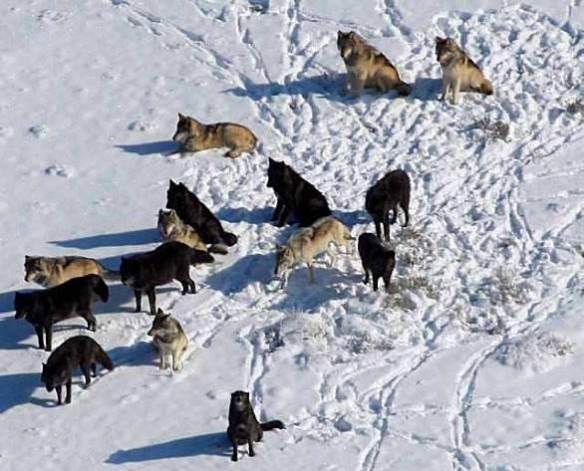
FAIRBANKS, Alaska (AP) — Alaska Fish and Game officials killed an Eastern Interior wolf pack last week, and the National Park Service — which had been studying the animals — is none too pleased.
The Fairbanks Daily News-Miner reports that all 11 wolves in the Lost Creek pack near Yukon-Charley Rivers National Preserve were shot. That included the pack’s alpha pair, which had been fitted with tracking collars as part of an ongoing research project.
Doug Vincent-Lang, acting director for the Alaska Division of Wildlife Conservation, says the wolves were in an area adjacent to the preserve that has been targeted by the state for aerial predator control, which is part of an effort to boost moose and caribou numbers.
But Yukon-Charley Superintendent Greg Dudgeon…
View original post 230 more words
Ann Novek( Luure)--With the Sky as the Ceiling and the Heart Outdoors
View original post 262 more words
Ann Novek( Luure)--With the Sky as the Ceiling and the Heart Outdoors

Photo: U.S. National Ocean Service
View original post 468 more words
Ann Novek( Luure)--With the Sky as the Ceiling and the Heart Outdoors
Agus Supangkat, a spokesman for the zoo, confirmed on Wednesday that a female anoa — basically a miniature water buffalo — and a male dromedary camel were the latest animals to have died there. He said there was nothing unusual in the deaths, citing old age in the case of the anoa and a skin disease in the case of the camel.
“There are no physical bruises on the anoa’s body,” Agus said.
“We tried our best to save its life, especially considering how the anoa has been under the medical team’s watch.”
He said the anoa, named Happy, was on a list of 84 animals categorized in January as being ill…
View original post 352 more words
Ann Novek( Luure)--With the Sky as the Ceiling and the Heart Outdoors
February 26, 2013
New report exposes the double standard which stimulates demand
LONDON: Despite signing up to global initiatives seeking to protect wild tigers and double their number by 2022, Government departments in China have quietly set about stimulating domestic markets for tiger skins and body parts.
As few as 3,500 tigers survive in the wild, yet more than 5,000 captive-bred tigers are held in Chinese ‘farms’ and ‘zoos’.
Investigations by the London-based Environmental Investigation Agency (EIA) have uncovered a legalised domestic trade in the skins of captive-bred tigers, sold as luxury home décor and stimulating the poaching of wild tigers and other Asian big cats as cheaper alternatives.
In addition, new evidence suggests a ‘secret’ Government notification on the use of the bones of captive-bred tigers is being used to justify the manufacture of ‘tonic’ wines.
Released today, the new EIA report Hidden in Plain Sight: China’s Clandestine Tiger…
View original post 529 more words
A beloved, venerable African elephant named Torn Ear was killed in Kenya on February 7 by poachers who shot him with poisoned arrows. Richard Bonham discovered Torn Ear’s fatal injury while observing him at a watering hole.
Bonham is the co-founder and the African operations director of the wildlife conservation organization, Big Life Foundation. He noticed that the elephant was walking with an irregular gait, and then he saw two wounds behind Torn Ear’s rib cage.
A veterinarian was summoned, and Torn Ear was darted with a tranquilizing drug. It was clear upon examination, Bonham said, that “the arrows had penetrated into the abdominal cavity, and peritonitis had set in, which meant that there was no hope for survival.” So Torn Ear was euthanized.
In a blog post the next day Bonham wrote:
“Yesterday we lost an iconic elephant, one of the few left on the continent…
View original post 62 more words
Ann Novek( Luure)--With the Sky as the Ceiling and the Heart Outdoors

Odzala-Kokoua National Park, Republic of Congo (CNN) — The Republic of Congo’s main north-south road runs right on the edge of Odzala-Kokoua National Park. For now, it remains nothing more than a narrow dirt track and Odzala, the country’s largest park, very much remains one of the world’s last isolated natural Edens.
But Mathieu Eckel, head of the park’s anti-poaching unit, knows that is quickly changing. For the past year, Eckel has been gathering evidence…
View original post 1,869 more words