
Sign the petition to save Aceh
1,500,000 signatures are needed.
1,337,662 people have already signed. Please help and add yours. This is an incredibly important issue for all of us.


Sign the petition to save Aceh


By Martin Fletcher
7:00AM GMT 03 Feb 2014
From the air the Minkébé National Park in the central African state of Gabon would inspire wonder in even the most jaded traveller. Its steamy equatorial rainforest stretches from horizon to horizon, unbroken by a single track or human habitation, punctuated only by occasional swamps and granite outcrops. It is a dense green jungle the size of Belgium, with towering trees – some hundreds of years old and 150ft high…
View original post 3,173 more words
The animal rights group Eleventh Hour for Animals has filed a federal complaint against the University of Florida alleging a “culture of negligence” in regards to its treatment of lab research animals.

Stereotactic halo used on 6 macaques inside University of Floria.
Karen Kline, senior laboratory investigator for Eleventh Hour said the records show that Louis and other animals were treated in a way that violated the Animal Welfare Act.
There is no happy ending when going through the records of care given to these animals,” she said. “There just is not.”
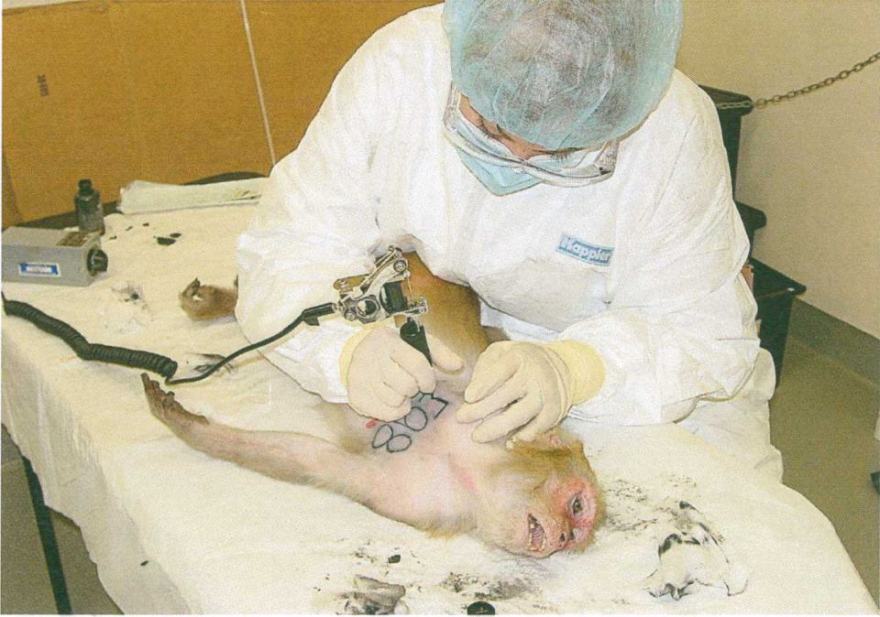
U.F lab tattoo.
Eleventh Hour asked for swift, disciplinary action if the allegations are substantiated. That it were otherwise, but in all likelihood nothing will change and the lawsuit will come to naught.
The lab inspection office of the USDA, the Animal and Plant Health Inspection Service (APHIS), claims its inspectors try to visit each lab in the country a minimum of once a year to ensure compliance.
It doesn’t happen. APHIS has been chronically understaffed and underfunded since its inception. APHIS inspections are few and far between and generally superficial. Most “compliance” involves self-reporting by the labs themselves.
Laws protecting research animals are minimal, at best. Things that a private person does to a pet that would be considered animal cruelty and punishable by law, are allowed under the Animal Welfare Act. Once an institution’s Animal Care and Use Committee approves an experiment, it’s a done deal.
The Animal Welfare Act is fatally flawed in that it has no control at all over what happens to an animal in the operating theater.
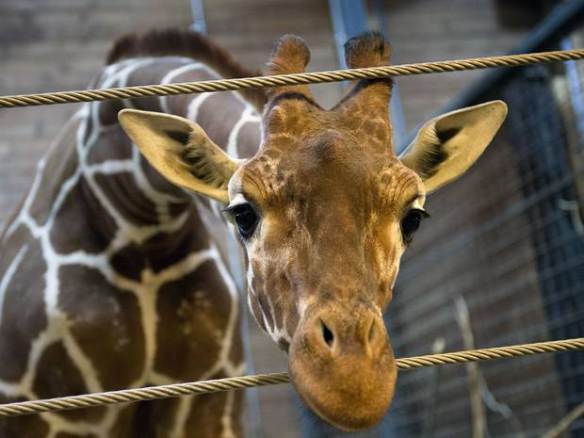
We wouldn’t go to a prison to learn about typical human society, so it makes no sense to observe imprisoned animals in order to learn about them
by Mimi Bekhechi
Monday 10 February 2014
If there had ever been any doubt that zoos serve no purpose beyond incarcerating intelligent animals for profit, the slaughter of Marius, an 18-month-old giraffe, on Sunday has surely settled the issue. Copenhagen Zoo delivered Marius into a life of captivity, allowing his mother to give birth to the calf while knowing that the baby would be “surplus” to its requirements and “useless” for breeding because his genes were too common.
The zoo used the baby calf to attract visitors and then slaughtered him. He was shot rather than given a painless lethal injection, just so that his flesh wouldn’t be contaminated when it was cut up in front of horrified schoolchildren and, quite literally…
View original post 582 more words
“Wilderness is about humility, the acceptance that we humans don’t know it all and never will. More than any other landscape, wilderness takes us beyond “self”; in it, we are part of something greater” – Howie Wolke.
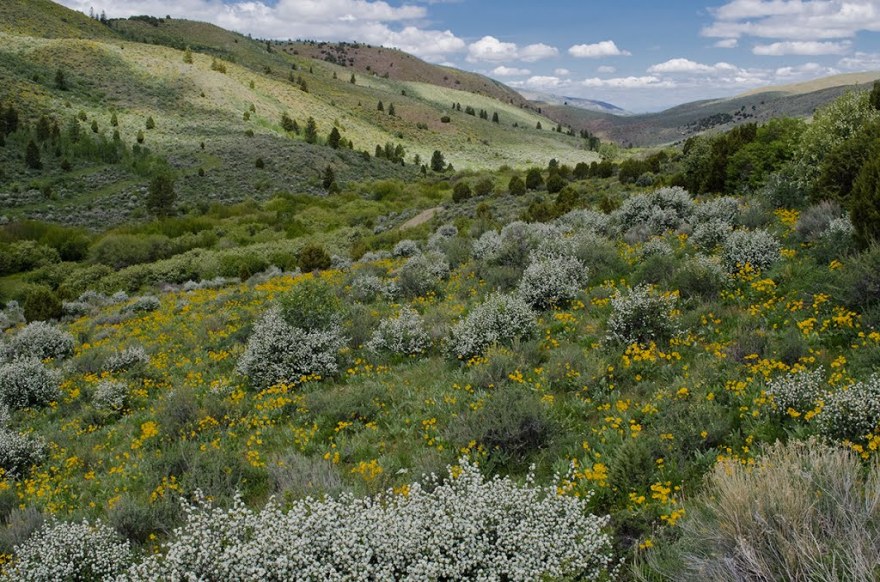
Down East Fork Mink Creek. Bannock Mountains. May. (Photo: Ralph Maughan)
“When mechanized mountain bikers demand access to proposed and designated wilderness, they fail to understand that if they succeed, owners of unimagined future contraptions will certainly demand equal treatment. So will modern-day snow machine and all-terrain vehicle owners. To loosen wildland restrictions now starts us down that slippery slope.”
Wolke makes a good point.
Even as the world’s leaders gather in London for the global wildlife trade summit, we all know what part of the world they have their eyes on.
China, where everyone knows demand for wildlife products is the highest.
I welcome the attention. Because in the last few months, we have made huge strides in my home country to fight wildlife trade, promoting awareness, changing attitudes, and ultimately reducing-perhaps in some cases, eliminating-this demand.
In just two days after the International Fund for Animal Welfare (IFAW) launched its Chinese New Year campaign “Give Peace to Elephants, Say No to Ivory Gifting,” the Weibo message was retweeted over 27,000 times.
While I was delighted to see more than 6,000 Chinese netizens sent in supporting comments @IFAW on Weibo, what particularly encouraged me were two other social media campaigns against wildlife consumption organized by none other but the Chinese government media…
View original post 889 more words
History buffs will be familiar with Palau, an island country in the Pacific ocean with a population of about 20,000 people spread across 250 islands, because of the battle of Peleliu, one of the major engagements on the Pacific front between the imperial troops of Japan and the U.S. Marines. But that’s the past. These days, Palau is making headlines for much more peaceful reasons: President Tommy Remengesau Jr. has declared the Pacific nation will ban commercial fishing. At a UN oceans conference, he declared that Palau’s 200 nautical mile Exclusive Economic Zone will be a “100 per cent marine sanctuary” (see the map above). This is very impressive and would create a protected zone about the size of France!
Why is he doing this?
“We have no choice – the ocean is our way of life,” president Remengesau said. “It’s our livelihood…
View original post 178 more words
Researchers report the existence of one of the last thriving large colonies of chimpanzees on the planet in the remote Bili-Uele forest in the Democratic Republic of Congo (DRC).
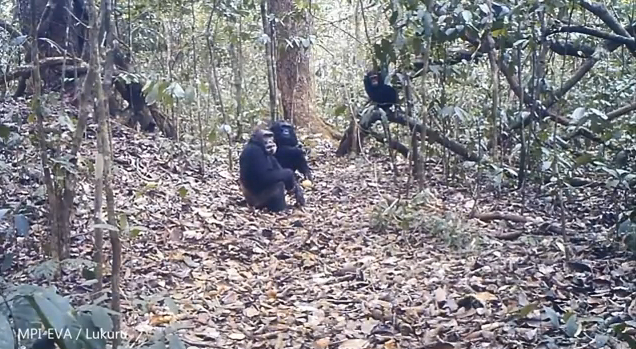
Bili-Uele forest, Democratic Republic of Congo. (Lukuru Foundation)
Researchers first identified the chimp kingdom in 2007. Estimates place the number of chimps there in the multiple thousands. Elsewhere in Africa, chimp populations have shrunk from millions to just a few hundred thousand in the last century.
The unusually large chimps in the Bili-Uele have been seen feasting on leopard. They build ground nests far more often than other chimps, and they have a unique taste for giant African snails.
Motion-activated video cameras have recorded gangs of males patrolling their territory.
The area is at great risk of being opened up. There is illegal gold mining in nearby areas. Members of the Lord’s Resistance Army move through the area, along with refugees and armed brigands from the war in the Central African Republic. Researcher fear these incursions will draw hunters seeking to feed the enormous bushmeat trade in the Congo basin.
The chimps are protected in DRC law, but the law means little to poachers and corrupt officials who look the other way when paid to do so.
Shout out: Damian Carrington.
Rhinos are wild, large, sometimes unruly animals, but possess a peaceful, gentle side and form strong bonds just as much as any other creature. Sometimes it’s with people, often other rhinos, but occasionally it’s a bond of a more unusual nature. Such is the case with the following amazing individuals.
Fabian and Madame Gigi
Recently there was a rhino poached in the Nyaru Game Lodge in Cape Town. This was particularly painful to the Lodge as Fabian the White Rhino was a favorite among guests and employees. Fabian was the only rhino at the reserve, as the rest were already sold because of poaching concerns. But the decision to keep him was due in part to his relationship with his friend Madame Gigi, resident pug puppy.
Nyaru owner Ruan Fouché described the day they met. “Madam Gigi, still a puppy, saw Fabian and ran towards him, and there, right in…
View original post 449 more words
by Christopher Baranowski
Target: Governments of South Africa, Namibia, and Zimbabwe
Goal: End the brutal and inhumane hunting of giraffes for sport.
In many African countries, it is legal to hunt giraffes for sport. Hunters from around the world pay up to 15,000 dollars just for the chance to kill one of these animals. Despite declining giraffe populations, these African countries claim that hunting can be profitable for the government and citizens and that giraffe populations can be sustainably managed. But the continuation of this brutal practice only perpetuates the idea that these animals are a commodity and encourages illegal poaching. End the hunting of giraffes for sport today.
Hunters from countries like Russia, the United States and Germany pay thousands of dollars for plane tickets to countries like South Africa, Namibia and Zimbabwe where hunting of giraffes is still allowed. Game parks charge trophy fees for killing the animals…
View original post 379 more words
TRENTON, N.J. (AP) — Drugmaker Merck & Co. is joining two dozen other pharmaceutical companies and contract laboratories in committing to not use chimpanzees for research.
The growing trend could mean roughly 1,000 chimps in the U.S. used for research or warehoused for many years in laboratory cages could be “retired” to sanctuaries by around 2020.
That’s according to Kathleen Conlee of the Humane Society of the United States, which seven years ago began urging companies to phase out all chimp research.
The trend is driven by improved technology, animal alternatives and pressure from animal rights groups, the National Institutes of Health and Congress.
Last June, reacting to an Institute of Medicine study Congress had requested that concluded nearly all chimp research is unnecessary, the NIH announced it would retire and send about 90 percent of government-owned research chimps to the Chimp Haven sanctuary in Keithville, La. It’s now home…
View original post 470 more words
via ‘Bigwigs involved in cyanide poisoning’ – DailyNews Live by Bridget Mananavire 29 OCTOBER 2013
A wildlife conservation organisation kicked out of Hwange National Park has alleged that government bigwigs were involved in the cyanide poisoning of wildlife.
More than 100 elephants have died of cyanide poisoning at Hwange National Park in one of the worst poaching atrocities in Zimbabwe.
John Rodrigues, the Zimbabwe Conservation Task Force (ZCTF) chairperson, said it was shocking that his organisation that had invested more than $1,5 million dollars on conservation of wildlife was now an enemy and denied access to Hwange and other national parks.
“They are afraid we will tell people the truth about the poaching situation and how the elephants were killed,” Rodrigues said, without mentioning names.
“There is a cover-up going on there at Hwange, and bigwigs are involved.
“We have helped in the conservation of wildlife and used more than…
View original post 251 more words
China’s long dark nightmare has a produced a spiritual deficit.
 Photo: Far East Russia Project
It cost a reported US$5 billion to build. It features the world’s biggest aquarium. It showcases what it claims is the world’s longest roller coaster. And it boasts a massive collection of whales, sharks and animals rarely, if ever, seen in captivity in China.
There’s no question about it: Ocean Kingdom, the giant theme park on Hengqin island, at the southern tip of Zhuhai, which was scheduled to open this weekend, in time for the Lunar New Year holiday, is destined to make something of a splash.
Owned by the Chime-Long Group, which runs China’s biggest theme park – Chime-Long Paradise, in Guangzhou – Ocean Kingdom is about twice the size of Hong Kong’s Ocean Park and three times the size of the city’s Disneyland.
A turreted, fairy-tale palace-like 1,888-room resort hotel has already opened next to the massive main attraction, which – although it…
View original post 2,784 more words
Sumatran rhinos are the smallest of the living rhinos, and probably the most unique in appearance. They are covered in hair and most closely resemble their extinct ancestors woolly rhinos.
They are the most vocal, and quite agile. Living in jungle conditions, they climb mountains and riverbanks surprisingly easily.
There are less than 150 Sumatrans left in the wild. In captivity there are only 9; and of them, just two captive females have reproduced in the last 15 years. Doesn’t make for a bright outlook does it?
Sumatrans live in fragmented areas due to deforestation and an ever shrinking habitat. They also face the same peril as their African cousins-poaching.
The plight to save the remaining endangered Sumatran rhinos has grown more urgent following the death of Gelugob. She resided in Lok Kawi Wildlife Park in Sabah, Northern Malaysia, and passed away of old age on January 11th.
For 19…
View original post 97 more words
It seems Mother Nature still has a few secrets up her sleeve.
In a study published in PLOS ONE this week, researchers announced the discovery of a new species of river dolphin in Brazil. The marine mammal is the first river dolphin to be described since 1918, the authors noted in the research.
Discovered in the Araguaia River basin, Inia araguaiaensis is believed to have diverged from river dolphins in the Amazon more than 2 million years ago due to a shift in the landscape. Unlike other river dolphins in Brazil, the newly discovered species has only 24 teeth per jaw, instead of the typical 25 to 29.
“It was something that was very unexpected, it is an area where people see them all the time, they are a large mammal, the thing is nobody really looked. It is very exciting,” lead author Dr. Tomas Hrbek of…
View original post 173 more words
A rare treat.


 First Light Productions