First Light Productions
investigative journalism
Posts from the “SANCTUARY” Category
Shout out: narhvalur

(These are orphaned orangutans rescued from palm oil plantations (partially funded by donations to Orangutan Outreach at redapes.org) who are now being nursed back to health, trained and rehabilitated for a return to safely protected forests.)
_______________________________
The law of unintended consequences strikes again (a la Dr. Oz). The FDA, in a move designed to curtail heart disease (in humans), has proposed a rulemaking that will ban trans fats in foods — at the expense of other species. Although it gets a bit technical, trans fats come from hydrogenated vegetable oils, which means these liquid vegetable oils are converted into a solid that helps extend the efficacy and shelf life of processed food, like frozen pizzas, etc.

What’s a good substitute, though? “Palm kernel oil, which is solid at room temperature and has become a popular substitute for trans fats, might work in some cases but some products might have to be dropped,”…
View original post 447 more words


While we’re eating turkey and opening gifts around a tree in our cozy homes, rangers are standing guard in the bush ready to fight. These men and women put their lives on the line every day to protect our rhinos and elephants from the evil clutches of poachers.
A few months ago, there was a letter writing campaign to “thank a ranger”. What better time to do it again, than at Christmas!Please take a moment to give them hope and inspiration. Let them know how much they mean!
Please go to the SANParks facebook page and post your messages of support and well wishes for the holiday and the new year.

The following letter from a friend and fellow blogger/photographer, Ingrid Taylar, completely annihilates Time Magazine’s recent anti-wildlife article, “America’s Pest Problem…
Dear Editor:
David von Drehle’s piece, “America’s Pest Problem,” barely touches on the crux of the issue which is our own exponentially growing population combined with our gluttonous appetite for land and resources, all of which present wild animals with fewer options. He describes our ecological role in heroic terms, without delving into the much more complicated morass of human intrusion. We encroach on wild spaces, sterilize formerly complex habitats with subdivisions and lawns, raze and trample forests to provide grazing lands for cattle, pollute water sources with our industrial production of food and materials, poison critical plants like milkweed out of existence for Monarch butterflies and bees, build roadways through critical migration corridors, produce trash to the degree that there is no feasible way to dispose of it…
View original post 463 more words

It was revealed on Monday that over the weekend, Journey, Oregon’s wandering wolf, crossed the border into California once again. He didn’t stay long before returning to the Southern Cascades of Oregon. Karen Kovacs, Wildlife Program Manager with the California Department of Fish and Wildlife reported that the wolf was following migrating deer and elk.
Dispersal is a normal behavior for wolves, although few travel as far or for as long as Journey. He has gone over 3,000 miles since leaving the Imnaha pack in the northeast corner of Oregon in September of 2011. I remember that time well. I left the same area a few weeks behind him after attending a rural writing retreat along the Imnaha River. Driving home, I watched for OR 7 (he hadn’t earned the name Journey yet) as I made the long trip back to southern Oregon. I didn’t see him of course, but…
View original post 749 more words
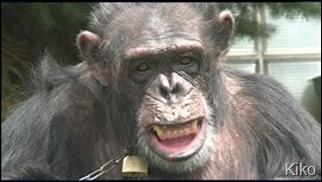
The lawsuits, filed last week by the Nonhuman Rights Project on behalf of four chimpanzees — Kiko, Tommy, Leo, and Hercules — were all promptly rejected out of hand by New York judges.
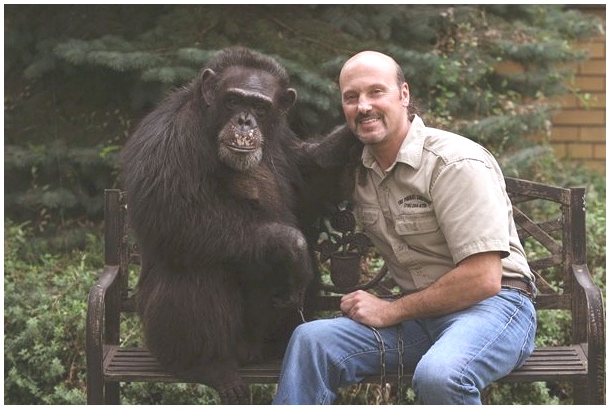
Kiko with owner Carmen Presti. (Photo- Charles Lewis)
Kiko’s hearing was conducted over the phone by Judge Ralph Boniello. Asked to rule on the claim that chimpanzees deserve to be granted rights of bodily liberty historically reserved for humans, Boniello commented, “I’m not going to be the one to make that leap of faith.”
Tommy’s case was heard by Judge Joseph Sise. “I will be available as the judge for any other lawsuit to right any wrongs that are done to this chimpanzee because I understand what you’re saying,” Sise said. He noted that the Nonhuman Rights Project made “a very strong argument,” but article 70 of New York’s legal code, which guides habeas corpus decisions, didn’t include chimps.
Leo and Hercules, owned by the University of Louisiana at Lafayette’s New Iberia Research Center and on loan to a laboratory at Stony Brook University, were denied habeas corpus by Judge Gerard Asher summarily without holding a hearing.
All the decisions will be appealed.

Andrea Rodricks
Although the U.S. Food and Drug Administration(FDA) does not require cosmetic testing on animals, it does allow a company to take whatever steps necessary to prove product safety. This includes animal testing. Even though the FDA does advocate for alternative methods of testing, it seems to be an all too common perception that animal testing is necessary for the development of safe products. This is evidenced by the hundreds of companies that still test on animals. I have never understood why it is seen as the best way to test cosmetics. Does testing mascara on a rabbit really prove that it is safe for human use? There are plenty of alternatives to testing on animals, so it is any wonder why companies continue this horrific practice. 
The United States is significantly behind in banning animal testing of cosmetics. In 2004, the European Union(EU) banned domestic…
View original post 245 more words

Answer by Rory Young:
Ivory poaching has not decreased as poverty has been alleviated, the opposite has happened. This is because ivory and rhino horn poaching are about green not hunger!
As Africa (where the poaching happens) and the Far East (where the biggest market is) have grown economically, and especially with regards to their per capita income, the poaching of ivory and rhino horn has escalated in tandem with this economic growth.
Zimbabwe National Parks Rangers On Parade At Tashinga in Matusadona National Park.
I have received a number of negative and even aggressive dismissive comments about raising funds for anti-poaching activities in National Parks. These people have been saying that it is a waste of time and that to end poaching we need to focus on poverty alleviation. These people are wrong.
First of all, there is a massive difference between poaching for meat and the poaching of…
View original post 1,696 more words
http://www.predatordefense.org/exposed/
In our newest film you’ll see three former federal agents and a Congressman blow the whistle on the USDA’s barbaric and wasteful Wildlife Services program and expose the government’s secret war on wildlife.
Dec. 1, 2013 – An agency within the USDA called Wildlife Services—a misnamed entity if there ever was one—has been having their way for almost a century, killing over 100,000 native predators and millions of birds each year, as well as maiming, poisoning, and brutalizing countless pets. They have also seriously harmed more than a few humans. And they apparently think they are going to continue getting away with it.
But in our new documentary, EXPOSED: USDA’s Secret War on Wildlife, whistle-blowers go on the record showing Wildlife Services for what it really is—an unaccountable, out-of-control, wildlife killing machine that acts at the bidding of corporate agriculture and the hunting lobby, all with taxpayer dollars.
Our…
View original post 95 more words
http://switchboard.nrdc.org/blogs/awetzler/breaking_usda_inspector_genera.html#.Up_WZK6fC54.twitter
Andrew Wetzler
December 4, 2013
Responding to Congressional requests and well over a hundred thousand letters from the public, the Department of Agriculture’s Inspector General confirmed today that it plans to conduct an audit of the USDA’s controversial Wildlife Services predator control program. Every year, at a cost of tens of millions of taxpayer dollars, Wildlife Services uses traps, poisons and guns to kill over 100,000 native carnivores such as bears, wolves, coyotes, and mountain lions. The audit, which is planned for 2014, will examine the following topics:
determine whether wildlife damage management activities were justified and effective;
assess the controls over cooperative agreements;
assess Wildlife Services’ information system for reliability and integrity; and
follow-up on the implementation of prior audit recommendations, such as the accountability over hazardous materials and equipment.
This audit is a much-needed development, one that will hopefully shed light on the long-documented problems with Wildlife…
View original post 259 more words
The notoriously substandard Las Vegas Zoo, where 150 animals were confined on just three acres, closed its doors a few months ago after all its zookeepers mysteriously quit.
The animals at the zoo included a lion, a cheetah, a chimp, a crocodile and some apes, including a chimp named Terri.
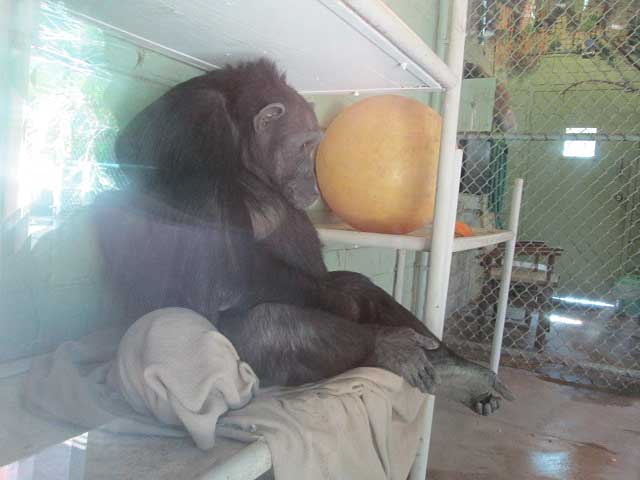
Terry at the Las Vegas zoo. (Photo: PETA)
Observers described Terry as a forlorn individual living in a cage with rotten, shriveled fruit, and filthy drinking water. He came to the zoo nearly 20 years ago with his longtime friend Simon. As youngsters they had performed an ice skating routine for the Ice Capades, a traveling entertainment show. Simon died shortly after they arrived at the zoo. Since then Terry lived alone.
A few people, including his former owner and trainer at the Ice Capades, dropped by once in awhile to try and cheer him up, but it was generally agreed he was deeply depressed.
Fortunately, Terry’s story has a happy ending. In October he was taken in by Save the Chimps (STC), a Florida sanctuary, where he has made his first friend, a female named Indie.
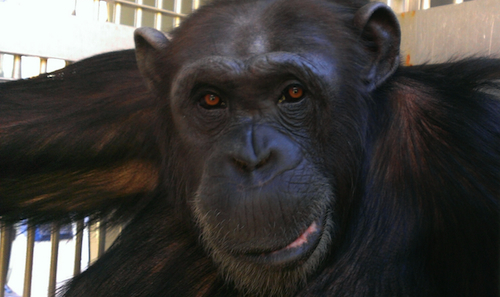
Terry at Save the Chimps
A recent post from the sanctuary described how
Indie, a very laid-back, quiet, friendly chimpanzee, wasn’t troubled when Terry ignored her. In fact, she pretty much lost interest in him. Ironically, this is exactly what Terry needed. Since Indie wasn’t bothering to even attempt to interact with Terry, he had the opportunity to observe her without feeling threatened in any way. Over the next few days, he became more and more curious about her, even following her from room to room in the Special Needs building. Then, a little over a week after they met, Terry let Indie groom him!”
The staff considered this an enormous breakthrough. To their knowledge, “It was the first time Terry had been touched by another chimpanzee in eighteen years.”
Donate to STC: https://www.savethechimps.org/donate
The Nonhuman Rights Project is filing three lawsuits in New York State this week to rescue chimpanzees from abusive situations and move them to sanctuary.
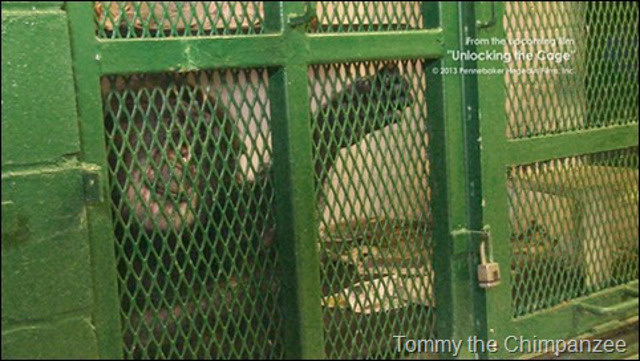
(Photo: Nonhuman Rights Project)
The first suit, filed today, concerns Tommy, who lives alone in a small cement cage at a used trailer lot in Gloversville. Tommy is the last of six chimps that were kept in cages at the business to attract customers. In the last three to four years, all but Tommy have died.
(Photo: Nonhuman Rights Project)
The second lawsuit will be filed Tuesday on behalf of Kiko, a chimpanzee who is deaf and living in a private home in Niagara Falls. The third will be filed Thursday on behalf of Hercules and Leo, who are being used in locomotion experiments at Stony Brook University on Long Island.
The legal cause of action being invoked is the common law writ of habeas corpus, in which a person being held captive seeks relief by calling upon his captors to show cause as to why they have the right to hold him or her. The aim is to breach the legal wall that separates humans from nonhuman animals.
 First Light Productions