First Light Productions

investigative journalism

Posts from the “SANCTUARY” Category

Another Kind of People

Posted on September 14, 2013

I posted this unforgettable photo “Dorothy” last November with a comment about the chimps’ reactions from the photographer Monica Szczupider.

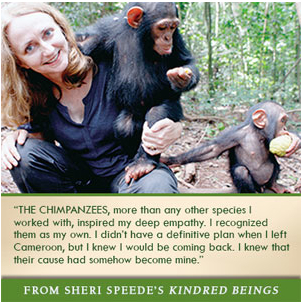
Small world, I recently attended a reading by author Sheri Speede who has just published the book Kindred Beings, an account of how she started the Sanaga-Yong Chimpanzee Rescue Center in Cameroon for IDA Africa. Speede, it turns out, is the woman in the photo with Dorothy.

She begins the book with her account of the events surrounding that photograph:

On September 24, 2008, beloved elder chimpanzee Dorothy lay down on the grass at the edge of the forest in a somewhat obscure African sanctuary and died. About five decades earlier, when Dorothy was an infant, poachers supplying the illegal ape meat trade killed her mother and took her captive. She spent most of her sad life chained by her neck as a hotel tourist attraction, but she died among friends who loved her at Sanaga-Yong Chimpanzee Rescue Center in Cameroon’s Mbargue Forest.

The morning after Dorothy’s death we conducted a small funeral service for volunteers, our African staff, and people from the village community who came to pay their respects. Afterward, Dorothy’s longtime caregiver, Assou Francois, pushed her body in a creaky wheelbarrow toward her gravesite, which had been prepared beside the twenty-acre forested enclosure where she had lived. With a small procession of staff and volunteers, I followed behind. As we neared the enclosure, the twenty-five chimpanzees who had lived with Dorothy heard the wheelbarrow and came out of the forest. As they lined up at the fence line, straining to see her body, I instructed Assou to pull the wheelbarrow close to the fence and stop. As I caressed Dorothy’s head, and the chimpanzees she loved best gazed at her a final time in silent grief, volunteer Monica Szczupider snapped a photo.

After we buried Dorothy, I saw Monica’s picture and hardly gave it a second thought, but this snapshot of emotion soon would be seen around the world. After Monica won a National Geographic photo contest and the magazine published the funeral photo in a glossy double-page spread, numerous other magazines and newspapers also published it. Several journalists interviewed me about it. Invariably, they asked me if I had been surprised by the chimpanzees’ reactions to Dorothy’s death.

No, I wasn’t surprised in the slightest,” I always answered honestly.

After working closely with chimpanzees for years, I took for granted their capacity for a broad range of deep emotions. I had always been deeply sympathetic to the suffering of animals; their particular vulnerability and innocence awakened the compassionate defender in me, enough so that I had dedicated my career to it even before coming to Africa. But my direct experience with captive adult chimpanzees was something different. They were so much more similar to me than either of us was to any other animal. In these chimpanzees I recognized another kind of people, like me in many way, unlike me in others.

Because I knew Dorothy and for years had observed her role in her chimpanzee society, I wasn’t surprised by the chimpanzees’ grief over her death. The human reaction to Monica’s photo was a different matter; it did surprise me. Although we share more than 98 percent of our DNA with chimpanzees, and this genetic similarity had become common knowledge, often cited by popular media. I knew that few human people could really comprehend the intelligence and emotional complexity of chimpanzees any more than I had understood it before I worked with them. That this photo showing a simple expression of grief drew such intense interest around world told me that many of my kind might have opened their hearts to a real understanding that among us animals there is an evolutionary continuum.

The book is a compelling read. Pick it up. And support IDA.

Loggerheads update

Posted on September 12, 2013

Mexico appears to be doing little or nothing to enforce changes in its Gulf of Ulloa fishery to protect the loggerhead sea turtles that migrate from their nesting grounds in Japan across the Pacific Ocean to the Baja California Peninsula.

LoggerheadSeaTurtle. (Photo: DamienDuToit/WikiCommons)

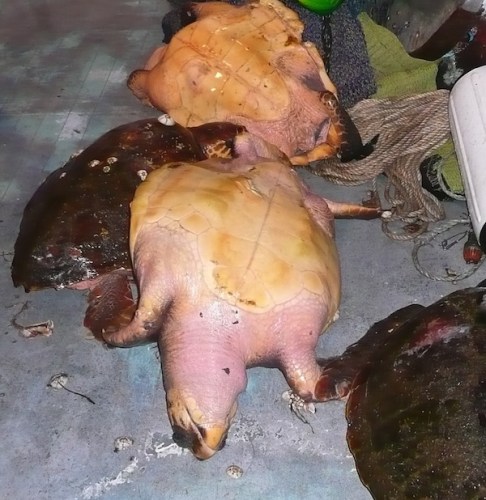
    The loggerheads stay in Baja for decades as they grow and mature, feeding primarily on red crabs. In the last few years the crabs have become a huge fishery and thousands of gillnets are now stretched across Baja’s Pacific coastal waters; “walls of death” that are snaring and drowning  vast numbers of turtles.

    Mexican government officials last week reported that so far this year 705 loggerheads have stranded dead along a 30-mile shoreline in Baja California’s Gulf of Ulloa. Last year, scientists estimate over 2,000 loggerheads were killed there in gillnets.

 Last summer in the Gulf saw a 600% increase in turtle deaths. Needless to say, the enormous bycatch is jeopardizing the turtles’ survival.

    Dead sea turtles bycatch on-board a Baja gillnet vessel.

    Nets have been developed that can solve the bycatch problem but Mexico has shown an unwillingness to act to insure that the fishery utilizes these measures.

      Rather than embrace a solution, the Mexican government has chosen to appease the fishing industry by ignoring and misrepresenting the findings of its own scientists who have pointed to bycatch as the leading cause of the deaths.

      Conservation groups are proposing that the United States consider a ban on the import of fish and other wildlife products from Mexico under trade agreements that authorize sanctions against countries that allow excessive bycatch of U.S.-protected species, like loggerhead sea turtles.


      Shout out: Center for Biological Diversity.

Bovine Bodhisattva

Posted on August 23, 2013

Emily the cow was on her way to a slaughterhouse in the winter of 1995, when she decided she would rather be free. In a daring escape she leaped over a five-foot fence and disappeared into the woods.

Emily.

    The three-year-old, 1,600-pound Holstein heifer evaded capture for 40 days and 40 nights, foraging for food in the woods around the town and hobnobbing with a herd of deer. As she cleverly evaded capture, townspeople took up her cause, leaving her hay and shielding her from a return to the slaughterhouse.

    Inspired by Emily’s spirit, animal lovers Meg and Lewis Randa coaxed her into a trailer with a bucket of feed, bought her from the slaughterhouse and retired her to a life as a charismatic spokescow, espousing a meat-free diet for humans at The Life Experience School at The Peace Abbey in Sherborn, Massachusetts.

    Her huge eyes and friendly disposition inspired all who met her. People traveled to Sherborn and pledged in her presence to stop eating meat. She was the bovine-of-honor at several human weddings in the Abbey barn.

    Emily’s story was featured on national television and in countless newspaper and magazine articles—People magazine called her a “bovine pimpernel…sought everywhere but never captured.” She inspired a children’s book.

    Emily was buried in 2005. A statue inscribed as the “Sacred Cow Animal Rights Memorial,” was dedicated in her honor on Earth Day.

    The Peace Abbey is closed, but her statue can be seen from the public road.


    Peace Abbey
    Address:
    2 N. Main St., Sherborn, MA
    Directions:
    In town, just north of the only stop sign on Hwy 27. Watch for the Gandhi statue and Peace Abbey driveway.

If you are in the area, it’s worth a detour.

Lakshmi

Posted on August 22, 2013

In an eleven hour operation carried out in the dark of the night, a team of about 20 officers from the Forest Department, Police and Wildlife SOS/India, rescued an 18 year old ailing elephant named Lakshmi, from a property where she had been concealed by her owners in an attempt to evade law enforcement agencies.

Safe.

    The operation involved walking the elephant to a safe location 5 kms distant from where she had been held, to a point where she could be easily loaded onto a truck. Lakshmi was unable to get on the truck herself due to her health problems, so Wildlife SOS rented a hydraulic crane to lift her onto the truck bed.

    She was given a light sedative to keep her calm during the rescue.

    Her owners had used Lakshmi for street begging in violation of the law. They paid no attention to her health and she has become extremely obese and is suffering severe joint pains making her prone to acute arthritis and other ailments. Her companion, Bijlee, owned by the same people could not be rescued in time and died a month ago in pain, due to severe neglect.

    Lakshmi has been relocated to the Wildlife SOS Elephant Rescue Center in Mathura.


    Source: Wildlife SOS/India. Wildlife SOS is a registered Non Profit Charity in India, USA and UK.

America: Land of the Free, Home of the Arrogant

Posted on August 11, 2013

Tisha Wardlow's avatarFight for Rhinos

rhino with US flag

Saving the rhino in Africa, from China and Vietnam is a familiar scenario. But another disturbing piece of the equation lies within the US. American hunters have long been drawn to the thrill of “big game”, hunting down rhino, elephant and lion in Africa.

Recently the US Fish and Wildlife Services set a new precedent, giving permission to a hunter to bring back his rhino kill from Africa. This has not been allowed for 30 years. Opening the door to wealthy Americans to slaughter endangered species in the wild for trophies is a dangerous trend to start.

Of course it takes two to tango. Shame on the Namibian government for allowing the hunt, and shame on US Fish and Wildlife for encouraging  the hunter with incentive to keep the trophy.

According to Fish and Wildlife, “The Service cannot and will not allow the importation of sport-hunted trophies of species protected…

View original post 321 more words

Lolita

Posted on July 31, 2013

With release of the new documentary Blackfish it seems like a good time to revisit a piece posted here last fall depicting the inhuman practice of imprisoning orcas for exhibition.


Life as Lolita knew it ended 40 years ago.

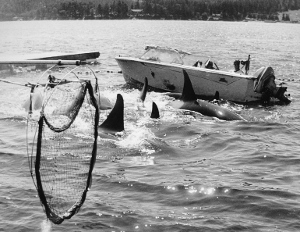
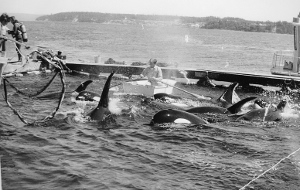
Penn Cove capture 1970

    In the waters off Washington State in the summer of 1970, hunters using speedboats and explosives herded more than 60 orcas from Puget Sound’s J, K and L pods into a three-acre net pen in Penn Cove off Whidbey Island. They lassoed adolescents ranging in age from 2 to 7 and separated them from their mothers. Local residents reported the air was thick with the sound of screaming whales thrashing in the tangled nets and fluke slaps which could be heard across the inlet. One mother orca drowned desperately trying to reach her infant through the twisted nets. Her body was later discovered by reporters.

Four youngsters also died in the assault. Their deaths were kept from the public. At night their bodies were weighted and hauled out to sea and sunk.

Seven of the surviving youngsters were hoisted onto boats, towed to a dock and put on flatbed trucks. The call went out to aquariums around the world proclaiming there were whales for sale in Puget Sound. It was the largest whale capture in history.

    Two of the orcas went to Japan, one each to Texas, Australia, The UK, and France, and one 6-year-old female from L pod, wound up at Miami Seaquarium in Florida, where she became Lolita, the Killer whale.

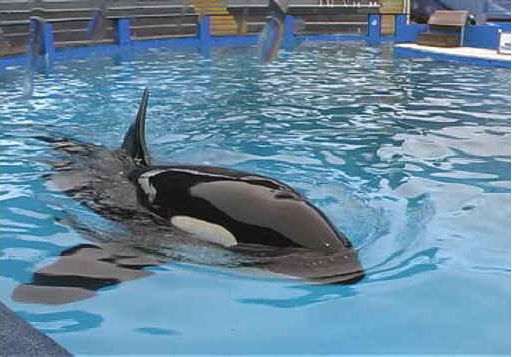
When not performing, Lolita is confined to a tank barely larger than she is. (Photo: Slaveforentertainment.com)

When Lolita is not performing she is left to swim in her tank by herself. The tank is not a reasonable habitat for a whale. She is 22 feet long and weighs about 8,000 pounds. From the front wall of her pool to the concrete barrier that spans the middle of the pool is only 35 feet. At its deepest the pool is just 20 feet. Orcas in the wild swim an average of 80 miles a day.

Killer whales are highly intelligent and social beings that have close bonds with pod members. Years ago another whale was briefly housed with her but died in the tank. Lolita has been without a companion since 1980.

Cetacean lovers for decades campaigned for her release, and often protested outside the Miami Seaquarium. In the 1990s, Washington Gov. Mike Lowry demanded that the marine park return the whale to Puget Sound.

In 2005, Puget Sound orcas were listed under the Endangered Species Act (ESA), but the National Marine Fisheries Service exempted orcas currently in captivity from the listing.

A lawsuit was filed in December, 2011, in U.S. District Court in Seattle seeking to force Lolita’s release under the Act.

Whale activists contend that keeping a highly social animal like an orca in a tank should be viewed as harassment, and the ESA makes it illegal to “harass, harm, pursue, shoot, wound, kill, trap, capture, or collect” an animal under its protection.


Lolita has been in her tank for 40 years. Surely it is time for her–and Tilikum and the 44 other orcas in captivity–to be retired.

A Line to be Drawn — Our Hypocrisy About Animals

Posted on July 30, 2013

An op ed today in the New York Times talks about America’s “inconsistent, hypocritical” attitude toward animal rights.

“We disagree about where to draw the line to protect animal rights, but almost everyone now agrees that there is a line to be drawn.”
— Nicholas Kristof


    “In many cases, we simply cannot know what consciousness is like for, say, an orca or a pig. We can hazard guesses from comparing their brains with ours – but, in my view, the captivity and use of any intelligent animal for entertainment will one day be seen as barbaric. It is a violation of the animals’ dignity. While that may not ascend quite to the level of human dignity, it demands that we cease treating our fellow inhabitants of earth as captive slaves. With the dominion humans have over the natural world comes great responsibility. And right now, we humans are behaving with criminal recklessness toward the planet that gave us life.
    –Andrew Sullivan

Former NIH Director Says Animal Research Doesn’t Work

Posted on July 28, 2013

Stacey's avatarOur Compass

SourceNIH Record
From New Vantage
Ex-Director Zerhouni Surveys Value of NIH Research
By Rich McManus

On the front page…
Former NIH director Dr. Elias Zerhouni gives remarks at June 4 SMRB meeting in Bldg. 1.

Nearly 5 years removed from his NIH directorship, Dr. Elias Zerhouni returned to campus June 4 to offer his views about how to value NIH research economically in an era of flat federal research budgets. His remarks at the end of a day-long meeting on that topic, conducted by the scientific review management board (SMRB), included vintage observations from the veteran of academia (Johns Hopkins), government (he was NIH director from 2002 to 2008) and industry (he is president of global research and development at French pharmaceutical firm Sanofi). For example, his comment that “it’s not very smart to go to the grocery store in an F-16 [fighter jet] when you can go on…

View original post 1,137 more words

Pepper

Posted on July 28, 2013

Pepper was in her forties when she passed away last year at Fauna Sanctuary in Canada. She is one of the many research chimps I’m writing about in my upcoming book SANCTUARY.

(Photo: Kletr via Shutterstock)

    Pepper spent 27 years in various laboratories. The last was the Laboratory for Experimental Medicine and Surgery in Primates in New York. Until it was disbanded in 1997, LEMSIP supplied scientists with primates and primate parts for transplantation and virus research. In its heyday the lab held over 300 chimps and hundreds of monkeys. For fourteen years at LEMSIP Pepper lived in a 5 x 7 x 5-foot cage suspended above the ground with a number tattooed on her chest.

    She was used in hepatitis studies and underwent 36 procedures to cut out pieces of her liver for examination. She was repeatedly infected with HIV as were hundreds of other chimps around the country until scientists finally admitted that chimpanzees are extremely poor models for AIDS research (they test positive for AIDS once infected but virtually never evidence symptoms).

    Pepper’s last years at Fauna were a final respite for all the years of confinement and torture. Hundreds of apes like her remain in laboratories around the country suffering the same brutal treatment. Simply for being born a chimpanzee.


    Colin Mcadam writes about Pepper here.

Owl vs Owl — You Choose

Posted on July 24, 2013

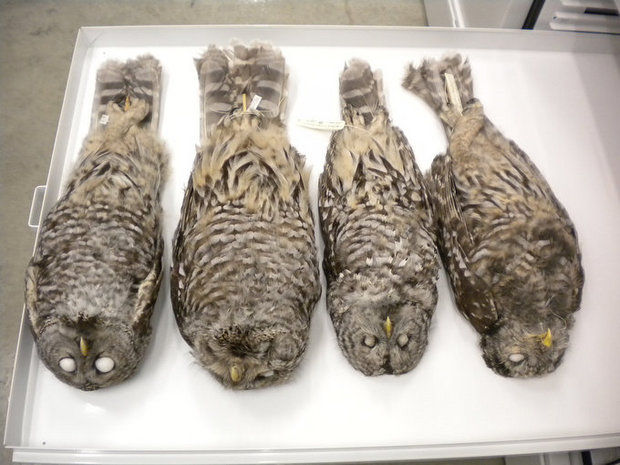
Over the next four years the U.S. Fish and Wildlife Service plans to kill 3,600 barred owls to save the spotted owl from extinction.

When researchers killed barred owls in a northern California management experiment, threatened spotted owls returned to nesting sites. (Photo: California Academy of Sciences)

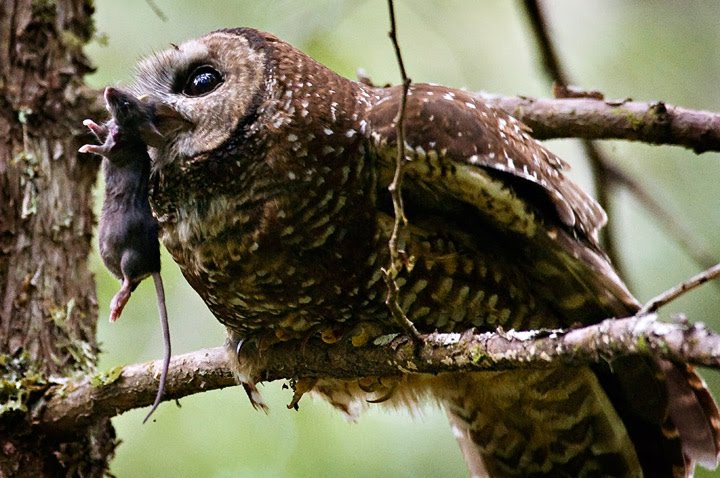
Larger and more aggressive than spotted owls, and able to adapt to denuded forest environments spotted owls can’t tolerate (thanks to the forest industry and its mantra of “sustained yield”), barred owls have taken over much of the spotted owl’s territory in Oregon, Washington and Northern California.

Northern Spotted Owl. (Photo: Robin Loznak)

An ethicist was hired to help guide the decision to do this. Hard to imagine a right answer.


Read the full story on Oregon Live.

Terrible Mouse

Posted on July 24, 2013

A recently compiled Who’s who of Bolivian mammals describes over a hundred species endemic to Bolivia, shedding light on the country’s vast wildlife diversity.

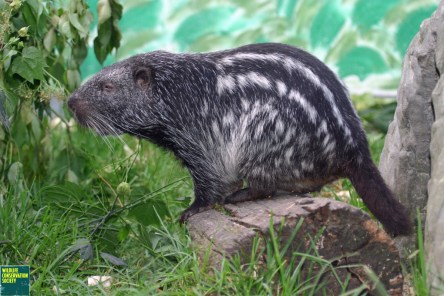
Count Branikii’s Terrible Mouse, also known as a pacarana. Weighing up to 30 pounds and looking like a cross between a Capybara and a skunk, this slow-moving nocturnal rodent is named after a Polish count who first described the species in the 1870s. (Photo: Rene Wuest-ZGAP)

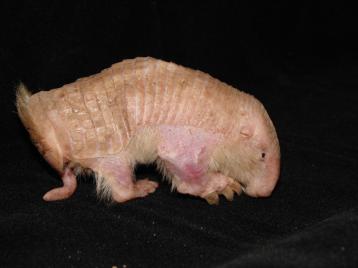
    The survey includes animals ranging from the pacarana to the Tolkein-like Chacoan fairy armadillo.
Armadillo:Bolivia

Chacoan fairy armadillo — A burrowing species that lives in very specific sandy habitats of the Chacoan tropical dry forests in the lowlands of southern Bolivia. (Photo: Luis Acosta)

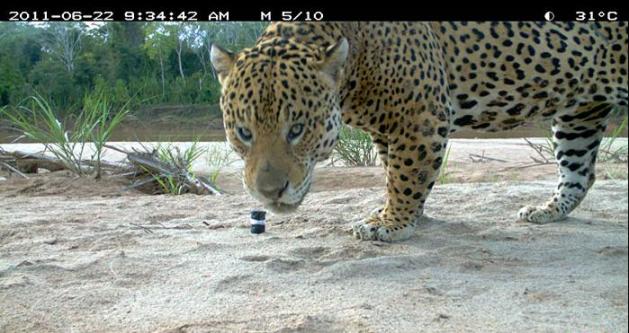
In between are a host of better known species such as the jaguar, bush dog, black spider monkey, vicuna, giant anteater, and the water opossum,

Jaguar/Bolivia. Camera trap photo.

Bolivia is teeming with wildlife. Madidi National park in the northwestern part of the country may be the most biologically diverse place on earth.

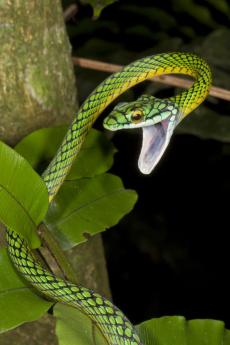
Parrot snake, one of at least 50 species of snake in Madidi National Park. (Photo: Mileniusz Spanowicz/WCS)

    Ranging from lowland tropical forests of the Amazon to snow-capped peaks of the High Andes, the 7,335 square mile (19,000 square-kilometer) park contains 11 percent of the world’s birds, more than 200 species of mammals, almost 300 types of fish, and 12,000 plant varieties.

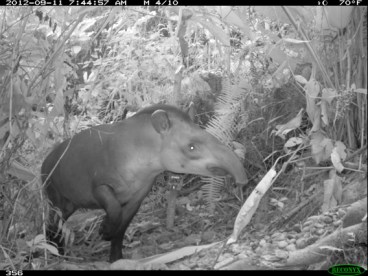
Camera trap image of tapir in Madidi-Tambopata Landscape. (Photo: Wildlife Conservation Society)

Bordering Peru, Madidi is estimated to hold a population of at least 14,500 lowland tapirs making it one of the most important strongholds for the species on the continent. But as elsewhere, species are winking out.

Maned wolf.

    The ancient Beni savanna is home to the Maned wolf. Demand for farmland and pressure to convert the ancient savanna into cattle pasture and soy fields has been disastrous for the species which is fighting for survival. Less than 1000 remain in the wild.

The Barba Azul Nature Reserve is home to the critically endangered Blue-throated Macaw. The bird is almost impossible to see given there are only 300 of them in an area almost twice the size of Texas.

Blue throated Macaw/Bolivia. (Photo: Paul B. Jones)

The bird was thought lost until the discovery a few years ago of a large roosting site.


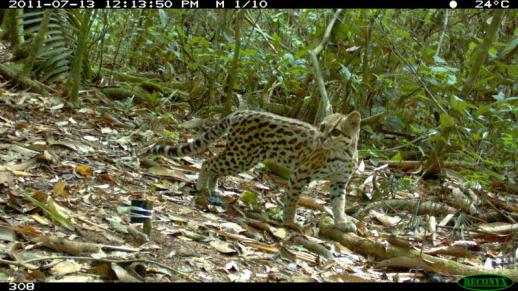
Compiling the database helped biologists in Bolivia identify where there is a lack of information about specific species and geographic areas where few records exist. For example, a small spotted cat called the oncilla is expected to occur across at least 50 percent of the country but there have only been 19 confirmed records to date.

Oncilla/Bolivia. Camera trap photo.


Shout Out: Science Daily.

Dear Lord Burns,

Posted on July 11, 2013

A British MP weighs in on the issue of fox hunting.

Fleeing fox in Britain. (Photo: Vibe Images/Alamy/Alamy)

Dear Lord Burns

I refer to my e-mail to you in February. I have delayed writing to you, firstly in order to obtain a copy of my constituent, Richard Matson’s paper described as The hypothetical consequences of closing down a large pack of foxhounds and secondly, because I wished to see the arguments emerging from those who wish to abolish hunting.

I have always lived in the country and have hunted since I was young. I now represent North Shropshire, which is a rural seat with several flourishing packs of hounds: Sir Watkin William Wynn’s , North Shropshire, the Cheshire and the North Staffordshire foxhounds, the Royal Rock beagles and the Border Counties minkhounds. You have received many submissions, including that from the Countryside Alliance, which I support. I will therefore make my comments general and brief.

Fox Welfare

I own a wood of approximately 20 acres. It contains three large earths. Because I hunt, shooting of foxes is forbidden and there is a flourishing and healthy fox population. They are protected for 360 days per years. On two days in the autumn and three days in the winter, they are at risk when the Wynnstay hounds visit. Only the old, sick and weak are generally caught. Hunting is strictly seasonal, so vixens can bring up their cubs in total safety in the spring. In contrast, opponents of hunting propose shooting 365 days a year. The IFAW submission to you, p10, para.2., states night shooting is becoming ever more popular with gamekeepers and is humane. In fact it is indiscriminate; healthy adult foxes and nursing vixens will be just as likely to be shot as older foxes. In all my years of hunting, I have seen numerous foxes which have been wounded by inaccurate shooting. Most farmers own guns; they are not expert shots and shot is not powerful enough to kill a fox. The abolition of hunting would leave many foxes to die long, lingering deaths and I have no doubt that this is significantly more cruel than death by hunting. Farmers in my constituency are adamant that if hunting were stopped, they would eliminate foxes by shooting or snareing.

Animal welfare groups talk about marksmen; however, given the current law and order debate, it is highly unlikely that any Government would wish to see a proliferation of rifles in the countryside. Although I have lived in the country all my life, I have never met a “marksman” and I fear such a proliferation, because most farmers are not highly skilled rifle shots.

If hunting is banned, foxes will have to be culled and every alternative is significantly crueller. The tragedy is that it would lead to the disappearance of the fox in many parts of the country.

Agriculture

Bordering my constituency are several foot packs, some of which kill as many as 250 foxes in a season. The only way to flush out foxes from a large block of forestry on a steep Welsh hillside is to send in a pack of hounds. If large numbers of foxes are allowed to breed unhindered, sheep farmers who come to Oswestry market would see their industry devastated. The IFAW states that hunting is very unpopular with many farmers. A few farmers do ban hounds from their land, but the vast majority welcome them because fox numbers are controlled and will even call on the hunt to deal with particularly troublesome foxes; surely it should be for the individual farmer to decide, not for national politicians.

Another hugely important function of the hunt is the disposal of fallen stock; I have read that 400,000-600,000 animals are taken in by hunt kennels. In the past year, the Wynnstay kennels has disposed of 2,400 calves and the North Shropshire kennels nearly 2,000 calves. The hunts provide a free and humane service and if they did not exist, an enormous state infrastructure would have to be established very rapidly to cope with a problem which could become an environmental and animal welfare disaster, if farmers have to kill and bury stock on their own land.

Horses

The IFAW submission states that very few horses are used solely for hunting. This is incorrect. I own horses which are too slow, too old and too inagile for other activities, such as cross country, showjumping or dressage. In order to get them fit for hunting, recreational riding is undertaken, but their prime purpose is for hunting. They are all by-products of the racing, point to point, cross country and showjumping industries, all having been bred originally for these purposes. It is vital to understand how hunting underpins the market for specialist horses. A good hunter costs £4000-5000; its value in the Belgian meat market would be about £300.

Draghunting would not be an alternative use for such horses as it requires particularly bold, fast jumpers and is not an activity for more elderly people or children. My farming constituents with land suitable for draghunting would not tolerate a large increase of draghunting and the majority of land in my constituency is not suitable for draghunting at all.

Jobs

The local saddler has told me he would close, with the loss of seven jobs. Local vets, blacksmiths, feed merchants and transport suppliers have all told me that they would significantly reduce their workforces.

Conservation

The hunts around here ensure that coverts are well maintained with a mix of undergrowth and mature timber and that not only are hedges maintained, but new ones are laid.

Hunts play a significant part keeping open bridleways and ensuring bridges over brooks are maintained. It would be tragic if this good work were lost.

Social Cohesion

In thinly populated rural areas such as mine, the hunts provide a unique organisation, binding lonely country people together, Throughout the year, there are fundraising events, which re-inforce the community in the best sense of the word. People of every age and an extraordinary diversity of background are brought together by hunting. One of my sons is taken hunting on a quad bike and meets stockbrokers, mechanics, forklift drivers, vets, apprentices and farmers’ sons on level terms. The social dimension of hunting is hugely misunderstood, partly because of the uniform of those who ride horses. The only man I know who wears a top hat to hunt is a window cleaner. Large numbers of people go hunting on foot or bicycle; many of those who do so on a horse can only do so by making great financial sacrifices. These are some of my hardest working constituents and they see no good reason why their pleasure should be taken from them by those who are prejudiced against hunting without understanding it.

Minorities

I acknowledge that a majority of those polled in the country have stated that they are opposed to hunting. I also acknowledge that a majority supports the return of capital punishment, which I oppose. I do not understand how a pluralist democracy can function effectively if substantial minority groups have their traditional rights and freedoms taken from them. I suspect that the polls would be different if they asked such questions as would you like your law-abiding neighbour, who drives forklift trucks to be sent to jail and would you like to pay a significant increase in tax to bear the cost of law enforcement of a ban?

Civil Unrest

The recent debate on policing rural areas has shown that it is inadequate. North Shropshire currently has the lowest ratio of police to population in Western Europe. I am convinced that the police simply do not have the resources to enforce a ban on hunting. In Welsh border areas, where feelings run extremely high, I have been told many times that people will resort to civil disobedience. I believe that a ban would be unenforceable.

No one needs to hunt, but nor does anyone need to eat meat. Protein is available without putting a beast through the trauma of an abattoir. Neither activity does any human being any harm at all. I believe that it is a fundamental freedom to pursue activities, so long as no harm comes through them to other human beings. Hunting is one of those rights.

Thandi: Plastic Surgery after Poaching

Posted on July 6, 2013

Tisha Wardlow's avatarFight for Rhinos

Thandi’s story started in March of 2012, when she was brought to our attention after the brutal poaching attempt on her life, along with her companion Themba.  (see previous post http://fightforrhinos.wordpress.com/2013/01/09/thandis-story/)

Thandi recovered.

After a long and painful recovery, Thandi survived. But her medical crisis is still not over. Unfortunately all of her skin which healed over her horrible scar, has been torn open after a normal interaction with another rhino.

The following is a message from Dr. William Fowlds who continues to care for Thandi:

Day 480 since the poaching of Thandi, Themba and Bull #84.

“Today we converge yet again on Kariega Game Reserve in support of the rehabilitation of Thandi the survivor of rhino poaching. Following the successes of various phases of her recovery, a recent set-back occurred when her face was damaged by a bull introduced to replace the breeding capacity lost by the poaching incident over a…

View original post 468 more words

Border Cats

Posted on July 3, 2013

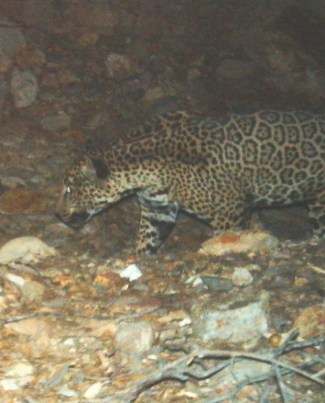
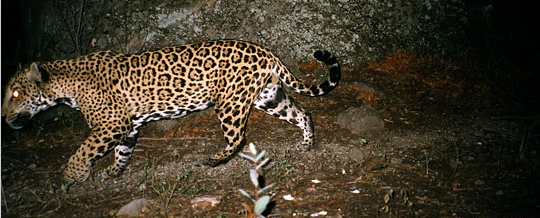
Recently released trail cam photos are evidence that a jaguar has been roaming the eastern flank of the Santa Rita Mountains in southern Arizona for at least nine months.

A jaguar prowls the mountains at night on the eastern flank of the Santa Ritas Mountains, southeast of Tucson. (Photo: USF&W)

    Since October, remote cameras have photographed the cat on seven occasions in five different locations. Three of the photos were taken close to the site of the proposed Rosemont copper mine in the Sky Island wilderness, raising the stakes as to whether the mine will be granted a permit.

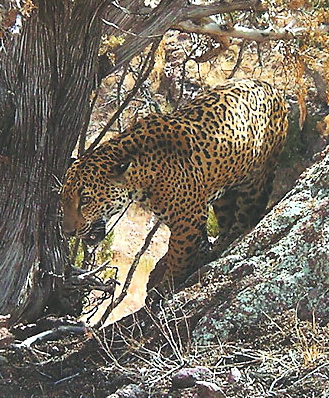
      This is the only jaguar currently known to be extant in the United States. But the cats are no strangers to the area. In February, 2006, in the Animas Mountains, animal guide Warner Glenn photographed a jaguar that his dogs had chased into a big cedar tree. “He did not run,” Glenn said. “He was not afraid of anything.” Later he estimated that the jaguar, by the look of his teeth, was eight or nine years old and weighed nearly 200 pounds. Glenn named the cat Border King.

    Border King in the Animas Mountains, March 7, 1996. (Photo: Warner Glenn)

    Despite photo evidence proving the presence of jaguars in the area, the USF&W dragged its feet developing a recovery plan for the cat as required under the EPA. Indeed, if jaguars were found it would open up the possibility that federal land would have to be put aside as “critical” jaguar habitat, something people in the livestock industry who range their cattle for next to nothing on federal land are dead set against.

    In 1997, the Arizona Fish and Game Department (AFG), with a wink and a nod to the local cattle industry, created the Jaguar Conservation Team (JCT), to “identify” and “protect” jaguar habitat,” believing that no cats would be found, thereby forestalling any usurpation of grazing land.

    Before long, remote cameras identified a cat which the JCT team dubbed Macho B. In an attempt to appear it was actually doing something meaningful, the team made plans to capture it and affix a radio-collar. Conservationists warned of the potential risks and questioned the purpose of such a plan and how it fit into protecting the big cat’s future. Non-intrusive methods of research were available, but the Jaguar team swept both objections and suggestions aside. They were dead set on capturing a jaguar. Yet, as an endangered species, to make capturing a jaguar legal, USF&W first had to issue a permit authorizing such a “take.”

    Macho B. (Photo: AZ Dept Fish and Game)

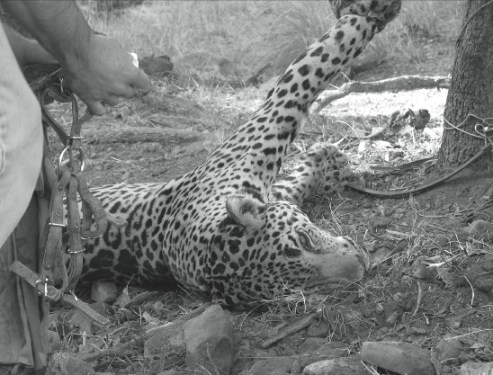
    On February 18, 2009, AFG biologists found Macho B captured in a wire snare. The snare had been set by biologist Emil McCain, who was working as a subcontractor for the department capturing mountain lions and bears for radio-collaring. Ostensibly, snaring a jaguar was a happy accident. The biologists tranquilized, radio-collared and released the cat.

    Twelve days later, after he did not move as far or as frequently as expected following his capture and after he was observed ailing, Macho B was re-captured, diagnosed as terminally ill from kidney failure, and euthanized.

    Macho B snared, Feb. 18, 2009. (Photo: AZ Dept Fish and Game)

    Arizona Fish and Game said the capture was accidental, occurring as part of a bear-lion study. The Center for Biological Diversity called for an independent medical investigation, which revealed that the jaguar’s death was at least in part due to agency mismanagement.

    Investigating Macho B’s death, the Interior Department’s inspector general concluded that AFG did not have a permit for the capture, and stated that skinning the jaguar to preserve the pelt, undertaken instead of a necropsy because a USF&W supervisor was unfamiliar with the word “necropsy,” resulted in loss of information and left doubt as to what had ailed Macho B.

    Although the entire corpse was not made available for a necropsy, some organs were preserved. A veterinary pathologist who examined the jaguar’s kidneys, but whose report was never released, told the Arizona Daily Star that the organs appeared healthy and that Macho B may have just suffered from dehydration.

    Santa-Rita mountains. (Photo: Tom Vezo/Save the Scenic Santa Ritas)

    In May, 2010, Emil McCain admitted in federal court that he deliberately and without a permit captured Macho B by baiting a snare set in a canyon that he knew Macho B traversed and pleaded guilty to a misdemeanor crime: illegal take of an endangered species. (McCain had convinced a female co-worker to plant the bait, and she was sentenced as well.) McCain said he knew there had been recent evidence a jaguar had appeared in the area of the snares as photographs of the cat had been taken near the capture site months earlier. He was sentenced to five years’ probation and fined $1,000.

    Twelve years after it was created, and with little else to show for its efforts, the Jaguar Conservation Team and its powerbroker the Arizona Fish and Game Department, had killed, for scientific purposes but absent the rigor of real science and outside the constraints of federal law, the last known wild jaguar in the United States.

    Now there is another.

    The photos of the new cat were released as USF&W and the Forest Service are wrapping up a draft biological opinion regarding the proposed Rosemont copper mine’s impacts on the jaguar and nine other federally protected species.

    The biological opinion is supposed to examine measures that can ease a project’s impacts on an endangered species. In an earlier biological assessment, the Forest Service wrote that the mine is “likely to adversely affect” the jaguar.

    Despite the cat’s presence the Arizona Fish and Game Department remains opposed to designating the area as jaguar critical habitat, citing lack of evidence of a breeding pair.

    The jaguar’s continued presence in the Santa Ritas and elsewhere in the “Sky Islands” mountain ranges of Southern Arizona shows that jaguars belong in this region and underscores the need to protect their critical habitat, said Sergio Avila, a large cat biologist for the environmentalist Sky Island Alliance.

    Oddly, or perhaps not, the Arizona Daily Star needed a Freedom of Information Act request to obtain the photos.

Urgent! Tragedy Strikes Rhino Orphanage

Posted on June 30, 2013

Tisha Wardlow's avatarFight for Rhinos

29 Saturday June- This just in from the Rhino Orphanage:

Rhino Mike butchered

A young rhino bought to act as a surrogate parent to orphaned babies has been shot and killed and his horn removed while a young female has been shot and wounded.
The five-year-old bull white rhino named Mike was killed at Legend Golf & Safari Resort in Limpopo while his fellow free-ranging surrogate parent Nana is being treated for gunshot wounds. Her condition is being assessed by specialists.
The resort is also home to The Rhino Orphanage, a centre which forms a vital part of the EWT Rhino Response Strategy, which was not breached or attacked.
Mike was donated by suppliers to health company Netcare to help raise orphans of the war being waged on South Africa’s rhino population.rhino with karen at orphan
The resort and The Rhino Orphanage were on a full security alert and now ADDITIONAL measures are being…

View original post 672 more words

Mysterious Die-offs in Florida Lagoon

Posted on June 30, 2013

EF! J Collective Everglades Office's avatarEarth First! Newswire

by Gayathri Vaidyanathan / Discovery News

At least 111 manatees, 300 pelicans, and 46 dolphins — emaciated to the point of skin and bones — were all found dead in America’s most biologically diverse estuary.

Something is seriously wrong. The northern stretches of the Indian River Lagoon of Florida has a mass murder mystery that biologists are racing to figure out. The lagoon contains more species than anywhere else in the U.S. It is a barrier island complex stretching across 40 percent of Florida’s coast, around Cape Canaveral, and consisting of the Mosquito Lagoon, the Banana River and the Indian River Lagoon.

View original post 458 more words