
-
In an adaptation from her new book, “How Animals Grieve” (University of Chicago Press), Barbara J. King, a professor of anthropology at the College of William and Mary, explains why grief may be an emotion many animals share.
Source: New York Post.
Source: New York Post.
The Marine Stewardship Council (MSC), which administers a well known eco-labeling process to inform consumers which fisheries are sustainable, is becoming increasingly industry-friendly.

Swordfish (Xiphias gladius) on deck during long-lining operations. (Photo: Derke Snodgrass, NOAA/NMFS/SEFSC/SFD)
A study just published by a group of researchers in the journal Biological Conservation found that several of the fisheries that received the MSC’s “sustainable” label — accounting for 35 percent of labeled seafood worldwide—do not meet the council’s standards.
Case in point: the sustainable label awarded to Canada’s longline swordfishery which has an extraordinarily high bycatch of other species. As the researchers noted, “for the 20,000 swordfish “sustainably” hooked in Canadian waters yearly, longliners also catch 100,000 sharks, 1,200 endangered loggerhead turtles, and 170 leatherback turtles.”
As the report’s lead author, Claire Christian, director of the Secretariat of the Antarctic and Southern Ocean Coalition, observed “When the MSC labels a swordfish fishery that catches more sharks than swordfish ‘sustainable,’ it’s time to re-evaluate its standards.”
The UK based Marine Stewardship Council was founded by the World Wildlife Fund, one of the world’s biggest environmental groups, and Unilever, one of the world’s biggest seafood processors.
Source: Blue Marble.
In the United States:
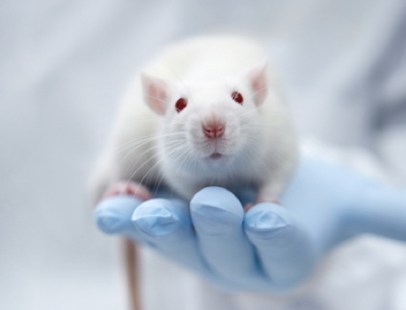
(Photo: Novartis AG)
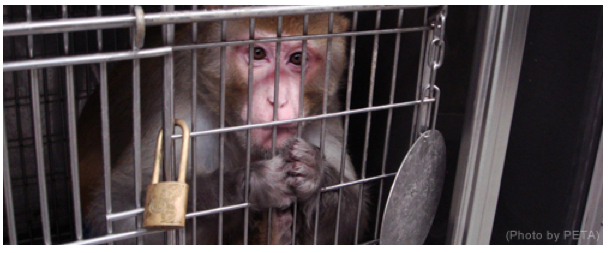
(Photo: PETA)
Starving sea lion pups are washing up on Southern California beaches from San Diego to Santa Barbara, in what the National Oceanic and Atmospheric Administration (NOAA) calls an “unusual mortality event.”
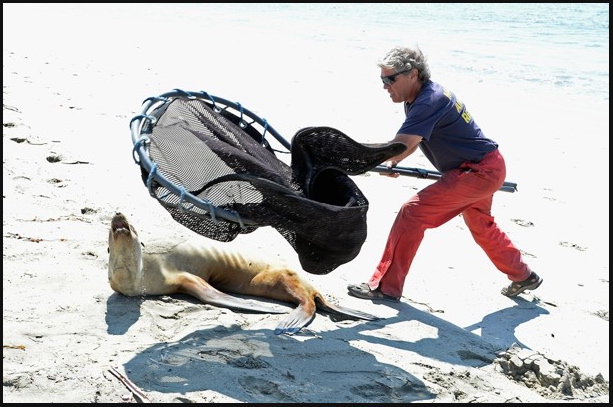
Starving sea lion is rescued by Peter Wallerstein, the Marine Animal Rescue director for Friends for Animals. (Photo: Kevork Djansezian/Getty Images).
Peter Wallerstein said he has picked up 300 sick and dying sea lion pups, after fielding calls from residents who spot them on the beach.
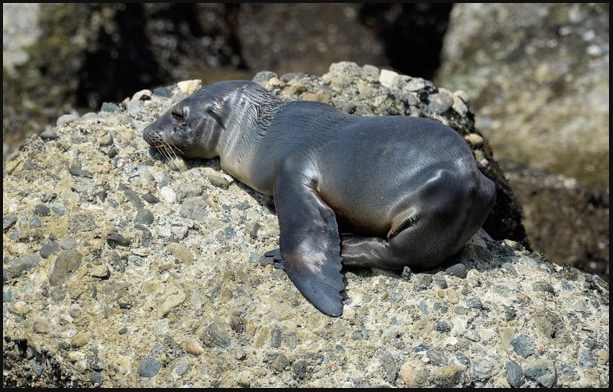
Stranded and malnourished sea lion pup sits on the rocks of White Point Park before being rescued. The pup was transported to Marine Mammal Care Center at Fort MacArthur for rehabilitation. (Photo: Kevork Djansezian / Getty Images)
NOAA estimates that in the first three months of 2013, more than 900 malnourished sea lions have been rescued, compared with 100 during the same time period last year.
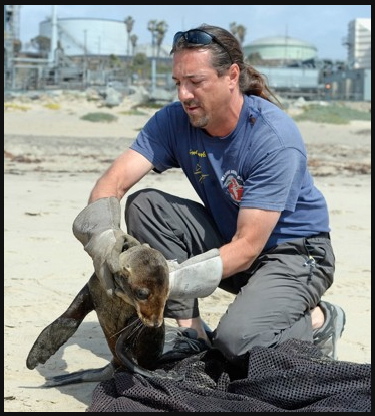
Mike Remski of Marine Animal Rescue checks for sign of injury after rescuing a malnourished sea lion pup on Dockweiler State Beach in Los Angeles. The pup was transported to Marine Mammal Care Center at Fort MacArthur for rehabilitation. (Photo: Kevork Djansezian / Getty Images)
The National Marine Fisheries Service says the likely cause is the loss of the smaller fish that make up the sea lions’ main diet. Why this food source has disappeared remains a mystery.
While some of the pups are taken to centers, overcrowding has forced rescuers to return some to the water.
Source: Washington Post.
Rapidly shrinking sea ice in the northern and southern hemispheres due to global warming has dire implications for a multitude of animals, including the Emperor penguins in East Antarctica.
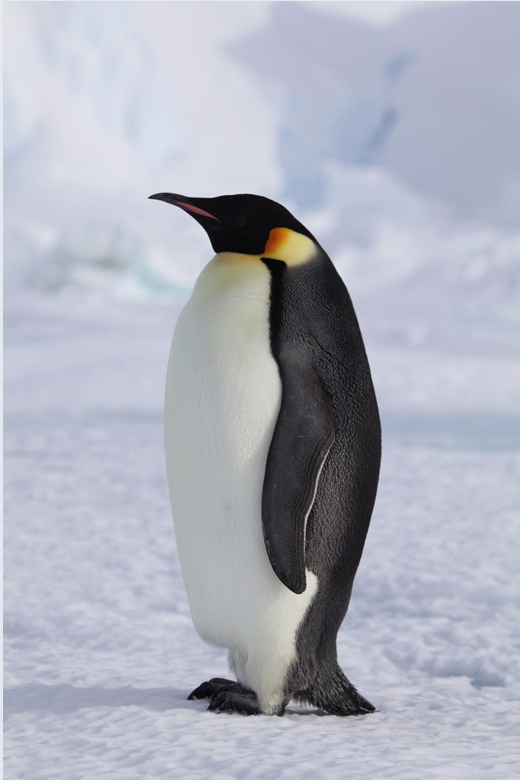
Emperor penguin. (Photo: Stephanie Jenouvrier, Woods Hole Oceanographic Institution)
Environmental changes have been wreaking havoc on penguin populations across the ice-sheathed continent in recent years. According to a report from the Woods Hole Oceanographic Institution (WHO), in 1948 and the 1970s, scientists studying the Dion Islets penguin colony, close to the West Antarctic Peninsula, recorded more than 150 breeding pairs. By 1999, the population was down to just 20 pairs. By 2009, it had vanished entirely. They believe the changes that killed the Dion Islets colony may be doing the same to the Emperors.
Unlike other sea birds, Emperor penguins breed and raise their young almost exclusively on sea ice (frozen seawater floating on the surface of the ocean). In normal circumstances, only 50 percent of Emperor chicks survive to the end of the breeding season, and only half of those fledglings survive until the next year. If the sea ice breaks up and disappears early in the breeding season, as has been happening the last several years, massive breeding failure may occur.

Biologist Stephanie Jenouvrier with an Emperor penguin chick/Antarctica (Photo: Stephanie Jenouvrier, Woods Hole Oceanographic Institution)

Emperor penguins/Terre Adelie, East Antarctica. (Photo: Stephanie Jenouvrier, Woods Hole Oceanographic Institution)
The disappearing ice may also affect the penguins’ food source; primarily fish, squid, and krill, a shrimplike animal, which in turn feeds on zooplankton and phytoplankton, tiny organisms that grow on the underside of the ice. If the ice goes, so too will the plankton.
Researchers have calculated that if greenhouse gas emissions continue to rise at projected levels, the loss of Antarctic sea ice will shrink penguin population numbers slowly until about 2040, after which they will decline at a much steeper rate with catastrophic consequences.
Meanwhile, the human world sits on its hands.
Source: Woods Hole Oceanographic Institute.
Who is smarter: a person or an ape? Well, it depends.

Illustration: Richard Lydekker 1849–1915.
A growing body of evidence shows that we have grossly underestimated both the scope and the scale of animal intelligence.
Can an octopus use tools? Do chimpanzees have a sense of fairness? Can birds guess what others know? Do rats feel empathy for their friends? We’re not so sure.
Experiments with animals have long been handicapped by our anthropocentric attitude: We often test them in ways that work fine with humans but not so well with other species.
The field of animal cognition has a long history of claims about the absence of capacities based on severely limited information….and the fact that humans put all life-forms in rank order, from low to high, with humans closest to the angels. Animals might be capable of learning, we argue, but surely not of thinking and feeling.
Frans de Waal’s complete thoughts on the matter are found here.
Shout out: 3quarksdaily
Shell Oil’s ongoing problems in the Arctic raise serious questions as to whether the company can safely operate in the frozen north, where an oil spill could irreparably damage fragile ecosystems.
The latest slipup occurred during the final days of 2012, when the drilling rig Kulluk broke free from towropes and, after a days-long struggle, on New Year’s Eve ran aground on the uninhabited Sitkalidak Island—an Important Bird Area where more than 100,000 birds overwinter and 180,000 nest in the summer. The rig remained intact and doesn’t appear to have spilled any of its around 140,000 gallons of diesel fuel or 12,000 gallons of drilling fluids. It was subsequently towed to a bay in Kodiak Island.
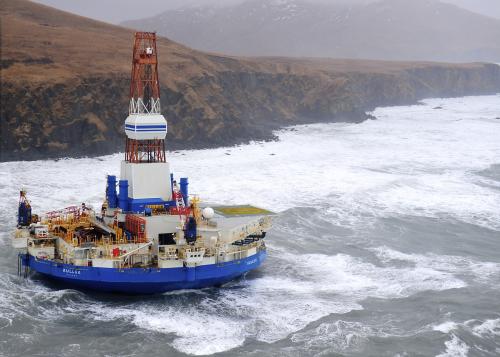
The Kulluk on New Year’s Day after it ran aground on an uninhabited Alaskan island. (Photo: Coast Guard Petty Officer 1st Class Sara Francis)
In July, Shell’s other drilling rig, the Noble Discoverer, became unmoored in Dutch Harbor in the Aleutian Islands and threatened to run aground. In September, in the Chukchi Sea, an advancing ice floe forced the rig to retreat to safer waters.
The company’s numerous Arctic blunders—including other instances of mismanagement—have spurred the government to launch an urgent review that could hinder—or halt—the company’s efforts to open up waters off of Alaska’s coast to oil exploration.
The Chuckchi and Beaufort seas and their shorelines support a wide array of wildlife, including walruses, seals, bowhead whales, polar bears, and enormous numbers of birds.
The company confirmed that it was moving the Kulluk during the last days of the year to avoid paying taxes in Alaska for the vessel in 2013.
Source: Audubon

This gray fox tested positive for three types of rat poison. It died within 24 hours of arriving at the Wildcare animal rehabilitation center. (Photo: Melanie Piazza/Wildcare)
Developed with a longer half-life to overcome the resistance mice and rats have built up to older poisons, the new compounds being pushed by pesticide manufacturers have been wreaking havoc on the rodents’ natural predators.
The California Department of Fish and Game (CFG) has confirmed 240 cases of non-targeted wildlife being exposed to the anticoagulants that work by causing animals to bleed to death.
Wildcare animal hospital in San Rafael, California has found that 74% of the predators that come through its doors test positive for rat poison.
This includes the San Joaquin kit fox, the coyote, red fox, gray fox, black bear, badger, fox squirrel, mountain lion, bobcat, golden eagle, great horned owl, barn owl and turkey vulture.
CFG recently urged the California Department of Pesticide Regulation to restrict the sale of the rodenticides mostly to professional pest-control operators, rather than making them available to urban and suburban homeowners.
The U.S. Environmental Protection Agency has been pushing to ban the sale of the super-rodenticides to consumers and to restrict how they’re stored and used.
In the American tradition, manufacturers are pushing back with lawyers and lobbyists.
Dateline, Los Angeles — A necropsy performed on a young female mountain lion by the California Animal Health and Food Safety Laboratory and UC Davis, detected exposure to two anticoagulant compounds commonly found in rodent poison.

Puma-25, about 1 year old, appeared in a photo taken by a remote camera in 2012 in the Santa Monica Mountains. (Photo: National Park Service)
Anticoagulants can cause uncontrolled bleeding and have been confirmed as the cause of death of two other mountain lions in the Santa Monica Mountains during the last decade. Mountain lions may ingest poisons when they eat animals that have consumed them.
Source: LA Times
Accompanying the recent news that “researchers” at the University of Wisconsin are continuing to conduct obscene animal experiments in the tradition of the demented Harry Harlow, evidence unearthered in a PETA lawsuit reveals that the school has still more secrets in its closet.
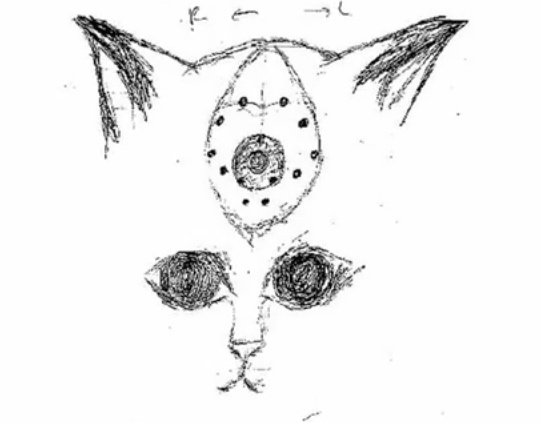
by screwing a steel post into her skull and implanting electrical devices deep inside both her ears. After being deprived of food for several days to coerce her into cooperating in exchange for a morsel of food, they bolted her head into place, restrained her in a nylon bag and forced her to listen to sounds coming from different directions.
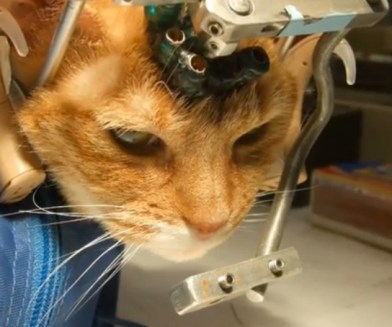
Double Trouble. (Photo: University of Wisconsin)
Records say that she was observed twitching, which the clinical notes indicate was a “neurological sign.” Her face became partially paralyzed and the head wound that experimenters created during surgery never healed.
One of the last entries in her records states that she “appear[ed] … depressed.” In the end, experimenters noted she was too ill to continue and that the device they had implanted did not work, so she was killed and decapitated so her brain could be dissected. A former UW-Madison veterinarian who oversaw the treatment of this cat and others recently issued a letter confirming this abuse, stating that many of the cats “suffered unnecessarily.”
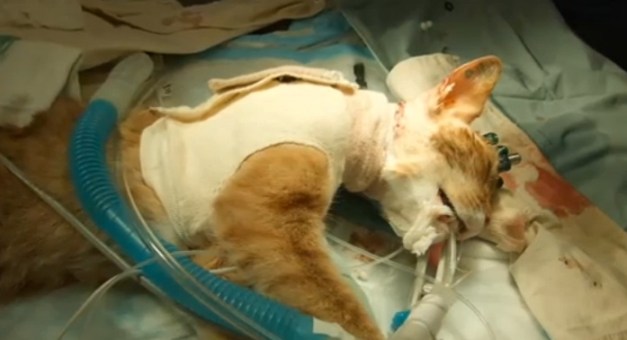
(Photo: University of Wisconsin)
For a more detailed—and gruesome—look at what happened, see this video.
Correspondence between UW experimenters and their collaborators conclude that the experiment was a failure because there was a problem with the cat’s surgery.
This experiment is part of a larger project that has received more than $3 million from the National Institutes of Health (NIH) with the stated purpose of understanding how the brain determines the location of a sound.
Source: PETA
are removed from their mothers immediately after birth and kept in total isolation. Deprived of their mothers’ protection and comfort, each infant is exposed to multiple frightening experiences, including a live kingsnake. When the infants are about one year old, they are killed and their brains dissected.

If this sounds like something out of the middle ages, you would be wrong. It is the latest in a long line of similar experiments being conducted at the University of Wisconsin.
Chair Department of Psychiatry at the University of Wisconsin School of Medicine and Public Health, has coauthored approximately 180 published scientific papers most of which have involved experimentation on animals. Go HERE for a short list of some of his studies.
As regards his newest “maternal deprivation” project, “Effects of early experience on the development of anxiety and its neural substrate,” Kalin says that he has gone as far as he can in his study of anxiety in “normal” monkeys. Now, he must study fearfulness in monkeys taken from their mothers almost at birth and compare it to the fearfulness of monkeys allowed to stay with their mothers for a few months.
Kalin will kill 40 male monkeys in his experiment when they are 61 to 70 weeks old. He will cut out parts of their brain and report on any differences he can identify.
Over the past 18 years, Dr. Kalin’s research using monkeys to study the neurobiology of fear has cost taxpayers many millions of dollars. In the past ten years alone, it has cost us $5,075,798. [National Institutes of Health. Grant R01MH046729. Development and Regulation of Emotion in Primates.]
Kalin’s experiment is all the more macabre because it follows in the horrific tradition of tests conducted years ago by the infamous Harry Harlow, a psychology professor–at the same school–who rose to prominence by physically damaging the brains of rhesus monkeys then testing their learning ability.

Harlow “discovered” that infants removed from their mothers quickly developed abnormal behaviors.
Harlow’s maternal deprivation tests consisted of taking baby monkeys from their mothers at birth and putting them in cages with surrogate mothers made of cloth and wire. He concluded what one would assume without any study at all—that social creatures can be destroyed by destroying their social ties.
Many psychologists continue to hold Harlow in esteem as a major figure in experimental psychology.
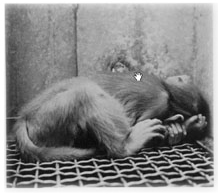
When challenged about the value of his work, Harlow stated: “The only thing I care about is whether a monkey will turn out a property I can publish. I don’t have any love for them. I never have. I don’t really like animals. I despise cats. I hate dogs.”

Well of Despair (top removed).
Harlow’s studies became increasingly pathologically disturbed. In the late 1960s he invented a device he called the Well of Despair, a stainless-steel trough with sides that sloped to a rounded bottom and a covered top, equipped with a food box and a water-bottle holder. Into the box he placed monkeys between the ages of three months and three years, who had bonded with their mothers for up to ten weeks, and left them alone. The aim of the research was to produce an animal model of clinical depression. Unsurprisingly it worked. The monkeys would spend the first day or two trying to climb up the slippery sides. After a few days, they gave up. They stopped moving about and spent most of their time huddled in the bottom. They were found to be psychotic when removed. Most did not recover.
Social isolation and maternal deprivation experiments at UW-Madison continued through the 70s and 80s. These types of experiments have not been used at the University for over twenty years. So one wonders: Did the ethical problems raised by Harlow’s experiments not register with the researchers there at all?
The University of Wisconsin’s Institutional Animal Care and Use Committee (IACUC) and ask them to cease these cruel and unethical experiments.
COMMENT posted by MAGGIE on January 30th, 2013:
I have aggregated all the vet and primate researchers emails into one place to make it easy to email them, and the first address is for the director of the school. This is sickening. You can copy and paste these into your own email program. sandgren@rarc.wisc.edu; kbrunner@primate.wisc.edu; capuano@primate.wisc.edu; jbacon@primate.wisc.edu; cclark@primate.wisc.edu; mharke@primate.wisc.edu; slarson@primate.wisc.edu; welter@rarc.wisc.edu; gaudio@rarc.wisc.edu; shvs@rarc.wisc.edu; newman@rarc.wisc.edu; riley@rarc.wisc.edu; schiffman@rarc.wisc.edu; sjohnson@rarc.wisc.edu; peter@rarc.wisc.edu; sawall@wisc.edu; duchesneau@rarc.wisc.edu; girard@rarc.wisc.edu; bogdanske@rarc.wisc.edu
Add your name to the pledge to withhold all donations to the University of Wisconsin until the institution bans the use of maternal deprivation once and for all.
Source: Animal Legal Defense Fund.
The federal civil trial against BP is scheduled to begin on February 25. A coalition of environmental groups have mounted a letter campaign to urge the government to fine British Petroleum the maximum amount possible for the Gulf Oil Spill. So far more than 100,000 people have sent letters.

Oiled sargassum in the Gulf of Mexico, 2010. [Photo: NOAA]
Under the RESTORE Act, the basis of the civil trial, BP faces from $5 billion to $21 billion in Clean Water Act penalties. 80% of those funds will help restore ecosystems, economies and communities affected by the 2010 oil spill.
The company and government may reach a settlement before the trial, but there’s no word on that yet.
The massive spill killed an untold number of wildlife. Some 7,000-23,000 birds died, and sea turtles, fish, and other marine life were also affected.
Scientists estimate as much as one-third of the oil from the spill may be on the sea floor, mixed with sediment, putting at risk the marine ecosystem and perhaps even causing potential harm to commercial fisheries in the future.
The explosion aboard the Deepwater Horizon drill rig occurred nearly three years ago, but the social, economic, and environmental repercussions will take far longer to understand and address.
SPEAK UP: To send a letter to the DOJ, click here.
Source: AUDUBON.
recently obtained the U.S. primate import statistics for 2012.
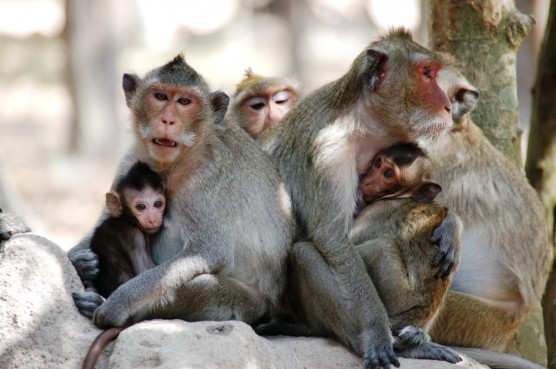
Long-tailed macaques like these are the most commonly imported primate into the U.S.


As a science project Lauren Rojas, a 13-year-old in Antioch, California, decided to send a Hello Kitty “catonaut” nearly 100,000 feet into space, with a high-altitude balloon, and to record the results
Tip off: James Fallows The Atlantic.

in Barataria Bay, LA, a site which received significant and prolonged oiling following the Deepwater Horizon oil spill, are showing signs of ill health. The dolphins were evaluated as part of a collaborative study involving NOAA and the Chicago Zoological Society (CZS).
Preliminary results based on comprehensive physicals of 32 dolphins found that Barataria Bay dolphins are underweight, anemic, and many have symptoms of liver and lung disease. Nearly half of the dolphins sampled had abnormally low levels of hormones that help with stress response, metabolism and immune function. Many of the dolphins were in such poor health that they likely will not survive.
one of the sampled dolphins, was found dead in January 2012.
NOAA, with CZS and local, state and federal partners, in cooperation with BP, initiated the Barataria Bay dolphin study in 2011 as part of the Natural Resource Damage Assessment (NRDA), the process for studying the effects of the Deepwater Horizon oil spill.
Source: Nick ‘N’ Notches newsletter, January 2013.
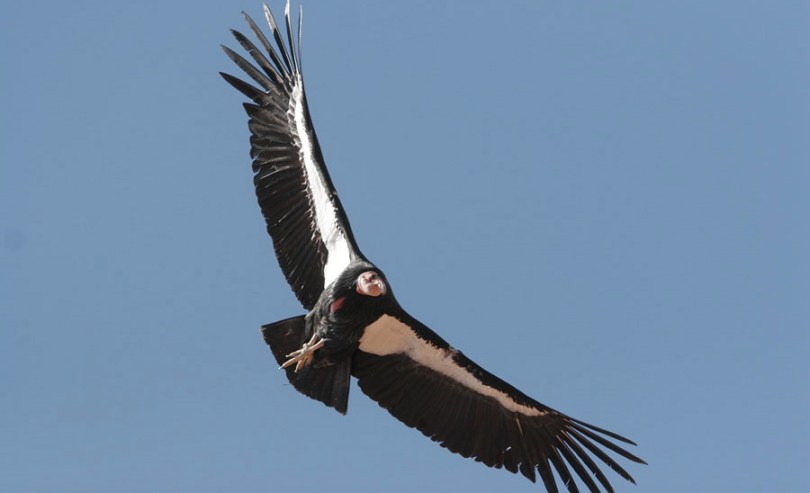
California condor. (Photo © The Peregrine Fund)
SALT LAKE CITY (AP) — A California condor found dead at Zion National Park this month is believed to have died from lead poisoning after foraging on a bullet-ridden game carcass. The female had been observed searching nesting cavities together with a mate which means her death takes out Utah’s only breeding pair of the endangered birds. Biologists were alerted to a problem when a motion device signaled the bird hadn’t moved for much of a day.

Photo taken Jan. 16, 2013. (Photo: Eddie Feltes/ AP/The Peregrine Fund)
By 1982 the world population of California condors had dwindled to 22. The last remaining individuals were captured in the 1980s and a captive breeding program was begun. In the last three decades, captive-bred birds have been released in California, Baja California, and northern Arizona. Condors are now breeding successfully in the wild. Pairs mate for life and produce only one egg every other year.
About half of the roughly 130 condors released since 1996 along the Arizona-Utah border have died or vanished. For birds that have been recovered, lead poisoning turned up as the main cause of death. Despite mounting scientific evidence about the dangers of lead to both wildlife and people, the National Rifle Association keeps pushing legislation to ban the federal government from addressing these preventable poisoning.
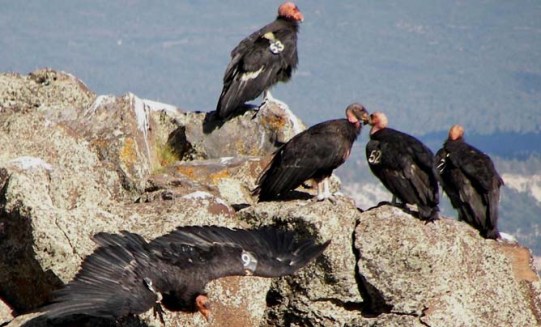
California condors. (Photo: National Park Service)
The California Department of Fish and Game in 2008 banned the use of lead ammunition in the 15 counties considered condor territory, but many ranch owners ignore the directive, and some have said it’s because they believe the ammo ban subjugates their rights.
The birds are known for flying 100 miles or more a day on wings that stretch up to 9 feet from tip to tip, surveying the land for any sign of commotion. Even wildfires alert the birds to a possible dinner, experts say.
The world population of condors inches up and down at around 400, approximately half of which are flying free in the wild.
Source:WildlifeExtra
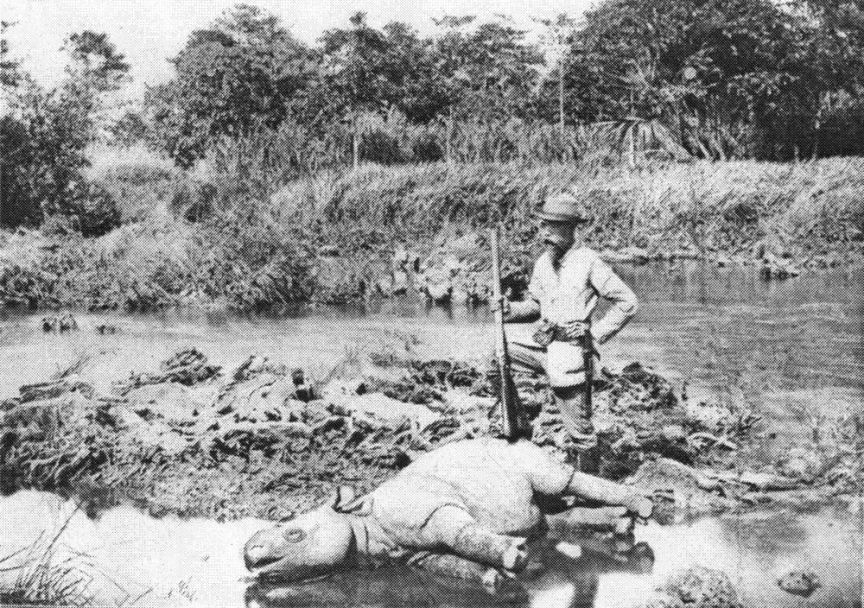
European hunter with a dead Javan Rhino in 1895.
Critically Endangered Javan Rhinoceros R. sondaicus was, until recently, found in only two populations. One, in Ujung Kulon National Park in western Java, Indonesia, is estimated to number fewer than 50 animals based on a 2008 census and comprised only the subspecies R. s. sondaicus.
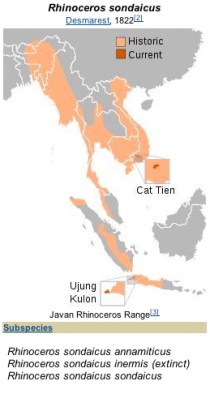
Javan rhino ranges.
Another population was only discovered by scientists in 1989 in a forest location in southern Viet Nam at a time when it was widely assumed that no rhinos could have survived the years of conflict in the country.
This area became proclaimed as Cat Tien National Park, and until relatively recently held the last estimated five to 12 animals of the only other surviving Asian continental mainland population of the Javan Rhinoceros subspecies R. s. annamiticus. Since then, this remnant population appeared to be in steady decline, based on the number of camera trap photos obtained in the area.
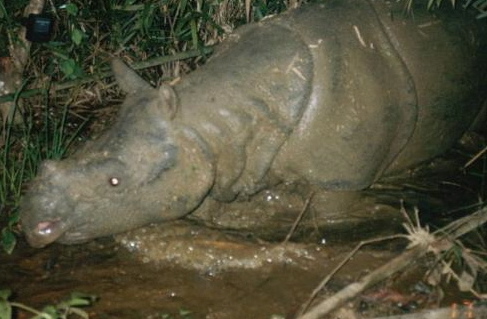
July 8, 2004, photo taken by a trap camera shows the last rhino in Vietnam in Cat Tien National Park in Lam Dong Province, southern Vietnam. (Photo: World Wildlife Fund)
A World Wildlife Fund project using sniffer dogs to find evidence of rhino presence led to the discovery in April 2010 of a rhino carcass with a gunshot wound in the leg. The horn had been removed from the carcass. Genetic tests found that the last 22 dung samples collected between 2009 and 2011 had all originated from this one animal. Hence, with the poaching of this last known rhino for its horn, as of October 2011, rhinos in Viet Nam are presumed to be extinct.
Park director Tran Van Thanh said that while some of his rangers failed to fulfill their duties, it is impossible for them to stop all of the estimated 100,000 people living near the park from hunting exotic animals when the average farmer there earns around 150,000 dong ($7.50) per day.
The Park has had no sightings, footprints or dung from live rhinos since the last known animal living there was found dead last April.
The small remaining population of Javan rhinos in Ujung Kulon National Park in Indonesia are the last known living members of the species, with none in captivity.
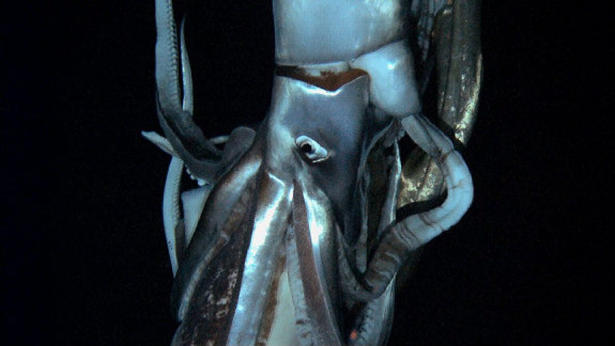
Frame from footage. (Photo: Japan National Science Museum)
Last summer, scientists with Japan’s National Science Museum, in a submersible equipped with near-infrared beams off the coast of Japan, captured the first footage ever of a giant squid in its natural habitat.
Using a smaller squid as bait, they first encountered the giant squid at 2,066 feet below sea level, then followed it down to 2,952 feet.
Giant squid have appeared in drawings depicting reports by seamen for thousands of years, but still little is known about them. To date, scientists have described several species of giant squid, all in the Architeuthis genus.
The squid, said to have razor-toothed suckers and eyes the size of dinner plates, was encountered in the black depths after more than 285 hours and 55 submarine dives, some as deep as 3,000 feet below the surface.
Tsunemi Kubodera of Japan’s National Science Museum said the creature would have been eight meters long but it was missing its two longest arms.
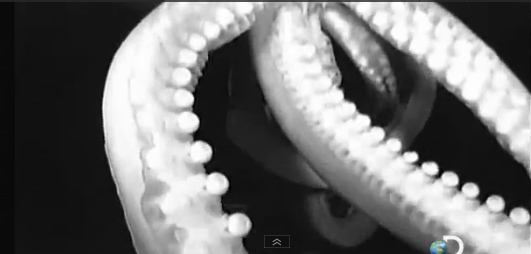
Frame from giant squid video.
of the encounter will air in Japan on January 13th on the country’s public broadcasting organization NHK. The Discovery Channel will air the footage in the U.S. on January 27th.
 First Light Productions