First Light Productions

investigative journalism

Posts from the “SCIENCE” Category

Big gulp

Posted on December 21, 2012

Whales all feed in much the same way. They swallow up water and filter it through fronds in their mouths called baleen. Most of the food they eat is tiny stuff, like krill and other small invertebrates. So some scientists have wondered how big whales manage to put enough tiny bits of food in their bodies to get to such huge sizes.

Fin whale lunge diagram, Nick Pyenson.

Fin whale lunge diagram, Nick Pyenson.

The very act of getting that food–diving deep, lunging open-mouthed, and then pushing a school-bus-sized volume of water forwards–requires a lot of energy.

Whales lunge into a cloud of krill and drop open their jaws. Pleats under the lower jaw open up, engulfing huge amounts of water. The whale slows down because of the drag. It behaves, in other words, a lot like a parachute. scientists have found: in one lunge, a fin whale can momentarily double its weight. As the water rushes in, the whales contract muscles in their lower jaw. The water slows down and then reverses direction, so that it’s moving with the whale. Once the water is moving forward inside the whale it can then close its mouth and give an extra squeeze to filter the water through its baleen.

A fin whale can get 20 pounds of krill in a single gulp, but it can gulp every 30 seconds. Because krill live in gigantic swarms, they can keep gulping and get enough food in four hours to fuel their bodies for an entire day


Source: discovermagazine.com

Why I love vultures

Posted on December 18, 2012

Nature’s garbage collectors

vultures

As natural garbage collectors, vultures are vital to our ecosystem — so why all the bad press? Why are so many in danger of extinction? Raptor biologist Munir Virani says we need to pay more attention to these unique and misunderstood creatures, to change our perception and save the vultures.

Video: Munir Virani talks vultures

Munir Virani is a raptor biologist and wildlife photographer, and Director of The Peregrine Fund  Africa Program, devoted to conserving birds of prey.

True wolf?

Posted on December 4, 2012

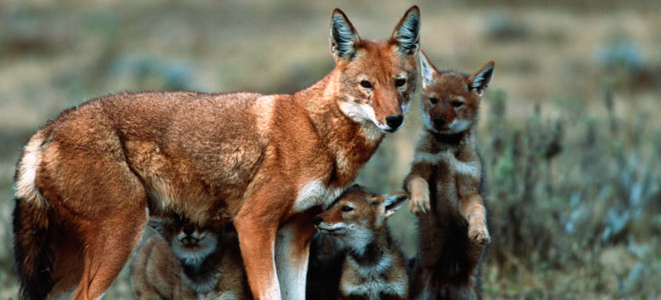
Ethiopian wolves. (Photo: International Wolf Center, M.Harvey)

Ethiopian wolves. (Photo: International Wolf Center, M.Harvey)

The Ethiopian Wolf (Canis simensis) is tied with the red wolf (see ANIMAL POST Canus Rufus 11/23/12) as the rarest member of the family Canidae, which includes the dogs, foxes, jackals and wolves.

Also known as the Simien fox or jackal, Ethiopian jackal, red jackal or fox, and Abyssinian Wolf, some 500 survive today in small populations, threatened by loss of highland habitats, disease and persecution.

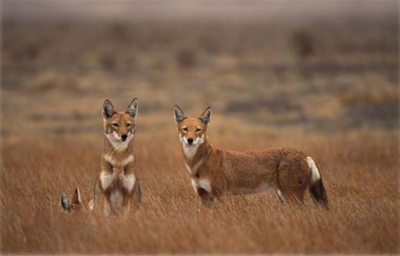
Ethiopian wolves. (Photo: ©A.L. Harrington)

Ethiopian wolves. (Photo: ©A.L. Harrington)

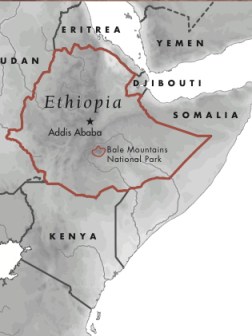
Range detail.

Range detail.

Unlike most canids, the Ethiopian wolf lives in open country, confined to seven isolated mountain ranges of the Ethiopian highlands above the tree line at about 3000 m (10,000′) where rodents are found in abundance.

The Bale Mountains in southeastern Ethiopia–often called “the roof of Africa”–where the largest population of the Ethiopian wolves live, contain the largest contiguous area above 3000 m on the African continent.

Digging for rodents.

Digging for rodents.

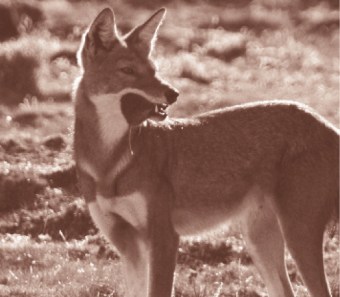
Ethiopian wolf with mole.

Ethiopian wolf with mole.

A large part of this wolf’s diet is made up of giant mole rats. Wolves look for underground homes conspicuously advertised with an opening on top. They pounce on the opening, press their ear to the ground, and dig and dig until they are rewarded with a 1.5-pound rodent.

These elegant, long-legged wolves resemble the North American coyote in both shape and size. They have a long muzzle, a distinctive reddish coat with a white throat, chest, and underparts, broad pointed ears, and a thick bushy black tail with a white base. They range in size from 43 to 55 inches (tip of nose to end of tail) and weigh from 24 to 42 pounds.

The only predators that pose a danger to them other than humans are spotted hyenas and tawny eagles that occasionally prey on unattended pups. Life span in the wild is about 8 to 10 years.

Conservation Status: IUCN Red List: Endangered–officially protected in Ethiopia.

Ain’t nature grand

Posted on November 21, 2012

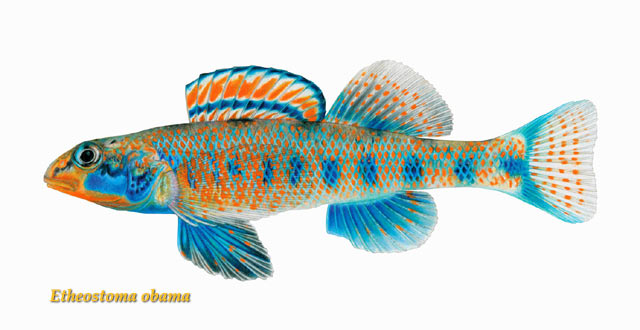
Biologists have discovered five new species of darters in freshwater river systems in the eastern United States and named them after four U.S. presidents and a vice president: Theodore Roosevelt, Jimmy Carter, Bill Clinton, Al Gore and Barack Obama.

Saving primates

Posted on November 18, 2012

In 1978, Shirley McGreal, founder of the International Primate Protection League (IPPL), learned that the U.S. Armed Forces radiobiology Research Institute was using rhesus macaque monkeys imported from India in neutron radiation experiments. She was aware that the U.S. had signed an agreement with India three years earlier stating that the monkeys were to be used only in medical research and vaccine production. What she stumbled across was anything but.

She published news of what she found in IPPL’s newsletter with a photo showing one of the hapless animals involved and a description of the experiment:

Monkey on radiation wheel at the Armed Forces Radiobiology Research Institute, 1979.

“The monkeys would be taught some “task” such as running on a tread(mill), then irradiated with a super lethal dose of radiation, and put back to work on the “task” and tested until death occurred some hours or days later. No therapy was attempted, since the dose was inevitably fatal. Observers would watch the dying monkeys, calculating the duration of “incapacitations.””

At the time India was exporting some 20,000 of the monkeys annually–nearly all to the U.S.–resulting in a big reduction in both geographic range and population numbers of the species

McGreal sent letters to the U.S. Department of Defense asking for more information. Receiving no response, she sent a press release to all the major newspapers in India drawing attention to the tests and explaining how the monkeys were being imported under false pretenses as the U.S. Public Health Service and other agencies had developed means of bypassing the treaty restrictions. Indian papers gave the radiation experiments prominent coverage. The Time of India ran an editorial headlined: “Appalling Cruelty.”

IPPL also appealed directly to India’s prime minister to “either to ban the export of the monkeys to the U.S. or insist on strict enforcement by the U.S. of India’s conditions of export.” The Prime Minister banned the export of monkeys to the United States.

Shirley McGrill at IPPL’s gibbon sanctuary.

The next year McGreal induced the government of Bangladesh to ban export of their monkeys for similar reasons.

India’s ban caused a huge disruption in ongoing research at U.S. biomedical laboratories, earning McGreal the eternal enmity of the National Institutes of Health. McGreal calls it one of her proudest achievements. “We have never played politics with primate lives,” she says. “And we never will.”


Source: International Primate Protection League.

Caught

Posted on November 15, 2012

Conservationists with the Zoological Society of London (ZSL) are setting camouflaged camera traps in Russia to capture images of park trespassers and poachers.

Camera trap catches intruders in Lazovsky Nature Reserve. (Photo: Zoological Society of London)

Thirty camera traps have been set in two Russian far east protected areas: Lazovsky Nature Reserve and Zov Tigra National Park, home to at most twenty Amur tigers.

Amur tigers, also known as Siberian tigers, are down to around 360 animals and listed as Endangered by the IUCN Red List. Poaching for traditional Chinese medicine remains the most pressing concern but the Amur is also imperiled by habitat loss, prey decline, low genetic diversity, and human-tiger conflict.

Poached Amur tiger. (Photo: ZSL)

    Scientists believe poachers may have killed as many as seven tigers in the last five years. In the last twelve months authorities have confiscated tiger parts in three different operations.

    In 2010 Russia hosted a tiger summit with all 13 tiger range countries. The meeting ended with an ambitious pledged to double the number of wild tigers in the world by 2022. Amur tigers represent around 10 percent of the total wild population. Already three tiger subspecies have vanished forever.


    Source: Mongabay

Carnivores in the city

Posted on November 8, 2012

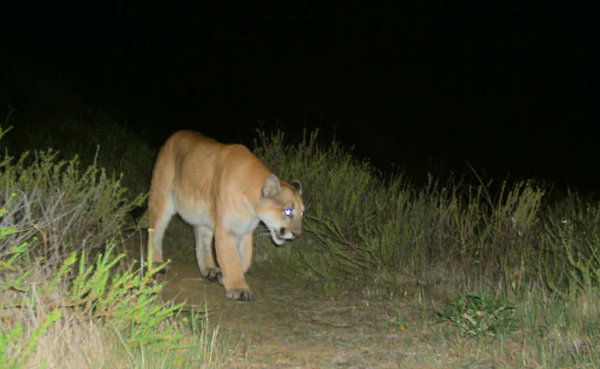
P-22, a mountain lion from the Santa Monica Mountains walked eastward across the 405 and 101 freeways and settled in Griffith Park, smack in the middle of downtown Los Angeles. During the journey, an odyssey of perhaps 20 miles, the cat had to cross concrete and backyards, dodge commuter traffic and thread an obstacle course of culverts, bridges and roads.

P-22, snapped by a remote camera Feb. 12, 2012, at 9:15 p.m. in the Griffith Park area of Los Angeles. (Photo: Griffith Park Wildlife Connectivity Study)

Mountain lions have recently been shot near the Wrigleyville neighborhood of Chicago and in Des Moines, Iowa.

No surprise, the most common mammalian carnivores to establish thriving communities in urban settings are coyotes. For at least the last six years, a coyote community has occupied a third of a square mile area about five miles from Chicago O’Hare International Airport.

Coyote in a downtown Chicago Quizno’s sandwich shop in 2007.

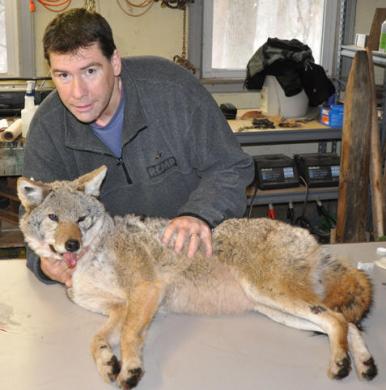
Researchers at Ohio State University, conducting a long running study of coyotes in greater Chicago, estimate the 9 million people in the metro area share their space with about 2,000 coyotes.

Stan Gehrt, a wildlife ecologist at Ohio State University, inspects a coyote captured in the greater Chicago area. (Photo: Stan Gehrt)

The researchers found that the urban coyote pup survival rate is five times higher than the rate for rural pups. In both environments, humans are the coyotes’ primary predator; cars being the No. 1 cause of death.

This coyote hopped a Max train leaving the Portland, Oregon airport in 2002. (Photo: Port of Portland)

Opportunity for food abounds in urban areas for coyote communities. Once they settle, resident coyotes don’t move much. Transient animals, typically youngsters that have recently left their parents’ pack, will try to find a vacancy in an existing territory or find a new area to start their own pack.

Night shift

Posted on October 10, 2012

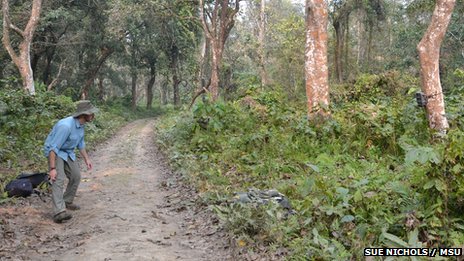
People and tigers in a Himalayan valley are walking the same paths, albeit at different times of the day.

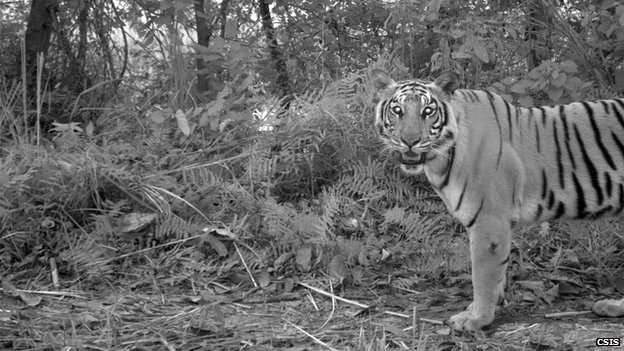
Tiger in Chitwan National Park, Nepal.

    A recent study using motion-detection camera traps provided thousands of photos as evidence that the approximately 121 tigers in Nepal’s Chitwan valley have made a pronounced shift towards nocturnal activity.

Study co-author Neil Carter spent two seasons setting motion-detecting camera traps for tigers. (Photo: Sue Nicols, Michigan State University)

    Since the start of the 20th Century, the world’s population of wild tigers has dropped by 97% from an estimated 100,000 to approximately 3,000 individuals. The world’s remaining tigers are being pushed into small spaces, and being able to share that space with humans is a critical survival skill.

    The tigers here appear to have found a middle ground that keeps their population viable.


    Source: BBC.

Bat tracking

Posted on October 4, 2012

Bat facts: One in five mammals is a bat. Bats are the only mammals that can fly.

Little brown bats hibernate in mines and caves and eat mosquitoes and other insects. (Photo: Laura Kruger)

In the fall, bats often migrate hundreds of miles to abandoned mines and caves where they hibernate through the winter. Deep in the caverns, they cuddle up in tight, furry clusters.

In an effort to determine the cause of White Nose Syndrome that has has killed nearly 7 million bats since it first appeared in the US in New York State, researchers are gathering information about bat-to-bat interactions and how far bats travel between seasonal habitats.

In a recent study scientists have used the hydrogen “fingerprints” from bats’ hair samples to locate three geographic areas in Michigan from which the bats migrate–some as far 351 miles from the mine in which they hibernate.

They were able to estimate with 95 percent certainty the summer origins of the tens of thousands of bats that hibernate in the three areas.

Bat-to-bat contact is believed to be the way white-nose syndrome is spread, so understanding the bats’ movements can help determine which hibernation sites are connected and how disease could potentially be transmitted among locations.


Source: from materials provided by Michigan Technological University, via sciencedaily.com.

Recreating the past

Posted on October 3, 2012

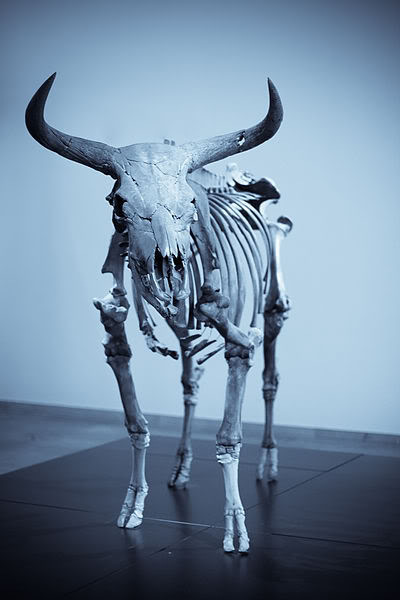
Aurochs were magnificent beasts. Standing well over six feet tall at the shoulder and weighing over a ton with huge sweeping horns, they once roamed the whole of Europe, large parts of Asia, and North Africa.

Auroch – Bos primigenius.

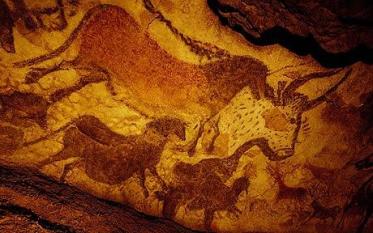
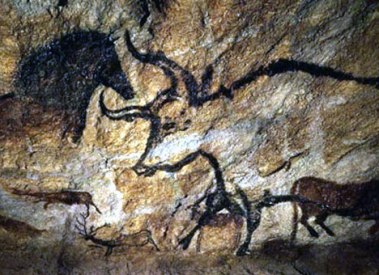
The aurochs date as far back as 2 million years ago. They appeared approximately 700,000 years ago in Spain. Ancient man drew their images on the walls of caves in France and Spain, as historical testament to their once prolific existence throughout Europe and Asia.

Aurochs depicted in ochre and charcoal on the cave walls at Lascaux in France. (Photo: ALAMY)

Lascaux around 17,000 years ago.

Around 30 BC Vergillius mentioned that ‘wild aurochs’ were captured in the north of Italy. They were one of the wild animals ancient Romans made big efforts to catch and transport to Rome and other cities to use in arena fights.

Caesar described them in The Gallic Wars as being “a little below the elephant in size” and a favorite hunting prey for wild Germanic tribesmen. In ancient times, killing an auroch was seen as a great demonstration of courage, with the horns turned into silver-clad drinking cups. Having figured prominently in Teutonic folklore, they remain as a heraldic symbol for several European states and cities.

The species was gone from the majority of its range by the 15th century and persisted only in the Jaktorowka Forest, Masovia, Poland. The last wild individual was reported to have died in 1627.

The Nazis ordered a pair of German zoologists to recreate the auroch as part of the Third Reich’s belief in racial superiority and eugenics.

Heck bull. A modern-day aurochs descendant in France. (Photo: Dominique Faget / AFP)

    The result, known as Heck cattle, may to some extent resemble the ancient aurochs, say experts, but they’re genetically quite different. Heck cattle, for example, are more aggressive than aurochs because they were bred, in part, using Spanish fighting bulls.

    Using genetic expertise and selective breeding of modern-day wild cattle, scientists today are attempting to bring the giant animals back to life in a form that more truly replicates the ancient auroch.

    Whether it’s possible to breed a true auroch is very much an open question. Genetic evidence suggests all “taurine” cattle (the docile cows and raging bulls common to Wild West films) descend from only about 80 females and came from a single region in what is now Iran about 10,500 years ago.

    The fact that all cattle seemingly descend from a single domestication event is unusual. For most other domesticated animals like horses or dogs, there’s good evidence to support multiple domestication events. But it’s known from analysis of ancient Iranian cattle bones that all cows throughout history likely only came from this one tiny auroch population.

    Little genetic variation meant the founding population didn’t have many different versions of the mitochondrial genes to start with, which are necessary to replicate a true descendent.

    The size and nasty disposition of the wild auroch would have made it a formidable beast to tame for the ancient Iranians and possibly the reason why domestication only occurred with a small number of animals. Scientists who have studied the auroch think that capturing and containing them would have been extremely difficult for hunter-gatherer societies, which represented the vast majority of human populations throughout Eurasia 10,000 years ago where goat was the preferred domestic species. The few sedentary, agricultural groups who had settled down into villages were the only ones even capable of domesticating such a beast.

    “The Aurochs” by Heinrich Harder (1858-1935), probably created in 1920.

    And what if scientists were able to come up with the real thing. Even the wild cattle we have today are very hard to handle. Aurochs were significantly larger than any cattle in existence. Brought to life today they would be potentially dangerous. There would be some serious management issues. To look after their teeth and feet, for instance, you might have to sedate them with dart guns. As one researcher put it, “You wouldn’t want to try to milk one.”

Cattle before vultures

Posted on September 30, 2012

Cambodian vultures (photo: : A. Michaud)

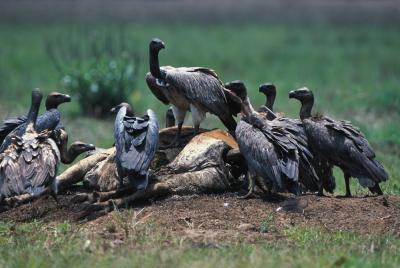
    In the face of what has become a precipitous slide toward extinction across the Asian continent, the vultures of Cambodia have persisted, giving conservationists hope that these important scavengers can come back from the brink.

    Results from vulture censuses from several sites in Cambodia, Lao PDR, and Vietnam over the past several years have been encouraging, with new nests recorded and even population increases.

    While Cambodia’s vulture populations remain healthy, the use of poison by hunters and fishers for capturing other species are leading to unintended vulture mortalities. A study from the Wildlife Conservation Society, the Royal Government of Cambodia and other groups, reported that seventy-four percent of the forty-two recorded mortalities during the study period were attributable to poison.

    An enormous problem is the veterinary drug diclofenac widely used as an anti-inflammatory drug for cattle in South Asia that is toxic to vultures, causing death through renal failure and visceral gout to birds that feed on the cattle carcasses.

    In 2004 the governments of India, Pakistan and Nepal were presented with irrefutable proof that diclofenac was killing vultures at a catastrophic rate. All three countries banned the manufacture of veterinary diclofenac in 2006.

    In spite of a long crusade by researchers to warn of the drug’s danger, veterinary diclofenac continues to be used widely after its ban.

    Continued widespread use of the drug has led to global population declines higher than 99 percent in some vulture species. The slender-billed vulture, white-rumped vulture, and red-headed vulture are all listed as “Critically Endangered” by the International Union for Conservation of Nature.


    Source: Wildlife Conservation Society via Science Daily.

Proverbial canary

Posted on September 27, 2012

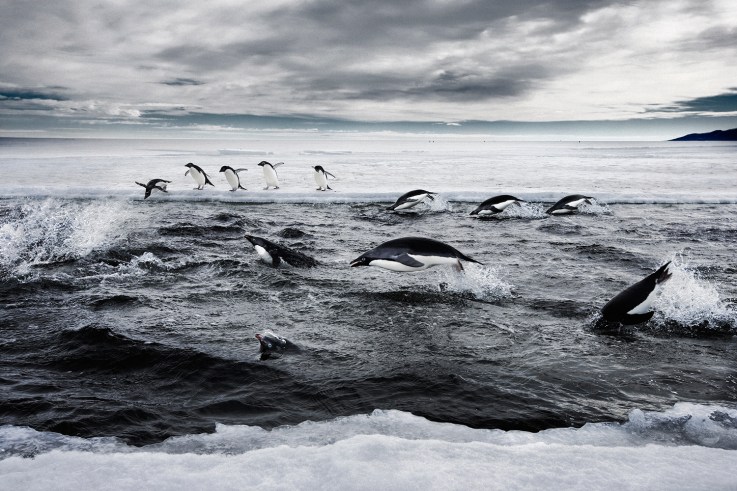
Dependent on delicately balanced marine food sources, penguins are in trouble.

Adelie penguins hunting for food. (Photo: J. Weller)

Overfishing is decimating their prey species. Climate change is shifting their resources and imperiling their habitat. Pollution is putting even healthy colonies at risk.

More than half of all the 18 penguin species are listed as Vulnerable or Endangered.

In a recent interview, Pablo Garcia Borboroglu, President of the Global Penguin Society, talks about penguin science and conservation.


Source: Mongabay.com

Human pathogens

Posted on September 19, 2012

Young, motherless chimps need close contact. (Photo: Emory University)

ABSTRACT: Reintroduction of sanctuary apes to natural habitat is considered an important tool for conservation; however, reintroduction has the potential to endanger resident wild apes through the introduction of human pathogens. We found a high prevalence of drug-resistant, human-associated lineages of Staphylococcus aureus in sanctuary chimpanzees (Pan troglodytes) from Zambia and Uganda. This pathogen is associated with skin and soft tissue diseases and severe invasive infections (i.e. pneumonia and septicemia). Colonization by this bacterium is difficult to clear due to frequent recolonization. In addition to its pathogenic potential, human-related S. aureus can serve as an indicator organism for the transmission of other potential pathogens like pneumococci or mycobacteria. Plans to reintroduce sanctuary apes should be reevaluated in light of the high risk of introducing human-adapted S. aureus into wild ape populations where treatment is impossible. Am. J. Primatol. 00:1-5, 2012.


Source: Science Daily.

Soundscape

Posted on September 19, 2012

An emeritus professor and an acoustic ecologist from the University of Wisconsin-Madison, have recreated a “soundscape” from observational notes made by Aldo Leopold 70 years ago.

Aldo Leopold at his Sauk County shack in about 1940. (Photo: University of Wisconsin Digital Archives)

Leopold, a professor at the University of Wisconsin, who died in 1948, was a key figure in the development of the modern environmental movement. His book, Sand Country Almanac, a collection of essays describing the land around his Sauk County, Wisconsin home, is a signature achievement in American literature.

Rising before daylight at his shack in Depression-era Wisconsin, Leopold routinely took notes on the dawn chorus of birds. But that chorus no longer exists.

Changes in the landscape and the bird community around the shack, including a nearby interstate highway, airplanes, chainsaws and the other constant and varied noises of the modern world have completely change the aural ambience of the area.

The soundscape is a compressed version of the chorus described by Leopold, taking 30 minutes of notes and compressing them into five minutes of recording. Bird songs and calls were obtained from the audio collection housed at the Cornell Lab of Ornithology’s Macaulay Library.

The background sound on which the bird songs is superimposed is all Wisconsin, but the archivists struggled to find a place where human noise was as it would have been in Leopold’s time.

In the lower 48 states, there is no place more than 35 kilometers from the nearest road, making it nearly impossible to tune out the hum of human activity, even in places designated as wilderness.

Leopold wrote several well known essays about the importance of how people associate sound with a particular landscape.


Listen: Leopold soundscape


Source: University of Wisconsin-Madison

Acoustic Smog

Posted on September 2, 2012

High levels of background noise, mainly due to ships, have critically reduced the ability of endangered North Atlantic right whales to communicate with each other.

North Atlantic right whale (photo: NOAA)

Large whales, such as right whales, rely on their ability to hear far more than their ability to see. Chronic noise is likely reducing their opportunities to gather and share vital information that helps them find food and mates, navigate, avoid predators and take care of their young.

Leila Hatch, a marine ecologist  for the National Oceanic and Atmospheric Administration, likened the whales’ situation to “A visually impaired person, who relies on hearing to move safely within their community, which is located near a noisy airport.”

North Atlantic right whales, which live along North America’s east coast from Nova Scotia to Florida, are one of the world’s rarest large animals and are on the brink of extinction. Recent estimates put their population at approximately 350 to 550 animals.

Noise from an individual ship can make it nearly impossible for a right whale to be heard by other whales.

Bioacoustic researchers studying the whales, liken the environment they inhabit off the coast of Boston as like living in a world full of acoustic smog.

Scientists worldwide are starting to quantify the implication of chronic, human-created ocean noise for marine animals. Watch for more on this here.


Source: materials provided by National Oceanic and Atmospheric Administration.

Lead

Posted on August 31, 2012

The condor once teetered on the brink of extinction. In 1982 the total population of the species totaled just 22 birds. A captive breeding program reintroduced condors into the wild at sites in California, Arizona, and Baja California, and the population grew to nearly 400 birds by the end of 2010. A new study, which focuses on condors in California, describes a population still on the verge of collapse, sustained only by ongoing human intervention.
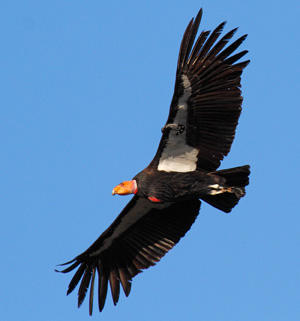
The California condor is the largest land bird in North America, with a wingspan of up to 9-1/2 feet. (Photo: Gavin Emmons)

Condors are opportunistic scavengers, feeding primarily on the carcasses of large mammals such as deer. They can ingest fragments of lead bullets from feeding on carcasses or gut piles of animals shot by hunters. Lead poisoning from ammunition was probably one of several factors that led to the near extinction of the species.

The new study shows that lead poisoning continues to prevent the species’ recovery.

California condors are tagged and monitored, trapped twice a year for blood tests, and when necessary treated for lead poisoning, and they still die from lead poisoning on a regular basis.

The researchers identify the source of the lead in a condor blood sample using a “fingerprinting” technique based on the isotope ratios found in different sources of lead. Condors raised in captivity that have not yet been released into the wild have low blood lead levels, with lead isotope ratios that fall within the range of background environmental lead in California. Most free-flying condors, however, have lead isotope ratios consistent with those found in ammunition.

The study shows that without a solution to the problem of lead poisoning, the condor population can only be sustained through intensive and costly management efforts. Since 1997, about half of all free-flying condors in California have required treatment to remove lead from their blood and supportive care until they are healthy enough to return to the wild. Each year about one in five of the birds need treatment. This usually involves capturing the birds and transporting them to a zoo where they can receive chelation therapy.

Condors are slow to reproduce–females lay one egg every other year. (Photo: Gavin Emmons)

The study found that the free-flying condor population appears to be roughly stable under current levels of intensive management. But without continued releases of captive-reared birds and interventions to treat lead-poisoning, researchers believe the condor population would again decline toward extinction, reducing the wild population in California within the next few decades, once again to just 22 birds.

The current cost of the condor program is estimated to be about $5 million per year, including the contributions of all the agencies and organizations involved in the effort. This level of management would have to continue in perpetuity to keep the population viable.

Efforts in California to address the problem of lead exposure have led to state regulations banning the use of lead ammunition in condor habitat. A partial ban went into effect in July 2008 and was later expanded. So far, however, researchers have found no evidence that the ban has resulted in a reduction in condors’ blood lead levels. The problem is that very small amounts lead have devastating consequences.

The researchers estimate that if just one half of one percent of carcasses have lead in them, the probability that each free-flying condor will be exposed is 85 to 98 percent, and one exposure event could kill a condor.

The findings suggest that greater regulation of lead-based ammunition may be necessary to protect the birds. Although alternatives to lead ammunition are available, regulations limiting the use of lead-based ammunition face stiff opposition from hunting organizations and gun-rights groups.

This research was supported by the National Park Service, Western National Park Association, and the U.S. Fish and Wildlife Service.

Source: University of California, Santa Cruz