First Light Productions

investigative journalism

Posts from the “WONDERS” Category

7 x 5

Posted on April 8, 2013

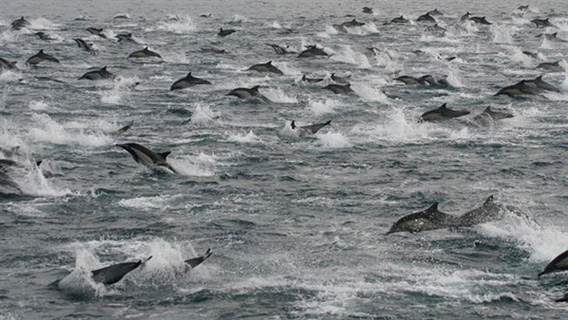
A giant pod of common dolphins (Delphinus delphis) was sighted by a tour boat off the coast of southern California in February.

Photo of the ‘super mega-pod’ by Antonio Ramirez, a passenger aboard the Hornblower Cruise that spotted the dolphins.

    The Captain, Joe Dutra, told NBC San Diego, “They were coming from all directions, you could see them from as far as the eye can see. I’ve seen a lot of stuff out here… but this is the biggest I’ve ever seen, ever.”

    Marine mammal expert Sarah Wilkin with NOAA’s National Marine Fisheries Service told NBC San Diego that the large pod could indicate there is an abundance of food in the area. “They’re attracted to kind of the same thing, they might wind up in the same place,” she said. “They’re definitely social animals, they stick together in small groups. But sometimes, the schools come together.”

    Captain Dutra said that the pod measured seven miles long and five miles wide.

CIRCUS DEATHS

Posted on April 3, 2013

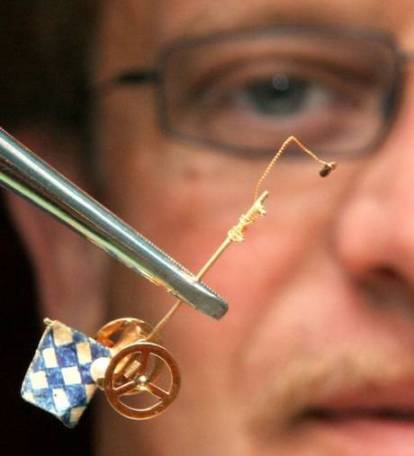
An entire troupe of 300 performing fleas have fallen victim to the freezing weather gripping Germany.

AN18567410FILE---In-this-Se


The acrobatic insects, which were due to appear at an open-air fair in the western town of Mechernich-Kommern, were found dead inside their transport box on Wednesday morning.

Flea circus director Robert Birk said it was the first time he had lost all his fleas in one go because of cold weather.

The circus scrambled to find and train a new batch of insects so it could fulfill its engagements at the fair.

Fleas are famous for their phenomenal strength which allows them to pull 160,000 times their own weight and jump to heights 100 times their size.

When contacted Mr Faber told the Independent the story was not an early April Fools joke.

Apparently the circus keeps its fleas outside.


Shout out: Strange Behaviors.

WILD

Posted on February 21, 2013

The Amazon as one imagines it as a child.

In just four weeks at a single colpa (or clay lick where mammals and birds gather) on the lower Las Piedras River, in Peru, Paul Rosolie and his team captured footage of 30 Amazonian species. The footage includes appearances by seven species that are imperiled. The short film was assembled from 2,000 clips.

Rosolie says the number of species captured at this colpa surprised even him. “Most people think of the rainforest and they picture animals everywhere, but in reality, even in healthy forest, you could walk all day and see nothing. Seeing such incredible abundance and diversity at a single location in the forest, in so short a time, is something we have never seen before.”

Endangered

The very spot Rosolie and his team filmed is under threat. The headwaters of the Las Piedras River are protected, but the lower Las Piedras River is being infiltrated by loggers, miners, and farmers following the construction of the Trans-Amazon highway.

If protected,

the lower Las Piedras River connected together with Manu National Park and Alto Purus National Park to Bahuaja-Sonene National Park and Madidi National Park in Bolivia, would constitute the single greatest contiguous area of biodiversity on Mother Earth.

Anyone interested in learning more about the Las Piedras River or supporting conservation efforts there can contact Paul Rosolie: Adventure@tamanduajungle.com

Read interview with Rosolie.


Source: mongabay.com

BLUE CREEK BIGFOOT

Posted on February 5, 2013

Anatomy of a Beast

John Green investigates footprints on Blue Creek Mountain above the Bluff Creek drainage, 1967. (Photo: John Green)

Only weeks

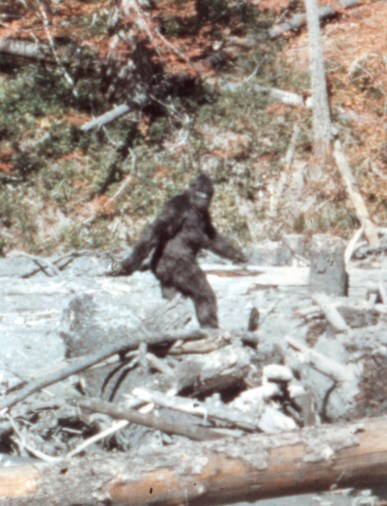
after Canadians John Green and Rene Dahinden investigated mysterious giant footprints on Blue Creek Mountain, Roger Patterson and Bob Gimlin emerged from the woods just a few miles away from that very spot with film footage of what they claimed was a Bigfoot. Speculation emerged it may have been the same animal.

Frame from Patterson/Gimlin film.

American Cetaceans

Posted on January 23, 2013

American Cetacean Society/Los Angeles Chapter

Gray whale swims near the Port of Long Beach, California. (Photo: Gina Ferazzi / LA Times)

Gray whale swims near the Port of Long Beach, California. (Photo: Gina Ferazzi / LA Times)

ACS/LA GRAY WHALE CENSUS AND BEHAVIOR PROJECT

As of 21 JAN 2013

Southbound Today —————- 5

Northbound Today —————- 0

Total Whales Today ————– 5

Southbound Calves Today ——— 0

Northbound Calves Today ——— 0

Season to Date (since 1 Dec 2012)


Southbound ——————– 465

Northbound ———————- 1

Total ————————- 466

Calves South ——————- 17

Calves North ——————– 0

Message from the observers: Although we had great visibility today, we did not see many gray whales compared to yesterday; this could be a local lull in the nearshore migration, or a lot of today’s gray whales may have chosen an offshore migration route (favored by many adult gray whales). Most of our five gray whales passed by us extremely close to shore. Whales in three of our four sightings fluked. One whale kept a very low profile. It would come up and only expose its blowhole region; when it reached the area right in front of us, it showed its back and flukes. We tracked at least ten FIN WHALES; one pair kept lunge-feeding, and other fin whale fluked. We also spotted multiple groups of PACIFIC WHITE-SIDED DOLPHIN (including a group of about twenty that came in just above the kelp, swam in circles, and had at least one calf with them), COMMON DOLPHIN, and BOTTLENOSE DOLPHIN….


This year, 460 southbound gray whales have been counted, compared with 455 last year. Last year and this year’s numbers are some of the largest southbound counts that the ACS/LA census project has seen in about 15 years.

Typically, as evidenced in the report above, gray whales travel by themselves. Sometimes in groups of three. On the 20th, whale watchers counted 23 — give or take a whale — in a single pod.

The group was the largest that volunteers with the American Cetacean Society/Los Angeles Chapter Gray Whale Census and Behavior Project have seen in 30 years.

Grays traveling.

Grays traveling.

Gray whale migration route.

Gray whale migration route.

Gray whales begin their southbound migration from Alaska in the late fall. Observers start seeing the whales generally around November. The southbound migration will likely peak in the next week.

The man behind Bigfoot

Posted on January 22, 2013

From Anatomy of a Beast

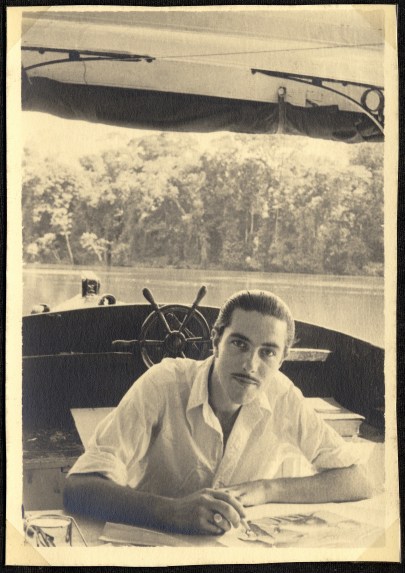
Ivan Sanderson made his mark in the 1930s as a best selling author of nature books, featuring exquisitely rendered drawings of exotic jungle animals he drew himself.

Ivan Sanderson, the Caribbean, 1937

During WW II, as an officer in the Royal Navy (Sanderson was a Scot), he sailed a schooner in the Caribbean with his wife Alma, in the guise of a naturalist (which he was) secretly on the lookout for German U-boats.

Ivan and Alma Sanderson, 1938

After the war he and Alma established residence in New York City where Ivan hosted the world’s first color television series “The World Is Yours.”

Ivan in TV studio, ca. 1949

He was for many years the Animal Man on the Garry Moore television show, a frequent guest on early national talk radio, and a prolific writer of magazine articles and books.

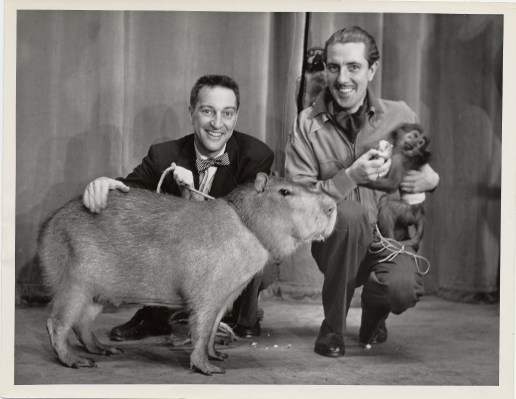
Ivan with Garry Moore and capaberra, ca. 1956

As the Animal Man, Ivan was required to produce exotic animals on a weekly basis. He originally sourced his animals from the Staten Island and Bronx zoos, but the constant need for new species to exhibit forced him to begin importing animals directly and he and his animal wrangler partner, Ed Schoenenberger, soon found themselves waist deep in what Schoenenberger called the “animal business.” They christened their new venture Animodels and quickly expanded beyond television appearances to include renting their creatures out for film shoots and exhibitions at sportsmen’s shows and other events.

Alma Sanderson, New York City, 1957

New York being the center of the action, Ivan always maintained an apartment in the Whitby, close to Times Square where the television studios were located. Being in the animal business meant that the apartment was used as a way station for the creatures he was exhibiting on TV. In essence, a mini-zoo in the middle of Manhattan with an ever-changing menagerie.

“Ivan met a lot of people,” Schoenenberger said. “And a lot of people he went to school with at Cambridge had become famous.” It wasn’t unusual to walk into Ivan’s apartment and meet someone like Edmund Hilary.”

In 1958, Ivan was preparing a car trip across the continent for research on a book about the natural history of North America when he learned that a giant Yeti-like creature that the newspapers had dubbed “Bigfoot,” had just been reported in California. He immediately altered his itinerary…


–Mike McLeod

Raju

Posted on January 21, 2013

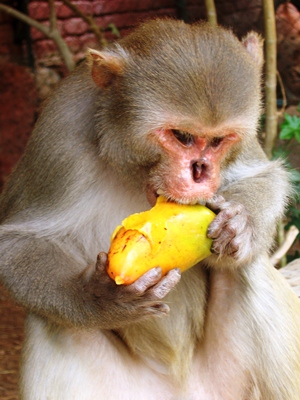
Raju lives in Udaipur, India in a sanctuary called Animal Aid. He is blind. Most likely electrocuted. Electrical burns from the chaotic electrical supply of Indian cities are, apparently, common among monkeys there. The incident left Raju with a badly scarred face.

The sanctuary staff

says Raju is about 10 years old and that he came to their facility when he was maybe six months of age. Initially he was housed with others. But when his last companion was successfully healed and released back to the wild, Raju was left alone.

Shirley McGreal,

founder of the International Primate Protection League, learned about Raju and wanted to improve his living conditions. Shirley lived in India for several years, and abhorred the way monkeys were often treated, tied up and forced to perform by the side of the road on the way to tourist sites like the Taj Mahal.

IPPL

provided funds to the sanctuary to double the size of Raju’s enclosure and put a divider down the middle, so that one side could be cleaned and safely re-stocked with enrichment while Raju inhabited the other half.

Erika Abrams 

Animal Aid’s co-founder, wrote to Shirley to say thanks: “I know for an outsider who doesn’t know the situation it would not perhaps be obvious what it means to double someone’s entire world as you are doing for Raju. Raju will know it. And you and your [supporters] are angels who are seeing the world through the eyes of a blind monkey.”

Rhesus monkeys are the world’s second-most-widely-distributed primate species (after humans), says Shirley. “They don’t always get a lot of respect in their native countries. Still, Raju’s tale reminds me of the classic story about returning one stranded starfish among thousands back to the sea.”

Architeuthis

Posted on January 10, 2013

Kraken

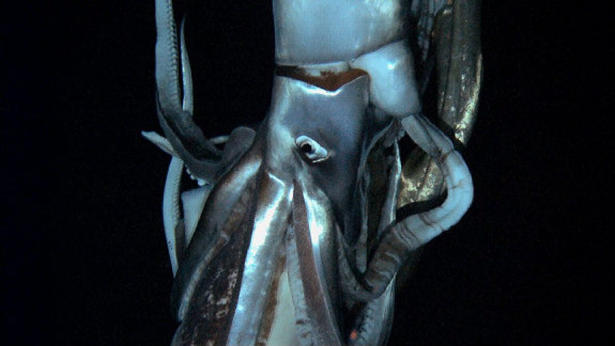
Frame from footage. (Photo: Japan National Science Museum)

Frame from footage. (Photo: Japan National Science Museum)

Last summer, scientists with Japan’s National Science Museum, in a submersible equipped with  near-infrared beams off the coast of Japan, captured the first footage ever of a giant squid in its natural habitat.

Using a smaller squid as bait, they first encountered the giant squid at 2,066 feet below sea level, then followed it down to 2,952 feet.

Giant squid have appeared in drawings depicting reports by seamen for  thousands of years, but still little is known about them. To date, scientists have described several species of giant squid, all in the Architeuthis genus.

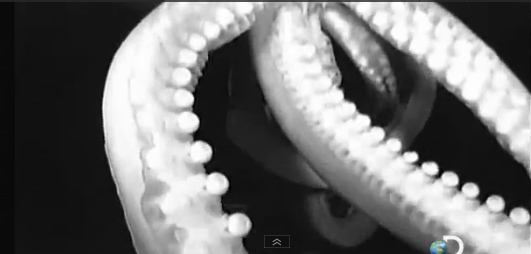
The squid, said to have razor-toothed suckers and eyes the size of dinner plates, was encountered in the black depths after more than 285 hours and 55 submarine dives, some as deep as 3,000 feet below the surface.

Tsunemi Kubodera of Japan’s National Science Museum said the creature would have been eight meters long but it was missing its two longest arms.

Frame from giant squid video.

Frame from giant squid video.

Footage

of the encounter will air in Japan on January 13th on the country’s public broadcasting organization NHK. The Discovery Channel will air the footage in the U.S. on January 27th.

Lucky

Posted on December 27, 2012

Neil Shea’s dispatch from Kunar Province in Afghanistan:

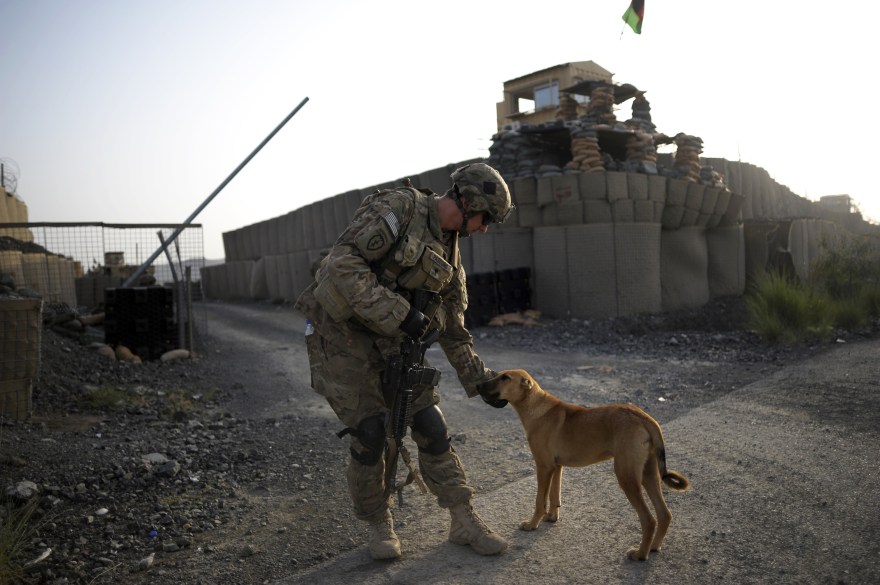
A member of the 1st Platoon Comanche Company of the US Army pets a dog at a checkpoint in the Combat Outpost Lakon in Buwri Tana District, Khost Province on August 9, 2012. (Photo: Jose CABEZAS/AFP/GettyImages)

A member of the 1st Platoon Comanche Company of the US Army pets a dog at a checkpoint in the Combat Outpost Lakon in Buwri Tana District, Khost Province on August 9, 2012. (Photo: Jose CABEZAS/AFP/GettyImages)

“Here comes Lucky,” a soldier says. “Means we won’t get shot at today. Yesterday she didn’t show, and we got fucked up.” Lucky is sweet and hopeful, she curls between the camouflaged legs of the soldiers and they speak to her but are not allowed to touch. Regulations. I’m not bound by them so I kneel and whistle and she bounds over and folds herself softly into me. Someone has fashioned a collar for her. From the collar hangs a single silver dog tag. It reads DO NOT KILL.

“First Sergeant shot the last dog,” someone explains. The army does not allow mascots.


Lifted from: Andrew Sullivan

Big gulp

Posted on December 21, 2012

Whales all feed in much the same way. They swallow up water and filter it through fronds in their mouths called baleen. Most of the food they eat is tiny stuff, like krill and other small invertebrates. So some scientists have wondered how big whales manage to put enough tiny bits of food in their bodies to get to such huge sizes.

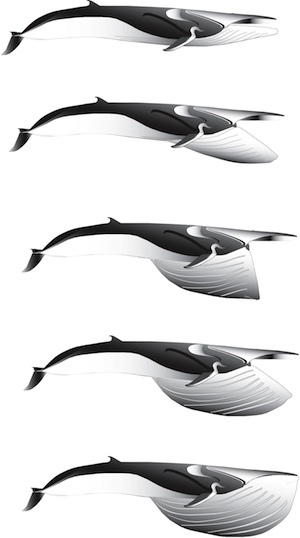
Fin whale lunge diagram, Nick Pyenson.

Fin whale lunge diagram, Nick Pyenson.

The very act of getting that food–diving deep, lunging open-mouthed, and then pushing a school-bus-sized volume of water forwards–requires a lot of energy.

Whales lunge into a cloud of krill and drop open their jaws. Pleats under the lower jaw open up, engulfing huge amounts of water. The whale slows down because of the drag. It behaves, in other words, a lot like a parachute. scientists have found: in one lunge, a fin whale can momentarily double its weight. As the water rushes in, the whales contract muscles in their lower jaw. The water slows down and then reverses direction, so that it’s moving with the whale. Once the water is moving forward inside the whale it can then close its mouth and give an extra squeeze to filter the water through its baleen.

A fin whale can get 20 pounds of krill in a single gulp, but it can gulp every 30 seconds. Because krill live in gigantic swarms, they can keep gulping and get enough food in four hours to fuel their bodies for an entire day


Source: discovermagazine.com

A day at the zoo

Posted on December 1, 2012

By Katy Muldoon, The Oregonian
November 30, 2012

Portland, Oregon, USA — The Oregon Zoo’s oldest animal and the chimpanzee estimated to be the nation’s second oldest was euthanized Friday, the same day the zoo welcomed a newborn elephant.

Coco, photographed early this year. (Photo: MICHAEL DURHAM/Oregon Zoo)

Coco, photographed early this year. (Photo: MICHAEL DURHAM/Oregon Zoo)

Coco, who apparently suffered a stroke, was born in the wild around 1952. She was approximately 60 and the years showed.

Soft gray whiskers wrapped her chin. Silver streaked her coal-black fur. Wrinkles rimmed deep-set eyes that, over the decades, watched millions of zoo visitors gaze back as she as climbed, played, dined, groomed, and nurtured her 17 offspring.

“She was a very feisty, spirited individual, which is what people loved about her,” said Jennifer Davis, curator of primates.

Perhaps it shouldn’t surprise that a zoo holding more than 2,000 animals experiences such a notable birth and death so close together.

Newborn November 30, 2012. (Photo: Portland zoo)

Newborn November 30, 2012. (Photo: Portland zoo)

Coco was imported to the United States through the pet trade, which was legal in the ’50s. Her owner donated her to the zoo in 1961.

Early this year, Eugene-based artist Jan Eliot featured Coco in her nationally syndicated comic strip, “Stone Soup.”

Coco had other brushes with fame — or, rather, with famous visitors. In 1976, President Jimmy Carter and his wife, Rosalynn, ambled through her exhibit and chatted with her keepers.

Three years later, so did renowned primatologist Jane Goodall, who was instrumental in helping the zoo garner support to build outdoor exhibit space big enough for all its chimps.

During that same era, Portland’s zoo held about half the breeding population of zoo-born chimps in the United States and Coco was part of a study that changed the way they’re raised.

Over 15 years, Portland-based research showed that chimps cared for longer by their mothers were significantly more likely, once they reached adolescence and adulthood, to exhibit natural breeding behaviors.

Nancy King-Hunt and Dave Thomas, the zoo’s former senior primate keeper, wrote a chapter on chimp rearing for the Association of Zoos and Aquariums’ chimpanzee Species Survival Plan. AZA-accredited zoos across North America adopted the new standards, keeping chimps with their mothers at least three to five years.

In Coco’s last years, keepers made many accommodations to keep her healthy and comfortable, adding ropes and metal shower bars to make it easier for her to climb to high perches. They warmed her nest area with a heater to ease discomfort in her arthritic joints. And they carefully watched, Thomas said, for signs that arthritis medicine had ceased to be enough to ease her pain.

About three years ago, Coco’s left arm grew severely weak, and in 2011, Thomas, his fellow keepers and the veterinarian discussed whether they should euthanize or give her more time. They decided she still appeared to enjoy life.

She’d grow excited and grunt softly when favorite keepers greeted her or delivered food. Her exhibit mates, two of whom were her daughters, treated her respectfully; one routinely groomed her.

This week, however, Coco’s condition deteriorated. She grew lethargic, had trouble grasping objects and seemed disoriented. She may have gone blind, too.

Veterinarian Mitch Finnegan said that for no apparent reason, she was alarm calling, which sounds something like a bark. He surmised that if she was blind, she might have been vocalizing out of fear, or it might have been a sign of dementia.

Again, he met with keepers. This time, they all agreed: Coco’s time had come.

The veterinary crew euthanized her shortly after 10:30 a.m.

Keepers gave the three remaining chimps an opportunity to see her lifeless body. “We felt it was an important part of their grieving process,” Davis said. “No one vocalized. No one displayed. It was very peaceful and quiet.”

It was a rough morning for the staff, Davis said. “There have been tears. But there’s the comfort in knowing you’ve done the right thing for her.”

Little Mama, Lion Country Safari.

Little Mama, Lion Country Safari.

With Coco gone, Little Mama remains by far the oldest chimp in the U.S. She lives at Lion Country Safari African Adventure in Loxahatchee, Fla. She’s believed to be in her mid 70s, based on an estimate Goodall made in the early 1970s after examining the chimp’s body and teeth.

An Ice Capades performer in her youth, Little Mama is arthritic. She’s lost some hearing and eyesight and she’s going bald, though she still has most of her teeth. All in all, says Terry Wolf, wildlife director, “she’s doing fine.”
Camera trap prizes

Posted on November 30, 2012

Several camera trap photos recently received awards.

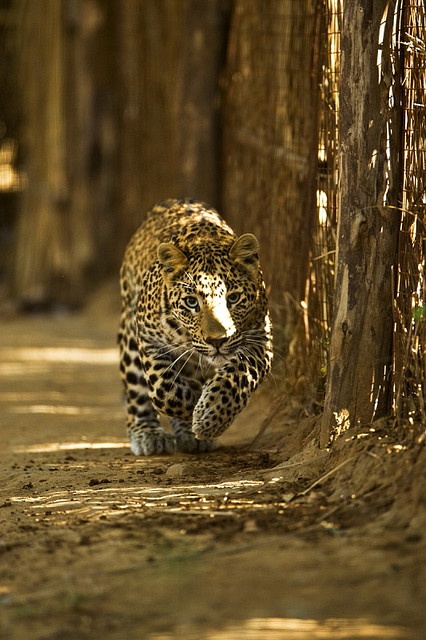
Top winner of the third annual BBC Wildlife Magazine Camera Trap Photo of the Year contest was this shot of a young leopard in China.

Young male leopard (Panthera pardus) in China’s Shuishui River Reserve. (Photo: Zhou Zhefeng)

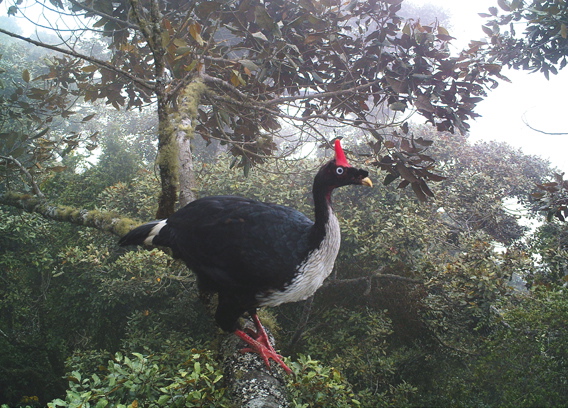
Second place went to this photo of a horned guan, the object of a birder expedition I filmed in Chiapas, Mexico in the mid 1970s for NBC. The only one we found was in the zoo in Tuxla Guitterez. Would have loved to see one in the wild.

A horned guan (Oreophasis derbianus) in Guatemala. Not a guan at all, this bird is the last survivor of a family of birds. It’s listed as Endangered by the IUCN Red List. (Photo: Javier Rivas)

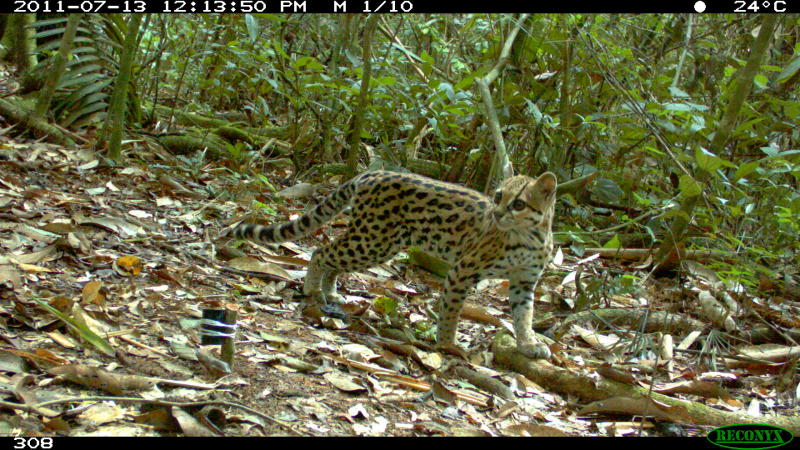
This shot of a little known Bolivian cat species called an oncilla is another winner.

Photograph taken by Wildlife Conservation Society scientists of a Bolivian cat species called an oncilla. (Photo: Guido Ayala, Maria Viscarra, and Robert Wallace/WCS)

Photograph taken by Wildlife Conservation Society scientists of a Bolivian oncilla. (Photo: Guido Ayala, Maria Viscarra, and Robert Wallace/WCS)

The Oncilla (Leopardus tigrinus) occurs across the Amazon and along the tropical Andes. About the size of a house cat, they are the smallest cat species of South America’s lowlands. Very little is known about their life history.

The photo was taken last July during camera trap surveys of jaguars and other wildlife living in Madidi–considered to be among the most biodiverse protected areas on the planet.


Sources: ScienceDaily and Mongabay.com.

Ain’t nature grand

Posted on November 21, 2012

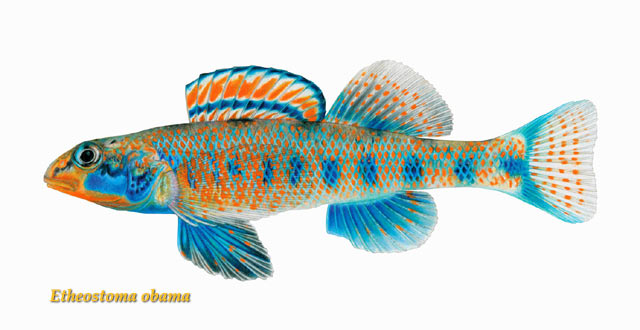
Biologists have discovered five new species of darters in freshwater river systems in the eastern United States and named them after four U.S. presidents and a vice president: Theodore Roosevelt, Jimmy Carter, Bill Clinton, Al Gore and Barack Obama.