First Light Productions

investigative journalism

Posts from the “WONDERS” Category

Kooloo-Kamba

Posted on November 10, 2012

There is a long history of debate over the existence of an alleged gorilla-like chimpanzee, known as the kooloo-kamba (an onomatopoeic reference to its call).

Mystery ape, Yaounde Zoo, Cameroon, mid 1960s (Photo: Peter Jenkins and Liza Gadsby)

As recently as the late 1960s, primatologist W. C. Osman Hill regarded the kooloo-kamba as a distinctive chimp subspecies thought to inhabit Cameroon, Gabon and the former French Congo, and to live alongside chimps of the nominate subspecies.

Previous researchers regarded it as a distinct species somehow intermediate between chimps and gorillas, or the product of gorilla-chimp hybridization.

Supposedly, several such individuals were kept in captivity during the late 1800s and ealy 1900s, including ‘Mafuca’ of the Dresden Zoological Garden, and ‘Johanna’ of Barnum and Bailey’s circus collection.

It now seems that the kooloo-kambas of the older literature reflect the fact that both gorillas and (especially) chimps are more variable in facial anatomy, body size and overall appearance than many primatologists were once willing to accept. Chimps of some populations are larger, darker-skinned and superficially more ‘gorilla-like’ than many of the chimps first brought back to Europe, but this doesn’t mean that such animals are hybrids, or intermediates.
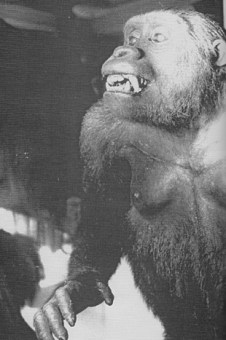
Pygmy gorilla Pseudogorilla mayéma (Photo: B. Heuvelmans)

Various other controversial African apes–most notably the Pygmy gorilla Pseudogorilla mayéma lauded by cryptozoologist Bernard Heuvelmans–also tell us more about our poor understanding of variation, and don’t necessarily point to the presence of additional distinct species.

Call me Ishmael

Posted on November 2, 2012

Crew member Dan Fisher, aboard the Dutch flagged ship SV Antigua in the waters off the Svalbard Archipelago in Norway got photos of a white Humpback.

Albino Humpback whale seen off Svalbard. (Photo: Dan Fisher)

White whales are unusual, but not unheard of. Another white Humpback, known as Migaloo, has been seen over the last 20 years off the coast of Queensland in Australia. Last October, a white Humpback calf was seen off the Queensland Coast.

White orca off Alaska’s Aleutian Islands.

Scientists aboard the NOAA research vessel Oscar Dyson in the North Pacific sighted an off-white orca with its pod about two miles off Kanaga Volcano, part of Alaska’s Aleutian Islands.


Source: Wildlife Extra. and National Oceanic And Atmospheric Administration.

Companion Animal

Posted on August 25, 2012

“Pocho is my best friend,” says Costa Rican fisherman, Gilberto “Chito” Shedden, of the 17-foot, 1,000-pound crocodile named “Pocho,” that he calls his pet. “This is a very dangerous routine but we have a good relationship. He will look me in the eye and not attack me. It is too dangerous for anyone else to come in the water. It is only ever the two of us.”

Oh, really.

Chito made friends with the croc after finding him with a gunshot wound on the banks of the Parismina river 20 years ago. He had been shot in the eye by a cattle farmer and was close to death.

Chito brought the croc into his house. He was small at the time, weighing only around 150 lb. He gave him chicken and fish and medicine for six months to help him recover. He stayed by Pocho’s side while he was ill, slept next to him at night. “I just wanted him to feel that somebody loved him,” Chito says. “That not all humans are bad. It meant a lot of sacrifice. I had to be there every day. I love all animals – especially ones that have suffered.”

At one point during his recovery, Chito left the croc in a lake near his house. But as he turned to walk away, to his amazement Pocho got out of the water and began to follow him home.

Chito recalls: “That convinced me the crocodile could be tame.” But when he first fearlessly waded into the water with the giant reptile his family was so horrified they couldn’t bear to watch. So instead, he took to splashing around with Pocho when they were asleep.

Now he swims and plays with Pocho as well as feeding him at the lake near his home in the lowland tropical town of Sarapiqui.
The odd couple have now become a major tourist attraction, with several tour operators, taking visitors on touring cruises to see the pair.

American crocodiles, which inhabit North, Central and South America, can live to around 70 years old. It is estimated that Pocho is around 50 – almost the same age as his owner. They are also said to be less aggressive than their Nile or Australian counterparts.

Chito, whose real name is Gilberto Shedden, was given his nickname by friends, who also call him “Tarzan Tico” – Tico being a familiar word for a Costa Rican. And he certainly plays up to the name, wearing a tattered pair of leopard-print shorts for his half-hour performances with Pocho.
A keen conservationist, he also offers boat tours, where he eagerly points out a variety of wildlife. But he only charges a few dollars to watch the breathtaking crocodile show, claiming he does not want to cash in on Pocho.

Watch them live
http://ticotimes.com/costa-rica/crocodile-man-sarapiqui-tarzan

From a story in the Costa Rica Tico Times.com 10/07/2009