First Light Productions

investigative journalism

Posts by Michael Elton McLeod

Sumatran Rhinos — winking out

Posted on August 15, 2012

INDONESIA. There are believed to be fewer than 200 Sumatran rhinos left in the entire world. To the delight of conservationists, seven were recently spotted on hidden camera in Indonesia’s Mount Leuser National Park. The Sumatran rhino population has dropped 50 percent over the past 20 years and conservationists feared the critically endangered species had completely disappeared from the region.

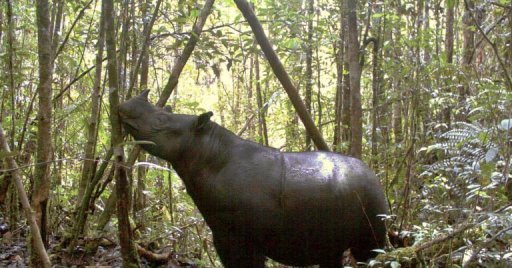
The Sumatran rhinoceros had not been seen in the park on the northern tip of Sumatra in 26 years. This photograph taken in 2011 and released by the Leuser International Foundation shows a Sumatran rhino on Indonesia’s Sumatran island.

The leader of the Leuser International Foundation, a conservation group working at the park said, “This discovery can allay doubts over the rhino’s presence in the park,” adding he hoped the discovery would encourage more efforts to conserve the species.

Images of the rhinos were captured by 28 infrared cameras set up between June 2011 and April this year and confirmed six female and one male rhino appearing in 1,000 photo frames.

The rhinos are commonly targeted by poachers, and rampant illegal logging has destroyed much of their habitat.

OR-7

Posted on August 15, 2012

OR-7, a young male wolf from Oregon that has won worldwide fame while trekking across mountains, deserts and highways, was recently photographed for the first time. A federal trapper, a state game warden and a state wildlife biologist were visiting ranchers on private land in Modoc County, the sparsely settled northeastern corner of Northern California to notify them that GPS signals showed the gray wolf was in the area, when they stopped to look over a sagebrush hillside with binoculars and spotted him hanging out with three coyotes. California wildlife biologist Richard Shinn snapped a photo, the first shot of the animal in color.

OR-7 left the Imnaha pack in northeastern Oregon in September, shortly before the state put a death warrant on his father and a sibling for killing cattle. He is a descendant of wolves introduced into the Northern Rockies in the 1990s, and represents the westernmost expansion of a regional population that now tops 1,650.
His travels took him down the Cascade Range into California in December, making him the first wolf in California in more than 80 years. He has since gone back to Oregon and returned to California.
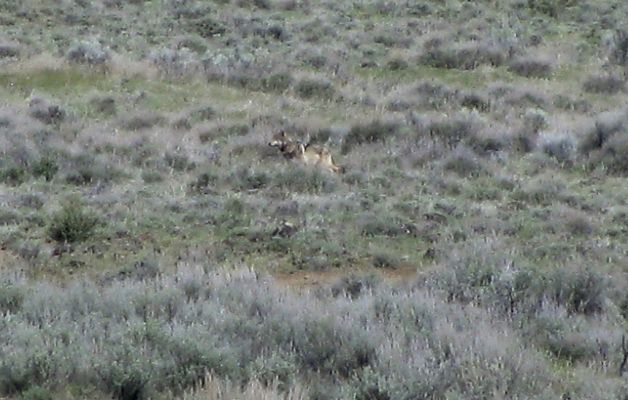
(California Dept. of Fish and Game)

OR-7’s brother was illegally shot in Idaho.

Biologists know he has fed on the carcasses of deer, dug up the burrows of ground squirrels, and fed from livestock carcasses left out by a rancher. As of yet, there are no reports he has killed any livestock.

State biologists have been keeping close tabs on him with the help of his GPS collar and keeping ranchers up to date on his general whereabouts as the wolf, is a federally endangered species and they want to prevent him being mistaken for a coyote and killed.

OR-7 is at high risk of suffering the same fate as his brother. Many ranchers and hunters would like nothing better than to shoot a wolf. Late word out of Montana illustrates how the reintroduction of wolves, of which OR-7 is a highly publicized part, might play out in the Pacific Northwest.

BEN NEARY (AP), August 14, 2012. CHEYENNE, Wyo. — The federal government plans to announce an end to protections for wolves in Wyoming later this month. Rather than ending years of wrangling between state and federal officials, however, the move promises to spark legal challenges from environmental groups outraged that the state plans to classify wolves as predators that can be shot on sight in most areas.

Ranchers and hunters started complaining that wolves were taking an unacceptable toll on cattle and wildlife soon after the federal government reintroduced the species to Yellowstone National Park in the mid-1990s.
The federal government’s final delisting plan calls for Wyoming to maintain at least 10 breeding pairs of wolves and at least 100 individual animals outside of Yellowstone and the Wind River Indian Reservation in central Wyoming. The state intends to classify wolves in the remaining 90 percent of Wyoming as predators, subject to being killed anytime by anyone.

The state would take over wolf management responsibility 30 days after the scheduled Aug. 31 publication of the federal government’s final delisting rule. The state is prepared to issue unlimited hunting licenses but will call a halt after hunters kill 52 wolves.

The federal delisting of wolves in Idaho and Montana in recent years included action by Congress specifying that the move wasn’t subject to legal challenges. Although Wyoming’s congressional delegation has said it wants similar immunity for delisting in Wyoming, it hasn’t happened.
Beagle Liberation

Posted on August 15, 2012

At least 30 beagle puppies were recently rescued by animal rights activists from a notoriously inhumane breeding facility in Italy.

Green Hill 2001 farms the animals out to vivisection labs, where the dogs are subjected to live experimental research and then death. Members of the Animal Liberation Front of Italy climbed over barbed wire fences on the grounds of Green Hill, then managed to squirrel the animals out through a breach in the fencing. Twelve activists were arrested in the liberation.

Beagles are the most popular dog used in biomedical research. According to the book, The Beagle as an Experimental Dog, “The most desirable qualities of the Beagle…are its medium size, moderate length of hair coat…even temperament, adaptability to living in groups, (and) conformation.” In short, beagles are docile individuals and they are convenient because they are small, allowing for more animals to be housed and cared for using less space and money. And because they have been utilized for so long, beagles are considered to be the best characterized ‘canine models’ in scientific literature, thus perpetuating their use.

Ironically, discoveries of what was happening to beagles in laboratories in the late 1950s and early 1960s led to enactment of the first laws designed to protect animals in labs.

In 1959 a nationally syndicated newspaper report revealed that beagles in a laboratory in downtown Washington D.C. within eyesight of the Capitol, were being harshly abused in a study to test food dyes. The exposé landed like a bombshell on legislators’ desks: “Hundreds of dogs flung themselves against the bars of their cages, piled tier on tier. They were barking, screaming, whining, mute—and drooped their heads in the dark corners. Others circled ceaselessly in their cages.” Shamed, Congress quickly appropriated $100,000 for new animal quarters at the lab.

The incident prompted introduction of the first major bill in the U.S. Senate aimed at protecting laboratory animals. Predictably, it was shot down as the biomedical lobby pounded home the message that such “paralyzing legislation” would hinder the search for medical advances that could save untold lives.

About this same time, the Veterans Administration together with the American Cancer Society used over a hundred beagles to study the effects of cigarette smoking by cutting “breathing holes” in the dogs’ windpipes and inserting tubes into the holes with cigarettes at the other end. Some dogs were made to “smoke” for as long as a year and a half. The dogs were then killed and autopsied to determine the effects of the smoke.

When knowledge of the tests became public, a VA spokesman defended the study on the grounds that “it would take 20 years with a human being to determine if a filter cigarette is safe and only 18 months with a dog.” (A statement imbued with some irony considering tobacco companies would fight like Spartans for another twenty years to hinder release of information about the deadly effects of cigarette smoke on humans.) Advertising and letter-writing campaigns by animal welfare groups protested the experiment as “cruel and immoral,” but the study continued.