
All three known species of vampire bats inhabit Belize. (Photo: Dr. Pascual Soriano)
All three known species of vampire bats inhabit Belize. (Photo: Dr. Pascual Soriano)
From the Wildlife Conservation Society’s “Rarest of the Rare” list of critically endangered species 2010.
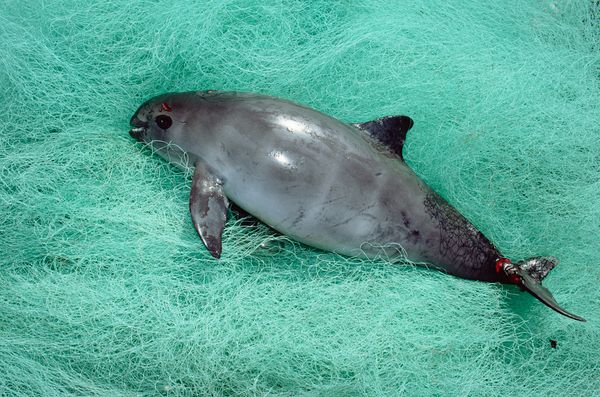
vaquita (photo: National Geographic)
Vaquita–“little cow” in Spanish–is the smallest of the cetaceans. This tiny ocean porpoise, endemic only to the northern part of the Gulf of California known as the Sea of Cortez, and rarely seen in the wild, is the species that will most probably disappear in the next years with only 150 left in the world
The greatest threat to the remaining vaquita is being caught up in fishing gear, particularly gillnets. They are also killed by commercial shrimp trawlers.
Source: sciencedaily.com
In early spring 2001, Drew Weber, owner of the Lowell Spinners, a minor league affiliate of the Boston Red Sox, had an idea to boost attendance by exhibiting chimpanzees during promotional events at the Spinner’s ballpark. He contacted a Hollywood animal dealer who brokered the purchase of 2 1/2 and 2 year-old Arthur and Phoenix, from the Coulston Foundation, a notorious biomedical research laboratory, for $67,500.
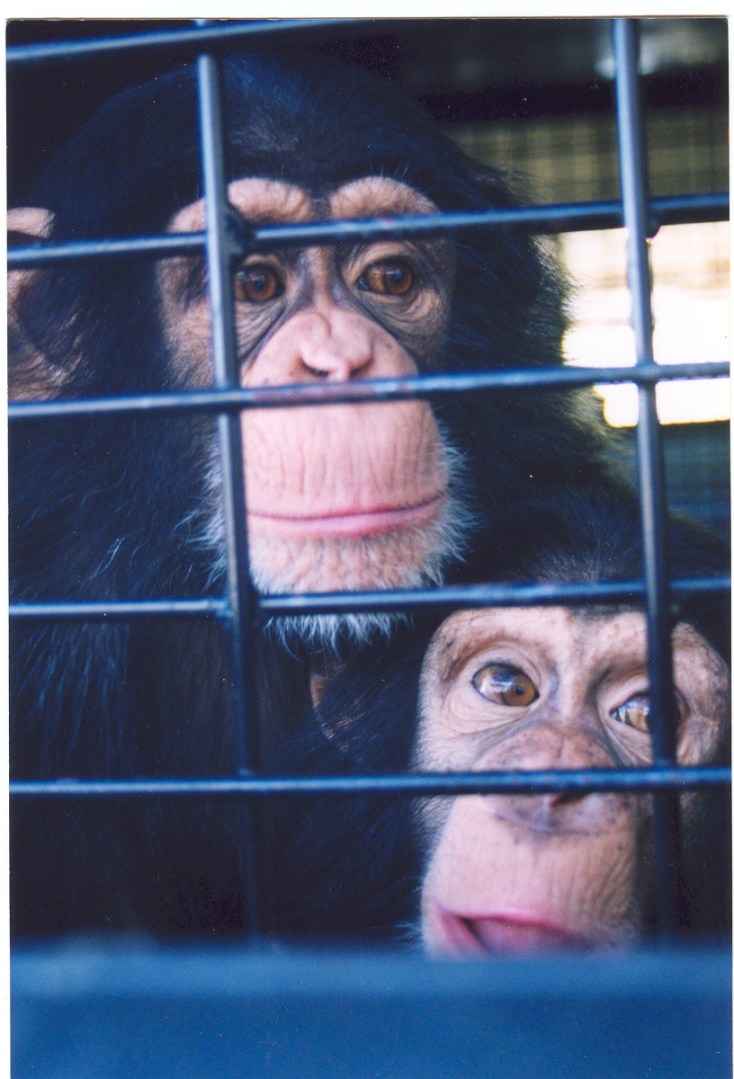
Arthur and Phoenix (credit: New England Anti-vivisection Society)
Weber made a “verbal agreement” with Glenford Eldridge, one of the owners of the Greenville Wildlife Park, a “tooth and nail” roadside animal park in New Hampshire, to care for them and train them to do tricks to perform at the ballpark.
A few months after Arthur and Phoenix were delivered to the Greenville park, a park employee contacted the New England Anti-Vivisection Society (NEAVS), an animal advocacy organization dedicated to ending research on animals, to say that the chimps were not being properly cared for and that they were both suffering from repeated respiratory infections and recurring diarrhea.
NEAVS President, Dr. Theo Capaldo, traveled to Greenville to see the chimps for herself. Arthur and Phoenix were not on exhibition. The Greenville whistleblower helped her locate them in a shabby building with broken windows, which housed several exotic species in cramped, urine-soaked, wooden enclosures. “Arthur was bigger than Phoenix,” Capaldo recalled. “He seemed to derive security from her. Arthur had more of an innocence and vulnerability to him, while Phoenix was more confident and eager to explore.”
NEAVS contacted the U.S. Department of Agriculture who sent inspectors to the park. The USDA report noted that Arthur was rocking back and forth, a sign of stress in captive chimpanzees, and cited the park for non-compliance with the Animal Welfare Act for failing to provide enrichment for the chimps.
NEAVS contacted Weber and explained to him the conditions at the park and the plight of chimpanzees in entertainment and research and convinced him that keeping the chimps was, for many reasons, a boneheaded idea. First and foremost was pubic exhibition, a traumatic experience for chimpanzees. And the fact that as the chimps matured, at about age five they would become too dangerous to handle and Weber would be forced to give them up or keep them permanently behind bars.
Weber told Eldridge that he wanted to see the chimps but Eldridge would not let him onto the Park property, claiming that he owned them.
Realizing Eldridge had little concern for the chimps’ welfare, Weber agreed to let NEAVS file a lawsuit on his behalf to regain custody of Arthur and Phoenix from Greenville, with the understanding that, if successful, “ownership” of the chimps would then be transferred to NEAVS who would facilitate their transfer to sanctuary.
Weber sued for custody of the chimps, claiming Eldridge was not properly caring for them.
In Nov 2002, a New Hampshire superior court judge, satisfied that Weber was the rightful owner of the chimpanzees, and observing that “The present living arrangements [at Greenville] will probably have a detrimental effect on the chimps’ appropriate development and socialization,” ordered the wildlife park to give up the chimps to Weber. Per their agreement, Weber transferred ownership of Arthur and Phoenix to NEAVS, which funded their placement at the Center for Captive Chimpanzee Care, a widely respected sanctuary in Florida, now known as Save the Chimps.
The Greenville Wildlife Park subsequently came under criticism from local animal-rights activists, whose complaints prompted the U.S. Department of Agriculture to launch an investigation of the entire facility. The park was shuttered in November, 2003.
Source: NEAVS Website “From cage to stage to rescue!”
The African lion is a threatened species. Only 20,000 to 40,000 wild lions remain, in just 20 percent of their historical range. The vision of lion prides roaming endless savannas, unaffected by people, is a romanticized image that survives in just a few very large protected areas. As the human population continues to grow, rates of conflict with lions and other wildlife are growing.
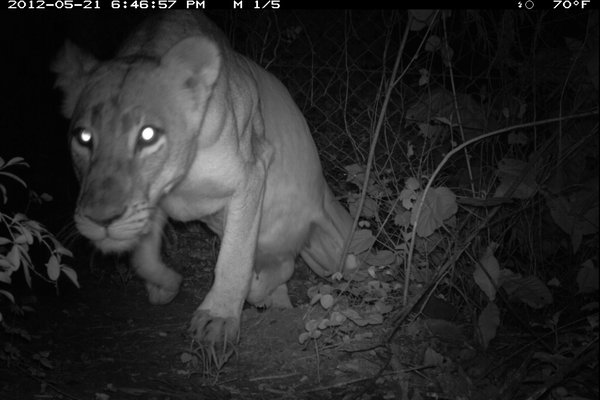
A lioness crawls through a hole in a fence in the suburbs of Nairobi, less than a mile from Nairobi National Park. (Photo: Stephanie M. Dloniak)
A recent report out of Kenya tells of a young lioness discovered living in a bushy suburb of Nairobi with a trio of 2-month-old cubs. It took 12 rangers and 3 vets from the Kenya Wildlife Service and a small fleet of vehicles more than six hours to dart her and capture the cubs. Then came the question: what to do with her?
Such situations have become so common that some wildlife experts are saying that the best solution for such lions may be euthanasia—despite the lion’s threatened status. The reasoning is unique to Africa. This lion was found in Mukoma Estate, a partly forested, developing suburb on the south side of Nairobi immediately west of Nairobi National Park, about 45 square miles of partly fenced grassland and forest less than five miles from the central business district of a city of more than three million people; baboons, warthogs and a leopard still call Mukoma home.
Many urban carnivores including coyotes, foxes, raccoons and badgers—small animals with generalist diets that allow them to eat just about anything—can be tolerated. But lions, weighing 240 to 600 pounds and eating only meat, are a direct threat to people.
Kenyan wildlife experts believe she was probably living and having cubs outside the park because there is a large lion population inside it—including a number of adult males that pose a risk of infanticide. If she was moved back into the park, she would likely move the cubs back through the fence and into the suburb again creating an ongoing problem and a continuing threat of someone being killed or injured. So returning the lions to the park was not a solution.
Translocation—moving an urban lion to a distant region—is no answer either. Lions do not welcome newcomers. Released into another park, the existing lion population would force her to the boundaries, where she would encounter livestock and people at a time when she is desperate to feed her cubs. Such a move would be a death sentence.
While appearing heartless on the surface, the utilitarian act of euthanizing some problem animals for the greater good of the species may prove critical to having any wild lions in Kenya at all.
Many years ago a renowned anthropologist I know, who spent years in Sierra Leone establishing the country’s first national wildlife park, had a chimpanzee for a pet that he’d rescued from the bush trade. When his work was completed he made plans to return to the U.S. but couldn’t find a home for the chimp. There were no sanctuaries in Africa at the time. And the chimp was habituated to humans. Leaving it uncaged meant certain death. So he put it down. The memory haunts him.
Putting down a lioness and her cubs is a call I certainly wouldn’t want to make.
The report did not say what happened to the lions.
Source: New York Times.
Two coalitions of environmental groups in the U.S. filed notice September 10 in federal court in Washington that they intend to sue the U.S. Fish and Wildlife Service over the agency’s decision to end federal protections for wolves in Wyoming.
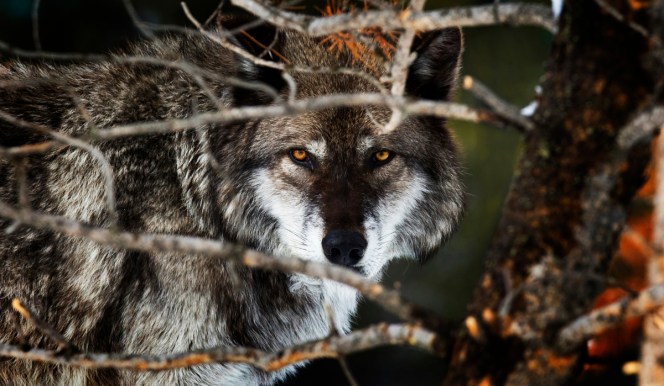
yellowstone wolf.
The groups oppose the state’s classification of the estimated 350 wolves within its borders as “predatory animals” that can be shot on sight in more than 80 percent of state when federal protections end Oct. 1.
Wyoming has also scheduled a regulated trophy wolf hunt in the remainder of the state, an area around the eastern and southern borders of Yellowstone National Park, starting next month.
Wyoming’s action is one of the latest salvos against wolves, which have slowly lost their protected status in the Rockies and Great Lakes regions over the past four and a half years after the U.S. Fish and Wildlife Service declared them “recovered”—a contention disputed by most conservation groups.
Since that time environmental, conservation and wildlife groups have filed a series of lawsuits to protect the wolf. As a result the wolves in these regions have regained and re-lost their protected status at least a half dozen times since March 2008. In the interim several hundred wolves have lost their lives while political forces worked to remove their protected status once and for all, which is pretty much where they stand today.
The groups involved include: Earthjustice, Defenders of Wildlife, Center for Biological Diversity, Natural Resources Defense Council, the Sierra Club, WildEarth Guardians, Alliance for the Wild Rockies, Biodiversity Conservation Alliance, Conservation Congress, Friends of Animals, Friends of the Clearwater, National Wolfwatcher Coalition, and Western Watersheds Project.
Wyoming’s current wolf management plan is similar to an earlier version that the federal agency repudiated after initially accepting it a few years ago. The groups claim the federal government is stopping wolf management for political reasons, not because the current plan is any better than the last one.

gray wolf
Wyoming Gov. Matt Mead and Interior Secretary Ken Salazar, both strongly tied to the ranching industry in which they grew up, have worked closely together since Mead took office last year on an agreement to end federal wolf protections. The federal government already has turned over wolf management in Idaho and Montana to those states and both have held wolf hunts.
The chance to legally shoot a wolf is apparently irresistible to hard core hunters, and states; eager to collect fees for hunting licenses. In Minnesota, more than 23,000 hunters from 33 states have applied for the 6,000 permits to shoot gray wolves that the state will issue for its fall hunting season, set to start November 3.
A spokesman for the state’s Department of Nature Resources told the Associated Press that only a few hundred of the 23,477 requests were filed by Minnesotans. The licenses, to be issued by lottery on October 14, will cost $30 for Minnesota residents and $250 for out-of-state hunters.
Minnesota has set a limit of 400 wolves that can be killed this season. The state has an estimated wolf population of 3,000 animals, the highest number in the U.S. outside of Alaska, where the species has never been protected.
To keep up on this constantly changing situation, the Defenders of Wildlife blog runs a weekly wolf news wrap-up for all things related to this species.
Source: Missoulian, Scientific American
New to me but a thriving business in Asia. Bear farming involves raising bears to extract a digestive juice from their gall bladders called bile, a substance used in traditional Asian Medicine for thousands of years, believed to aid ailments ranging from fevers to heart disease.

Asiatic Black Bear, aka. moon bear
The bears most commonly used on bear farms are Asiatic Black Bears known as Moon Bears because of the distinctive white or cream-colored crescent moon shape on their chests. The Asiatic Black Bear is listed as vulnerable on the World Conservation Union’s (IUCN’s) Red List of Threatened Animals.
Moonbears grow four to six feet long. Males weigh from 220 to nearly 500 pounds. Females about half that size.
The species occupies a narrow band from southeastern Iran eastward through Afghanistan and Pakistan, across the foothills of the Himalayas, to Myanmar. It occupies all countries in mainland Southeast Asia except Malaysia. It has a patchy distribution in southern China, and is absent in much of east-central China. A small remnant population exists in South Korea. They also live on the southern islands of Japan and on Taiwan and Hainan
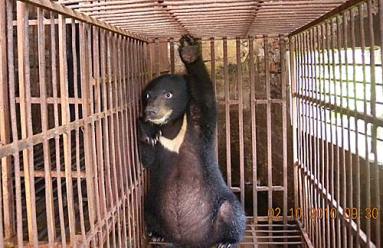
photo: TRAFFIC
The bile is usually extracted twice a day through an implanted tube. The bears can be seen moaning and chewing their paws while being milked. Another method involves pushing a hollow steel stick through the bear’s abdomen. With the “free drip” method a permanent hole or fistula is made in the bear’s abdomen and gall bladder, from which bile drips out freely. The wound is vulnerable to infection and bile can bleed back into the abdomen, causing a high mortality rate. Sometimes the hole is kept open with a catheter, which causes severe pain. Whatever method is used, extraction of the bile is cruel and painful and leaves bears with open weeping wounds that often become infected and inflamed.
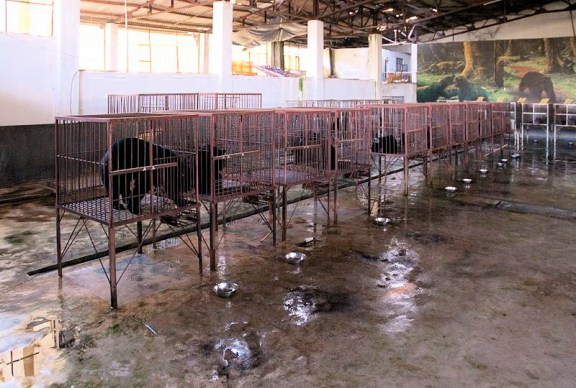
Sun Bear Bile Extraction Operation in Mong La, Shan, Myanmar. (photo: Dan Bennett)
To facilitate the bile milking process, the bears are commonly kept in small extraction cages, also known as crush cages which allow for easier access to the abdomen. It also prevents the bears from being able to stand upright, or in some cases move at all. The cages shown here are typical.
Cage sizes differ from facility to facility but none are anything but cruel.
It’s hard to fathom, but bears are confined in these tiny cages for 10–12 years with little to no enrichment.
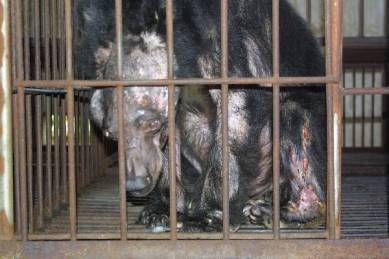
photo: thebeartruth.org
The obvious result is severe mental stress and muscle atrophy which produces the stereotypical behaviors—swaying, self biting, vocalizing–common to primates and other research animals.
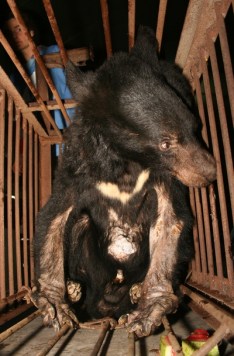
thebeartruth.org
The World Society for the Protection of Animals sent researchers to 11 bile farms. They reported seeing bears moaning, banging their heads against their cages, and chewing their own paws. The mortality rate is high. Bile bears suffer from a variety of physical problems which include loss of hair, malnutrition, stunted growth, muscle mass loss, and often have their teeth and claws extracted. When the bears stop producing bile after a few years, they are usually killed for their meat, fur, paws and gall bladders. Bear paws are considered a delicacy.
The increased availability and marketing of bile due to the growth of bear farming has created a widening demand among consumers who consider the product an essential “tonic” to promote and maintain good health, rather than a medicine simply to fight illness.

product of Sun Bear Bile Extraction Operation in Mong La, Shan, Myanmar (photo: Dan Bennett)

product of Sun Bear Bile Extraction Operation in Mong La, Shan, Myanmar (photo: Dan Bennett)
The term ‘farm’ is a misleading one, as it implies the bears are being bred and that the trade may be sustainable. Wildlife experts with the conservation group TRAFFIC have found this is not the case as many consumers believe wild bile is more potent and pure than “farmed” and cubs are routinely poached from the wild to stock the farms.
The unconscionable cruelty involved in bile farming and the threat it poses to the viability of the Moon Bear population has not gone unnoticed. The motion to phase out farming of bears for their bile has been submitted for consideration and debate at the coming IUCN World Conservation Congress.
Source: wildlifeextra.com
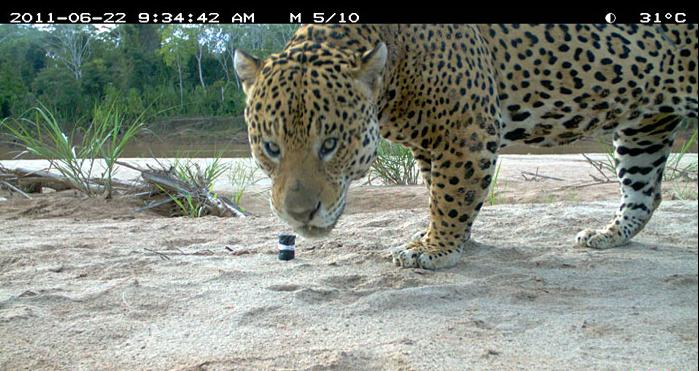
Photo: Wildlife Conservation Society Bolivia Program
During a recent camera trap survey in Bolivia, researchers from the Wildlife Conservation Society identified 19 individual jaguars, more than any previous camera trap survey in that country. (Credit: WCS Bolivia Program)

photo: Amal Mongia
Air India recently announced it has stopped ferrying animals like rabbits, cats and dogs for laboratory tests, where they are experimented upon and finally killed.

Air India is now among international airlines like Air Lingus, British Airways, Cargolux, Cathay Pacific, Qantas and, recently, Air China which decline transporting rabbits, rodents, dogs, cats, primates and other creatures destined for laboratories.
Source: The New Indian Express
The largest of the African eagles, the Martial Eagle weighs in at almost 14 pounds with a wingspan of over 6 feet.
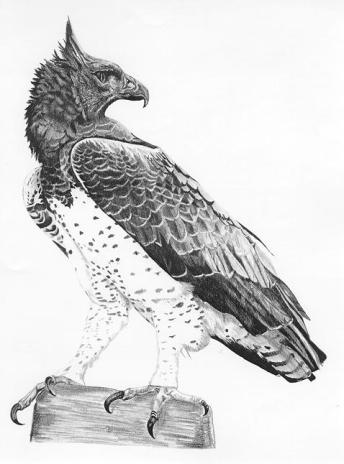
artist: Jana Gale Connell http://www.indigomoonarts.com/
An emblematic bird of prey that is disappearing at an alarming rate. A decline mirrored in many species on every continent.
Source: IUCN, International Union for Conservation of Nature.
On September 6 a federal judge gave the U.S. Navy the go-ahead to build an undersea warfare training range close to the right whales’ only known calving ground in North Florida. The facility will inundate the surrounding waters with sonar, which has a disastrous effect on whales and other marine mammals.
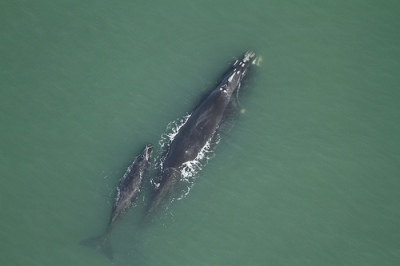
A mother right whale and her calf swimming off of Amelia Island, Florida. (Photo: FWC Fish and Wildlife Research Institute)
North Atlantic right whales are the most critically endangered species of large whale with only 300 individuals left in the world. This massive species was called the right whale by whalers because they were the “right” whale to kill. Swimming slowly close to shore, they made easy targets.
The Navy’s $100 million facility, designed to train submarines, ships, and aircraft, will span nearly 500 square miles of ocean perilously close to the calving grounds, putting whales and other sea mammals at risk of both ship strikes and sonar.
Hunting of the right whale ceased in the 1930s following the Convention for the Regulation of Whaling, the predecessor to today’s International Whaling Commission. By then it was almost too late–the right whale population was already decimated, and things haven’t improved since. Like other large mammals, right whales are slow breeders. Females do not reach sexual maturity until they are about nine years old, and they only breed every three years.
Though the threat of whaling has passed, right whales are still in terrible danger of being struck by ships or entangled in their fishing gear. In 2010 alone there were five right whales perilously entangled in fishing gear. Two did not survive.
Right whales spend much of the year in the waters off of Nova Scotia, near the Bay of Fundy, feeding on plankton. As winter arrives they migrate south along the coast to give birth to their calves in the warm waters off of southern Georgia and northern Florida. The small patch of ocean is the only known calving area for right whales.
Right whales are especially vulnerable to fatal collisions with ships because of their dark color and lack of a dorsal fin. The danger increases for calving mothers, who spend a lot of time near the surface as they give birth and as their young develop the lung capacity to dive deeper. Currently, the Navy’s only way to avoid ship strikes is by visual detection, which does not bode well for the fate of nearby whales.
Just as menacing is the threat of sonar which can be deadly for ocean mammals. Sound travels through water much faster than air, and can be deafening to marine mammals miles from the source. Loud blasts of sonar often cause whales to surface quickly, and the rapid change in pressure can lead to bleeding from the ears and eyes.
Naval sonar has been linked to multiple marine mammal deaths, notably the stranding of whales and dolphins in the Bahamas in 2000. Examinations of the stranded animals revealed internal hemorrhaging and bleeding in their ears and brains. Another stranding occurred in North Carolina’s Outer Banks in 2005, when 34 whales beached shortly after Navy sonar training. Similar problems have been reported with Orcas in Puget Sound off the coast of Washington.
Sonar can also disrupt normal whale activity like navigation or feeding, cause panic and disorientation. Even whale watching boats can cause hearing trouble and make it hard for whales to communicate.
The Navy’s refusal to give the baby whales a fighting chance by restricting sonar use during the calving season is outrageously typical of the military when it comes to environmental problems. It’s not hard to see how this court decision will likely spell disaster for right whales.
Source: Justine E. Hausheer, “The Wrong Choice for Endangered Right Whales,” audubon.org.
Why is it the most iconic of North American animals has no status as true wildlife?
They’ve been saved from extinction, but recent history hasn’t been so romantic for the buffalo. Their storied past has given way to an uncertain future tied up in the realities of land management, bureaucracy, court trials and town-hall meetings.
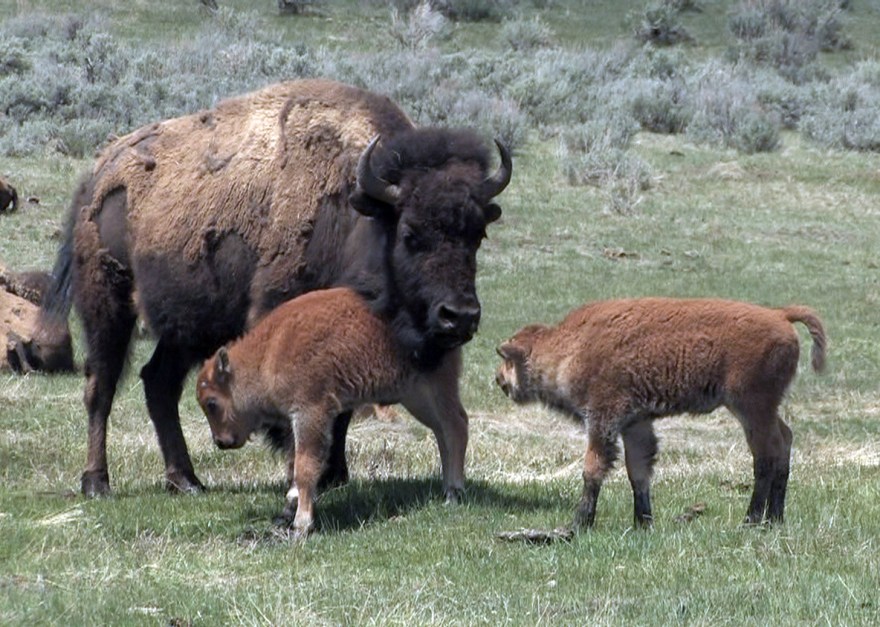
Today, even as buffalo unite Indian tribes under a common cause, they divide hunters and conservationists, lawmakers and constituents, as America continues to argue what, exactly, home on the range means for the buffalo.
The film is great history. Take a look.
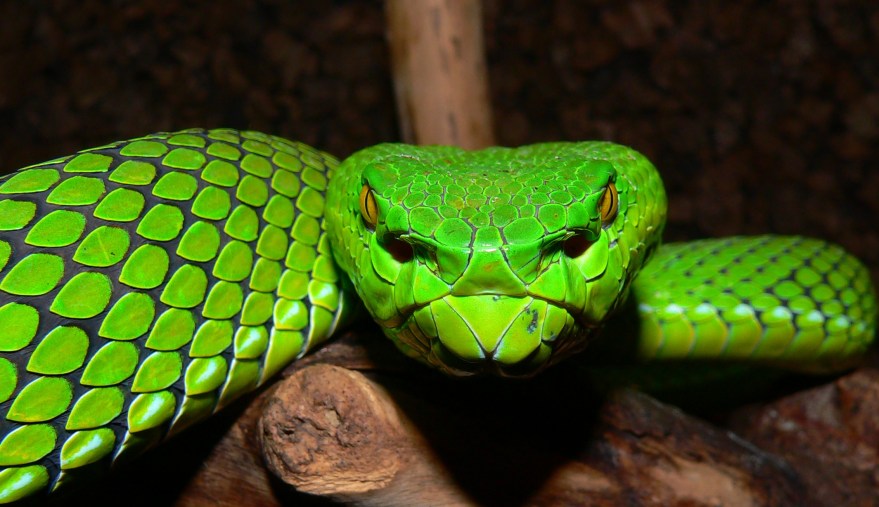
Gumprechts green pitviper (Trimeresurus gumprechti). Photo: © Rene Ries.
Found across much of the Greater Mekong region in Thailand. The snake’s poison brings on pain and swelling in humans but is not usually fatal.
Source: news.mongabay.com
As I prepare to post about a newly “discovered” monkey, NPR beats me to the punch with the same story. With so many newly described animals being reported in the wildlife press, I can only deduce they decided to report on this one because of its face.
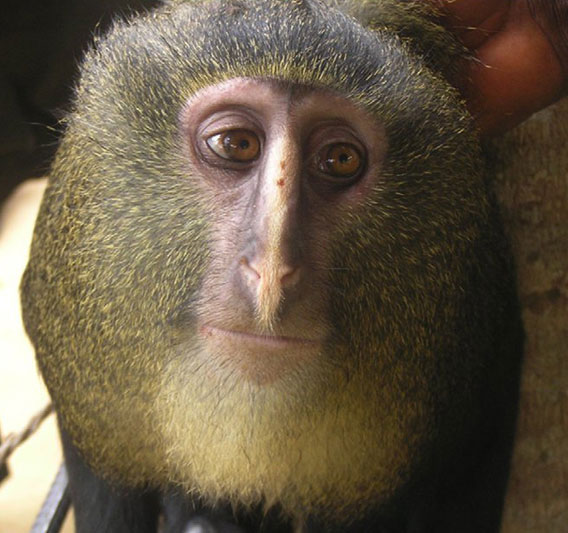
Captive adult male lesula (Cercopithecus lomamiensis). Photo: John Hart
The ‘lesula’ (Cercopithecus lomamiensis) inhabits the largely unexplored old-growth rainforests of the Democratic Republic of the Congo (DRC). According to scientist and explorer, John Hart, the area is so remote that primates only come out of it as heavily smoked and unrecognizable bushmeat.
Researchers estimate the lesula habitat at around 6,500 square miles. The species is not uncommon as the region is so far untouched by logging and mining. Like many of Africa’s primate, however, the monkey is imperiled by a growing bushmeat trade.
The monkey lives in a region home to bonobos, okapi, forest elephants, and Congo peacock. The Harts originally came to the area to study bonobos, sometimes called pygmy chimps, the great apes that are closely related to chimpanzees but have unique social structures,
Researchers suggest that the lesula be listed as Vulnerable by the IUCN Red List, due to a likely decline from “uncontrolled” bushmeat hunting.
John and Terese Hart have been working with authorities to combat illegal poaching in the region and are working with the DRC government and local communities on establishing a 3,470 square mile protected area in the region known as Lomami National Park.
The lesula is only the second newly discovered monkey in Africa in the past 28 years
Source: Mongabay.com
His name is Baghdad, because of the bullet scar in his ear. He lives in a national park in Gabon, and he’s one of only 20 African forest elephants left on Earth whose tusks touch the ground, making him worth about a hundred thousand U.S. dollars—dead.
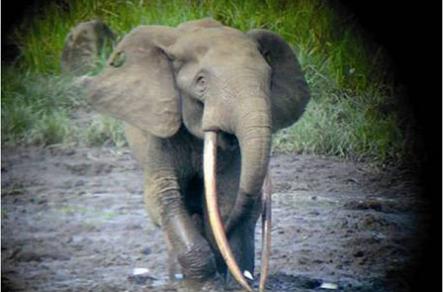
Baghdad, Ivindo National Park, Gabon, Africa
Delegates to the World Conservation Congress in Jeju, South Korea, this month, appealed for aid from the International Union for Conservation of Nature (IUCN) as African elephant populations plummet.
With international crime syndicates coveting more and more elephant ivory—a symbol of wealth in booming Asia—elephant numbers have fallen to “crisis levels,” according to a June report by the Convention on International Trade in Endangered Species of Wild Fauna and Flora (CITES).
The highest rate of elephant poaching since a global ivory ban in 1989 occurred in 2011, with tens of thousands of the animals slaughtered, their ivory shuttled out of West and, increasingly, East African seaports enroute mainly to China but also to other Asian consumer countries such as Thailand.
About 472,000 to 690,000 African elephants—currently classified as vulnerable by IUCN—likely roam the continent today, down from possibly five million in the 1930s and 1940s.
African countries are in desperate need of increase protection of their wildlife, particularly elephants and rhinoceroses, as dozens of park rangers have been killed this year in Africa by well-armed poachers, including 15 in the Kenya Wildlife Service alone.
One African delegate said, “We’re going into a phase now where we’re basically at war. We’re shifting from biologists being out in these parks to military people being out there.”
Worldwide, more than 60 rangers have died this year. There are many dead who go unreported. Rangers need more funding, training, and equipment—particularly as wildlife crime tightens its grip on Africa.
The World Wildlife Fund recently launched a campaign to stop wildlife crime. One of its main goals is raising the profile of rangers, since many don’t receive the support and training they need.
Gabon, a country that’s taken a strong stance against the ivory trade, recently upped its national park staff from 100 to 500 and is in the process of adding a new military branch of 250.
Even so, poachers have become more brazen, shooting at cars carrying park staff. Poachers are have even taken to killing elephants by putting out poison, which can harm other animals as well.
Source: Christine Dell’Amore, National Geographic News, September 9, 2012.
The photograph is a startling image: a monkey held upright in a crude frame fashioned from pipes, the animal’s arms and legs splayed out from its body, ankles and wrists bound by tape.

Institute for Behavioral Research, Silver Spring, Maryland, 1981
A clamp affixed to its abdomen holds the ape’s trunk immobile, another around its neck, secured by a C-clamp, fixes its face upward toward the ceiling. Prominently tattooed on its chest is the number 25. Were the photograph created as an artwork it would hold its own alongside the iconic photo by Andres Serrano titled Piss Christ (a crucifix submerged in a glass of the artist’s urine), ironically also funded by a government grant, just as the monkey’s circumstances were supported by the National Institutes of Health.
According to Alex Pacheco who took the photo in the fall of 1981, the monkey’s name was Domitian; one of seventeen apes at the Institute for Behavioral Research (IBR) in Silver Spring, Maryland, that had been surgically crippled (a procedure known as “deafferentation”) by severing the sensory nerves to their limbs at the spinal cord (in Domitian’s case the left arm had been rendered useless). Restraint, electric shock, and withholding of food were then used to force the monkeys to try and use those limbs, to see if the neural pathways would regenerate.
Pacheco was a seasoned animal-rights activist when he arrived at the lab. (He had participated in animal rights protests in college, and crewed on the infamous anti-whaling ship Sea Shepard.) Living in Washington D.C., he volunteered to work at IBR on the night shift and was given keys. Finding that the monkeys were in poor health due to lack of veterinary care and living in squalid conditions, he set out to build a case against the lab’s director Dr. Edward Taub for cruelty to animals.
Pacheco photographed what he saw, copied lab documents and over a period of weeks snuck five primate experts and veterinarians inside to see the conditions firsthand and write affidavits testifying to what they’d observed. He took his evidence to the local police who obtained a warrant and raided the lab, seized 17 monkeys and carted away lab files. Alerted by a tip, a camera crew filmed the raid. The footage, broadcast on the CBS evening news, showed 17 cages, each holding a bewildered monkey, being carted from the building and placed in the back of a van bearing a hand lettered sign reading “People for the Ethical Treatment of Animals.” The reporter noted it was the first time the monkeys had seen natural light and fresh air since their capture in the Philippines years before.
©Mike McLeod, 2012
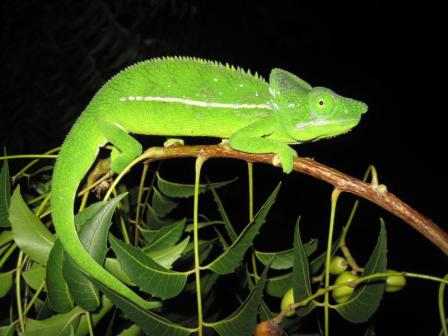
Belalanda chameleon, found only in Madagascar (photo: University of Kent)


 First Light Productions