First Light Productions

investigative journalism

Posts by Michael Elton McLeod

Owl vs Owl — You Choose

Posted on July 24, 2013

Over the next four years the U.S. Fish and Wildlife Service plans to kill 3,600 barred owls to save the spotted owl from extinction.

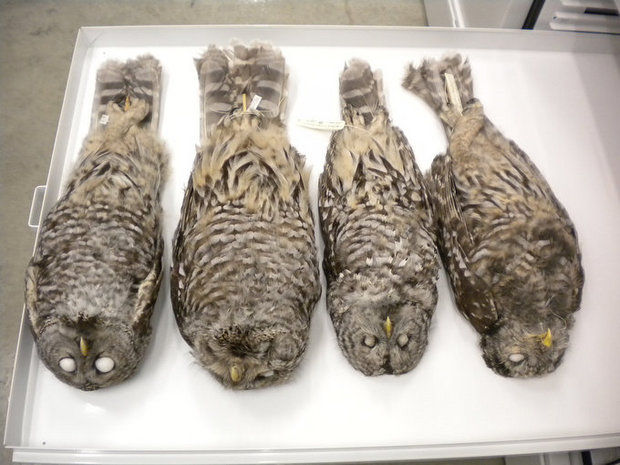
When researchers killed barred owls in a northern California management experiment, threatened spotted owls returned to nesting sites. (Photo: California Academy of Sciences)

Larger and more aggressive than spotted owls, and able to adapt to denuded forest environments spotted owls can’t tolerate (thanks to the forest industry and its mantra of “sustained yield”), barred owls have taken over much of the spotted owl’s territory in Oregon, Washington and Northern California.

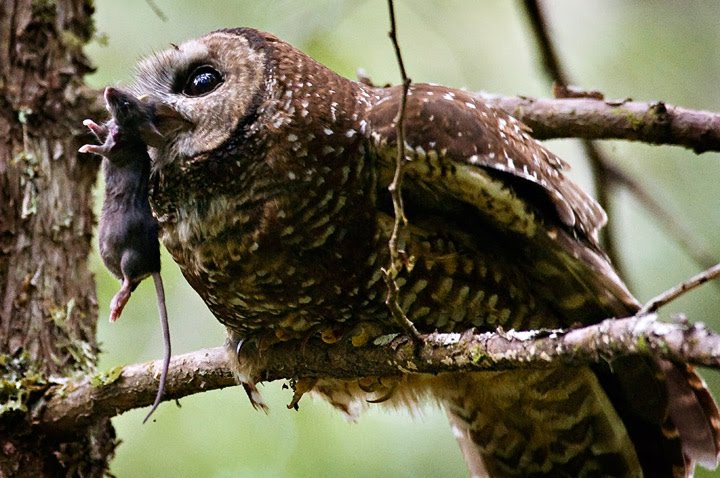
Northern Spotted Owl. (Photo: Robin Loznak)

An ethicist was hired to help guide the decision to do this. Hard to imagine a right answer.


Read the full story on Oregon Live.

Terrible Mouse

Posted on July 24, 2013

A recently compiled Who’s who of Bolivian mammals describes over a hundred species endemic to Bolivia, shedding light on the country’s vast wildlife diversity.

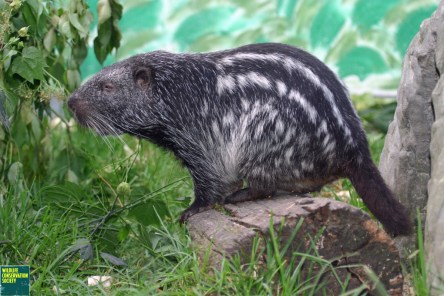
Count Branikii’s Terrible Mouse, also known as a pacarana. Weighing up to 30 pounds and looking like a cross between a Capybara and a skunk, this slow-moving nocturnal rodent is named after a Polish count who first described the species in the 1870s. (Photo: Rene Wuest-ZGAP)

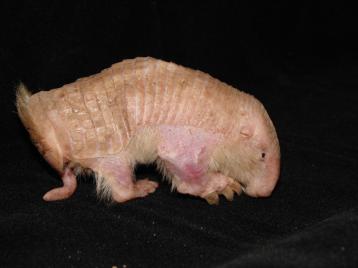
    The survey includes animals ranging from the pacarana to the Tolkein-like Chacoan fairy armadillo.
Armadillo:Bolivia

Chacoan fairy armadillo — A burrowing species that lives in very specific sandy habitats of the Chacoan tropical dry forests in the lowlands of southern Bolivia. (Photo: Luis Acosta)

In between are a host of better known species such as the jaguar, bush dog, black spider monkey, vicuna, giant anteater, and the water opossum,

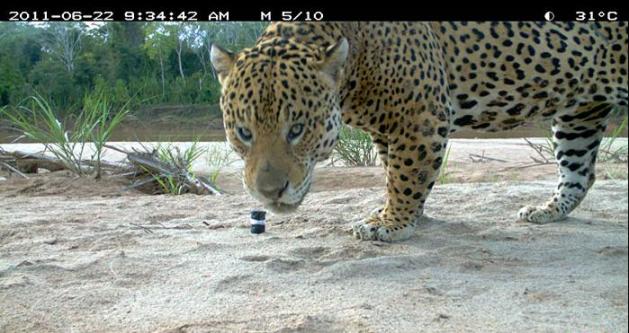
Jaguar/Bolivia. Camera trap photo.

Bolivia is teeming with wildlife. Madidi National park in the northwestern part of the country may be the most biologically diverse place on earth.

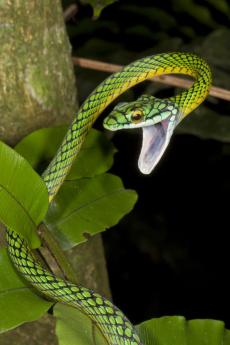
Parrot snake, one of at least 50 species of snake in Madidi National Park. (Photo: Mileniusz Spanowicz/WCS)

    Ranging from lowland tropical forests of the Amazon to snow-capped peaks of the High Andes, the 7,335 square mile (19,000 square-kilometer) park contains 11 percent of the world’s birds, more than 200 species of mammals, almost 300 types of fish, and 12,000 plant varieties.

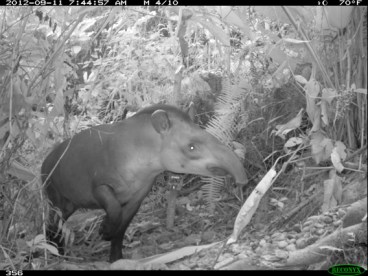
Camera trap image of tapir in Madidi-Tambopata Landscape. (Photo: Wildlife Conservation Society)

Bordering Peru, Madidi is estimated to hold a population of at least 14,500 lowland tapirs making it one of the most important strongholds for the species on the continent. But as elsewhere, species are winking out.

Maned wolf.

    The ancient Beni savanna is home to the Maned wolf. Demand for farmland and pressure to convert the ancient savanna into cattle pasture and soy fields has been disastrous for the species which is fighting for survival. Less than 1000 remain in the wild.

The Barba Azul Nature Reserve is home to the critically endangered Blue-throated Macaw. The bird is almost impossible to see given there are only 300 of them in an area almost twice the size of Texas.

Blue throated Macaw/Bolivia. (Photo: Paul B. Jones)

The bird was thought lost until the discovery a few years ago of a large roosting site.


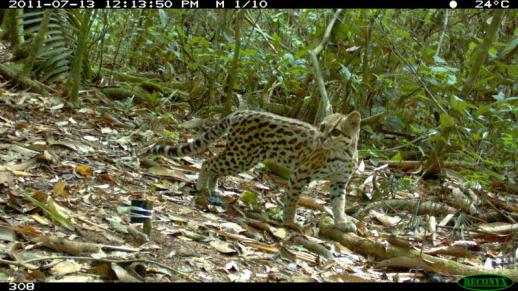
Compiling the database helped biologists in Bolivia identify where there is a lack of information about specific species and geographic areas where few records exist. For example, a small spotted cat called the oncilla is expected to occur across at least 50 percent of the country but there have only been 19 confirmed records to date.

Oncilla/Bolivia. Camera trap photo.


Shout Out: Science Daily.

Acoustic wolves

Posted on July 23, 2013

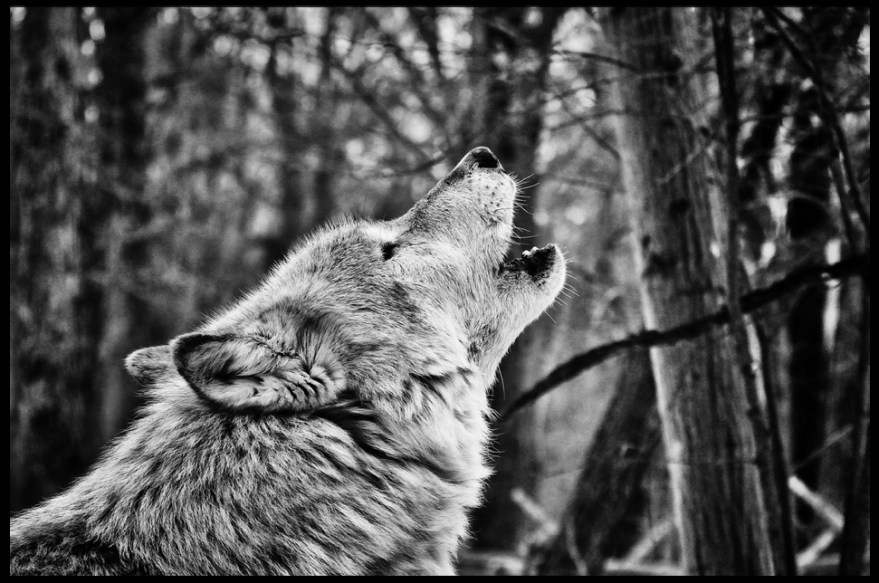
Researchers in the U.K. have designed a computer program that can read the howls of individual wolves with amazing accuracy.

(Photo: CC By-NC-ND)

    With the new program, the researchers catalogued 67 archived calls made by 10 wolves, and were able to identify the solo howls with 100 percent accuracy. In recordings where wolves howled together in groups, the program identified the source of each howl with a success rate of 97 percent.

    The method of identification measures both the pitch of a wolf’s howl and the volume. This gives conservationists a way of tracking the animals as they move with less hassle than using GPS. The system is said to be particularly useful for counting individual pack members.

    In the course of their research the team also deduced that wolves from specific areas may have regional accents.


    Get more detail here.

    Read the full study.

Winking Out

Posted on July 22, 2013

Decimated by overpopulation, pollution, boat traffic, massive dam-building, illegal electro-fishing, and habitat loss, the Yangtze River ecosystem has lost its ability to support marine life.

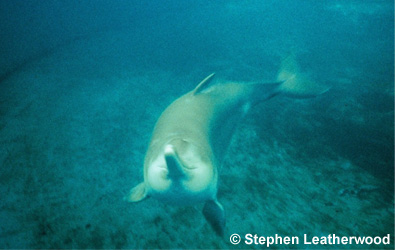
Baiji. (Photo: Stephen LEatherwood)

Six years ago, China’s most revered river animal, the baiji dolphin, a beautiful slender creature long celebrated in stories and legend as the reincarnation of a drowned princess, was declared “functionally extinct.”

The baiji

was usually found in pairs, but also in social groups of 10 to 16. They fed on small, freshwater fish, using their long, slightly upturned beak to probe the muddy river bottom.

It was long known the animal was in trouble. In the 1950’s the Yangtze supported an estimated 5,000 baiji. The population shrank to 300 in the 1980’s. Surveys in the late 1990’s found only 13 individuals. Urgent appeals for effective international action to help save the dolphin were made time and again. But what could be done…

Winked out

Meanwhile, a single male named Qi Qi survived at the Institute of Hydrobiology for more than 22 years. When Qi Qi died in 2002 he was the last of his species.

Baiji, Qi Qi. (Photo: Xiaoqiang Wang. IUCN)

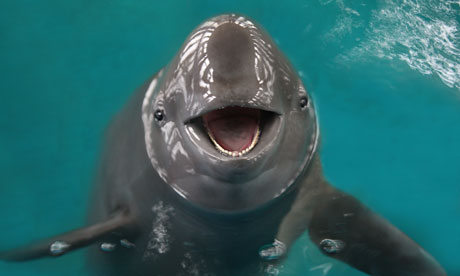
Now the river is about to snuff out the Yangtze finless porpoise (Neophocaena asiaeorientalis asiaeorientalis).

Finless porpoise in the aquarium of a conservation centre in Wuhan, Hubei province, China. (Photo: Yangtze Finless Porpoise Conservation Society)

Known as jiangzhu or “river pig”

and not least for its mischievous smile, the porpoise is reported to have a level of intelligence comparable to that of a gorilla.

Where the baiji was difficult to get close to, conservationists say the porpoise likes to interact, to chat and play.

Thirty years ago the population was estimated at 2,000. A survey last year counted only 1,000. A spike in deaths this year is causing experts renewed anxiety. At least two of the deaths were attributable to electrofishing.

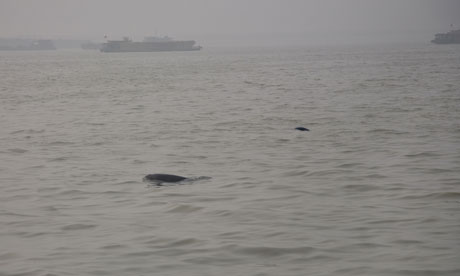
inless porpoise are seen on the busy Dongting Lake in Hunan province, China

Undated photograph. Two finless porpoise are seen on busy Dongting Lake in Hunan province, China. (Photo: Yangtze Finless Porpoise Conservation Society)

The jiangzhu

is decreasing at a rate that makes it rarer than the giant panda, China’s national treasure. The IUCN Red List has downgraded its status from Endangered to Critically Endangered. Conservationists give the dolphins only 10 to 15 years.

Annals of Game Management

Posted on July 19, 2013

Three years ago, wildlife biologists from the Texas Parks and Wildlife Department drove into the paddock of James Anderton’s Whitetail Ranch hunting reserve. Using rifles mounted on tripods they killed more than 70 of Anderton’s animals, shooting for hours, working the panicked herd back and forth across the paddock, picking them off one by one.….

A sharpshooter with the Texas Parks and Wildlife Department guns down deer at the Anderton Whitetail Ranch in 2010.

      A white helicopter with what appeared to be a forward-looking infrared camera mounted to its nose flew lazy loops over the ranch, scanning for survivors.

      Texas wildlife officials were concerned that animals in the herd might be carrying a highly transmissible killer of deer known as chronic wasting disease (CWD).

      Anderton said the deer had been bought in Arkansas, a state with no documented cases of the disease so far. But he couldn’t provide evidence of the state of origin for every animal because he was locked in prison for wildlife trafficking. The FBI and Texas Department of Public Safety had evidence that he was trucking deer in from out of state as well as capturing wild deer.

      Because CWD can be diagnosed only through autopsy, the agency concluded there was only one way to insure the animals didn’t present a disease threat: kill the entire herd.

      Max Dream, the Madera Bonita Ranch’s prized buck, is a semen-producing cash deer. (Photo: Mike Wood)

      Raising game for captive shoots

      is big business in Texas. Breeding deer with giant antlers pays off in the sale of semen and fees hunters pay to walk into a compound surrounded by high wire fence and shoot them. The fee for a prize buck ranges from $7,000 to $25,000. Proponents of the industry say it’s a business that’s keeping failing cattle ranches alive.

      The industry is growing. TPW officials say the number of game ranches is increasing along with the number of animals they’ve had to kill for wasting disease testing. In 2011 Texas wildlife agents killed almost 600 deer.

      Chronic wasting disease

      has been detected in wild populations in 22 states and in 50 different breeding farms. Little understood by researchers, the only means of controlling it is quarantine and the preemptive slaughter of deer like Anderton’s

      Test results showed Anderton’s deer were free of the disease.

      Anderton is suing, claiming the agency violated his constitutional rights by depriving him of property without due process. The complaint poses the legal question of whether the deer are considered wildlife, and thus the property of Texas? Or are they livestock belonging to Anderton?

      If TPW is ordered to compensate the him for the deer they shot, it would signal a fundamental shift in the concept of wildlife as an irrevocable public trust.

    Somewhere in Western Queensland

    Posted on July 18, 2013

    An Australian bushman says he has video footage of the night parrot, a bird thought to have disappeared more than a century ago.

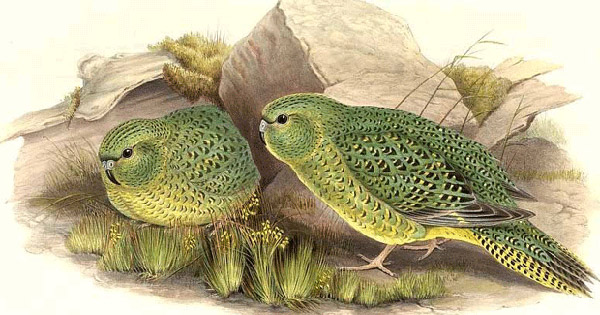
    Night parrot. (Illustration by John Gould)

      The only evidence of the continued existence of the desert-dwelling night parrot, Pezoporus occidentalis, are two dead birds found in 1990 and 2006.

      A senior ecologist at the Anangu Pitjantjatjara Yankunytjatjara Land Management Unit in South Australia, told the Australian Broadcasting Corporation that the finding was a certainty as John Young, who describes himself as a “wildlife detective” has still photos, video and feathers.

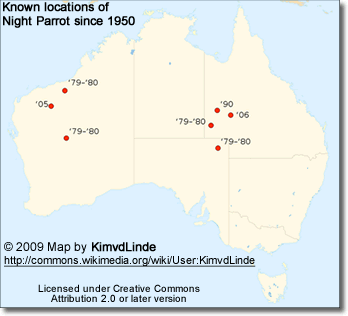
      Night Parrots reported sightings.

      The species fell out of the scientific record in the 20th century until a dead bird was found by a roadside in southwest Queensland in 1990. The discovery sent excited birders into the vast, dry, dusty, inhospitable Australian interior hoping to add it to their life lists. But there were no sightings and the parrot developed a mythological reputation.

        Young, who says he’s been hunting the bird for 15 years, has refused to make public the precise location of the find, somewhere in Western Queensland, in order to preserve the security of the habitat. His photographs and footage were unavailable at this time.


        Source: Mongabay

    Condition X

    Posted on July 17, 2013

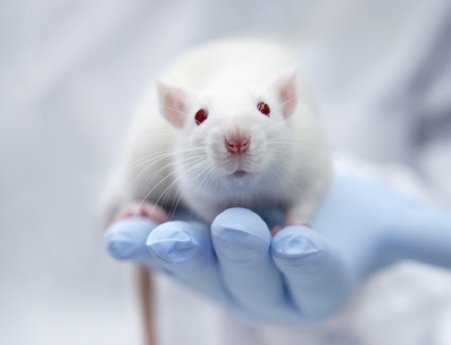
    According to Malcolm Macleod writing in the International Journal Nature, “We are in a golden age of medical research,” where ever more scientists around the world are “spending more money, writing more papers and building more shiny institutes,” searching for new treatments for “Condition X.”

    Many animal studies of neurological disease are often biased, claiming positive results and then failing in human trials. (Photo: Novartis AG)

      The driving engine of this industry is animal research which is used to secure funding for clinical trials using humans.

      Now comes a study from researchers at Stanford University cautioning that animal studies on neurological disorders are subject to considerable bias.

      The study found that a vast number of scientists doing animal research often suppress negative findings and report only the positive, giving the study a better result. This bias helps explain why many treatments that appear to work in animals do not succeed in human patients.

      In addition to a tendency to publish only positive results, the study also found that: animal studies produce many false positives, scientists tend to chose the statistical technique that gives the best result, and that animal studies are not as well planned as clinical trials.

      Among the studies most likely to report an inflated number of significant findings were those with the smallest sample sizes and those that were unbinded (failed to incorporate randomization) which can skew results significantly.

      It was also noted that many biased studies were authored by scientists who reported a financial conflict of interest, that scientists tended to seek out high-profile journals to publish their work, and, even more insidious, was the tendency of journals to publish studies with positive results.

      Underlying the findings is the simple fact that the hugely lucrative animal research industry is running on auto-pilot, reaping such vast rewards for researchers that far too little thought is being given to the ethical implications of wantonly killing vast numbers of living creatures for no good reason.

    Zoo Fail

    Posted on July 15, 2013

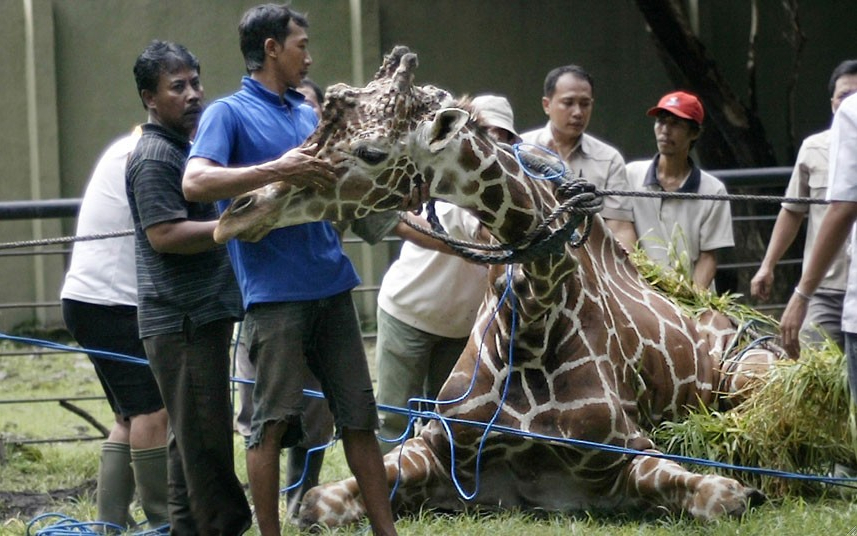
    What did this animal ever do to deserve this?

    In this photo taken March 1, 2012, Surabaya Zoo staff attend to a 30-year-old ailing giraffe named Kliwon. The last remaining giraffe in the zoo died with 20 kilograms of plastic found in its stomach, the latest in a string of unusual animal deaths at Indonesia’s largest zoo.

    The tragic story of the state of affairs at the Surabaya Zoo, In Surabay, Indonesia.

    Saving the Desert Porpoise

    Posted on July 12, 2013

    The Mexican government recently adopted important modifications to their fishing rules in an effort to save the vaquita.

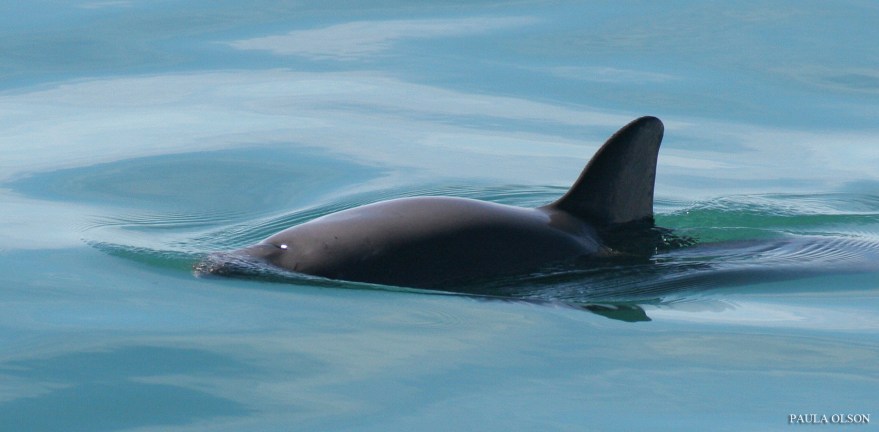
    Vaquita. Pictures in the wild are rare. (Photo: Paula Olsen)

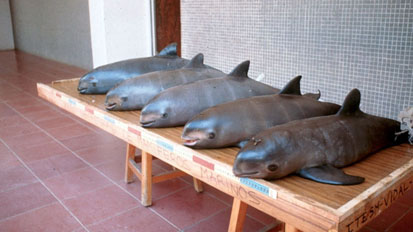
    The vaquita is the world’s smallest (seldom exceeding four feet in length and 100 pounds) and rarest cetacean with less than 200 left alive. It lives solely in the Sea of Cortex in the upper Gulf of Mexico an area surrounded by desert on three sides.

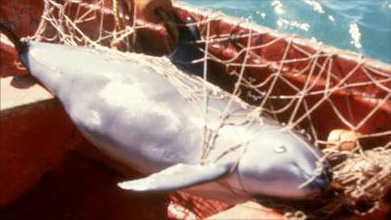
    The main threat to the vaquita is as incidental bycatch in fishing gear, especially gillnets set for shrimp by fishers in the towns of El Golfo de Santa Clara, San Felipe and Puerto Penasco. The majority of shrimp caught in the Sea of Cortez is destined for the U.S. market where it is the nation’s most popular seafood.

    Vaquita bycatch.

    The estimated mortality from gillnet fishing is at least 39 (and maybe as many as 84) vaquitas per year, which is shockingly unsustainable, considering that the total population is only estimated to be 200 or so individuals. The estimated minimum number of vaquita needed to maintain a reproductively fit population is fifty.

    Vaquita bycatch.

      The new rules will require a three-year progressive substitution of porpoise safe nets to replace drift gillnets, one of the main fishing gears in which vaquitas die as incidental bycatch.

    The new net is a small driftnet adapted so it can be deployed from small, artisanal fishing vessels (“pangas”). It has a number of features that exclude capturing smaller and non-target species, and engineering modifications that include a turtle excluder device and rollers and light weight materials that minimize seabed damage.

    Vaquitas, A truly tragic catch. (Photo: Omar Vidal)

      A key to making this conservation measure work is for the Mexican government and other organizations to get buy-in from from local fishermen by providing training in the use of the new light trawls and temporary compensation programs as the fishermen live on their daily sales.

        Bycatch is a problem for cetaceans everywhere. An estimated 300,000 are drowned every year in fishing gear set or drifting lost across the oceans, seas and rivers of the globe. This equates to one cetacean death every two minutes somewhere in the world.
        Go

      here

        to learn more about helping the vaquita.

      Shout Out: Wildlife Extra.

    Africam

    Posted on July 11, 2013

    Courtesy of Elephants Without Borders.

      The date and time is in South Africa which is GMT +2. (Rough estimates on time – USA is 6 hours behind us, Australia is 8 hours ahead. UK / Europe is 2 hours behind.

    Most active time for elephants at the water hole is 11:00 am to 3:00 pm but you will be able to see many other animals at different times of the day. A night light has been installed so there is 24 hour viewing.

      Sponsored by the National Elephant Park, KwaZulu-Natal, South Africa–www.tembe.co.za–and Africam in recognition of Elephants Without Borders outstanding contribution to Elephant research.

      And THERE IS SOUND!

    Dear Lord Burns,

    Posted on July 11, 2013

    A British MP weighs in on the issue of fox hunting.

    Fleeing fox in Britain. (Photo: Vibe Images/Alamy/Alamy)

    Dear Lord Burns

    I refer to my e-mail to you in February. I have delayed writing to you, firstly in order to obtain a copy of my constituent, Richard Matson’s paper described as The hypothetical consequences of closing down a large pack of foxhounds and secondly, because I wished to see the arguments emerging from those who wish to abolish hunting.

    I have always lived in the country and have hunted since I was young. I now represent North Shropshire, which is a rural seat with several flourishing packs of hounds: Sir Watkin William Wynn’s , North Shropshire, the Cheshire and the North Staffordshire foxhounds, the Royal Rock beagles and the Border Counties minkhounds. You have received many submissions, including that from the Countryside Alliance, which I support. I will therefore make my comments general and brief.

    Fox Welfare

    I own a wood of approximately 20 acres. It contains three large earths. Because I hunt, shooting of foxes is forbidden and there is a flourishing and healthy fox population. They are protected for 360 days per years. On two days in the autumn and three days in the winter, they are at risk when the Wynnstay hounds visit. Only the old, sick and weak are generally caught. Hunting is strictly seasonal, so vixens can bring up their cubs in total safety in the spring. In contrast, opponents of hunting propose shooting 365 days a year. The IFAW submission to you, p10, para.2., states night shooting is becoming ever more popular with gamekeepers and is humane. In fact it is indiscriminate; healthy adult foxes and nursing vixens will be just as likely to be shot as older foxes. In all my years of hunting, I have seen numerous foxes which have been wounded by inaccurate shooting. Most farmers own guns; they are not expert shots and shot is not powerful enough to kill a fox. The abolition of hunting would leave many foxes to die long, lingering deaths and I have no doubt that this is significantly more cruel than death by hunting. Farmers in my constituency are adamant that if hunting were stopped, they would eliminate foxes by shooting or snareing.

    Animal welfare groups talk about marksmen; however, given the current law and order debate, it is highly unlikely that any Government would wish to see a proliferation of rifles in the countryside. Although I have lived in the country all my life, I have never met a “marksman” and I fear such a proliferation, because most farmers are not highly skilled rifle shots.

    If hunting is banned, foxes will have to be culled and every alternative is significantly crueller. The tragedy is that it would lead to the disappearance of the fox in many parts of the country.

    Agriculture

    Bordering my constituency are several foot packs, some of which kill as many as 250 foxes in a season. The only way to flush out foxes from a large block of forestry on a steep Welsh hillside is to send in a pack of hounds. If large numbers of foxes are allowed to breed unhindered, sheep farmers who come to Oswestry market would see their industry devastated. The IFAW states that hunting is very unpopular with many farmers. A few farmers do ban hounds from their land, but the vast majority welcome them because fox numbers are controlled and will even call on the hunt to deal with particularly troublesome foxes; surely it should be for the individual farmer to decide, not for national politicians.

    Another hugely important function of the hunt is the disposal of fallen stock; I have read that 400,000-600,000 animals are taken in by hunt kennels. In the past year, the Wynnstay kennels has disposed of 2,400 calves and the North Shropshire kennels nearly 2,000 calves. The hunts provide a free and humane service and if they did not exist, an enormous state infrastructure would have to be established very rapidly to cope with a problem which could become an environmental and animal welfare disaster, if farmers have to kill and bury stock on their own land.

    Horses

    The IFAW submission states that very few horses are used solely for hunting. This is incorrect. I own horses which are too slow, too old and too inagile for other activities, such as cross country, showjumping or dressage. In order to get them fit for hunting, recreational riding is undertaken, but their prime purpose is for hunting. They are all by-products of the racing, point to point, cross country and showjumping industries, all having been bred originally for these purposes. It is vital to understand how hunting underpins the market for specialist horses. A good hunter costs £4000-5000; its value in the Belgian meat market would be about £300.

    Draghunting would not be an alternative use for such horses as it requires particularly bold, fast jumpers and is not an activity for more elderly people or children. My farming constituents with land suitable for draghunting would not tolerate a large increase of draghunting and the majority of land in my constituency is not suitable for draghunting at all.

    Jobs

    The local saddler has told me he would close, with the loss of seven jobs. Local vets, blacksmiths, feed merchants and transport suppliers have all told me that they would significantly reduce their workforces.

    Conservation

    The hunts around here ensure that coverts are well maintained with a mix of undergrowth and mature timber and that not only are hedges maintained, but new ones are laid.

    Hunts play a significant part keeping open bridleways and ensuring bridges over brooks are maintained. It would be tragic if this good work were lost.

    Social Cohesion

    In thinly populated rural areas such as mine, the hunts provide a unique organisation, binding lonely country people together, Throughout the year, there are fundraising events, which re-inforce the community in the best sense of the word. People of every age and an extraordinary diversity of background are brought together by hunting. One of my sons is taken hunting on a quad bike and meets stockbrokers, mechanics, forklift drivers, vets, apprentices and farmers’ sons on level terms. The social dimension of hunting is hugely misunderstood, partly because of the uniform of those who ride horses. The only man I know who wears a top hat to hunt is a window cleaner. Large numbers of people go hunting on foot or bicycle; many of those who do so on a horse can only do so by making great financial sacrifices. These are some of my hardest working constituents and they see no good reason why their pleasure should be taken from them by those who are prejudiced against hunting without understanding it.

    Minorities

    I acknowledge that a majority of those polled in the country have stated that they are opposed to hunting. I also acknowledge that a majority supports the return of capital punishment, which I oppose. I do not understand how a pluralist democracy can function effectively if substantial minority groups have their traditional rights and freedoms taken from them. I suspect that the polls would be different if they asked such questions as would you like your law-abiding neighbour, who drives forklift trucks to be sent to jail and would you like to pay a significant increase in tax to bear the cost of law enforcement of a ban?

    Civil Unrest

    The recent debate on policing rural areas has shown that it is inadequate. North Shropshire currently has the lowest ratio of police to population in Western Europe. I am convinced that the police simply do not have the resources to enforce a ban on hunting. In Welsh border areas, where feelings run extremely high, I have been told many times that people will resort to civil disobedience. I believe that a ban would be unenforceable.

    No one needs to hunt, but nor does anyone need to eat meat. Protein is available without putting a beast through the trauma of an abattoir. Neither activity does any human being any harm at all. I believe that it is a fundamental freedom to pursue activities, so long as no harm comes through them to other human beings. Hunting is one of those rights.
    Duke

    Posted on July 10, 2013

    A nine-year old bucking horse named Duke was electrically shocked out of the chute and died in front of a grandstand packed with spectators at the 2013 Cowtown Rodeo in New Jersey.

    Duke dies a needless and cruel death as public spectacle.

    In a post in Psychology Today, Marc Bekoff, Professor Emeritus of Ecology and Evolutionary Biology at the University of Colorado, Boulder, comments on Duke’s death and calls for a ban on rodeos as “entertainment.”

      The animal advocacy group

    SHARK

      has cited examples of this practice at several rodeos.

    Clear evidence of the use of electric prods, which is apparently widespread throughout the sport, can be seen in the photo below taken last month by a woman at a rodeo in Reno.

    Reno rodeo. Man holds a horse’s tail to the side while another man sticks a prod in the horse’s anus. (Photo: Ellie Lopez-Bowlan)

    Type of electric prod used on Duke.

    Reno Rodeo president John Tipton denied  shocking devices were used.

    Released

    Posted on July 10, 2013

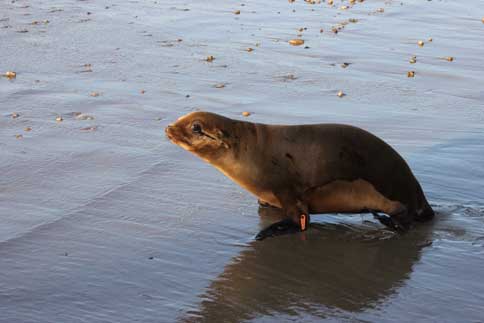
    After weeks of rehabilitation many of the sea lions rescued from Southern California beaches earlier this year have regained their health and are being released back in the ocean.

    Young sea lion pups return to the sea at Point Reyes, California, April 19, 2013. (Photo: The Marine Mammal Center)

      Between January 1 and March 24, the National Oceanic and Atmospheric Administration declared an “unusual morbidity event” during which more than 900 malnourished and weak sea lions were rescued on the region’s beaches. By early April the Marine Mammal Center was providing medical care and nourishment for 165 seals and sea lions, more rescues than in any previous year in the Center’s history.

      Sharp Scissors, one of the sea lion pups rescued from Southern California beaches, returns to the ocean at Point Reyes, CA.. May 24, 2013. (Photo: The Marine Mammal Center)

      So far there is no evidence that the large number of strandings were due to underlying primary infectious disease or toxic insult.

      Young California sea lions at The Marine Mammal Center in Sausalito, CA. (Photo: © Ingrid Overgard/The Marine Mammal Center)

      A preliminary determination of the causes of the strandings points to a simple lack of food. In particular, extremely lows numbers of sardine and anchovies last year which resulted in female adult sea lions having a difficult time providing their pups enough nourishment.

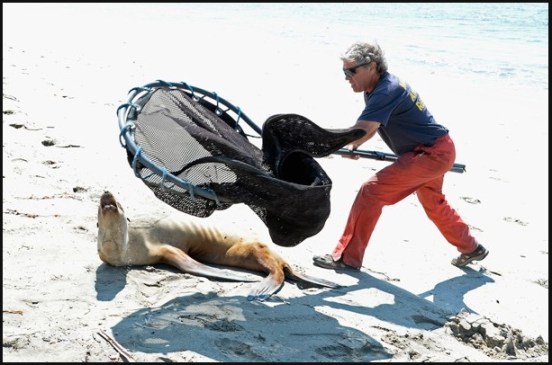
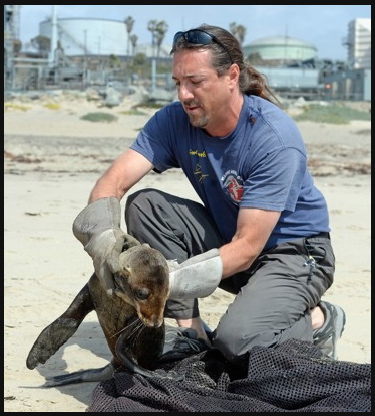
      A stranded and malnourished juvenile sea lion is rescued by Peter Wallerstein, the Marine Animal Rescue director for Friends for Animals. (Photo: Kevork Djansezian / Getty Images)

      The result was a large number of pups either underweight or weaned a month or two early. Those that survived were starving and ended up on the beaches extremely emaciated.

      Mike Remski of Marine Animal Rescue checks for sign of injury after rescuing a malnourished sea lion pup on Dockweiler State Beach in Los Angeles. The pup, was transported to Marine Mammal Care Center at Fort MacArthur for rehabilitation. (Photo: Kevork Djansezian / Getty Images)

      Sea lions are one of the top predators in the ocean. Their suffering is a clear sign something is very wrong with the world’s seas.


      Source: Marine Mammal Center.

    Thandi: Plastic Surgery after Poaching

    Posted on July 6, 2013

    Tisha Wardlow's avatarFight for Rhinos

    Thandi’s story started in March of 2012, when she was brought to our attention after the brutal poaching attempt on her life, along with her companion Themba.  (see previous post http://fightforrhinos.wordpress.com/2013/01/09/thandis-story/)

    Thandi recovered.

    After a long and painful recovery, Thandi survived. But her medical crisis is still not over. Unfortunately all of her skin which healed over her horrible scar, has been torn open after a normal interaction with another rhino.

    The following is a message from Dr. William Fowlds who continues to care for Thandi:

    Day 480 since the poaching of Thandi, Themba and Bull #84.

    “Today we converge yet again on Kariega Game Reserve in support of the rehabilitation of Thandi the survivor of rhino poaching. Following the successes of various phases of her recovery, a recent set-back occurred when her face was damaged by a bull introduced to replace the breeding capacity lost by the poaching incident over a…

    View original post 468 more words

    Ag-gag Marineland

    Posted on July 6, 2013

    Former Marineland of Canada animal trainer Phil Demers worked at Marineland Ontario for 12 years.

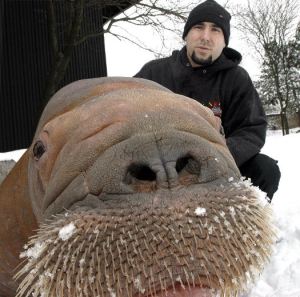
    Former Marineland trainer Phil Demers with pacific walrus Smooshi.

      He was one of eight initial whistleblowers—since grown in number to 15—who told the Toronto Star newspaper last August that poor water conditions at the park had caused blindness and other health problems among seals, sea lions and dolphins.

      After speaking out, Demers and fellow-trainer Christine Santos were sued by Marineland owner John Holer for $1.5 million for voicing their concerns for the animals’ well-being.

      In a recent interview Demers describes conditions at Marineland that are essentially torturing the park’s animals.

      Sea lion Baker has no lens in his left eye. He had to be pulled repeatedly from the water and confined in a dry cage, in one case for more than two months, to limit further harm to his already damaged eyes.

      Larry, the harbor seal arrived at Marineland about eight years ago and is now a shadow of his former self. After repeated exposure to unhealthy water, he has gone blind.

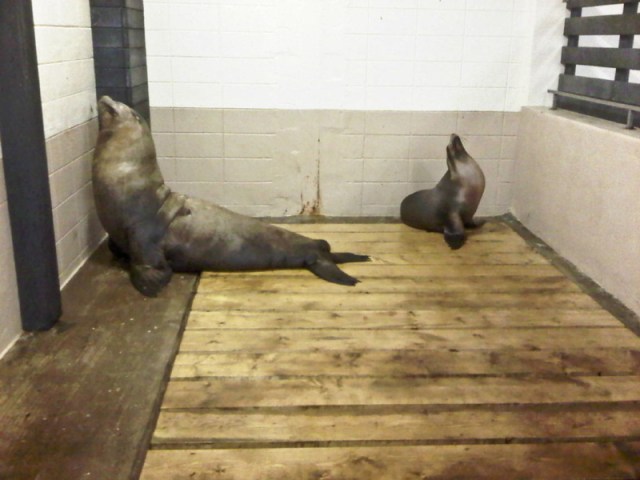
      February 2012 photo shows sea lions Sandy and Baker (left). The pair had to be pulled repeatedly from the water and confined in dry cages, in one case for more than two months, to limit further harm to their already damaged eyes. Videos shot in 2011 and 2012 show them writhing in pain or plunging their heads into a single bucket of clean water.

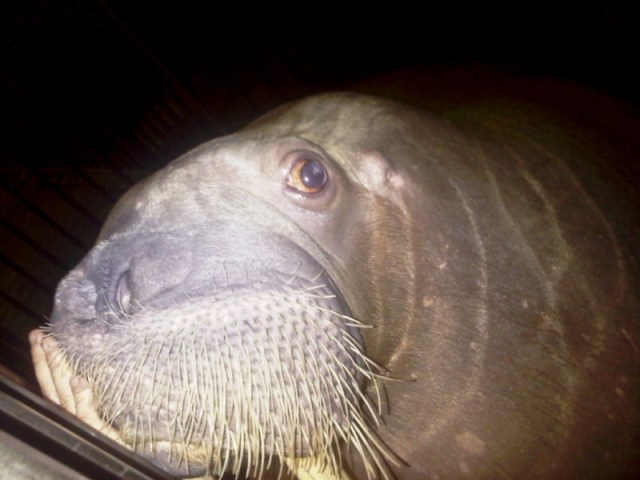
      Sonja, a female walrus show in an April 2012 photo, has suffered eye damage that former trainers blame on poor water conditions at Marineland.


      To follow the story and contribute to the cause of Devers and the other whistlblowers, go to the indiegogo/marineland site, and follow him on twitter @walruswhisperer.

    Border Cats

    Posted on July 3, 2013

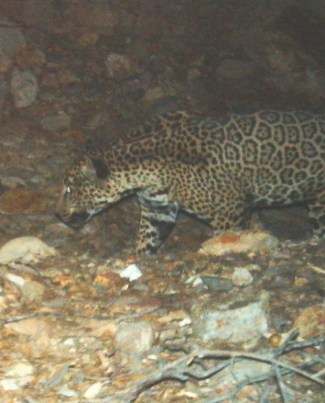
    Recently released trail cam photos are evidence that a jaguar has been roaming the eastern flank of the Santa Rita Mountains in southern Arizona for at least nine months.

    A jaguar prowls the mountains at night on the eastern flank of the Santa Ritas Mountains, southeast of Tucson. (Photo: USF&W)

      Since October, remote cameras have photographed the cat on seven occasions in five different locations. Three of the photos were taken close to the site of the proposed Rosemont copper mine in the Sky Island wilderness, raising the stakes as to whether the mine will be granted a permit.

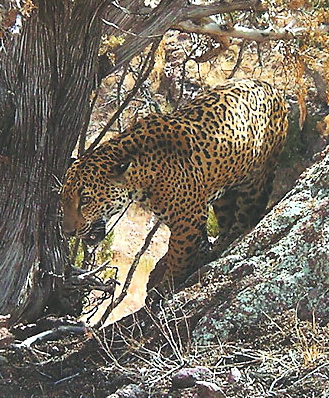
        This is the only jaguar currently known to be extant in the United States. But the cats are no strangers to the area. In February, 2006, in the Animas Mountains, animal guide Warner Glenn photographed a jaguar that his dogs had chased into a big cedar tree. “He did not run,” Glenn said. “He was not afraid of anything.” Later he estimated that the jaguar, by the look of his teeth, was eight or nine years old and weighed nearly 200 pounds. Glenn named the cat Border King.

      Border King in the Animas Mountains, March 7, 1996. (Photo: Warner Glenn)

      Despite photo evidence proving the presence of jaguars in the area, the USF&W dragged its feet developing a recovery plan for the cat as required under the EPA. Indeed, if jaguars were found it would open up the possibility that federal land would have to be put aside as “critical” jaguar habitat, something people in the livestock industry who range their cattle for next to nothing on federal land are dead set against.

      In 1997, the Arizona Fish and Game Department (AFG), with a wink and a nod to the local cattle industry, created the Jaguar Conservation Team (JCT), to “identify” and “protect” jaguar habitat,” believing that no cats would be found, thereby forestalling any usurpation of grazing land.

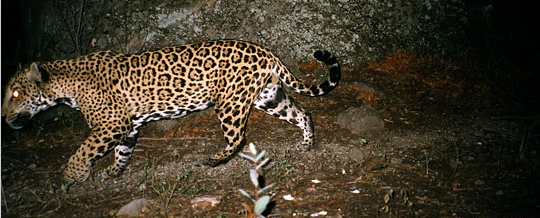
      Before long, remote cameras identified a cat which the JCT team dubbed Macho B. In an attempt to appear it was actually doing something meaningful, the team made plans to capture it and affix a radio-collar. Conservationists warned of the potential risks and questioned the purpose of such a plan and how it fit into protecting the big cat’s future. Non-intrusive methods of research were available, but the Jaguar team swept both objections and suggestions aside. They were dead set on capturing a jaguar. Yet, as an endangered species, to make capturing a jaguar legal, USF&W first had to issue a permit authorizing such a “take.”

      Macho B. (Photo: AZ Dept Fish and Game)

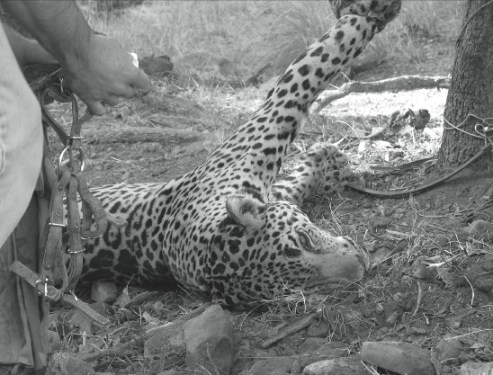
      On February 18, 2009, AFG biologists found Macho B captured in a wire snare. The snare had been set by biologist Emil McCain, who was working as a subcontractor for the department capturing mountain lions and bears for radio-collaring. Ostensibly, snaring a jaguar was a happy accident. The biologists tranquilized, radio-collared and released the cat.

      Twelve days later, after he did not move as far or as frequently as expected following his capture and after he was observed ailing, Macho B was re-captured, diagnosed as terminally ill from kidney failure, and euthanized.

      Macho B snared, Feb. 18, 2009. (Photo: AZ Dept Fish and Game)

      Arizona Fish and Game said the capture was accidental, occurring as part of a bear-lion study. The Center for Biological Diversity called for an independent medical investigation, which revealed that the jaguar’s death was at least in part due to agency mismanagement.

      Investigating Macho B’s death, the Interior Department’s inspector general concluded that AFG did not have a permit for the capture, and stated that skinning the jaguar to preserve the pelt, undertaken instead of a necropsy because a USF&W supervisor was unfamiliar with the word “necropsy,” resulted in loss of information and left doubt as to what had ailed Macho B.

      Although the entire corpse was not made available for a necropsy, some organs were preserved. A veterinary pathologist who examined the jaguar’s kidneys, but whose report was never released, told the Arizona Daily Star that the organs appeared healthy and that Macho B may have just suffered from dehydration.

      Santa-Rita mountains. (Photo: Tom Vezo/Save the Scenic Santa Ritas)

      In May, 2010, Emil McCain admitted in federal court that he deliberately and without a permit captured Macho B by baiting a snare set in a canyon that he knew Macho B traversed and pleaded guilty to a misdemeanor crime: illegal take of an endangered species. (McCain had convinced a female co-worker to plant the bait, and she was sentenced as well.) McCain said he knew there had been recent evidence a jaguar had appeared in the area of the snares as photographs of the cat had been taken near the capture site months earlier. He was sentenced to five years’ probation and fined $1,000.

      Twelve years after it was created, and with little else to show for its efforts, the Jaguar Conservation Team and its powerbroker the Arizona Fish and Game Department, had killed, for scientific purposes but absent the rigor of real science and outside the constraints of federal law, the last known wild jaguar in the United States.

      Now there is another.

      The photos of the new cat were released as USF&W and the Forest Service are wrapping up a draft biological opinion regarding the proposed Rosemont copper mine’s impacts on the jaguar and nine other federally protected species.

      The biological opinion is supposed to examine measures that can ease a project’s impacts on an endangered species. In an earlier biological assessment, the Forest Service wrote that the mine is “likely to adversely affect” the jaguar.

      Despite the cat’s presence the Arizona Fish and Game Department remains opposed to designating the area as jaguar critical habitat, citing lack of evidence of a breeding pair.

      The jaguar’s continued presence in the Santa Ritas and elsewhere in the “Sky Islands” mountain ranges of Southern Arizona shows that jaguars belong in this region and underscores the need to protect their critical habitat, said Sergio Avila, a large cat biologist for the environmentalist Sky Island Alliance.

      Oddly, or perhaps not, the Arizona Daily Star needed a Freedom of Information Act request to obtain the photos.