First Light Productions

investigative journalism

Posts by Michael Elton McLeod

EYOS

Posted on May 14, 2013

Eyos, a female orangutan at the Sepilok Orangutan Rehabilitation Centre in the Malaysian Sabah District of North Borneo, was recently released into the Tabin Forest Reserve. Her reintroduction was part of a post release monitoring project sponsored by Orangutan Appeal UK, in cooperation with the Sabah Wildlife Department.
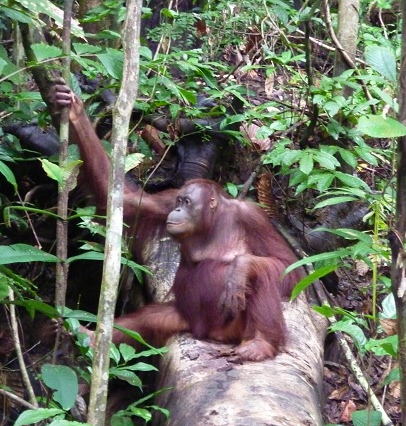
Eyos shortly after release, March 2013. (Photo: Orangutan Appeal UK)

Project Director, primatologist James Robbins, noted that Eyos was getting bullied by many of the other females at Sepilok and clearly needed her own space to live away from other orangutans.

She is the first of six orangutans the team is releasing into Tabin in 2013. All of the apes are implanted with a radio telemetry transmitter so that the team can stay in regular contact with them over the next several years. Wielding antennas, the team follows them 13 hours a day in the forest. The project is the first to use radio-telemetry to track apes in the wild.
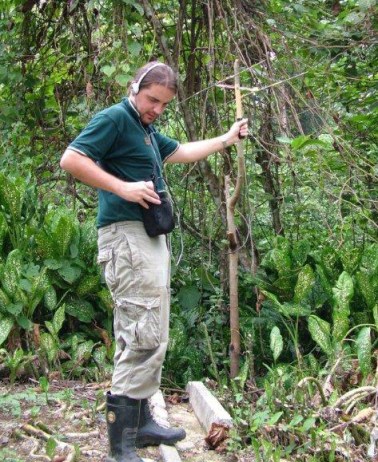
Primatologist James Robins.

The goal of the monitoring project is to obtain data on the behaviour and survival rate of the apes after their release. Orangutans had been released from Sepilok before, but prior to the monitoring project, which began in 2010, no one really knew what happened to them afterward. It was known that many had difficulty adapting to the environment and becoming independent enough to feed themselves as most had been raised by humans since they were rescued as babies.

The Tabin Forest was chosen for releases because it is a large area of protected mixed secondary and primary rainforest with a relatively small orangutan population, yet lots of food and suitable habitat available.

“Eyos is feeding really well so far and has managed to find plenty of fruits on the higher ground in the south of our release site,” Robbins writes. “She has even had some interaction with a wild male orangutan whom she approached last week. After a bit of a standoff that lasted a couple of hours, she got bored and moved on with her day! Eyos is old enough now to be a mother so over the next couple of years, with any luck, we may be reporting news of her getting pregnant with the help of a wild male orangutan!”
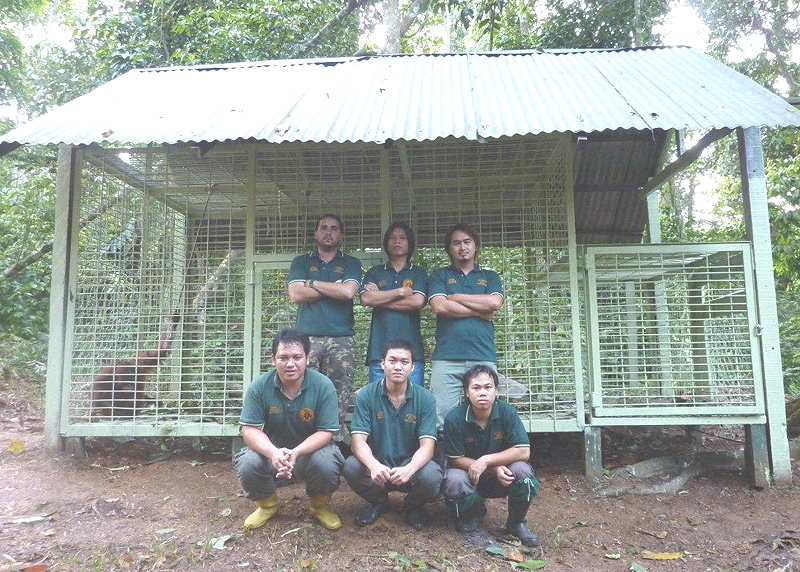
James Robins (top left) and the Tabin team.

Robins is working with the Sepilok Center to formulate a rehabilitation strategy to produce more viable candidates for release. This includes monitoring the rescued apes to ensure they acquire basic survival skills, including a good level of climbing expertise and the ability to make nests in the trees. They also learn how to forage for their food and which plants they can eat and which to be wary of. As their release times approach, they are put into the Kabili Reserve abutting the centre where they are able to visit a feeding platform on the edge of the forest to supplement their diet if they need to.

Robins is looking to compare the behavior of the released orangutans with wild orangutans. If any major deficiencies or abnormalities are noticed, these will be used to advise rehab center managers everywhere on how to most appropriately rehabilitate rescued orphans, so that all of their developmental needs can be met. The ultimate goal is always to release the rescued animals back into the wild.

So far, over a dozen orangs have been released to Tabin. Four have been returned to Sepilok for their inability to adapt. Several released apes have died.

Sepilok Orangutan Rehabilitation Centre occupies a corner of the Kabili-Sepilok rainforest reserve about 25km north of Sandakan, Borneo.

Sepilok Orangutan Rehabilitation Centre is one of only four orangutan sanctuaries in the world. It is located on 43 sq km of protected land at the edge of the Kabili Sepilok Forest Reserve. Around 25 young orphaned orangutans are housed in the nurseries, and 60 to 80 orangutans are living free in the adjacent reserve.

The facility provides medical care for apes orphaned as a result of illegal logging and deforestation, and confiscated orangutans who have been illegally caught and kept as pets. The sanctuary also harbors dozens of other wildlife species, including sun bears, gibbons, Sumatran rhinos and an occasional injured elephant.


The Centre, operated by the Sabah Wildlife Department, has become one of Sabah’s top tourist attractions. Along with its popularity have come problems. At times more than 700 visitors per day can flood the centre, with camera-clicking tourists far outnumbering the primates. Constant contact with humans has exposed the orangutans to diseases, which can make rehabilitation to the wild all but impossible. Expansion plans should solve some of the overcrowding problems.

The sanctuary receives funds from the Sabah Wildlife Department supplemented by an admission fee charged to tourists, who are allowed to visit the centre to witness the feeding times. Funds are limited and, as a result, in past years the Centre has been unable to replace much of its outdated or dilapidated equipment and staffing levels have been at a minimum.
Donations are badly needed.

GIR LIONS

Posted on May 9, 2013

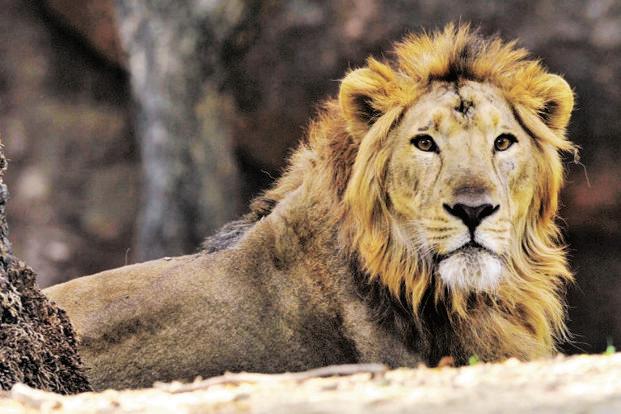
The Supreme Court of India has ruled that a portion of the endangered Asiatic lion population in the Gir Forest be relocated to a second home in Kuno Wildlife Sanctuary in the state of Madya Pradesh (MP).

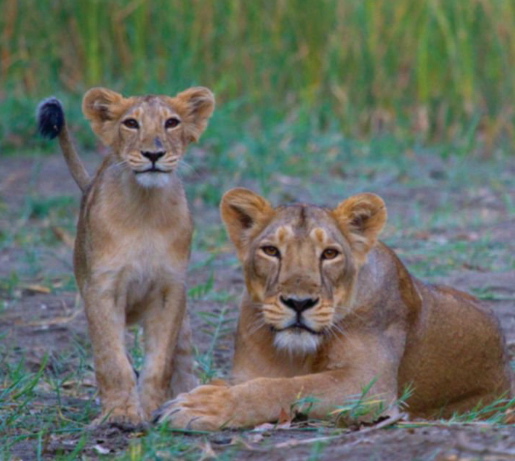
Gir Forest female and cub. (Photo-Kishore Kotecha)

The Asiatic lion was once found across large parts of central and northern India. But centuries of colonization and large-scale trophy hunting decimated the population. By the late 19th century the Asiatic lion was reduced to less than two dozen animals in the Gir Forest, in the Indian state of Gujarat.

Saved by a Prince.

After India received its independence in 1947, the district’s ruling prince placed strict restrictions on hunting the Gir lions and set up lion reserves on the southern tip of the Kathiawar Peninsula which became known as the Gir Conservation Area.

Today, the 560-square-mile Gir National Park and Wildlife Sanctuary, just a few kilometers from the Arabian Sea, holds the world’s last population of Asian (Gir) lions–around 400 animals.

Boxed in

by more than 100,000 people in villages surrounding the forest, the lions’ interactions with humans have become tenuous. With territory in short supply, the big cats have established satellite populations in wooded areas outside the park and human interaction is taking a toll.

India’s leading wildlife experts made the case that, being confined to a single location the lions were subject to extinction from an epidemic or forest fire, and the need to find a second home for the lions was flagged as a priority by the national wildlife action plan.

Researchers at the Wildlife Institute of India identified the Kuno-Palpur Wildlife Sanctuary in the central part of the country as the most promising location. It had space and, most important, potential for a large enough population of animals for the lions to feed on.

Gir forest lion. (Photo: AFP)

Unwilling to Cooperate.

Attached to the lions for social and political reasons, the state government of Gujarat has been unwilling to cooperate. Narendra Modi, the chief minister of Gujarat, made a public promise to his constituency that “Gujarat’s lions will not leave the state”. Many in Gujarat fear that Madya Pradesh, which has an extremely poor record of protecting its tigers, will not adequately protect the cats.

The Supreme Court’s judgment,

issued on April 15, concluded that Kuno had a sufficient density of prey to sustain lions, and that the state of MP had made the necessary preparations on the ground (24 villages were relocated). It therefore ordered the ministry of environment and forests “to take urgent steps for re-introduction of Asiatic lion[s] from Gir forests to Kuno”. The court asked that their order “be carried out in its letter and spirit and within a period of 6 months from today”. it added that there was a need to take urgent steps as “no species can survive on the brink of extinction indefinitely and the probabilities associated with a critically endangered species make their extinction a matter of time”.

Gujarati non-governmental organizations are mobilizing to stop any attempt at taking animals away from Gir and are preparing to file a review petition to prevent the transfer of the first lot of lions from Gir to Palpur Kuno.

SHOOTING ANIMALS

Posted on May 8, 2013

John Stockwell, a Marine and former CIA agent, sent the following message to James Fallows of The Atlantic about why he no longer had any stomach for guns and shooting:

Pavel – Kiev, Ukraine. (Photo: from Italian photographer Gabriele Galimberti’s project Toy Stories — photos of children from around the world with their prized possessions)

I was around guns much of my life. Grew up in the Congo, hunting.  Marine Corps recon, professional training and use. CIA paramilitary, more training and use. Three wars: upcountry in Vietnam I had a bunker full of exotic weapons that had been collected over a ten-year period but were not on the inventory and could not be taken home by our military when they left — we’d take them out and fire them every week; we carried guns everywhere we went, again upcountry just a few miles from the enemy’s battalions; then in the Angola War I hired and organized three bands of professional mercenaries, killers by definition.

In the consulate in the Katanga I had an impressive collection, bought out the weapons of the retiring elephant hunter. And I hunted. And at the family ranch in South Texas I hunted deer and javelinas.

Then I lost all interest in hunting. I killed a beautiful animal and looked at the carcass thinking how much more beautiful it had been alive. I shot a bird and had the same feeling. Both dead so I could have the dubious Freudian pleasure of pulling a trigger and killing them.

The Katanga had been flush beautiful wildlife; it had been alive, the hills crawling with beautiful animals.  Then came independence and arms turned over to the new armies.  And our war in the Katanga (JFK/CIA), thousands of modern semiautomatic and automatic weapons left in the hands of our disbanded army, and the animals were broadly exterminated, the rolling plains were lifeless–we could drive all day and not see an animal.

In Burundi, where I served, President Micombero got himself a helicopter. Began flying around the shores of Lake Tanganyika machine-gunning hippopotamuses in the water.

Recalling as a boy in the Congo driving with my father in a truck across the plains area.  We came on a Belgian who had been hunting all day, had a camera, wanted my father to take a picture of him with his trophies. He stood with his gun and his foot on a pile of 26 heads of little gazelles he had killed. In later years we drove through the same plains, and never ever saw another antelope.

Even here in Austin, we are retired across the street from a lovely quiet park on the river. I walk my dog. Talk to the squirrels – – they sit on limbs not far above my head. Then one morning I found my neighbor down in the park with his son and a 22, killing the squirrels to “teach his son how to hunt.” I pleasantly explained to him that he could teach his son how to enjoy live animals, that the squirrels he had killed were gone, dead. (He won– the park no longer has any squirrels.)


Source: James Fallows.

AG-GAG TENNESSEE RE-DUX

Posted on May 8, 2013

Prominent walking horse show trainer Larry Wheelon, was arrested last week in Tennessee and charged with felony animal cruelty on suspicions of soring.

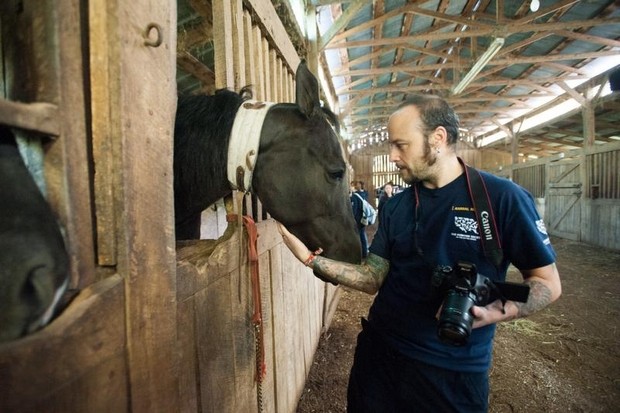
The Humane Society of the United States assisted the Blount County Sheriff’s Office, Blount County SPCA and Horse Haven of Tennessee with the seizure.

“Big Lick”

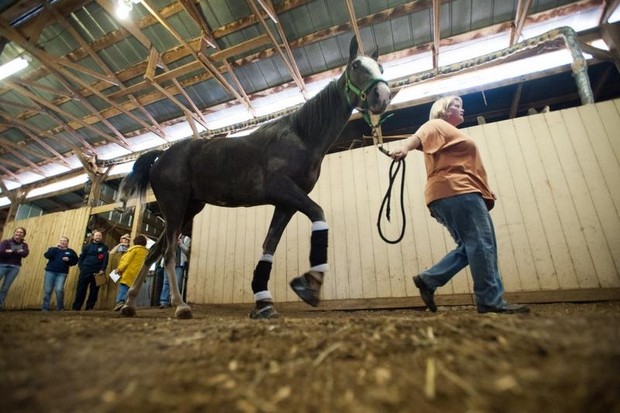
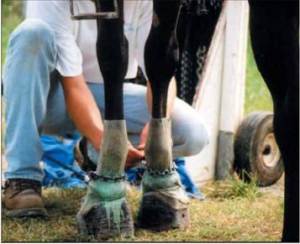
Authorities seized 19 Tennessee Walking Horses from Wheelon’s barn, all suspected of having been subjected to soring—the application of caustic chemicals and painful devices to the hooves and legs of horses to cause the animals to lift their front legs in an unnatural gait called the “Big Lick.”

Authorities transported the horses to safety. (Photo: Kathy Milani/HSUS)

All of the horses confiscated were described as exhibiting visible signs of soring and being in extreme pain. Several were barely able to stand. Some had painful globs of hardened epoxy under their front hooves, which is akin to walking with a big rock in one’s shoe. Others had wrappings on their legs where the burning chemicals would “cook.” One equine expert said that you could tell the horses were in great pain by looking in their eyes which were dull instead of glossy.

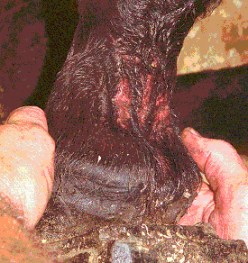
Soring.

Ethics

Larry Wheelon is an active director of the Tennessee Walking Horse Trainer’s Association and sits on its ethics committee. He has been suspended by U.S. Department of Agriculture (USDA) inspectors at least 15 times for violations of the federal Horse Protection Act. He is also an AAA-rated judge with Shelbyville, Tenn.-based S.H.O.W, which stands for “Sound horses. Honest Judging. Objective inspections. Winning Fairly.” All of the USDA-certified horse industry organizations such as S.H.O.W. self-police their competitions.

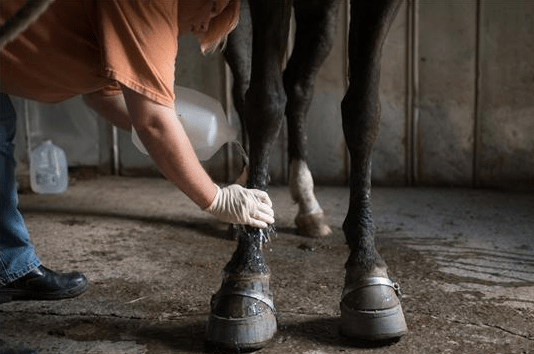
Rescuer washes down the legs of Tennessee Walking Horse to ease the pain of burning chemicals. (Photo: Kathy Milani/HSUS)

Veterinarians and assistants worked into the night removing what is believed to be a mixture of kerosene and cinnamon from the animals. Officials said mustard oil may have also been used but are awaiting lab results from the swabs.

Tennessee walking horse competition poster.

Despite the 1970 federal Horse Protection Act that outlaws the practice, soring is rampant in Tennessee where breeding and showing Tennessee walking horses is a multimillion-dollar industry.

Example of soring. (Photo: Tuesday’s Horse)

Several Walking Horse organizations in the state have actively battled efforts by the USDA, the Humane Society and other animal groups to curb the practice. Wheelon is the first to be charged under a new Tennessee law that makes horse abuse a felony punishable by one-to-five years in jail on each count.

The arrest and seizure were the result of an undercover investigation last year by the Humane Society of the United States (HSUS). An HSUS undercover investigation the previous year led to the arrest of acclaimed Collierville, Tennessee walking horse trainer Jackie McConnell, who has pleaded guilty to federal abuse charges and faces a July trial on 38 counts of animal cruelty.

Ag-Gag

This latest incident comes as Tennessee Gov. Bill Haslam considers an “ag-gag” bill that would ban long-term, undercover animal abuse investigations in the state by requiring investigators to turn their tapes over to police within days of recording them. The Humane Society investigation that netted McConnell took months.

Soring is one of many abuses perpetrated against animals that proponents of ag-gag laws are trying to cover up. Two days ago Animal Post spotlighted one such ag-gag proponent from Tennessee, lawmaker Andy Holt (R-Dresden) who accused the Humane Society of the United States of “using animals the same way human-traffickers use 17 year old women.” Holt referred to undercover animal cruelty investigations as “tape and rape.”


Source: Tennessean/Tuesday’s Horse.

AG-GAG DIVIDE

Posted on May 6, 2013

Tennessee lawmaker Andy Holt (R-Dresden) accused the Humane Society of the United States of “using animals the same way human-traffickers use 17 year old women,” and referred to undercover animal cruelty investigations as “tape and rape”.

Holt made the comments to Kayci McLeod of the Humane Society of the United States after McLeod sent him an email asking him to reconsider his position on supporting HB 1191, a bill which he sponsored. Both emails are below:

    From: Kayci McLeod [mailto:kmcleod@humanesociety.org]
    Sent: Wednesday, April 17, 2013 1:44 PM
    To: Andy Holt
    Subject: Please Oppose HB 1191

    Dear Representative Holt:

    Have you seen the editorial in the Tennessean today opposing HB 1191, the whistleblower suppression bill intended to cover up animal cruelty? The Tennessean editorial board condemns the bill, noting that the “bill would certainly take our state in the wrong direction, toward more senseless violence.

    We very much hope you’ll agree with the Tennessean and oppose this dangerous bill. Thank you for your time and consideration.

      Kayci McLeod
      Public Policy Coordinator
      Farm Animal Protection Campaign
      The Humane Society of the United States

      Rep. Holt’s response:

      Andy Holt, (R-Dresden) sponsored “Ag Gag legislation that would effectively ensure minimal prosecution of alleged livestock abusers in Tennessee.

      Sent: Wednesday, April 17, 2013 11:26 PM]

      To: Kayci McLeod
      Subject: RE: Please Oppose HB 1191

Ms. McLeod,

I am extremely pleased that we were able to pass HB 1191 today to help protect livestock in Tennessee from suffering months of needless investigation that propagandist groups of radical animal activists, like your fraudulent and reprehensibly disgusting organization of maligned animal abuse profiteering corporatists, who are intent on using animals the same way human-traffickers use 17 year old women. You work for a pathetic excuse for an organization and a pathetic group of sensationalists who seek to profit from animal abuse.

I am glad, as an aside, that we have limited your preferred fund-raising methods here in the state of Tennessee; a method that I refer to as “tape and rape.”

Best wishes for the failure of your organization and it’s true intent.

    Andy Holt

    State Representative – District 76
    Weakley & Northern Carroll Counties
    205 War Memorial Building
    301 6th Ave. North
    Nashville, TN 37243
    615.741.7847
    rep.andy.holt@capitol.tn.gov


    Source: Habitat for Horses.

TOURIST ANIMALS

Posted on May 2, 2013

Repeated complaints from tourists who visited the northern Peruvian village of Dos de Mayo, Sauce, in the province of San Martin, about the large amount of wildlife used to attract tourists for photo opportunities and to sell as pets or body parts, prompted an intervention and rescue by the group Neotropical Primate Conservation (NPC).

Boas. (Photo: Neotropical Primate Conservation)

NPC visited the village before the rescue disguised as tourists and found animals kept in appalling conditions. Two boa constrictors, used as photo props, had their teeth pulled out and the mouths wrapped with duct tape—apparently, a few months ago another boa bit a visitor’s cheek off when placed on her neck for a photo.

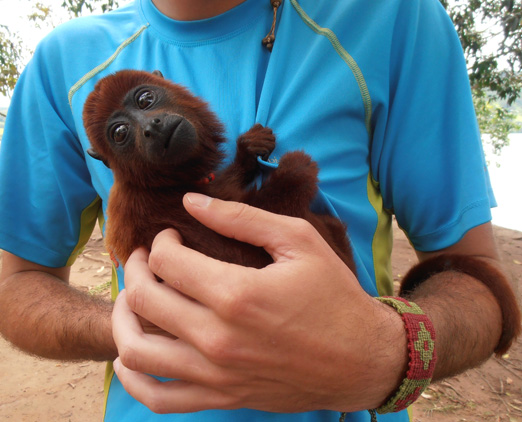
In the worst condition was a terrified infant howler monkey who was being offered to tourists for photographs. Howler monkeys are a protected species in Peru and are extremely sensitive to captivity.

NPC took photos of all the animals and returned the same day with San Martin Government officers, police, and the public prosecutors of Sauce and found most of the owners had taken their animals and fled.

Infant howler monkey. (Photo: Neotropical Primate Conservation)

The authorities explained to neighbors and the village authorities that those who didn’t give up their animals would face legal problems and grave economic costs and possible imprisonment. The police made it clear they would return shortly with a search warrant and legal proceedings would be begun against those who refused to cooperate. Three people came forward and voluntarily handed over their animals: a tamarin monkey; a boa constrictor; and a parrot. They will have no legal consequences for their illegal use of wildlife apart from warnings.

The high amount of wildlife in this village is due to a recent increase of tourism. Tourists, be they international or national, generally do not understand the damage they cause when they pay to have their photographs taken with wild animals, purchase one as a pet, or buy a body part. Poaching animals for the tourist trade is an enormous problem worldwide. It is especially acute throughout South America.


NPC cautions, when traveling and you see wildlife used as a tourist attraction, do not pay for it!

CONDORS AND LEAD

Posted on May 2, 2013

Seven of the 80 wild condors that soar over the Grand Canyon and surrounding areas have died since December. Three of the deaths have been conclusively linked to lead poisoning from ingesting spent lead ammunition fragments in carrion. Lead poisoning is also suspected in the other four deaths.

California condor. (Photo: Daniel George)

California Condors are the largest birds in North America, and one of the most endangered, protected animals in the U.S. Barely more than 400 are known to exist both in the wild and in captivity. Nearly half the birds reintroduced into Utah and Arizona since 1996 have died or disappeared. The leading cause of death is lead poisoning caused by eating carrion killed by hunters using lead bullets and shotgun pellets.

Lead poisoning is said to affect several other species, including the golden eagle and the turkey vulture, but affects the condor in particular, as they eat more and have powerful digestive systems that quickly dissolves lead which leaches into their bloodstream. The animals feel the effects within days. Lead poisoning paralyzes the digestive system often killing the animal slowly through starvation. Ingested lead is dangerous even at extremely low levels.

The research

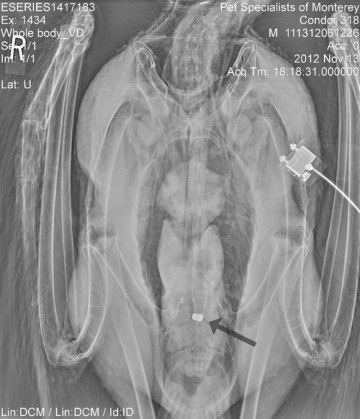
linking lead poisoning in condors to lead from spent ammunition is conclusive. Case in point: a 10 year-old male condor (#318), found inland from Big Sur in west/central California on a ranch near Pinnacles National Park, last November. The bird was barely alive and unable to feed or use its legs to stand. Veterinarians could not save it. A necropsy determined the cause of death was lead toxicosis. A radiograph showed multiple metal fragments and a bullet-shaped object in the digestive tract. The object was removed and found to be a .22 caliber lead bullet.

Radiograph of condor #318 with lead bullet. (Photo: Ventana Wildlife Society)

    The death of condor #318 was a huge loss for the central California population. The bird was a breeding male, the first at Pinnacles National Park in more than 100 years. With only a few breeding pairs established in the region, his loss leaves a void which might not be quickly filled. His surviving mate has left the breeding territory and it is not clear if and when she will pair with another condor and breed again. The loss of even a small number of breeding pairs, and the offspring they produce, puts the entire population at risk.

    Volunteer efforts to reduce lead ammunition around the Grand Canyon aren’t getting the job done. Most of the remaining wild Grand Canyon condors need regular, emergency blood treatment for lead poisoning to save their lives.

    About two dozen states have partial bans on hunting with lead bullets and/or shot, mostly in sensitive wildlife refuges. In California, hunting with lead bullets is prohibited in eight counties. In 2007 California passed AB 711 which banned the use of lead ammo for hunting in the roosting and scavenging territories of the condor, but the birds are still dying from ingested lead. The continuing mortality of the birds has California activists and legislators once again considering banning the use of lead ammo for hunting. A bill has been introduced to make the ban statewide. The new bill, which is expected to pass, would expand AB 711 to the entire state. A similar bill to ban the use of lead ammo for hunting was shot down in 2010. The EPA similarly rejected a nation-wide lead ammo ban in 2010.

    California condor: (Photo: The Peregrine Fund)

    The U.S. Geological Survey estimates that nationwide there are 400,000 pieces of lead shot per acre in wild game territory that can be eaten or washed into waterways, and that the 60,000 metric tons of lead fired off in 2012 is second largest use of lead behind storage batteries.

    Lead is by far the leading cause of death for the remaining 234 California condors left in the wild.


    Source: Center for Biological Diversity and Ventana Wildlife Society.

WORLD’S RAREST CAT

Posted on April 30, 2013

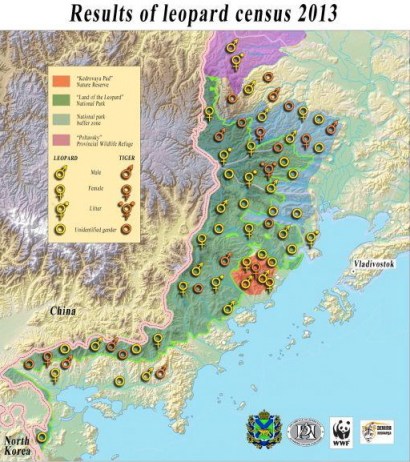
The 2013 census of critically endangered Amur leopards in the Russian Far East shows that the populations of some wild groups of the big cat are growing.

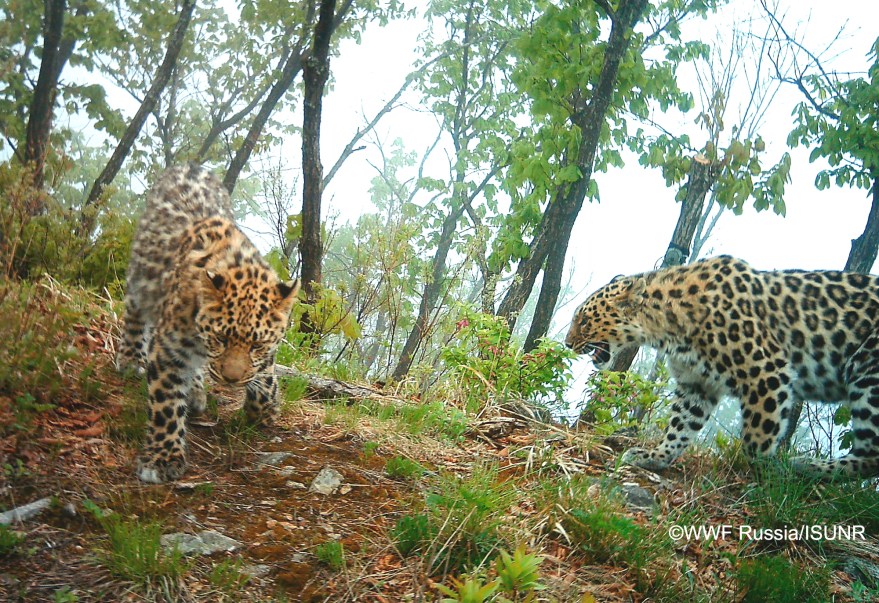
Camera trap photo of Amur leopard mother and cub, Kedrovaya Pad Nature Reserve, Primorsky Province, Russia. (Photo: WWF Russia/ISUNR

The most recent census shows “not less than 50” Far Eastern leopards now live in the Russian Far East. The 2007 census found evidence of 27-34 individuals. The leopards have expanded their territory to the north, west toward the coast, and south, where a leopard was recorded on the border with North Korea where no leopards have been observed for a century.

The leopard’s tenuous rebound is due in large part to State support for the establishment of the Poltavsky Provincial Wildlife Refuge, a large unified network of hundreds of thousands of hectares of protected areas known as “Land of the Leopard.”

Big cat competition.

The winter census also revealed 23 Amur tigers living in the territory, double the number of 5 years ago. Biologists suspect that the prey base of Amur tigers and leopards in the southwest  has begun to overlap and there is growing competition between the two rare cats. Trackers in the 2013 census found two cases where a tiger chased a leopard. Only the advanced tree-climbing skill of the leopard saved them. Over the past years at least three leopards are known to have been killed by tigers.

(Map: World Wildlife Fund/Russia)

Chinese border leopards.

A relatively large quantity of leopard prints were found along the border with China. The cats’ territory inside China is unknown as the Chinese have not conducted a census. Last year a minimum of 5 different leopards were photographed by camera traps in border regions; Chinese specialists suggest that 8-11 cats inhabit the Hunchun, Wangqing, and Suiyang Nature Reserves, mostly in the vicinity of leopards registered in the Russian border zone.

Census organizers express their gratitude to Russian border guards for taking active part in the census on the territory they patrol. They provided transportation, shared their excellent knowledge of the surveyed area and provided security along the routes.


Source: Wildlife Extra.

TONY INCHES TOWARD FREEDOM

Posted on April 30, 2013

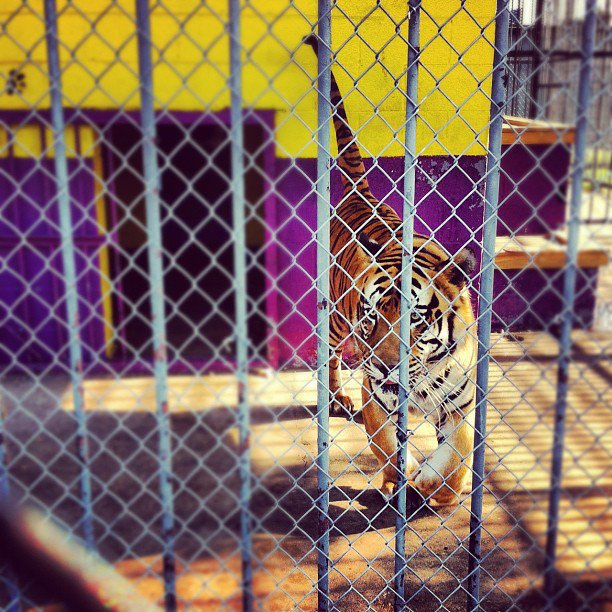
The Louisiana Court of Appeal ruled last week that the permit held by the Tiger Truck Stop in Grosse Tete, La. to house Tony, a 550-pound, 12-year-old Bengal-Siberian tiger who lives in a 40-by-80-foot pen on the premises was invalid.

Tony. (Photo: S. Zaunbrecher)

The battle between truck stop owner, Michael Sandlin, the Animal Legal Defense Fund and other animal rights advocates to free Tony from his concrete cage, has lasted more than five years.

The three judges upheld an order barring the Louisiana Department of Wildlife and Fisheries from granting a new permit to Sandlin or the truck stop to continue housing the animal because neither could prove rightful ownership.

Tony will remain in the cage where he was born and raised until all the appeals have been completed. If the truck stop loses the right to keep the animal, he will likely be sent to an animal sanctuary.


Source: Animal Legal Defense Fund.

HOW ANIMALS GRIEVE

Posted on April 28, 2013

    In an adaptation from her new book, “How Animals Grieve” (University of Chicago Press), Barbara J. King, a professor of anthropology at the College of William and Mary, explains why grief may be an emotion many animals share.


    Source: New York Post.

DRIFTNETS

Posted on April 27, 2013

A newly published National Marine Fisheries Service (NMSF) review of marine mammal bycatch in commercial fisheries, ranks California’s drift gillnet fishery for swordfish and thresher shark as the most dangerous fishery for whales and other marine mammals along the U.S. West Coast from California to Alaska. 

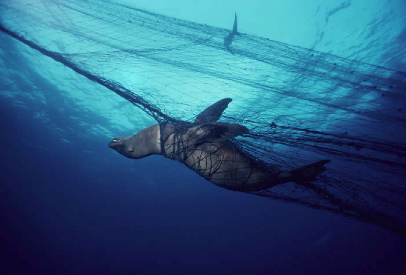
Sea lion in drift net. (Photo- NMFS)

    The report is long overdue. The bycatch in this fishery has been recognized as a serious problem for decades. But government funding for research necessary to establish data needed to set regulations to address the problem has not been forthcoming.

    While most gillnets have been banned in California because of their deadly toll on endangered wildlife, the state’s drift gillnet fishery targeting swordfish and thresher shark has continued to operate.

    Gillnets, a mile-long or more, are set at dusk. Hanging like invisible curtains in the water, they drift freely unselectively entangling all marine life traversing through the open ocean. They are retrieved the next day and the “bycatch” is thrown overboard.
    For every five swordfish caught in 2011, one marine mammal was killed and six fish were tossed back dead. Over the past decade, more than 1,000 sea lions, dolphins, whales and turtles drowned after getting tangled in drift gillnets.

    Divers attempt to free a gray whale from entanglement in a drift gillnet. (Photo: Bob Talbot/The LegaSea Project)

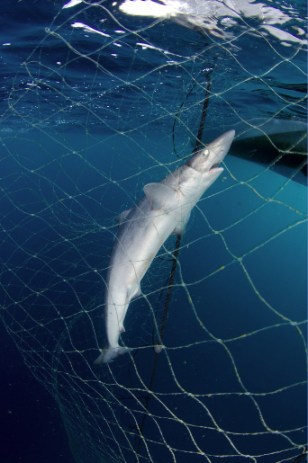
    The nets are particularly devastating to sharks of many species.

    Shark in drift net.

    The fishery accidentally captures and kills about 3 sperm whales a year, a rate that is more than double the number that biologists say the West Coast population can sustain without risk of extinction. The mainstays of the whaling industry in the 18th and 19th century, sperm whales are found year-round in California waters. They have been listed as “endangered” since 1970.

    Sperm whale pair. (Photo: National Marine Fisheries Service)

    Washington and Oregon have banned the use of drift gillnets off their coasts.

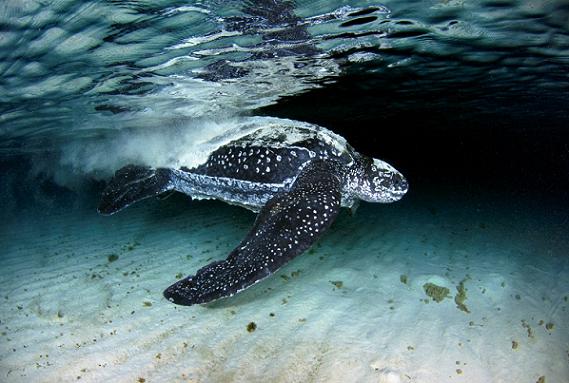
    Leatherback sea turtle. A frequent victim of drift gillnets (Photo: Jose Alejandro Alvarez)

    In 2014, federal fishery managers are slated to consider another proposal for allowing driftnets into sea turtle habitat southwest of Monterey, California.

FOLIAGE FOX

Posted on April 25, 2013

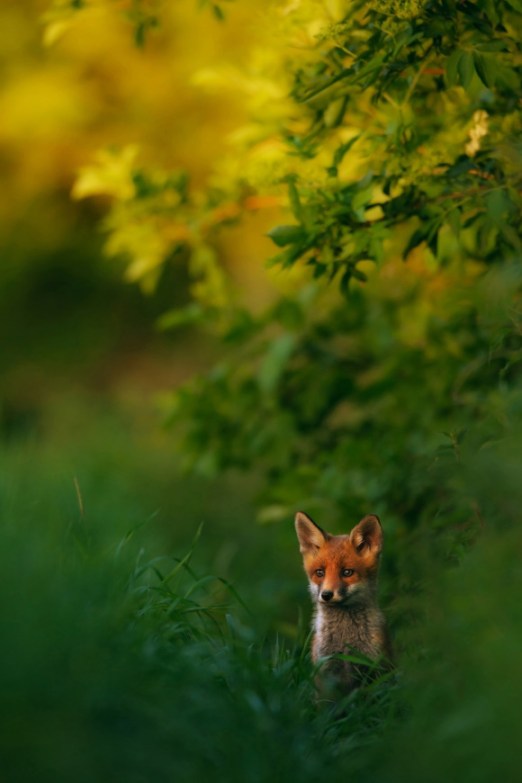
(Photo: Herman Hirsch)

Winning entry in the Society of German Nature Photographers‘ annual contest, taken by Herman Hirsch.


Source: Daily Dish.

VIDAAR AND LUCIA

Posted on April 25, 2013

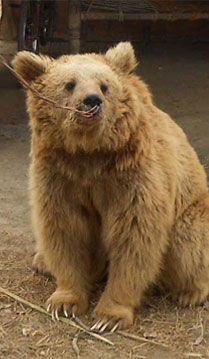
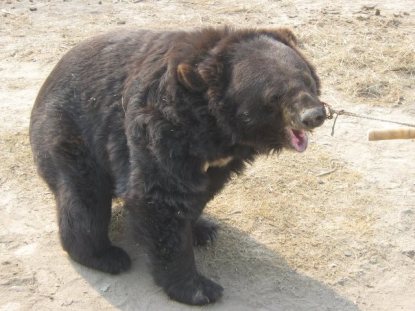
Last month the World Society for the Protection of Animals (WSPA) and its partner in Pakistan, the Bioresource Research Centre (PBRC), rescued two more bears from the bear baiting trade: a male Asiatic black bear named Vidaar, meaning “forest warrior,” and a female Himalayan brown bear named Lucia.

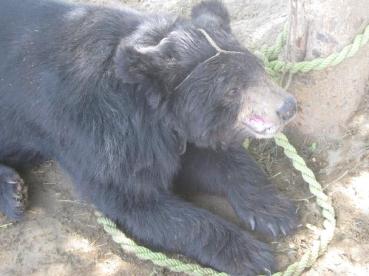
Vidaar. (Photo: BRC, Pakistan)

Both animals were in weak and starving conditions. Vidaar had been identified by PBRC in 2012 as a priority bear in need of rescue. A key part of the success of such rescue efforts has been the alternative livelihood (AL) program run by the BRC team in which a bear owner is helped to choose an alternative profession with the aim of providing him and his family with a steady and sustainable source of income, allowing the owner to give up the animal. And so it was that after months of negotiations his owner agreed to give Vidaar his freedom.

Lucia. (Photo: BRC, Pakistan)

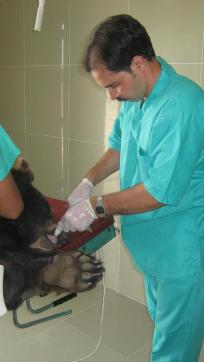
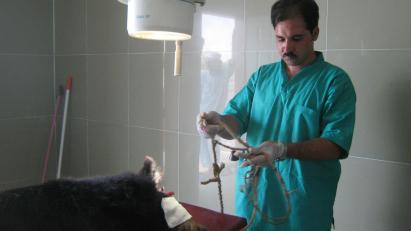
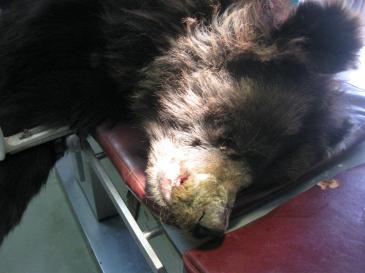
    Lucia, meaning ‘light’, had been neglected and severely malnourished for years. She had been used for about a year in baiting. On arrival at the sanctuary she was fearful of people and cowered in her cage. She was sedated so the veterinarian could free her from her nose ring and neck rope. A health check showed that her lungs, pancreas and liver were diseased and she was suffering from infection. She was placed into the quarantine area where she received round-the-clock medical care. The bear initially began to show signs of recovery, but the infection worsened and she passed away.
    Vidaar had been used in baiting for nearly four years and had suffered a significant number of injuries.

BRC Sanctuary Manager removing ring and nose ropes.

His wounds were treated and his neck rope (used to tether him to a post in baiting arenas) was removed.

Ropes gone, free forever.

He is recovering in the quarantine area and eating well. When he is strong enough Vidaar will join the other rescued bears in the Balkasar Sanctuary.

Recovering from ring/rope removal.

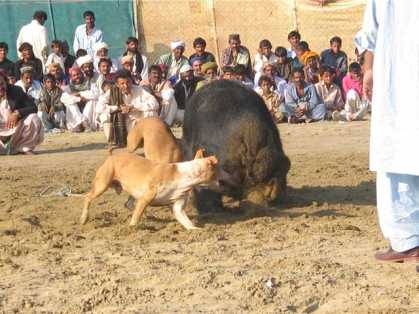
Bear baiting is a popular spectator sport In rural Pakistan, where thousands assemble to watch a tethered and clawless bear set upon by trained fighting dogs.

Bear baiting, Pakistan.

    The practice is banned by the Pakistan Wildlife Act and contravenes Islamic teachings, which forbid the baiting of animals, but in rural areas it is a long standing tradition. The brutal contests are organized by powerful local landlords who own and train the dogs. The bears are furnished by traditional bear owners called Kalanders.

Bear baiting, Pakistan.

    Bear baiting events are usually held during a festival or at the great dargahs or the hawelis of these landlords. They range from small events with one bear and few dogs, to gatherings featuring as many as ten bears and more than forty dogs.

      Since 1997 the WSPA and its local partner in Pakistan, the Bioresource Research Centre (PBRC) have helped reduce the number of bears being used in the brutal ‘sport’ to around 50. WSPA and PBRC have employed a number of tactics to reduce the number of bear baiting events and when possible rescue the bears. Other rescued bears:

Robin before rescue.

Yarrow.

Shabnam before rescue.

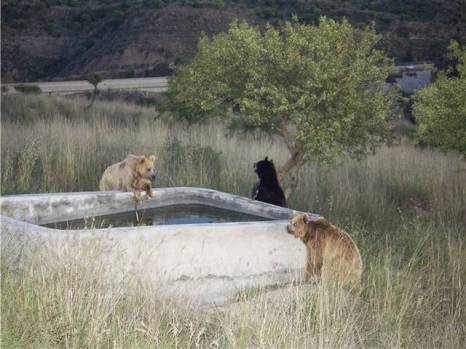
The Balkasar Sanctuary has two main electrically fenced enclosures, with water pools and ponds, a clinic for health checks, treatments and minor operations, and quarantine areas.

Balkasar Sanctuary for bears rescued from bear baiting.

Balkasar Research Complex and Sanctuary.

TO HELP RESCUE THESE BEARS

and support the Balkasar Research Complex and Sanctuary, become an Animal Protector with WSPA.

VICTORY FOR COLORADO DOGS

Posted on April 23, 2013

No longer will the police officers of Colorado be allowed to kill family dogs as a line of first defense.

By a vote of 64-0, the State House in Colorado yesterday passed bill SB226 requiring police officers to take mandatory canine behavioral training. The bill, dubbed the Dog Protection Act, is now on its way for Colorado Governor John Hickenlooper to sign. It passed the Colorado Senate on April 3.

Colorado is the first state in the nation to pass legislation requiring law enforcement officers to attend mandatory training on canine behavior.

Chloe.

The legislation was spurred by an incident involving a 3-year-old dog named Chloe. Chloe was staying with a relative while her owner, Gary Branson, was out of town. She escaped through an open door. A neighbor called police who cornered her in a garage, caught her on a catch pole, at which point an officer shocked her with a taser, then shot her five times.

The police claimed the dog was aggressive, but a neighbor caught the incident on cell phone video. Looking at the tape one can’t escape the conclusion that the dog was wary of being menacingly cornered by multiple strangers and only tried to escape the situation.

The officer who shot the dog, Robert Price, is facing a felony charge of aggravated cruelty to animals.

Branson said he still hasn’t been able to watch the video.

Researching the legislation, the bill’s sponsors, Senators Lucia Guzman, a Democrat, and David Balmer, a Republican, discovered that Colorado officers had shot and killed 37 dogs in the last five years. Many of the dogs shot were beloved pet, service and companion, sporting and working dogs, most which were docile and well-trained and had no history of threatening behavior. In many of the cases the dogs were shot despite not exhibiting any signs of aggression. Guzman and Balmer believe the training will help officers identify canine behaviors and learn how to use alternatives to lethal force.

Two other high profile Colorado cases helped push the measure along:

Brittany Moore and Ava.

In Erie, Colorado, Brittany Moore called for police help after receiving a threatening phone call. Officer Jamie Chester responded to the home and then wound up shooting and killing the family dog, Ava. “The dog was coming at me and had lunged at me,” Chester said, “I felt like it was attempting to bite me.”

The shot severed Ava’s spinal cord and disabled the dog’s legs. Moore said she wasn’t permitted to be with Ava as the dog slowly died.

The Boulder County District Attorney found that Chester had a reasonable fear he would be seriously injured and cleared him in the shooting. Moore has sued Chester and the town of Erie in federal court over the incident. “Their findings are incorrect,” said Moore’s attorney, Jennifer Edwards, with The Animal Law Center. “We have a number of witnesses that say the exact opposite of what those findings say.” The family released a video and has three witnesses who say Ava did not show any aggressive behavior toward the officer at any time. On the video, taken moments after the shooting, you can hear a man say, “It was the kindest, gentlest … that dog was. Really have no idea what that was all about.” No ruling has been made in the case yet.

Ziggy.

In Adam’s County, Colorado, Jeff Fisher watched as a deputy shot and killed his dog Ziggy in front of his workshop after the deputy entered the wrong building while responding to a burglary alarm.
 “Ziggy ran past the police officer at the door and he just wanted to see who it was and the police officer shot him three times,” Fisher told 7NEWS reporter Amanda Kost. “He killed my dog for no reason, no reason at all.”

    Police departments usually claim such shootings are justified because the officer felt threatened by the animal. But an officer’s perception doesn’t always mean the animal actually was a threat. The “tact squad” mentality that seems to have infected many cops nowadays and may be contributing to their eagerness to pull the trigger, is being exposed by Websites such as: “Dogs That Cops Killed“, and the Facebook group “Dogs Shot by Police“. The incidents described on these sites can break your heart.

    Cisco.

    In Austin, Texas, Michael Paxton was playing fetch in his backyard with his Australian Cattle dog Cisco when a police officer pulled into the driveway in response to a 911 call regarding a domestic dispute. Again, the officer had the wrong house. When Paxton left the yard to get something from his truck, the officer confronted him. Cisco ran around from the back, toward the officer. The officer simultaneously ordered Paxton to put his hands up then shot the dog. The officer claimed he was defending himself from the dog. Paxton said that isn’t true. “The dog ran to his feet, he lowered his aim and shot the dog and raised his aim back up at me and told me to get back,” Paxton said. “My dog never made a move to attack him other than challenging him and barking. He ran to his feet.” Paxton has created a Facebook page called “Justice for Cisco.”

    Rosie.

    In the Seattle suburb of Des Moines, Charles and Dierdre Wright’s dog Rosie was shot and killed by police responding to a report of a loose dog in the neighborhood. The neighbor who called was concerned that Rosie might get hurt. The Wrights were out of town and the 4-year-old dog somehow got out of their yard. Over the course of about an hour, the officers twice used a Taser on Rosie, chased her for blocks and ultimately shot her four times with an assault rifle in a stranger’s backyard.

      The Colorado bill requires police departments to adopt policies and procedures for dealing with dogs, including allowing owners to first try to handle the pet. Officers must initially go through a two-hour course, then a one-hour refresher course annually. The bill includes exceptions for using force, such as when police are responding to a dangerous dog call or violent crime.

      “We think the bill strikes the right balance,” Balmer said. “It is very respectful of law enforcement, but it is intended to safeguard our beloved dogs.” He hopes the training will help police understand the difference between a barking dog and a dangerous dog. “Landscaping companies, delivery companies—they deal with dogs all the time, and they don’t shoot dogs,” Balmer said.

WORST YEAR EVER

Posted on April 22, 2013

Japan’s whaling season has turned out to be the least successful ever thanks to the efforts made by the Sea Shepherd Conservation Society during this year’s anti-whaling campaign Operation Zero Tolerance.

Sea Shepherd crew harasses Japanese whaling ship. (Photo: Environmental Protection Agency)

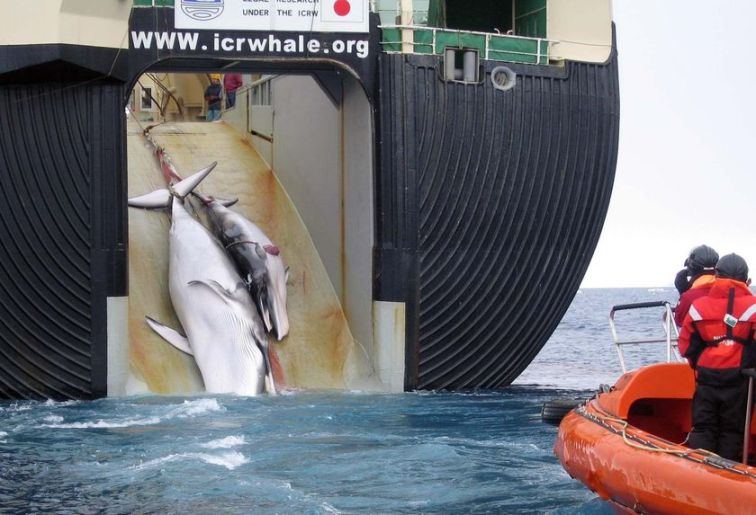
Of the 49 days this year spent hunting for whales, the Japanese “research” ships were forced to spend 21 of them avoiding the four Sea Shepherd boats. As a result the Japanese whalers returned home this year after killing just 103 minke whales of their stated goal of 935 and no humpback or fin whales out of their goal of 50 for each.

Adult minke whale and her calf being towed up the ramp of a Japanese factory processing ship in Antarctic waters in February 2008. (Photo: Australian Customs)

Japanese harpoon.

    According to Sea Sheherd Captain Peter Hammarstedt, disrupting the activities of the whalers has meant “saving the lives of 932 threatened, endangered and protected whales.”

    Anti-whaling activists are hoping the financial loss from this year’s low numbers will hasten the end of Japan’s whaling industry, heavily subsidized by the Japanese government including the use of funds designated for tsunami relief.

    Australia filed a lawsuit against Japan with the International Court of Justice (ICJ) accusing it of violating the 1986 global ban, while the U.S., Australia, New Zealand and the Netherlands continue to call for an end to whaling.

    Japanese whaling.

The International Fund for Animal Welfare (IFAW) is calling on Japan to end the slaughter and instead turn to whale watching–a humane, sustainable and profitable alternative.

Whale watching currently generates around US$2.1 billion annually for coastal communities around the world. In Japan alone, whale watching generated around US $22 million in 2008. There are currently around 30 whale watching operators working from a dozen locations around the Japanese coast.

    Commercial whaling is cruel and unnecessary. There is no humane way to kill a whale. Footage of previous Japanese whaling has shown whales taking up to half an hour to die after being shot with explosive harpoons.

ORANG RESCUE

Posted on April 21, 2013

International Animal Rescue’s team in Indonesia has released dramatic footage showing the rescue of four starving orangutans from an oil palm concession in Borneo after their forest homes were bulldozed

The footage shows the IAR team and members of the local forestry department capturing the starving orangutans for translocation to areas where there is sufficient food for their survival.

All of the apes had gone through long periods of starvation and were weak from hunger, as the company had cleared the forest around them, reducing them to eating bark and stems.

The video shows three rescues: the first of a lactating female whose baby could not be found, the second a pregnant female, and a mother and baby. All were successfully translocated.

One of the orangutans had lost her baby, probably killed before the rescue team arrived.

The palm oil concession is operated by BGA subsidiary PT Ladang Sawit Mas (LSM) in a forest buffer next to Gunung Palung National Park, an area that hosts a large population of Central Bornean Orangutans.

IAR Chief Executive Alan Knigh noted that on a positive note, on this occasion, rather than chasing the apes away or killing them, the palm oil company contacted IAR so they could be moved to a place of safety.

IAR is now urging the company to halt any further land clearing because it is believed that there are other orangutans trapped inside the concession that will die if they are not relocated.

IAR’s Indonesia team has saved more than 60 orangutans. The majority are currently undergoing rehabilitation in the agency’s new centre in Sungai Awan, Ketapang, with a view to eventually being returned to protected areas of forest.


Source: Wildlife Extra.

CHINA’S INSATIABLE DRAIN ON WILDLIFE

Posted on April 19, 2013

Philippines, April 13, 2013— The Philippine Coast Guard and marine park rangers at Tubbataha Reefs Natural Park discovered an estimated 2000 frozen pangolins on a Chinese fishing vessel which had run aground. The vessel is reported to have come from Indonesia.

Chinese fishing vessel F/V Ming Long Yun (bow number 63168) run aground on Tubbataha’s North Atoll in Tubbataha Reefs Natural Park. 
(Photo 10 April 2013 by Phillippine Naval Forces West)

    An inspection of the hold turned up four hundred boxes each containing four or five dressed pangolins. Twelve Chinese crewmen aboard the ship were taken into custody and charged with poaching, attempted bribery of marine park rangers and several violations of the Tubbataha Reefs Natural Park Act.

Inspecting frozen pangolin carcasses from the Chinese vessel.

    The crewmen face a dozen years in prison and fines up to $300,000 for the poaching, however wildlife criminals are rarely sentenced to the full extent of the law.

    While most news of illegal wildlife trade involves elephants, rhinos, and big cats, the Pangolin, also known as the scaly anteater, is the most illegally traded animal on earth.

    Pangolins are highly valued in China for their meat and scales, and supposed medicinal properties. A soup made with pangolin fetus is considered a delicacy.

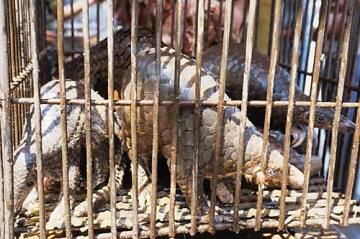
    Pangolin confiscated from a smuggler in Sumatra. (Photo: Jefri Tarigan)

    Pangolins seized in North Sumatra.

    Pangolins are nocturnal and solitary animals that spend most of their time in trees. They move slowly, have no teeth, and their only defense mechanism is to curl up into a ball.

    The decimating of the species is simply astounding. In 2012 an estimated 60,000 of the animals were killed in the illegal trade.

    Seizures so far in 2013 are more alarming still.

    Hornbill casques are used in traditional medicines and also carved into decorative trinkets. (Photo: Derek Ramsey/Wiki Commons)

    Part of Malaysia’s 5th pangolin bust of the year in 2012. This seizure totaled 46 individuals. (Photo: Dan Bennett)

    In January, customs officers at Jakarta International Airport nabbed four Chinese nationals who were attempting to smuggle 189 pangolin skins and 248 hornbill casques out of Indonesia and presumably into China. Pangolin skins and hornbill casques are both prized in traditional medicines. Hornbill casques are also carved into decorative trinkets. Both species are in decline, due to a combination of illegal trade and deforestation.

    In March, over 200 live pangolins were seized within 10 days in SE Asia:

    • Officials from the Department of Wildlife and National Parks in Malaysia, seized 133 pangolins at Kuala Lumpur International Airport (KLIA). The animals — declared as “live crabs” by the shipper — were headed to Vientiane, Laos.
    • One week later, the Thai navy intercepted wildlife traffickers on the Mekong River near Chiangrai and confiscated 104 pangolins destined for China, via Laos. Thailand is a hub for traffickers of all endangered species. The two pangolin traffickers — who confessed they transported the animals from the Thai-Malaysian border — were released on bail within three hours of their arrest. The rescue of 104 live pangolins turned into a tragedy when, according to Wildlife Friends Foundation Thailand (WFFT), the pangolins were left at the police station and packed into plastic crates without care for over 24 hours. 40 pangolins died during that time. WFFT reports that their staff and dog rescue groups were “not allowed to assist with the medical or any other care” and it is “unclear where the remaining live animals were taken.”

    Malaysian officials and forest police burn pangolins confiscated at Indonesian airport.

    All four Asian pangolins are listed by the International Union for Conservation of Nature (IUCN):

        • Chinese or Formosan pangolin (Manis pentadactyla): ENDANGERED
        • Malayan or Sunda pangolin (Manis javanica): ENDANGERED
        • Indian pangolin (Manis crassicaudata): NEAR THREATENED
        • Palawan pangolin (Manis culionensis): NEAR THREATENED

Despite the sanctions, pangolins are fast approaching extinction. Due to dwindling pangolin populations in Asia, it is believed the illegal take of the species is now shifting to Africa.


Source: annamiticuspangolins.org