First Light Productions

investigative journalism

Posts by Michael Elton McLeod

Moon bear update

Posted on November 29, 2012

The Animals Asia Foundation is fighting an audacious scheme allegedly advanced by the director of Tam Dao National Park to evict the conservation group Animals Asia and 104 moon bears from the Vietnam Bear Rescue Centre, on the edge of the park, and turn the Animals Asia facilities into a zoo. The Vietnam Bear Rescue Centre, modeled on a similar site operated by Animals Asia in Chengdu, China, rehabilitates Asiatic black bears, known as moon bears, rescued from bile farms.

Rescued moon bear at the Animals Asia Foundation sanctuary in China (Photo: Kim Bartlett)

The scheme emerged after legislation was introduced in 2011 allowing tourist resorts with environmental credentials to be built on park land.

Animals Asia had in September, 2011, moved ahead with a plan under an agreement with the Agriculture Ministry to build enough enclosures to house 101 more bears, implementing the second phase of their $3.4 million project. But as soon as workers began digging for the foundations of the new bear enclosure, they were told to stop.

The director, Do Dinh Tien, has submitted a proposal to the government to build his own wildlife park in the area. Animals Asia suspects that, should it be forced to leave its bear rescue facility, director Tien would simply appropriate the dens and enclosures belonging to Animal Asia for his own use.

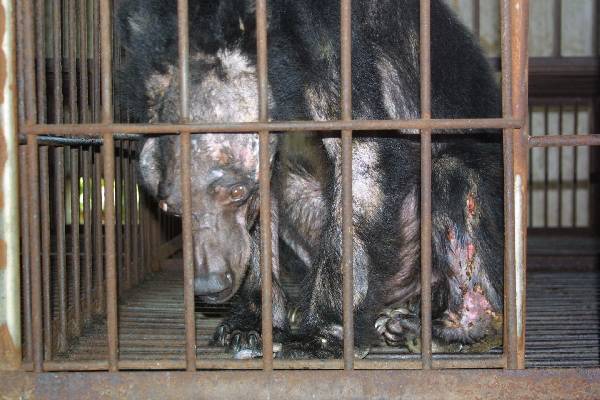
Asiatic black bear in bile farming operation.

Closure of the rescue center would mean that more than 100 bears, rescued from bear bile farms and smugglers, would lose their homes. Seventy-seven Vietnamese staff would lose their jobs. Animals Asia would lose $2 million worth of investment in building and development.

The local economy that depends on the center would be severely impacted and the Vietnamese government’s commitment to ending bear bile farming would be called into question.

At least 32 organizations from 14 nations, co-signed an October 2012 Animals Asia Foundation appeal to Prime Minister Nguyen Tan Dung, asking him to “intervene in this matter and ensure that the rescue center remains in Tam Dao National Park.”


Source: Animal People News

Congo

Posted on November 26, 2012

The war in the Democratic Republic of Congo has created a crisis in Virunga

To donate go to http://gorillacd.org/how-to-donate/

The Battle for Goma

November 21st, 2012 Filed under (Threats) by LuAnne @ 1:49 pm

The city of Goma appears to be back to “normal” although banks are still closed, and no one is certain what will happen next and how life will change.

The Virunga Alternative Energy facility in Munigi on the edge of Goma was in the center of the battle when the cease-fire ended on Monday afternoon. Balemba and about 30 rangers hid in the offices, crouched on the floor during the worst of the fighting with mortars and tanks firing at each other just meters away. Thankfully they suffered no injuries, and the facility was undamaged.

Background

Virunga National Park: Africa’s oldest national park (established in 1925) and a UNESCO World Heritage Site since 1979, is home to approximately 200 of the world’s mountain gorillas and a small population of eastern lowland gorillas. Formerly known as Albert National Park, Virunga lies in eastern DR Congo and covers 7,800 square kilometers. The park is managed by the Congolese Institute for the Conservation of Nature, the Institut Congolais pour la Conservation de la Nature (ICCN).

Virunga NP Rangers: Some 273 park rangers protect Virunga National Park in eastern DR Congo, a region affected by a 12-year civil war and political instability. The park is home to mountain gorillas, lowland gorillas, chimpanzees, okapi, forest elephants and buffalo, among other wildlife. The rangers have remained active in protecting the park, classified as a World Heritage Site by UNESCO. Poaching, wildlife trafficking and habitat destruction remain the key threats to the survival of the wildlife in the park.

mountain gorillas

Mountain Gorillas are critically endangered. They live in only three countries: DR Congo, Rwanda, and Uganda.  A new census last year put the total world population of mountain gorillas at a minimum of 880, representing the 400 individuals in Bwindi and 480 mountain gorillas in the Virunga Massif. Both populations of mountain gorillas have had positive trends in population growth over the last decade.

Small though their numbers are, the census reveals that the mountain gorilla is the only great ape whose population is increasing despite continuous pressure on its habitat. This positive trend is due to the strong collaboration among the three countries where mountain gorillas live and the collective efforts on the ground by park staff, surrounding communities and local government, and non-governmental organizations.

The Congolese Wildlife Authority (ICCN) and its rangers work throughout the country to protect the National Parks of Congo and their wildlife from poachers, rebel groups, illegal miners and land invasions. Rangers worked throughout the civil war to protect the 5 parks of eastern DRC, rarely receiving a salary, with over 130 killed in the last 15 years in Virunga National Park alone.


Report dated: 3 August 2012. For more information go to www.gorillacd.org/blog

Ivory

Posted on November 25, 2012

Ivory poaching has ballooned out of control in the Democratic Republic of Congo.

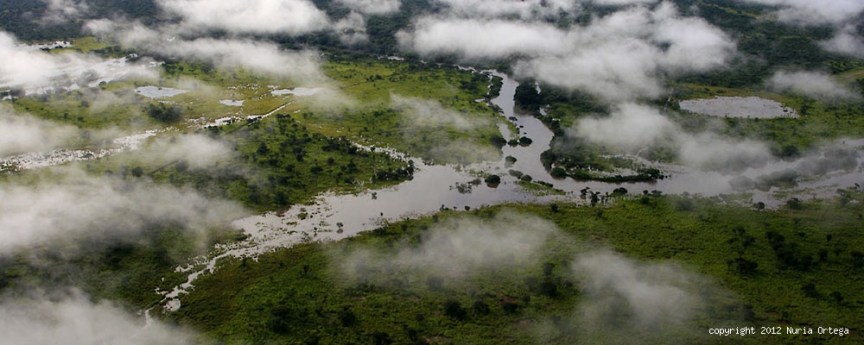
Garamba National Park, DRC. (Photo: Nuria Ortega)

Elephant herd in Garamba Park, DRC. (Photo: Nuria Ortega)

The director of Garamba National Park in the Democratic Republic of Congo, Spanish biologist Luis Arranz was recently interviewed about the severity of the problem.

Arranz says The government of DR Congo has no money to fund the park, and if the European Union stops the funding it provides to the African Parks Foundation to manage the park, and APF staff were to leave, in one year there would be no elephants or hippopotamus left.

“In the sixties,” he observes, “Garamba had one of the largest populations of white rhino in Africa, there were about 1,200, now there is not a single one left.”

The Park contains the four largest land mammals in the world: the elephant, the rhinoceros, the giraffe and the hippopotamus.

Wildlife rangers for Garamba National Park. (Photo: Nuria Ortega)

Arranz and a team of nearly 240 people, 140 guards among them, work to protect a vast area of about 5,000 square kilometers (1,930 square miles) of virgin forest, home to a population of more than 2.300 elephants.

Confiscated elephant parts from poachers. (Photo: Nuria Ortega)

The guards are encountering bigger groups of poachers with increasingly sophisticated weapons. Armed groups such as the Lord’s Resistance Army from Uganda are now killing elephants for their ivory.

The problem is China, where rising incomes have led to an insatiable demand for ivory, historically a valuable cultural item in Asia.

Iranian Cheetahs

Posted on November 23, 2012

Follow up to ANIMAL POST of October 24.

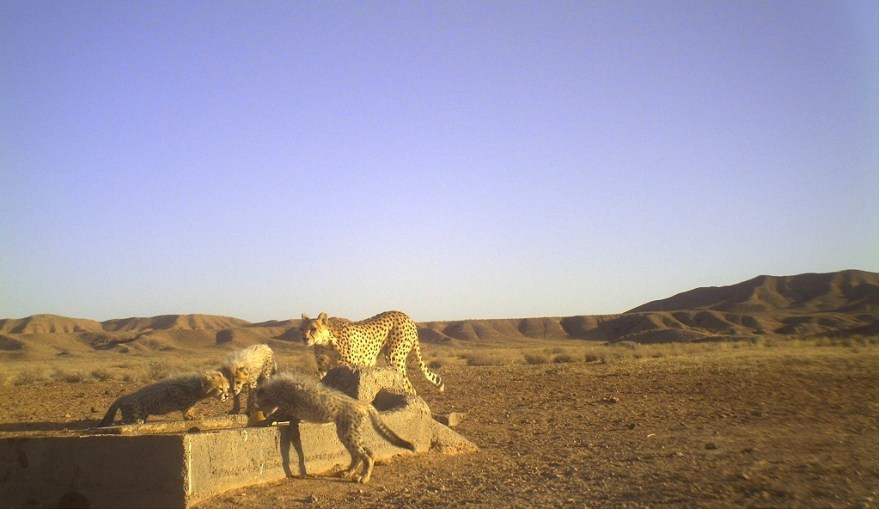
Asiatic Cheetahs in Iran (Photo: Iranian Cheetah Society)

A family of Asiatic cheetahs has been photo-trapped for the first time in the Miandasht Wildlife Refuge in north-eastern Iran. The adult cheetah and her three cubs were recorded on several occasions while coming to water sources to drink.

Unlike African cheetahs, Iranian cats are virtually invisible. They live at the lowest density recorded anywhere for the species, one to two cats per 1,000 square kilometers; the same-size area on East African plains can hold 100 cheetahs.

Intensely shy, scattered like grains of sand over Iran’s vast central plateau, they are impossible to see. However, SLR camera traps deployed by National Geographic photographer Frans Lanting and monitored by Iranian biologists have resulted in beautiful images.

The camera trap project was a partnership between Nat Geo, Iran Department of Environment, the Conservation of the Asiatic Cheetah Project, PWF and Panthera.

A Panthera blog about the cheetah project can be found here.

Canis rufus

Posted on November 23, 2012

A fourth radio-collared red wolf was recently found shot dead in North Carolina.

red wolf, North Carolina. (Photo: Steve Hillebrand)

Once common throughout the south-eastern United States, by the 1960’s red wolf populations were decimated due to intensive predator control programs and loss of habitat.

The species was declared endangered in 1967 and the U.S. Fish and Wildlife Service declared red wolves extinct in the wild in 1980.

A remnant population of the animals was found along the Gulf Coast of Texas and Louisiana, and biologists captured 14 and used them to start a captive breeding program in 1977. Since that time, enough wolves have been bred to impliment a restoration program on Alligator River National Wildlife Refuge in north-eastern North Carolina.

Today, about 100 red wolves roam their native habitats in five north-eastern North Carolina Counties.

Red wolves are known for the characteristic reddish colour of their fur most apparent behind the ears and along the neck and legs, but are mostly brown and buff coloured with some black along their backs. They are smaller than gray wolves, the other species of wolf in North America, but larger than coyotes. The average adult red wolf stands about 26 inches at the shoulder and is about 4 feet long from the tip of the nose to the end of the tail.

Red wolves are social animals that live in packs consisting of a breeding pair and their offspring of different years, typically five to eight animals. They prey on a variety of wild mammals such as raccoon, rabbit, white-tailed deer, nutria, and other rodents. Most active at dusk and dawn, red wolves are elusive and generally avoid humans and human activity.

Human predation is a constant problem as hunters seem to consider wolves enemy Number One as evidenced by wide open hunting of grey wolves that has commenced in the last year in Alaska, Idaho, Minnesota, Montana, Washington State, Wisconsin and Wyoming.

As there are just 100 Red wolves in North Carolina, there are suspicions that the death of a fourth radio collared wolf in the last two months, all killed in approximately the same area, may be no coincidence, and that they are possibly being tracked by someone other than the Wildlife Service.

The red wolf is protected under The Endangered Species Act. The maximum criminal penalties for the unlawful taking of a red wolf are one year imprisonment and $100,000 fine per individual.

Anyone with information that directly leads to an arrest or a criminal conviction for the suspected unlawful take of a red wolf may be eligible for a reward of up to $2,500. Anyone with information on the death of this red wolf or any others, past or future, is urged to contact Special Agent Sandra Allred at (919) 856-4786, Refuge Officer Frank Simms at (252) 216-7504 or North Carolina Wildlife Resources Commission Officer Robert Wayne at (252) 216-8225.


Source: wildlifeextra.com

Ain’t nature grand

Posted on November 21, 2012

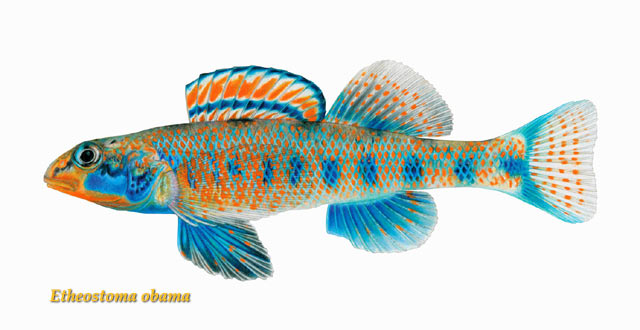
Biologists have discovered five new species of darters in freshwater river systems in the eastern United States and named them after four U.S. presidents and a vice president: Theodore Roosevelt, Jimmy Carter, Bill Clinton, Al Gore and Barack Obama.

Clueless

Posted on November 20, 2012

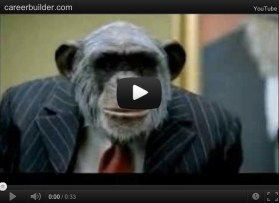
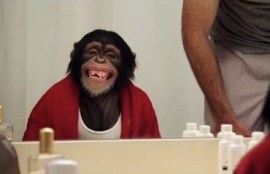
CareerBuilder, infamous for its Superbowl ads using chimpanzees, wants the public to know that it “followed the strictest guidelines to ensure our chimpanzee stars were treated well and not harmed in any way.” “Hired top trainers known to provide the highest standard of care” for the animals. And that there was a member of an animal rights group “on the set during the entire filming to ensure the chimpanzees were treated with respect.”


All of which totally misses the point of why chimps should not be used in TV commercials.  The company, in league with its ad agency Cramer-Krasselt, is so clueless that they titled one of the spots “Monkey Business.”

Show these people their ads don’t work by not using CareerBuilder and spread the word for others to do the same.

Sanctuary in Kentucky

Posted on November 19, 2012

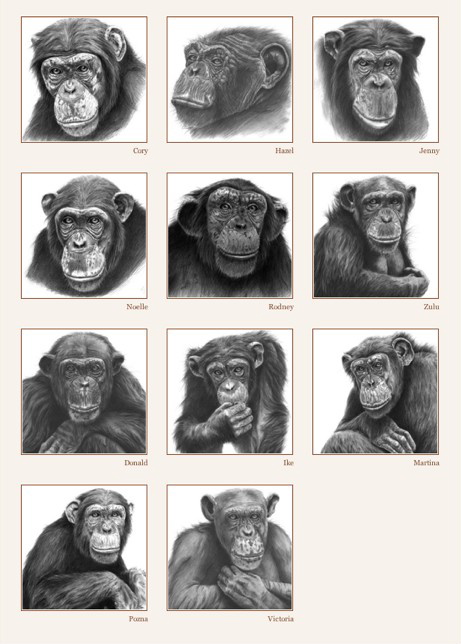
Primate Rescue Center. Thirty acres in central Kentucky, home to 40 animals including these people.

Primate Rescue Center chimps.

Saving primates

Posted on November 18, 2012

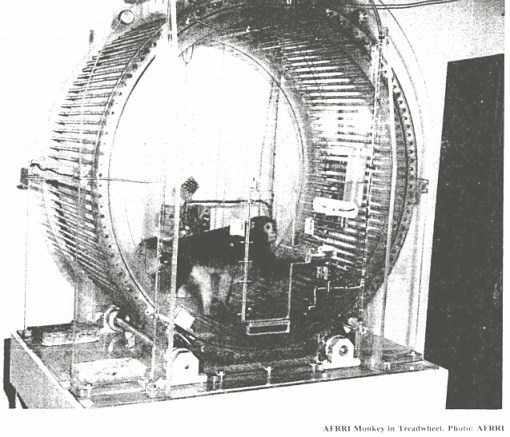
In 1978, Shirley McGreal, founder of the International Primate Protection League (IPPL), learned that the U.S. Armed Forces radiobiology Research Institute was using rhesus macaque monkeys imported from India in neutron radiation experiments. She was aware that the U.S. had signed an agreement with India three years earlier stating that the monkeys were to be used only in medical research and vaccine production. What she stumbled across was anything but.

She published news of what she found in IPPL’s newsletter with a photo showing one of the hapless animals involved and a description of the experiment:

Monkey on radiation wheel at the Armed Forces Radiobiology Research Institute, 1979.

“The monkeys would be taught some “task” such as running on a tread(mill), then irradiated with a super lethal dose of radiation, and put back to work on the “task” and tested until death occurred some hours or days later. No therapy was attempted, since the dose was inevitably fatal. Observers would watch the dying monkeys, calculating the duration of “incapacitations.””

At the time India was exporting some 20,000 of the monkeys annually–nearly all to the U.S.–resulting in a big reduction in both geographic range and population numbers of the species

McGreal sent letters to the U.S. Department of Defense asking for more information. Receiving no response, she sent a press release to all the major newspapers in India drawing attention to the tests and explaining how the monkeys were being imported under false pretenses as the U.S. Public Health Service and other agencies had developed means of bypassing the treaty restrictions. Indian papers gave the radiation experiments prominent coverage. The Time of India ran an editorial headlined: “Appalling Cruelty.”

IPPL also appealed directly to India’s prime minister to “either to ban the export of the monkeys to the U.S. or insist on strict enforcement by the U.S. of India’s conditions of export.” The Prime Minister banned the export of monkeys to the United States.

Shirley McGrill at IPPL’s gibbon sanctuary.

The next year McGreal induced the government of Bangladesh to ban export of their monkeys for similar reasons.

India’s ban caused a huge disruption in ongoing research at U.S. biomedical laboratories, earning McGreal the eternal enmity of the National Institutes of Health. McGreal calls it one of her proudest achievements. “We have never played politics with primate lives,” she says. “And we never will.”


Source: International Primate Protection League.

Soring

Posted on November 17, 2012

Soring is the practice of inflicting pain to a horse’s legs or hooves in order to force the horse to perform an artificial, exaggerated “Big Lick” gait to gain a competitive edge in the show ring. The practice is rampant in the walking horse industry in which Tennessee Walkers and other gaited breeds are exhibited.

Soring was made illegal under federally law with passage of the Horse Protection Act (HPA) in 1970. But the law has done little to curb the practice. Since 2002, 4,000 incidences of soring violations have been reported. In the last 12 months alone, over 1,000 suspensions have been issued for violations of the Horse Protection Act. These are only the people who have been caught at inspection stations at shows and sales.

A random inspection by agents of the Department of Agriculture at last year’s annual championship found that all 52 of 52 horses tested positive for some sort of foreign substance around front hooves, either to cause pain or to hide it.
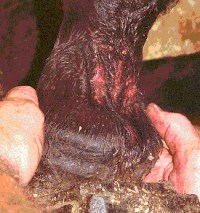
What a “sored” leg looks like after trainers have applied painful, toxic chemicals. (Photo: USDA)

49 nails being used in this Performance Horse package.

Soring takes a number of forms. Caustic chemicals—blistering agents like mustard oil, diesel fuel, and kerosene—are applied to the horse’s limbs, causing extreme pain and suffering.

A particularly egregious form of soring, known as pressure shoeing, involves cutting a horse’s hoof almost to the quick and tightly nailing on a shoe, or standing a horse for hours with the sensitive part of his soles on a block or other raised object. This causes excruciating pressure and pain whenever the horse puts weight on the hoof.

Mechanical means involve putting a foreign object, such as a screw or bolt, or half of a golf ball, against both of the horse’s front hoof soles, and then shoeing with a pad and horse show over the object. Each time the horse steps or puts weight on that hoof, it causes pain. Pressure shoeing also involves cutting a horse’s hoof wall and sole down to the quick, where it starts to bleed, and then nailing a shoe over that surface. This makes a very tender hoof that is sore again each time pressure from the animals’ weight.

The odds of stopping or even curbing the practice are not good when an entire industry is built around it, and judges continue to reward the High Lick gait that’s the hallmark of a Tennessee Walking Horse.

There is also BIG money in it.

Horse trainer Jackie McConnell convicted of soring.

In May, Jackie McConnell, considered one of the leading “trainers” of this sorry industry, was fined $75,000 and put on probation for three years for soring. He was also banned for life from the Tennessee Walking Horse organization’s main annual show competition and removed from its hall of fame. The fine is pocket change to McConnell who has made millions in the business.

He was unmasked by a video made by the Humane Society of the United States showing McConnell and his stable hands using painful chemicals on horses’ legs, and whipping, kicking and shocking them in the face to force them to perform the unnatural ‘Big Lick’ gait.

A blue-ribbon Tennessee walking horse stallion might be worth $1 million or more when put up for sale, but it can earn that money back for a new owner in a year through stud fees as others try to cash in on his champion bloodline.

David Williams, operations manager at Waterfall Farms, leads “Lined with Cash” to a pen at the farm.

Last year in Shelbyville, Tennessee, site of the annual Walking Horse National Celebration, William B. (Bill) and Sandra Johnson, owners of Waterfall Farms, which had some of the most-recognized walking horse champions available for stud service, were suspended from being involved in “any show or event” for one year by the United States Department of Agriculture for violations of the Horse Protection Act in connection with the “soring” of their Tennessee Walking Horse champion “JFK All Over” at the 30th Annual Spring Fun Show in Shelbyville.

If you want to see what kind of money we’re talking about in this business take a look at Waterfall Farms today. Formerly one of the finest equestrian breeding facilities in the South–over 905 acres, 340+ stalls, 3 ponds, fully stocked lake, riding trails, 5 residences, equipment sheds, Barns, offices, hospiltality house, and indoor arena–asking price $4,995,000.

Tara

Posted on November 17, 2012

Born: 1974
Birthplace: Burma

Tara, The Elephant Sanctuary.

• Captured from the wild: 1974
• Life before the Sanctuary: privately owned, performed in circuses and zoos
• Reason for coming to the Sanctuary: inspiration and founding member
• Moved to The Elephant Sanctuary March 3, 1995

Height: 8′ 2″
Favorite Food: Watermelon

Tarra the first resident and inspiration for the Sanctuary. She is short and stout with a dark complexion, typical of elephants from her region. Her tail is quite long; the end is covered with thick hair, quite effective for swatting insects! Her small ears fold back at the top. She has lovely eyelashes and “fuzzy” hair on the top of her head, although it is becoming thinner with age. Tarra walks more than any other elephant at the Sanctuary—exercise that gives her a more muscular build.

Tarra and Bella

Tarra is almost always seen with her dog Bella, Although Tarra is a “social butterfly” and likes to visit with all the members of her elephant herd, you are most apt to see her in the company of Shirley, and with Misty and Dulary. When Tarra greets other elephants or caregivers, she is often silly, playful and very vocal.

The Elephant Sanctuary, opened in 1995. It has twenty-four elephants on 2700 acres in Hohenwald, Tennessee. Check out the elephant cams.

Oreo

Posted on November 16, 2012

Last August, a six-year-old black and white spotted draft gelding named Oreo was working his regular shift pulling a red-and-white carriage with a jaunty flower bouquet near Central Park in the middle of Manhattan, when a bundle of scaffolding at a nearby construction site crashed to the pavement.

Oreo. (Photo: Ángel Franco/The New York Times)

Startled by the unusual loud noise, Oreo bolted. Despite the driver’s best efforts, Oreo got away from him, and headed west on Fifty-Ninth Street in the direction of his stable.

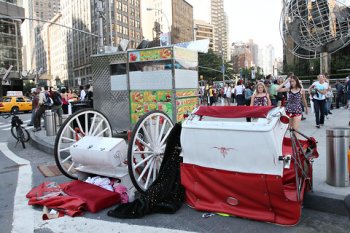
Remains of Oreo’s carriage.

The carriage struck several vehicles, the driver was ejected and the carriage broke apart, leaving two Australian tourists in the wreckage. The horse, still in harness but with no carriage attached, continued taking his regular route back to the stable. At Ninth Avenue and West Fifty-Seventh he slowed to a stop right behind the cars and waited for a red light. At that point he was approached by pedestrians and NYPD officers and led to the side of the street.

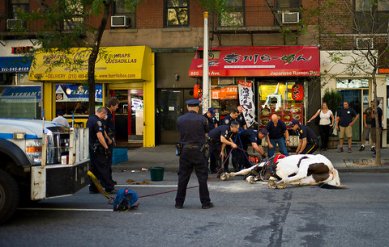
Oreo down at Ninth Avenue after being shot with a tranquilizer dart.

Not being familiar with horse harnesses, the officers tied Oreo to a street pole in such a way that he was forced to steadily move backward. Mistaking this movement for agitation, the officers shot him with a tranquilizer gun as a precaution and he slumped to the ground. A NYPD Mounted Unit arrived, loosened the harness, got him back on his feet, and led him into a trailer and transported him back to his Clinton Park Stables.

After the tranquilizer wore off a bit, Oreo was able to stand up and walk into a police truck.

He was checked by a vet and pronounced okay. The driver and the Aussie tourists were not injured.

Oreo stands 16 hands high and weighs 1,700 pounds. Young by draft-horse standards, he’d worked his trade for five years and was destined to pull carriages for at least several more. But his owner decided a mid-career change might be in order. There was concern that when a horse suffers such a traumatic experience something similar might happen in the future.

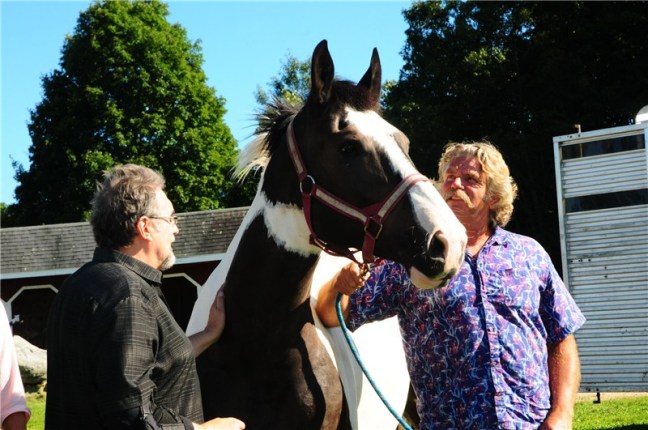
Oreo arriving at Blue Star Equiculture,

He was sent to Blue Star Equiculture, a draft-horse sanctuary and organic farm in Palmer, Mass., to rest and recover.

The incident reignited debate over New York’s carriage horses. Several animal rights groups and anti-carriage groups are backing previously proposed City Council legislation that would either ban horse-drawn carriages or replace them with “horseless carriages,” electric cars driven by the former carriage drivers.

Oreo at Blue Star Equiculture.

They say that subjecting the horses to endless hours treading pavement, exposure to toxic downtown air, subjecting them to the kinds of stresses that frightened Oreo, and the fact that carriage horses often end up in slaughterhouses when their work life is over (a fate carriage horse owners say they try to avoid) are all reasons to ban the use of horses in downtown New York.

NYC mayor Bloomberg thinks the horses are a plus for the city. “In our society, we have, from cave-man times, used animals as part of our economy,” he said. Of the horse-drawn carriages, “I think it’s something that a lot of tourists really love. It makes New York, New York.”

A spokesperson at Blue Star said that someone would eventually adopt Oreo. Probably to do farm work. “For him to stay healthy his whole life, he needs a job.”

Caught

Posted on November 15, 2012

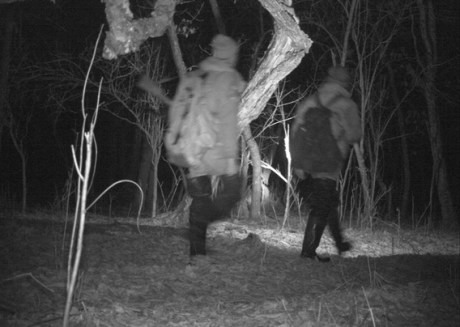
Conservationists with the Zoological Society of London (ZSL) are setting camouflaged camera traps in Russia to capture images of park trespassers and poachers.

Camera trap catches intruders in Lazovsky Nature Reserve. (Photo: Zoological Society of London)

Thirty camera traps have been set in two Russian far east protected areas: Lazovsky Nature Reserve and Zov Tigra National Park, home to at most twenty Amur tigers.

Amur tigers, also known as Siberian tigers, are down to around 360 animals and listed as Endangered by the IUCN Red List. Poaching for traditional Chinese medicine remains the most pressing concern but the Amur is also imperiled by habitat loss, prey decline, low genetic diversity, and human-tiger conflict.

Poached Amur tiger. (Photo: ZSL)

    Scientists believe poachers may have killed as many as seven tigers in the last five years. In the last twelve months authorities have confiscated tiger parts in three different operations.

    In 2010 Russia hosted a tiger summit with all 13 tiger range countries. The meeting ended with an ambitious pledged to double the number of wild tigers in the world by 2022. Amur tigers represent around 10 percent of the total wild population. Already three tiger subspecies have vanished forever.


    Source: Mongabay

Trophy animal

Posted on November 14, 2012

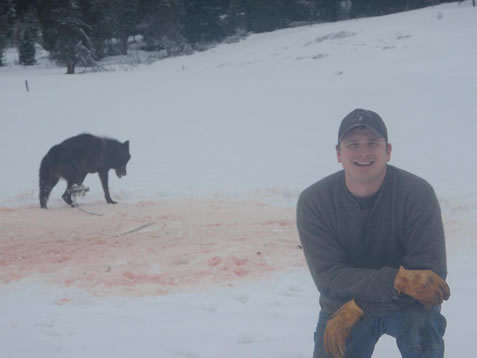
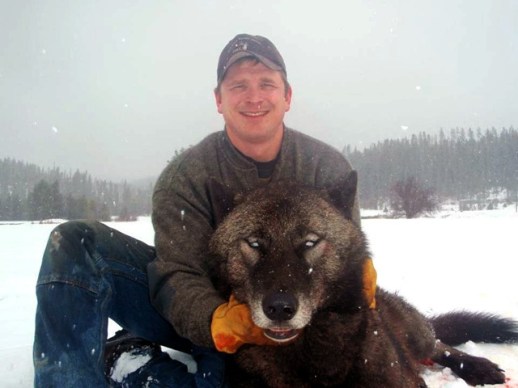
Nez Perce National Forest employee Josh Bransford whose web handle is Pinching.

Trapperman.comJosh Bransford with the black wolf he trapped.

For more on Josh’s exploits.

Good job Bransford.

Wolves have become the get for hunters in the west. In the last month alone, 177 wolves have been killed in the three Rocky Mountain states where wolves have been recently delisted from the Endangered Species Act–Idaho, Montana and Wyoming. Many of these wolves are part of highly social groups simply looking for a safe place to raise their families.

To add your two cents to stop this, click here.

Uga Beluga

Posted on November 12, 2012

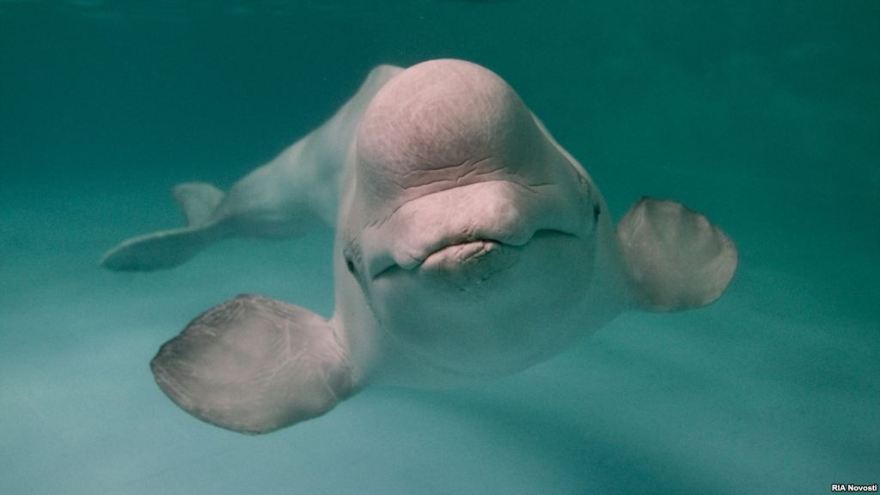
A request by one of the United States’ biggest oceanariums to import 18 beluga whales caught in the Sea of Okhotsk off Russia has set off a debate over the legality and ethics of wild-animal captures for science and entertainment.

Beluga whale at the Moscow Dolphinarium.

Georgia Aquarium in Atlanta wants eight males and 10 females, some of whom have been languishing in Russian facilities on the Black Sea for as long as six years, for a captive-breeding project that it claims will educate and inspire the public while helping ensure “the survival of belugas everywhere.”

Federal approval is required because the “take or import” of belugas and other marine mammals is banned under the U.S. Marine Mammal Protection Act (MMPA) of 1972.

Opponents of the plan see it as a threat to the moral underpinnings of the MMPA, legislation that was pushed by the scientific and conservation communities that has brought some mammal populations back from the brink of extinction. Collection of whales and dolphins from the wild for any purpose is a violation of conservation ethics. They say the permit application has everything to do with breeding more belugas for captivity, i.e. exhibition. While the capture of the animals was legal in Russia, and the import may be legal under a NOAA permit, this does not make it morally right and that NOAA should not allow US facilities to financially support a capture in another country’s waters

The plan calls for six of the whales to be housed in Atlanta, while the other 12 would go on “breeding loan” to the Georgia Aquarium’s partners: Sea World (in California, Florida, and Texas) and the John G. Shedd Aquarium in Chicago. All but four of North America’s current captive belugas are at those facilities.

It may be too late to help the belugas earmarked by the Georgia Aquarium. They have already been sucked into captivity. They will not be released by Russia, and if the US aquarium does not get its permit, they will be sold to other facilities outside of America.

Importing animals captured directly from the wild represents a significant departure from how US facilities have been acquiring whales and dolphins for public display over the past several decades, and is contrary to innovative and progressive trends within the aquarium community. Dolphin populations in US public display facilities have, in recent years, been maintained through captive breeding, imports, and the retention of stranded animals considered unsuitable for release back into the wild.

There have been no captures of wild dolphins in US waters since 1993, primarily because of public opposition and pressure.

If the aquarium succeeds, the belugas will become the first marine mammals caught in the wild and put on display in the United States since 1993.


Source: wildlifeextra.com

Kooloo-Kamba

Posted on November 10, 2012

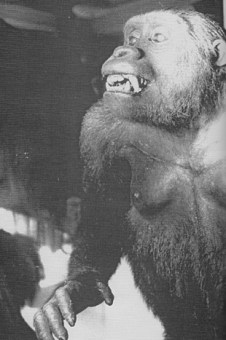
There is a long history of debate over the existence of an alleged gorilla-like chimpanzee, known as the kooloo-kamba (an onomatopoeic reference to its call).

Mystery ape, Yaounde Zoo, Cameroon, mid 1960s (Photo: Peter Jenkins and Liza Gadsby)

As recently as the late 1960s, primatologist W. C. Osman Hill regarded the kooloo-kamba as a distinctive chimp subspecies thought to inhabit Cameroon, Gabon and the former French Congo, and to live alongside chimps of the nominate subspecies.

Previous researchers regarded it as a distinct species somehow intermediate between chimps and gorillas, or the product of gorilla-chimp hybridization.

Supposedly, several such individuals were kept in captivity during the late 1800s and ealy 1900s, including ‘Mafuca’ of the Dresden Zoological Garden, and ‘Johanna’ of Barnum and Bailey’s circus collection.

It now seems that the kooloo-kambas of the older literature reflect the fact that both gorillas and (especially) chimps are more variable in facial anatomy, body size and overall appearance than many primatologists were once willing to accept. Chimps of some populations are larger, darker-skinned and superficially more ‘gorilla-like’ than many of the chimps first brought back to Europe, but this doesn’t mean that such animals are hybrids, or intermediates.

Pygmy gorilla Pseudogorilla mayéma (Photo: B. Heuvelmans)

Various other controversial African apes–most notably the Pygmy gorilla Pseudogorilla mayéma lauded by cryptozoologist Bernard Heuvelmans–also tell us more about our poor understanding of variation, and don’t necessarily point to the presence of additional distinct species.