First Light Productions

investigative journalism

Posts by Michael Elton McLeod

Terry

Posted on December 7, 2013

The notoriously substandard Las Vegas Zoo, where 150 animals were confined on just three acres, closed its doors a few months ago after all its zookeepers mysteriously quit.

The animals at the zoo included a lion, a cheetah, a chimp, a crocodile and some apes, including a chimp named Terri.
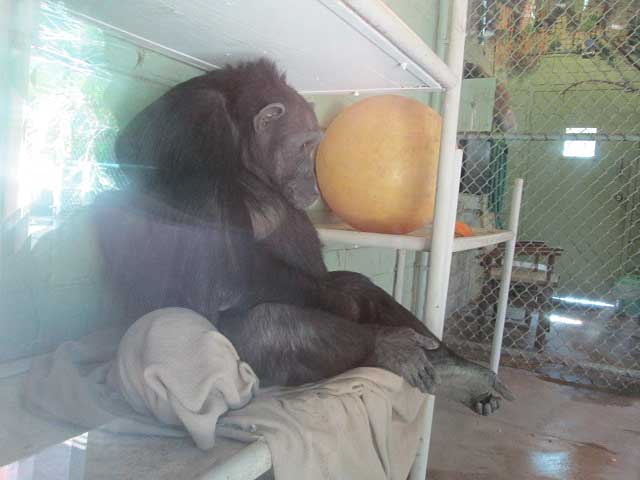
Terry at the Las Vegas zoo. (Photo: PETA)

Observers described Terry as a forlorn individual living in a cage with rotten, shriveled fruit, and filthy drinking water. He came to the zoo nearly 20 years ago with his longtime friend Simon. As youngsters they had performed an ice skating routine for the Ice Capades, a traveling entertainment show. Simon died shortly after they arrived at the zoo. Since then Terry lived alone.

A few people, including his former owner and trainer at the Ice Capades, dropped by once in awhile to try and cheer him up, but it was generally agreed he was deeply depressed.

Fortunately, Terry’s story has a happy ending. In October he was taken in by Save the Chimps (STC), a Florida sanctuary, where he has made his first friend, a female named Indie.
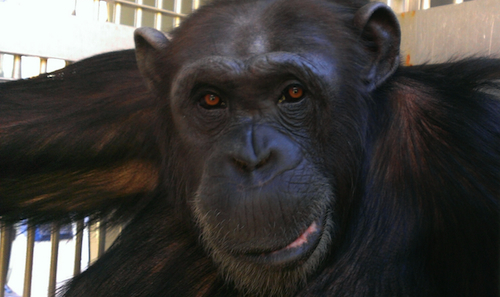
Terry at Save the Chimps

A recent post from the sanctuary described how

Indie, a very laid-back, quiet, friendly chimpanzee, wasn’t troubled when Terry ignored her. In fact, she pretty much lost interest in him. Ironically, this is exactly what Terry needed. Since Indie wasn’t bothering to even attempt to interact with Terry, he had the opportunity to observe her without feeling threatened in any way. Over the next few days, he became more and more curious about her, even following her from room to room in the Special Needs building. Then, a little over a week after they met, Terry let Indie groom him!”

The staff considered this an enormous breakthrough. To their knowledge, “It was the first time Terry had been touched by another chimpanzee in eighteen years.”


Donate to STC: https://www.savethechimps.org/donate
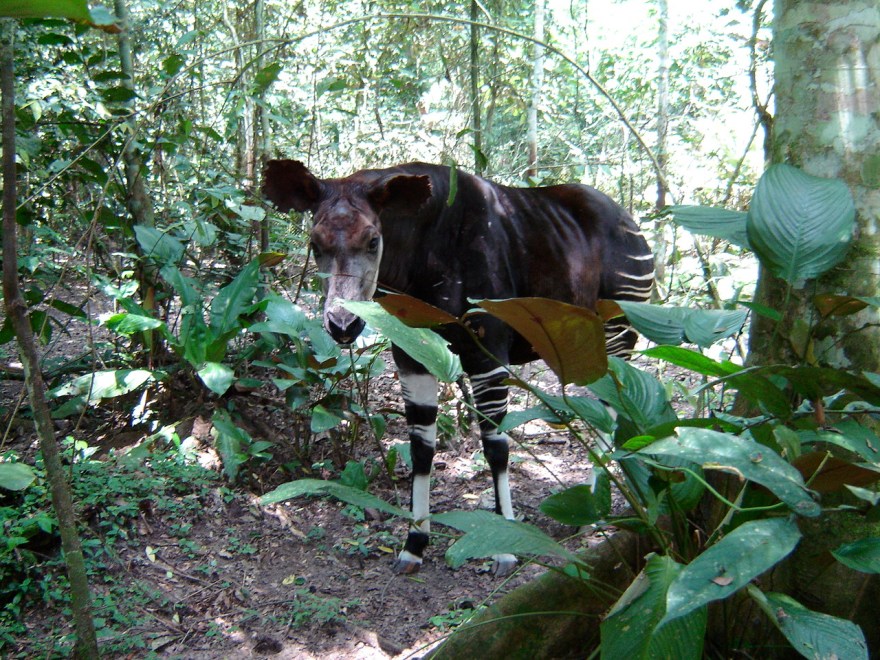
Okapia johnstoni

Posted on December 3, 2013

The IUCN has just listed the okapi as Endangered, only one step away from the highest risk of extinction, Critically Endangered.

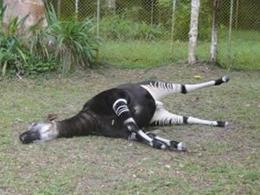
Okapi in the forest in DR Congo.

The animal wasn’t recognized by the western scientific establishment until brought to their attention by Sir Harry Johnston in 1901. I wrote about how the okapi got its (Western) name in Anatomy of a Beast:

Sir Harry Johnston…made a career in Africa during the reign of Queen Victoria. In his Book of Great Jungles, biologist and nature writer Ivan Sanderson devoted several pages to Sir Harry whom he viewed as the forerunner of a new guard of explorer: the naturalist. “Johnston went to ‘the dark continent’ on a shooting trip in 1882,” Sanderson wrote, “and stayed simply because he wanted to paint pictures and see the country, not explore for new routes or opportunities for trade.”
Against a legion of naysayers, Johnston became the first Westerner to “discover” the Okapi, an odd horse-sized mammal that resembled somewhat a zebra but shaped more like a giraffe. The reigning scientists in London finally had to admit his success when he presented them a skull and hide from the animal, which they hurriedly named Okapia johnstoni. Sir Harry collected animals for the London zoo and had his own zoological garden at home. Several of his pets accompanied him on his expeditions and, no matter the equatorial weather, he always dressed for dinner.

The elusive giraffe-like forest creature is one of the oldest mammals left on earth and nearly impossible to observe in the dense tropic forests because its sense of hearing and smell are extremely acute.

Armed conflict, human settlement, deforestation and poaching have reduced the okapi’s numbers to approximately 10,000 to 15,000 animals in the wild, down from an estimated 40,000 a decade ago.

Their last redoubt is the Okapi Wildlife Reserve in a 13,700-sq-km tract of the Ituri Forest in northeastern Democratic Republic of the Congo (DRC). Over 40% of the okapi left on earth live in and around the Reserve where the Okapi Conservation Project (OCP) works with ICCN rangers (the Institute in Congo for the Conservation of Nature) and local communities to protect the biodiversity of the Ituri Forest.

The reserve, home to significant populations of leopard, forest elephants, bonobos, chimpanzees, monkeys, peacocks, and crocodiles, became a World Heritage Site in 1996.

15 okapi among the victims killed in raid on the Epulu Breeding and Research Station, Democratic Republic of Congo.

Last September (ANIMAL POST “Men with guns” September 8, 2012), MaiMai Simba rebels, led by an elephant poacher known as Morgan, armed with AK-47 rifles, invaded the reserve’s Epulu station killed seven park staff and their family members and took others hostage. They destroyed the reserve’s infrastructure and, in a final brutal act, killed the station’s 15 okapi, who were serving as a reservoir for the infusion of new genetic stock into okapi populations in global conservation programs.

Over a year later, security and peace has begun to return to Epulu with the armed militias being run out of the Okapi Wildlife Reserve. However, the militia that conducted the raid, including its leader Morgan, remain at large.


For an update on the reserve and the okapi go here.

For more information or to donate, visit the Okapi Conservation Project.

Personhood

Posted on December 2, 2013

The Nonhuman Rights Project is filing three lawsuits in New York State this week to rescue chimpanzees from abusive situations and move them to sanctuary.

(Photo: Nonhuman Rights Project)

(Photo: Nonhuman Rights Project)

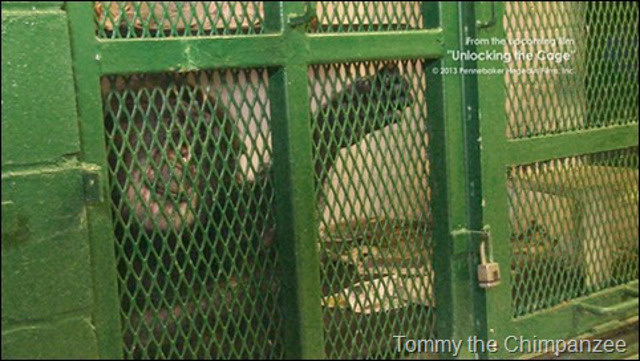
The first suit, filed today, concerns Tommy, who lives alone in a small cement cage at a used trailer lot in Gloversville. Tommy is the last of six chimps that were kept in cages at the business to attract customers. In the last three to four years, all but Tommy have died.

(Photo: Nonhuman Rights Project)

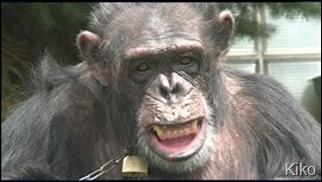
The second lawsuit will be filed Tuesday on behalf of Kiko, a chimpanzee who is deaf and living in a private home in Niagara Falls. The third will be filed Thursday on behalf of Hercules and Leo, who are being used in locomotion experiments at Stony Brook University on Long Island.

The legal cause of action being invoked is the common law writ of habeas corpus, in which a person being held captive seeks relief by calling upon his captors to show cause as to why they have the right to hold him or her. The aim is to breach the legal wall that separates humans from nonhuman animals.

Goddamnit! It Never Ends: Greenpeace Has Photos of Illegal Rainforest Destruction by Bumitama Ltd.

Posted on December 1, 2013

Thanks narhvalur.

gettingonmysoapbox's avatargettingonmysoapbox

Will this madness ever stop?

Mongabay reports that Greenpeace has photos of illegal clearing.

Flyovers of a concession owned by PT Andalan Sukses Makmur, a subsidiary of  Bumitama Agri Ltd, show excavators clearing peat forests and digging drainage  canals just outside Tanjung Puting National Park in Central Kalimantan. Tanjung  Puting is famous for its population of orangutans that have been intensely  studied by Birute Galdikas, a noted researcher and conservationist.

Greenpeace says mapping and field investigations show that forest conversion  took place February and October 2013, “including clearance of intact peatland  forests inside buffer zones identified on the high conservation value (HCV)  assessment for the concession.” The deforestation proceeded despite a pledge  from Bumitama not to clear an where a survey identified a group stranded  orangutans.

Read more at http://news.mongabay.com/2013/1122-greenpeace-palm-oil-photos.html#1VGVRrh5Dw2mrxLG.99

And sign this petition from RAN:

The Snack Food 20 are the makers of some of the best-known snack food brands in the world, and they’re using “conflict…

View original post 112 more words

WalmartCruelty.com

Posted on November 4, 2013

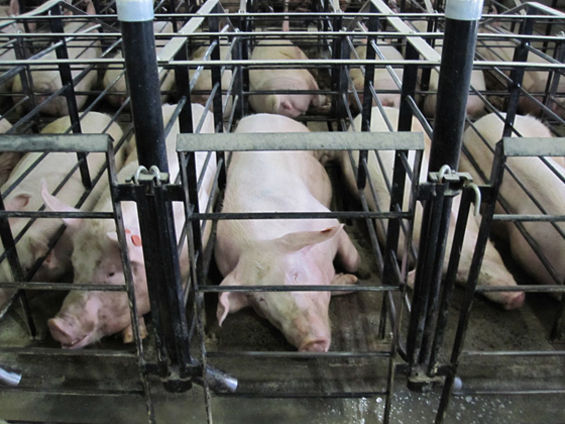
Nearly every major food provider in the United States has committed to eliminating gestation crates.

Torture plain and simple.

Not Walmart.

Tell the company how you feel here.


Shout out: The Dish.

Profiteering ivory

Posted on November 1, 2013

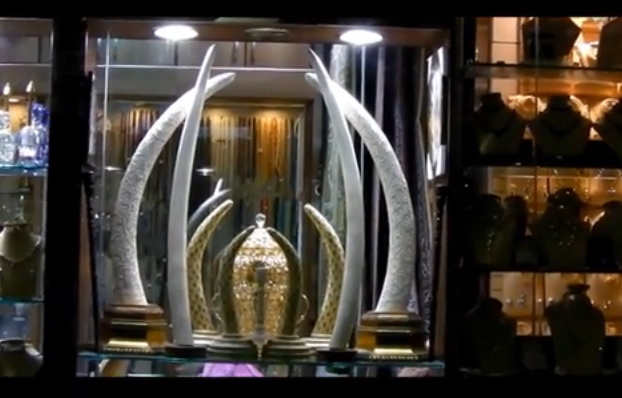
As the slaughter of elephants continues unabated, Möevenpick Hotels & Resorts in the Middle East are helping create the demand for ivory by renting shops inside their hotels to ivory traders.

Movenpick hotel ivory shop, Saudi Arabia.

      Booklets in each hotel room promote the shops.

      Meanwhile, tens of thousands of elephants are being killed every year for their tusks, and almost daily reports show the slaughter seems to be worsening.

      Contact Möevenpick Hotels and let them know how you feel about their policy.


      Source: Wildlife Extra.

Chimps choose their friends like us

Posted on October 30, 2013

Chimps make friends like nonhuman primates.

(Photo: Tushic-Jorg-Massen)

(Photo: Tushic-Jorg-Massen)

    Are we surprised? Read about it here.

    Animal friendships, like human friendships, are durable and pay huge dividends. Having friends with the same sensibilities is comforting.

    It also really screws with politics.


    Thanks: Nonhuman Rights Project.

Sorry, But Wolf Slaughter Is Not American by James William Gibson

Posted on October 28, 2013

Nabeki's avatarHowling For Justice

FacebookphotoOfWolfhuntres

October 28, 2013

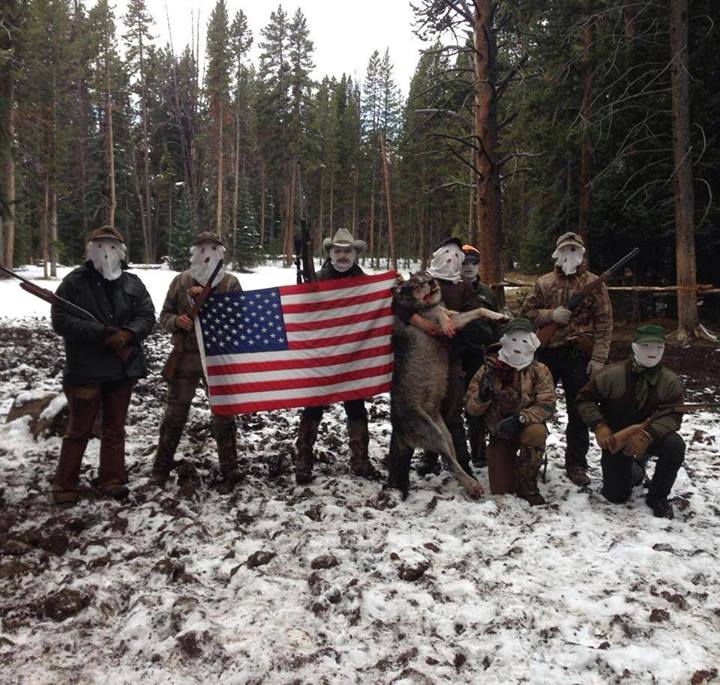
“Fed Up in Wyoming” reads the caption under this stunning photograph posted on a hunter’s Facebook page (reproduced here under Fair Use). The photo is yet more evidence that, two years after political reactionaries led a successful campaign in the House of Representatives and then the Senate to remove the North Rocky Mountain gray wolf from the endangered species list, the slaughter of wolves continues to escalate as wolf hunters fall deeper in their paranoid fantasy that the wolf represents a liberal conspiracy against rural communities.

The Facebook page  that originally posted the image belongs to two Wyoming hunting outfitters, Colby and Codi Gines. The Gines run CG Wilderness Adventures, headquartered in a highly remote part of Wyoming’s Bridger Teton National Forest, bordering on the southeast section of Yellowstone National Park.  “Wyoming is God’s country, and we invite you to come see it for…

View original post 912 more words

Red Wolves (and Coyotes) Under the Gun!

Posted on October 27, 2013

Exposing the Big Game's avatarExposing the Big Game

There are only about 100 left – and if drastic measures aren’t taken soon, the critically endangered red wolf could once again be pushed to extinction in the wild by coyote hunters in North Carolina.

Last week, Defenders of Wildlife and other conservation groups officially filed suit in federal court to halt uncontrolled hunting of coyotes in the red wolves’ North Carolina habitat. In the past year, hunters have killed at least 10 red wolves – that’s 10 percent of the remaining wild population of these remarkable creatures.

North Carolina’s red wolves are the last remaining wild population on earth. These animals were extinct in the wild as recently as 1980 due to intensive predator control and loss of habitat. A concerted reintroduction program has raised the wild population of these animals to roughly 100, all confined to a small area in the eastern part of the state.

Red wolves are almost…

View original post 76 more words

Amur Falcon success!

Posted on October 25, 2013

The Amur falcon migration from Siberia has arrived again in the northeastern Indian state of Nagaland.

Amur falcon. (Photo: Conservation India)

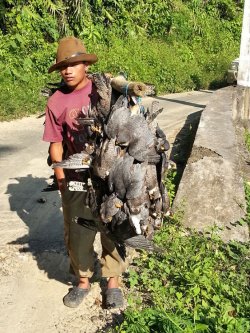
      Last year tens of thousands of the birds were trapped in nets and killed in their gathering place on the Doyang reservoir.

Last year – trapped.

This year, the Councils of three villages came together and passed a resolution making the hunting and killing of falcons a punishable offense.

Meetings were held with villagers in the district to advise them of the need to protect the birds and a number of awareness campaigns were conducted including an Animal Action Education programme for school children.

Last year. (Photo: Conservation India)

Last year. (Photo: Conservation India)

Patrols by local villagers have policed the birds’ roosting sites and brought the entrapment and killing to an abrupt stop.

Wildlife Trust of India’s Regional Head Sunil Kyarong talks to villagers about wildlife and the importance of protecting nature. (Photo: Yuri Pator)

Natural Nagas and Wildlife Trust of India (WTI) assisted the state Forest Department in mounting the campaigns.

Amazingly, many of the people helping to protect the birds are former hunters.

According to reports not a single bird this year has been killed.


Source: Wildlife Trust of India.

Killing dolphins for shark bait

Posted on October 24, 2013

Yes. Apparently, in Peru.

    As sharks don’t have enough problems–fifteen thousand a year according to this report.  Accompanying video is gruesome.

    Apparently it doesn’t matter that killing dolphins is a crime in Peru.


Saving chimps at Gombe

Posted on October 21, 2013

At the turn of the century there were nearly 2 million chimpanzees
in the wild.

    Today
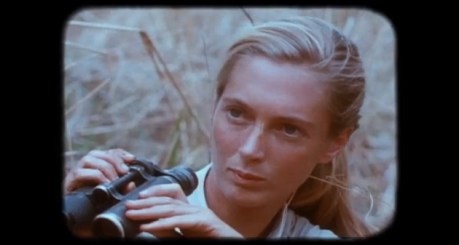
Jane Goodall, Gombe 1960. (Photo: JGI)

Jane Goodall, Gombe 1960. (Photo: JGI)

A new video

    from the Jane Goodall Institute demonstrates how technology can enable people to save habitat to save animals and help themselves in the bargain.

Elephant Down

Posted on October 20, 2013

I reblogged this but it got mashed by the tech gremlins, so click here to read this fascinating account of the travails of wildlife conservation in Africa.

(Photo: Rory Young)

(Photo: Rory Young)


Source: Anomie’s Child.

LOL

Posted on October 19, 2013

To all the “scientists” around the world who experiment on animals and claim their work is “ethics free” and that animals don’t have feelings….

(Photo: BBC)

(Photo: BBC)


Shout out: Andrew Sullivan.

Jaws of Hell

Posted on October 18, 2013

Made in six sizes, small ones for mink, the largest for bear, the Oneida-Newhouse leghold trap worked in all conditions; under water or on dry land, no matter the weather.

Oneida traps were widely used both in New England and in the American West. (Image: Project Gutenberg)

First produced in the 1850s in a factory in the wilderness of Western New York, the Oneida steel-jawed trap became a central tool in the nation’s war on predators.

Number one on the list was the wolf. So feared was the animal, the Puritan settlers of the Massachusetts Bay Colony put a bounty on them in 1630. By the middle of the 19th century they’d been exterminated throughout the eastern seaboard.

U.S. Department of Agriculture Year Book 1920.

U.S. Department of Agriculture Year Book 1920.

    The leghold trap became an essential tool for pioneers heading west who took the fear of the beast with them.

    “Evidence that Uncle Sam’s Hunters Get results.” U.S. Department of Agriculture Year Book for 1920.

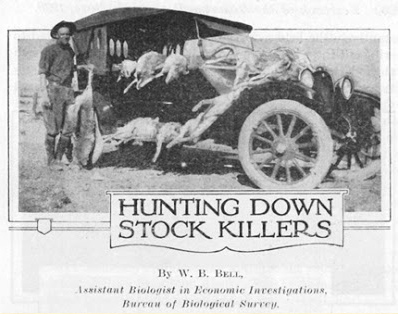
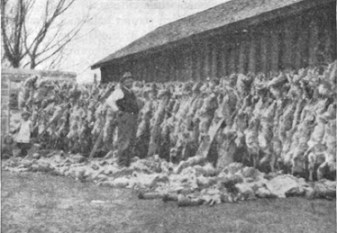
    Professional ‘wolfers’ hired by stockmen and a fearful settler population — abetted as today by the government — shot, poisoned and trapped wolves in an eradication effort that reached its apex in the early years of the last century, by which time some 55,000 wolves a year were being executed in the Western U.S..

    Over sixty countries have outlawed irrational “predator” control. But not the United States.