It’s a book.
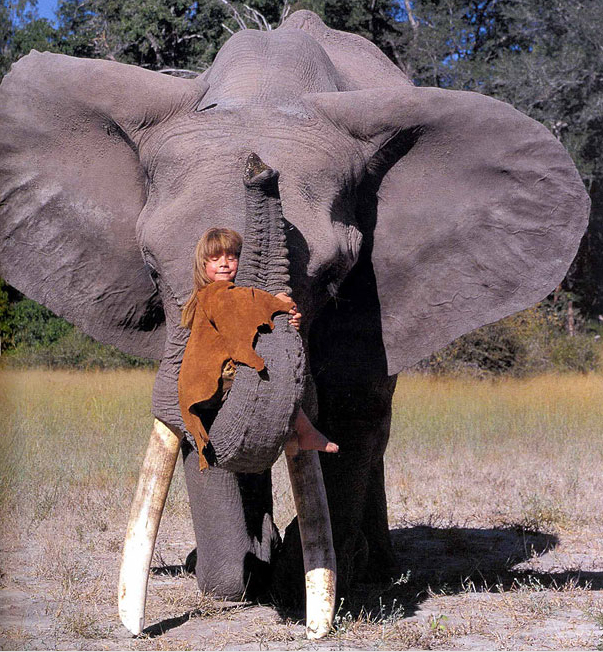
Tippi of Africa.
Or part of a mini-industry.
Shout out: Bored Panda.
It’s a book.
Tippi of Africa.
Or part of a mini-industry.
Shout out: Bored Panda.
A recent report from the British and Irish Association of Zoos and Aquariums (BIAZA) entitled “Top Ten Mammal Species Reliant on Zoos,” highlights a festering issue with critics of the zoo industry.

Critically endangered San Martin titi monkey.
Specifically, BIAZA’s claim that were it not for the work of their member zoos, the listed animals “may be lost to extinction forever.”
Putting to the side the fact we will all be lost to extinction forever, conservationists from the NGO Neotropical Primate Conservation (NPC), which operates in the Peruvian Amazon, and works extensively with one of the species on the list, the critically endangered San Martin Titi Monkey, takes the position that zoos claiming to be the last bastion of hope for any species undermines local conservation efforts.
NPC’s Project Director, Dr. Noga Shanee, PhD, said “The San Martin titi monkey is protected in seven different conservation areas under different schemes. Most of these schemes have been initiated and run by local communities. The Regional Government of San Martin and the local grassroots movement, the Ronda Campesina, are both running successful projects to control hunting and deforestation.”
Liz Tyson, the Director of the Captive Animals’ Protection Society, called the report by the zoo industry body “disingenuous” and said that it had the potential to damage in situ conservation efforts. “Zoos,” she said, “have been trying to move away from the perception that they hold animals captive for entertainment for some years by attempting to establish their work as based in conservation. But the funding that is provided by zoos to true in situ conservation projects is a pittance in comparison to the industry’s income. A report published in 2010 showed that two individual NGOs give more financial support independently of one another than all of the 300 plus members of the World Association of Zoos and Aquaria combined.”
Chris Draper, Programmes Manager from the Born Free Foundation added: “It is high time that zoos were judged on their merits, rather than on their publicity and spin. I strongly suspect that when all the facts are in, it will become clear that zoos’ role in conservation is limited at best. This should point us to the inevitable conclusion that the battle against extinction will not be won in zoos.”
Source: Captive Animals’ Protection Society.
Thirty-six years after General Electric was forced by court order to stop dumping PCBs into the Hudson River, the destructiveness of these manmade chemicals—of which chemists working for Monsanto (the manufacturer) and GE (Monsanto’s largest customer) were well aware—continue coming to light. The chemical industry has worked long and hard to cover up studies showing how these chemicals have affected human health.

October 11, 2013
“Sport” hunting is a brutal business. It means taking the life of an innocent animal for personal gain. The hunting industry doesn’t like the word kill because it exposes the lie that animals die peacefully after being arrowed, shot, trapped, choked and generally tortured to death. So they sanitize the cruelty of hunting by using euphemisms to describe their evil deeds. Harvest is a favorite.
Harvest: The gathering of a ripened crop
Are wolves ripened crops to be harvested as turnips, green onions, tomatoes, carrots, potatoes, lettuce, pumpkins, squash, bell peppers, grapes, etc? Or are wolves and other living creatures sentient beings who feel pain, who suffer, who bleed, who die?
Admit what you’re doing killers of beauty. You’re not harvesting anything. You’re making a conscious decision to take an innocent animal’s life. Stop sanitizing your actions. We have your number, you…
View original post 117 more words
Heavy flooding near Sonprayag in Uttarakhand last July left hundreds of animals, stranded and dying.

Exhausted.
The animal was tranquilized and secured so it would not move and, with the help of the pilot and copilot, loaded into a helicopter.
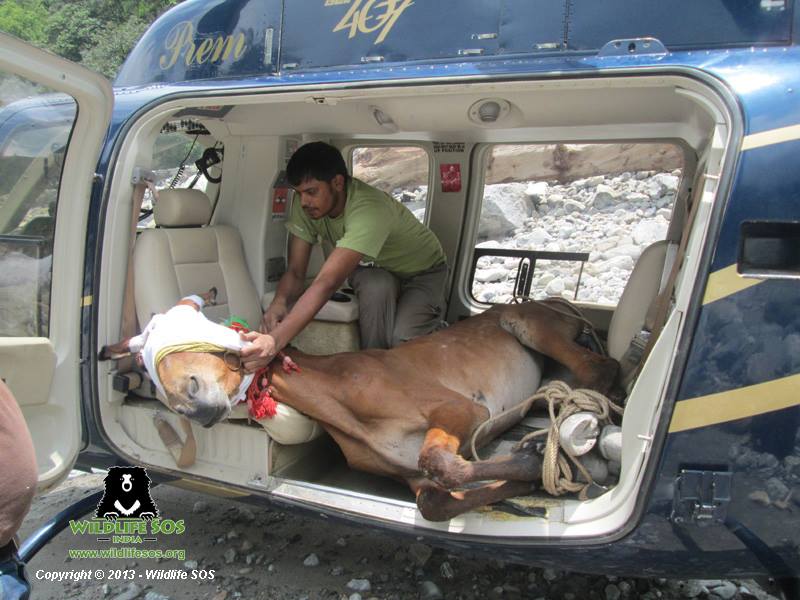
The groups deployed two relief teams consisting of veterinary doctors, para-vets with equine experience, farriers, and emergency drivers.
Source: Wildlife SOS India.
Please click HERE to sign and send letter
Source PCRM
Rogue, a brown, black, and white hound, endured months of experimental surgeries, having nine devices implanted in her body and being forced to run on a treadmill. At just 15 months old she died in October 2012 in a laboratory at Wayne State University in Detroit, where she was being used in cruel and misguided experiments. Unfortunately, Rogue was neither the first nor the last dog to suffer and die like this, but with your help we can stop these experiments once and for all.
Please speak out and demand that the president of Wayne State end these experiments immediately.
These experiments have been going on at Wayne State for more than 20 years. Over that time, hundreds of dogs have been used and killed with no human health benefits to show for it. Since 2000, more than $8 million…
View original post 348 more words
Found only in a small section of wetland marsh and swamp forests in Nigeria, the Niger Delta red colobus was wholly unknown to scientists until 1993.

Niger Delta red colobus. (Illustration by: Stephen Nash)
They hang out in large groups often with other species such as the Nigerian putty-nosed monkey and the Nigerian white-throated monkey. Few images of the red colobus exist.
Challenges to protecting the species are huge. The Niger Delta has suffered decades of environmental ruin from poorly-managed oil exploitation. Massive oil spills are widespread. Canals and pipelines built by the oil industry have disrupted the landscape with disastrous results for wildlife. Efforts to set aside parts of the delta as protected areas have been hampered by battles over oil rights.
The invasion of oil companies has also increased trade in bushmeat to feed workers and the colobus are easy prey.
According to the IUCN Red List, 48 percent of the world’s primates are threatened with extinction.
Source: Mongabay.
Amen.

My elderly mother adopted an Italian Greyhound named Ruby eight years ago.
Ruby brought out a maternal devotion in my mother that made my sister and me more than a bit resentful. Ruby has more clothes than we did as kids, and, more to the point, had to jump through none of the hoops we did to earn her love. Ah, but then dogs are less complicated than people, making the give and take of love fluid and easy. Ruby makes my mom happy; she’s a good companion and a social bridge to people. She gives mom a reason to get up in the morning, take walks and keep going.
When my mother was diagnosed with Alzheimer’s last year, she was in the early middle stages. Confused at times, unable to manage her finances, hold anything in her short term memory. But Ruby’s routine — her feeding schedule, her…
View original post 380 more words
A recent report trumpeting a broad recovery of iconic bird and mammal species across the European continent masks a deep problem.
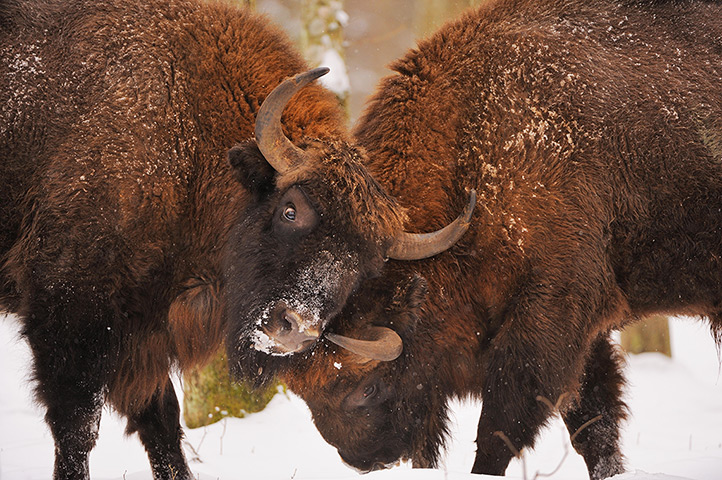
Rebound. European bison (Bison bonasus), Bialowieza forest, Poland. (Photo: Stefano Unterthiner/Wild Wonders of Europe)
Good news:large, rare animals locked away in protected areas benefit enormously from conservation measures taken by organizations that can buy land and create nature reserves.
Bad news: the “return” of an impressive number of birds and mammals does not signal a turnaround. None of the featured species have become sustainable populations. Global biodiversity continues to decline dramatically.
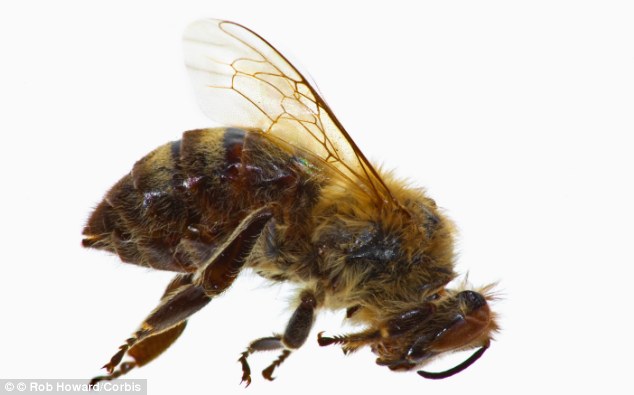
Falling behind. A dying honeybee who may have been inflicted with foulbrood disease which is killing bees in the US and Europe. 10 million bee hives have disappeared from the world in the last 6 years. EU member states have imposed a ban on classes of pesticides linked to massive bee die-offs. (Photo: Rob Howard/Corbis)
Worse news: the more ubiquitous species, the great bulk of life on earth—common plants, common birds, common insects, killed by resource extraction, agriculture, development and artificially altering the chemical makeup of the natural world—that require large diverse habitats and vastly different measures and systems to sustain life continue to show massive declines.
Saving a select few keystone animals isn’t enough. The key factor in all the recoveries listed is the withdrawal of human influence on landscapes.
The species falling behind can only be saved through changes in public policies directed at agriculture, extraction, hunting, and solid, unequivocal protection of air and water.
Shout out: Richard Conniff.
Animal welfare is in many ways an oxymoron when applied to China. But, as the saying goes, “it’s a process.”

Animals Asia China poster entry.
Animals Asia sees this as indicative of changes in how people in China view animals.
As an example, the group attributed cancellation of the 3 week long Jinan Animal Carnival Festival in Jinan, a city of 6 million in Shandong Province, to pressure from China’s growing animal welfare movement. Sponsored by the Jinan Bureau of Parks and Woods at the Quancheng Ecological Park, the festival has traditionally featured animals performing multiple times a day.
They also noted that since the Nanjing Zoo halted its staged performances of cycling moon bears, diving pigs and tiger taming, and put an emphasis on environmental awareness and education, visitor numbers at the zoo have increased sharply.
Animals Asia called it a “widespread awakening.” Fingers crossed….
A short film follows the rescue of an orangutan caught in a snare, his rehabilitation and release back into the wild.
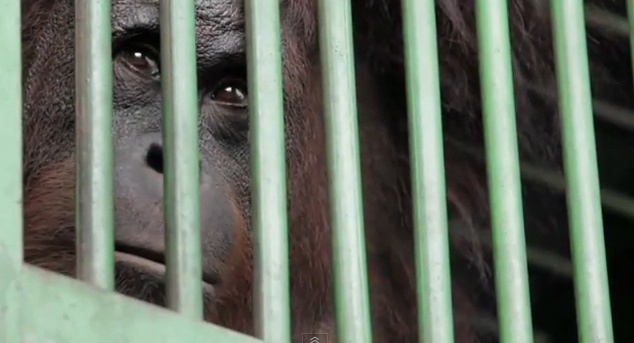
Pelangsi. (Photo: International Animal Rescue)
Efforts expended by groups such as International Animal Rescue to save these creatures are extraordinary. Footage of the ape moving through the trees near the end says it all.

Boycotting products containing palm oil is one thing we can all do to help the animals in Indonesia.
Shout out: Wildlife Extra
A few weeks ago in Panama, a group of Texans, including a representative from the Dallas World Aquarium, landed in a private jet intending to airlift out of the country roughly 10% of the entire wild population of one of the most endangered animals on the planet. When caught, they explained they had a plan to establish a breeding population…return some to the wild, etc, etc.

Pygmy sloth released back on Isla Escudo de Veraguas. (Photo: Shannon Thomas / the Sea Turtle Conservancy)
The pygmy three-toed sloth (Bradypus pygmaeus) is found on a single island–Isla Escudo de Veraguas–in Panama, and nowhere else in the world. A recent survey found fewer than 100 of the animals extant.
The secretive mission might have succeeded if suspicious bystanders hadn’t noticed a number of crates containing what appeared to be animals being loaded on the plane. Questions were asked. A large impromptu crowd formed vigorously insisting that the sloths be returned to the wild.
The Texans were forced to relinquish the animals and they were returned to the island the next day.
Source: Mongabay.
The recent mass poisoning of elephants in Africa is a reminder that such mindless brutality is anything but rare.
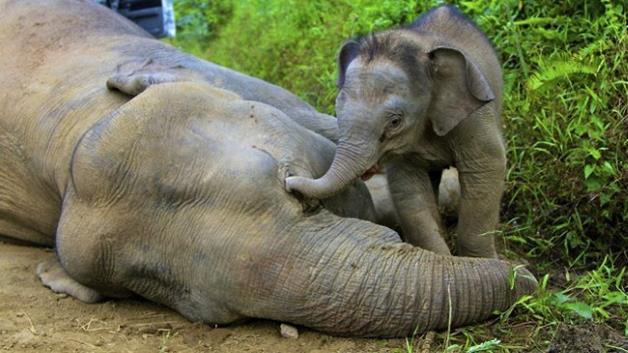
Borneo orphan. (Photo:EPA)
Last January, rangers of the Gunung Rara Forest Reserve in Northeastern Borneo came upon a baby pygmy elephant, nudging his dead mother, trying to get her to rise and feed him. Four other members of his herd lay on the ground nearby.
The rotting carcasses of six other members of the herd had been found earlier that month. Four more were found in the days to come. Initial autopsies revealed they were all suffering from severe bleeding and gastrointestinal ulcers, indicating they had been poisoned.
Unlike elephants poached for their tusks, these animals were killed because they posed problems for palm oil plantations which are gobbling up many of the country’s forests.
Poisoning of elephants in Borneo has become routine. Every year, at least a dozen elephants are found either poisoned or shot dead across Sabah’s elephant home ranges, particularly in districts where forests have been fragmented by large scale agriculture activities and plantations.
The herd had been staying at the edge of a rainforest reserve, close to a logging camp and oil palm plantations, land controlled by Yayasan Sabah, the state wood and palm oil group. The elephant family’s territory covers around 400 square kilometers and is being taken away from them.
Like orangutans, elephants love to eat palm tree fruits, which puts them in continual conflict with plantation workers.
Later chemical analysis of the elephants’ remains confirmed that their bodies contained high levels of heavy metals: arsenic, cadmium, iron and chromium. These metals are usually found around mining, smelting or waste disposal operations. As there is no such activity in the area, wildlife officials to believe the toxic substances were deliberately placed near the elephants’ feeding ground with the intention to kill them.

Borneo orphan. (Photo:EPA)
The baby was taken in by the Lok Kawi Wildlife Park. Now named “Kejora” or “Joe” for short, the calf appears to be healthy. He has gained weight and is now socializing with other elephants at the park..
Policymakers in Malaysia are in the process of clearing the last remaining rainforest areas in the states of Sarawak and Sabah for more plantations, as the country continues to rely on the export of tropical timber and palm oil.
The deforestation is being driven by Sabah Chief Minister Musa Aman, who personally grants permits for the clearing of the rainforest and for the establishment of palm oil plantations. Aman is also Chairman of the Board of Trustees of the state-owned Yayasan Sabah Group, which is scouring tens of thousands of hectares of rainforest for the new palm oil plantations.
The World Wildlife Fund estimates there are fewer than 1,500 Borneo pygmy elephants. Known for their babyish faces, large ears and long tails, they live mainly in Sabah and grow to about 8ft tall, shorter than mainland Asian elephants..
The future for Sabah’s elephants remains a question mark because 75 per cent of their territory lies in unprotected forest.
There have been no arrests in the poisoning of the 14 elephants.
If you want to shoot a lion or a tiger and save money in the process go to South Africa.

South Africa
The price of killing a wild lion shot on a safari in Tanzania may cost $70,000. In South Africa you can shoot a trophy size specimen for a fraction of that.
Hunting in South Africa also takes the strain out of the hunt as you are not only guaranteed a trophy, but the farm-raised, habituated animals are released for your pleasure inside a fenced area, just a few hours prior to your arrival, so there is no need to go driving and hiking all over the place and wearing yourself out.
The entrepreneurial spirit is strong in South Africa, which has more than 160 lion-breeding farms holding up to 5,000 lions, far exceeding the population of 2,000 or so remaining in the wild, hanging by a thread living off-limits behind fences in national parks and private nature reserves.
As an added bonus some South African game ranches also have tigers on offer, which they market with flair, pitching them “wink wink” as one ranch does using a photo showing a “Hunt trophy” with a specimen “taken from the wild.” An interesting turn of phrase as tigers are not native to Africa.
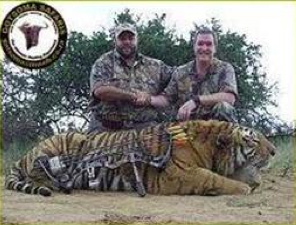
South Africa.
If you don’t want to shoot a tiger you can buy a cub–lion or tiger. Cubs are big business there as well.
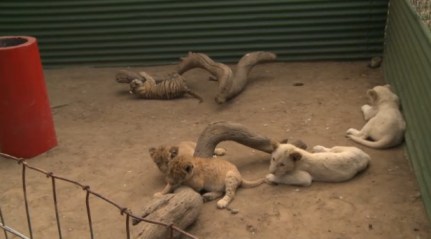
South Africa.
The South African wild cat trade is multi-faceted: lions, tigers, cubs…. The game farms make extra money selling them either alive or as parts to clients in Asia who grind up the bones for use in traditional medicine.
Demand for cats in the canned hunting industry is such—in the five years to 2011, the country exported 4,062 lion trophies, the vast majority captive-bred animals—that a substantial business has developed in neighboring Botswana capturing lions and selling them to South African game ranchers to supplement demand that can’t be met for farmed cats.
A look at big game hunting in South Africa can be found here.
Upon learning of the destruction of a French apiarist’s honeybees due to indiscriminate spraying of new post World War ll chemical insecticides, Dr. Albert Schweitzer wrote to a bee keeper:
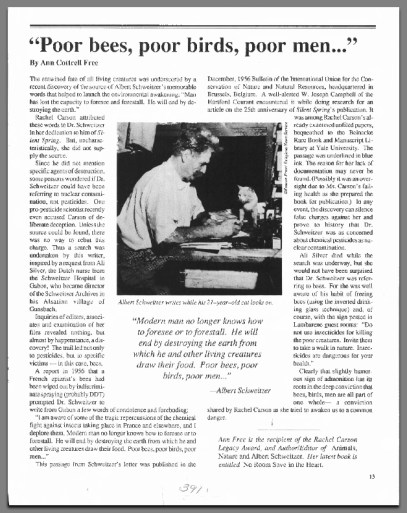
Animal Welfare Institute Quarterly, 1989.
“I am aware of some of the tragic repercussions of the chemical fight against insects taking place in France and elsewhere, and I deplore them. Modern man no longer knows how to foresee and to forestall. He will end by destroying the earth from which he and other living creatures draw their food. Poor bees, poor birds, poor men.”
Source: Animal Welfare Institute Quarterly 1989.
[This goes for observing animals in the wild as well.]
August letter by Robert Grillo, Free from harm.org
Visiting a sanctuary is a vastly different experience than visiting a farm. Farms value animals to the extent that they produce a profitable product via their flesh, mammary gland secretions or ovulation. Visiting animals on farms does not produce any “breakthrough” in our understanding of animals. On the contrary, most people simply walk away from a farm reaffirming what they have been taught: animals don’t object to being used as resources. It’s natural and sanctified by ancient traditions. Somehow, we rationalize, animals have passively accepted their lot in life. On farms, we view meek or fearful animals from a distance or on the other side of an electrical fence, typically in herds or flocks with ear tags (numbers instead of names), and under conditions which generally repress their ability to express themselves as…
View original post 343 more words


 First Light Productions