First Light Productions

investigative journalism

Posts from the “SANCTUARY” Category

Marbles

Posted on August 30, 2012

The Animals and Society Institute pointed me today toward a story in the Toledo Blade where several defendants recently charged in Municipal Court with animal abuse had prior domestic violence convictions. A pattern, experts say, that is not unusual.

Jason Burrell of Toledo, convicted of a domestic violence charge in 2000, was sentenced for crushing a puppy to death and leaving the body in his yard.

Marbles

Millbury resident, Aaron Nova, is facing a charge of abusively handling a dog named Marbles at the Lucas County Dog Warden’s Office, where he is a kennel worker. Nova was convicted this year of punching the mother of his child and trying to drag her from a car.

Domestic violence and animal abuse are connected because of what sociologists call generalized deviance. They are correlated, but it can vary which occurs first. Anti-social behaviors of different types can occur in the same individual.

Bee Friedlander, managing director at the Animals and Society Institute said, “It is important that all professionals who investigate violence in the home be trained on the cycle of violence, so that they are aware of the connection and better able to respond.” Some states, including Ohio, have gone a step further, with cross-reporting laws. In Ohio, animal control officers/agents are mandated to report child abuse (along with teachers, doctors, lawyers, and child-care workers.

Society doesn’t consider animal cruelty as severe as violence against humans. But animal abuse can be a tip-off to other violence or an abuse. If someone abuses animals early in life, it’s a sign that similar aggression may occur later to a spouse or a child. A bill that has been passed by the Ohio House would require a child under 18 years of age who commits cruelty to a companion animal to undergo psychological evaluation to determine if the child needs individual or family counseling.

Director of the Battered Women’s Shelter in the YWCA in downtown Toledo, said that threats against pets are often part of a partner’s tactics to keep the targeted partner under control and prevent plans for leaving. Problems of this type caused the YWCA to start a pet shelter program in partnership with the humane society, the dog warden, and local clinics, kennels, stables, and veterinarians. They have sheltered dogs, cats, bunny rabbits, gerbils, birds, and a ferret. The program is being expanded to provide help to areas outside the city.

Night Monkeys

Posted on August 28, 2012

On July 5, an Administrative Court in Colombia revoked the permits of noted malaria researcher Dr. Manuel Elkin Patarroyo. These permits, originally valid until 2015, would have allowed him to acquire as many as 4,000 night monkeys for his jungle laboratory, the Institute of Immunology Foundation of Colombia (FIDIC).

Night monkeys have been used as models for malaria research in Colombia (photo: International Primate Protection League)

Angela Maldonado

who has been studying New World monkeys in the wild for nearly 15 years, discovered that lab officials at FIDIC had persuaded the poor native people of Peru and Brazil—just across the Amazon River from Patarroyo’s facility—to capture night monkeys and transport them across the unguarded border.

Angela Maldonado just won a major legal victory for Colombia’s night monkeys (IPPL)

The local people probably didn’t know that they could be violating an international treaty (the Convention on International Trade in Endangered Species, CITES) by engaging in cross-border trade in a night monkey species, Aotus nancymaae, that is not native to Colombia.

Unscrupulous Science

According to evidence uncovered by Maldonado’s grassroots organization Fundación Entropika, the FIDIC had, for several decades, been rounding up at least 1,600 wild night monkeys a year for Dr. Patarroyo’s studies, then tossing them—often sick and weak from their lab experiences—right back into the Colombian jungle with no rehabilitation plan or environmental controls.

Night monkeys from Dr. Patarroyo’s lab, after they’ve been experimented on, are allegedly just thrown back into the forest. (Photo: © Fundación Entropika)

The judge ruled that the Colombian Ministry of Environment and the Corporation for the Sustainable Development of Southern Amazonia (CORPOAMAZONIA), which were responsible for monitoring FIDIC, had instead colluded with the lab in this inhumane and ecologically destructive travesty since 1984.


Source: “A legal Victory for night monkeys,” IPPL newsletter July 18, 2012.

Traffic in Rhinos

Posted on August 27, 2012

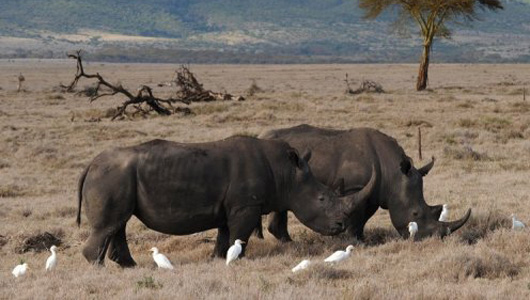
In a report issued this month, Global wildlife monitoring network, TRAFFIC, warned that if current poaching rates continue, 515 rhinos could perish by the end of the year in South Africa if no action is taken to stem the illicit trade in rhino horns.

South African rhino (Photo: Roberto Schmidt/AFP)

South Africa is home to about three quarters of Africa’s 20,000 or so white rhinos and 4,800 critically endangered black rhinos. In recent years the country has witnessed an unprecedented spike in sophisticated, violent and organized rhino-related criminal activities. Last year 448 rhinos were killed compared to 13 animals in 2007.

South Africa has lately scaled up its fight against illegal poaching and trade in rhinos horns, arresting 176 suspects so far this year, more than the 165 arrested in the 12 months of 2010. But even with the successful stories of high-value arrests and with anti-poaching security levels stepped up, the criminal syndicates and poaching gangs have become increasingly sophisticated and more aggressive.

The report named Vietnam as the worst offender fuelling the trade in the black market for rhino horns. The ground horn, which is believed by some to cure cancers, has taken on a new use and is now being pushed as a recreational drug mixed with drinks in the belief that it cures hangover.

Rhino crimes are receiving heavier sentences and South Africa now has a dedicated prosecutor to handle such crimes. In a promising development, South Africa and Vietnam are reportedly set to sign a landmark deal to help stem rhino poaching and the illicit trade in horns.

TRAFFIC’s report also described a worrying development where game ranch operators and custodians of rhinos have linked up with the crime syndicates and become major dealers in rhino horn.

Source: Susan Njanji for Mother Nature Network: http://www.mnn.com/earth-matters/animals/stories/more-than-500-rhinos-could-perish-this-year

Climate Change and the Oryx

Posted on August 27, 2012

In the New York Times today, reporter Leslie Kaufman writes about zoos grappling with how aggressive to be in educating visitors on the perils of climate change, fearful that too much bad news about damaged coral reefs, melting ice caps or vanishing species, might dent ticket sales.

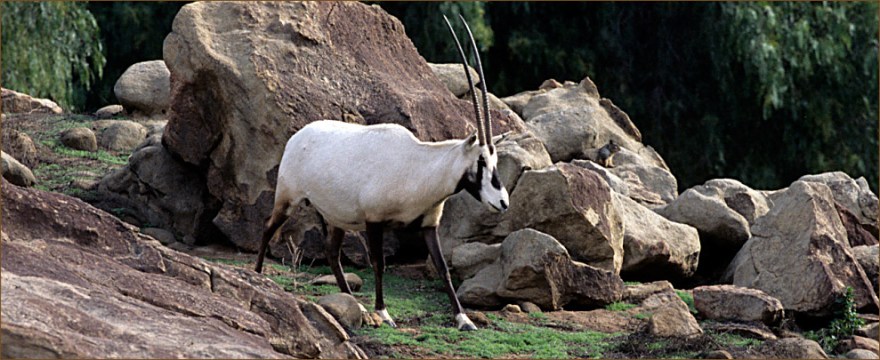
The long, slender horns of the oryx, carried by both males and females, give the oryx the nickname “spear antelope.” This is the most highly specialized oryx species for living in true desert extremes. Their light color reflects the desert heat and sunlight, and they can erect their hair on cold winter mornings to capture warmth to hold in their thick undercoats. Their legs also darken in the winter to absorb more of the sun’s heat.


This antelope of the Arabian Peninsula and Sinai Desert became extinct in the wild by the late 1960s, mostly due to hunters with high-powered rifles. To save the species, nine Arabian oryx from private collections in Oman, Kuwait, and Saudi Arabia, as well as from the London Zoo, were moved to the Phoenix Zoo in Arizona. A second breeding group of three oryx, from a zoo in Saudi Arabia, was started at the Los Angeles Zoo, and in the 1970s animals from both of these herds were sent to the San Diego Safari Park. As of 2010, 342 Arabian oryx have been born at the Safari Park, with many returned to Oman and Jordan for reintroduction in their native range. (Photo: San Diego Zoo Safari Park)

Some zoos and aquariums have held back, relegating information about climate change to nothing more than signs—about Arctic melting, for example, posted in the polar bear exhibit. On the other hand, many zoos and acquariums have put climate change “front and center.”

This month, the National Science Foundation awarded a coalition of aquariums $5.5 million for a five-year education effort to train staffs to develop ways of conveying information about climate change that will intrigue rather than daunt or depress the average visitor.

Most of the 224 members of the Association of Zoos and Aquariums now have some sort of climate message.

Unsurprisingly, talking about climate change in some locales is a tough sell. At the Georgia Aquarium in Atlanta, Brian Davis, the vice president for education and training, says to this day his institution ensures its guests will not hear the term global warming. Visitors are “Very conservative,” he said. “When they hear certain terms, our guests shut down. We’ve seen it happen.”

Denial is not just a river in Africa.

American Consumption

Posted on August 26, 2012

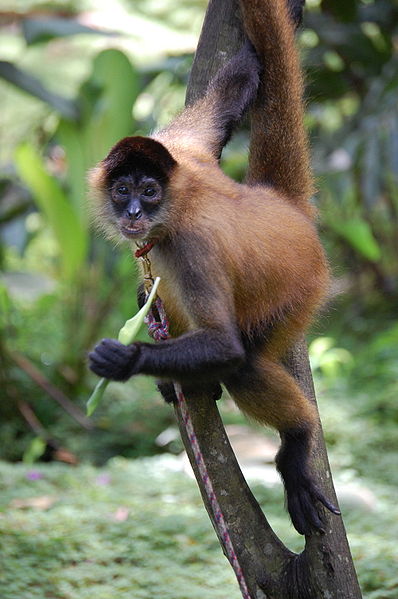
Female Panama spider monkey at the Caña Blanca wildlife sanctuary on the Golfo Dulce, Costa Rica. This individual had been illegally kept as a pet before being confiscated and sent to the sanctuary, and had spent her whole life on a short leash; because of this, she would panic whenever she was let off the leash and had to be kept on a 40-foot tether. (photo: Steven G. Johnson)

In Scientific American David Biello claims his morning coffee is killing the black-handed spider monkey.

The article (click thru) is a little hard to digest. Partly the writing. And a lot of the information covers old ground. But the fact that mindless consumption has consequences bears repeating. To wit, some of the comments from the very people of which Biello speaks who resent someone inferring they should take responsibility for their cravings.


From: Gatnos
“C’mon David, admit it – your making most of this up. Not a single scientific study was cited. Using emotionally charged words like “holocaust” and throwing around factoids as if they were real facts without supporting evidence. What is your point? Do you want Americans to stop using coffee? Do you have beef with Starbucks? I also saw cocoa mentioned as an evil crop. Just try to take chocolate away from the roughly 159,000,000 American females. Yes, you are right; humanity is selfishly using the world resources at the expense of other species, but you have a hard case to sell if you want us to get upset over fungi and microbes. The United States has taken great strides to be responsible conservationists (not environmentalists), the fact that the rest of the world has not; is not the fault of us the consumer. The blame lies squarely on the shoulders of those who are willing to destroy their property and natural resources for these cash crops. Stop with the guilt trips already and write something scientific.”

From: N a g n o s t i c
“So much verbiage over one stupid animal. Big deal if it goes extinct. Coffee helps people live longer, and staves off Alzheimer’s. Screw the monkeys.”

From: geojellyroll
“This article is a hodgepodge that meanders so many disciplines it’s akin to religion….sounds like it has some ‘meaning’ but is based on ‘nothing’. As a high school paper it might get a B-…as a paper on a science site it earnsd a big ‘F’. ‘Fellow travelers on the planet’…please!!!! This is not a beauty pageant site.”

From: priddseren
“I do enjoy environmentalists who can toss out a ridiculous statistic and then say except not counting this or that. Here is is the claim extinction is happening at 100 times faster than any other time except the 5 great mass extinctions don’t count. Well of course they don’t count because if you did count them the statistic would be extinction is happening at a slower rate than any time in history. But as if I would expect anything else. This author also drinks the warmist koolaid and the warmists leave out things like ice ages and the PETM and pretty much any other data that throws off their computer models. At least Mr. Biello is consistent in the way he uses invented statistical data to exaggerate his concerns.”

High in Galicia

Posted on August 24, 2012

Iberian wolf (Photo: Netícola – Raúl A)

Despite limited food resources and a presence that is not always welcome, the Iberian wolf holds out against all odds in the northwestern corner of Spain, an intensely human-dominated area since prehistoric times.

Although the wolf boasts highly adaptable strategies for survival, landscape is the factor that best explains their distribution across Galicia. They hold out by staying in high places with dense vegetation that are difficult for humans to access and allows them to go unnoticed. Studies have shown that Iberian wolves prefer wild hoofed animals–their favourite prey are roe deer, deer and wild boar–to livestock, in spite of the latter being readily available.

Humans are the known cause of wolf death in Spain in 91% of instances. Some 65% of wolves are killed on the road, 20% by poaching and 6% by legal hunting.

Source: from materials provided by Plataforma SINC, via AlphaGalileo via Science Daily.

The Concept of Sanctuary

Posted on August 24, 2012

Paradigm Shift

In recent years the battle to rescue the chimpanzee, endangered in the wild and jailed in research laboratories throughout the U.S., has acted as a catalyst to spur the growth of sanctuaries: lifelong homes for primates rescued from biomedical research, the entertainment industry, the exotic pet trade, or no longer wanted as pets. There are now seven primate sanctuaries in North America and eighteen in Africa united under the banners of the North American Primate Sanctuary Alliance and the Pan African Sanctuary Alliance that provide permanent homes for these animals, in close accordance with their social nature, with caregivers that recognize each animal as an individual, giving them, whenever possible, choices, and keeping them off-limits to the general public to shield them from anxiety and human disease.

Sanctuaries for many species are springing up around the world. Sometimes in man made environments for formerly captive animals incapable of return to the wild, others in protected parks and reserves carved from the wild.

New Definition

The idea of “sanctuary” doesn’t refer only to the dictionary definition of a safe place, but also a concept—an awareness. A goal. To treat all animals as sentient beings deserving of respectful treatment as individuals wherever they are found.

Late Breaking Success

Julius was one of the first chimps to be released into the sanctuary officially known as Chimpanzee Habitat for Conservation and Education.

With funding provided by the supporters of the International Primate Protection League, a new forested enclosure built especially for sanctuary chimpanzees in the eastern Democratic Republic of Congo welcomed its first residents. Construction on the 2.7 hectare (nearly 7 acre) electric-fenced enclosure at the Centre de Réhabilitation des Primates de Lwiro (CRPL) started in February 2008, was completed on May 1, 2012, at a cost of US $200,000. Two days later, the first chimpanzees were released into this forested habitat.

Misisi, Monique, Ituri, Maiko, Fizi, Julius, and Uvira (all around 4 to 6 years of age) were the first to investigate their new home. According to Andrea Edwards, the outgoing CRPL co-manager, “The young chimpanzees, accompanied by their long-time caregivers, were released into the forest and immediately began exploring. While Misisi and Monique were brave and independent, young Ituri decided it was wiser to be carried around by her dedicated caregiver, Papy.” A guava tree was the biggest hit!

Lonesome George

Posted on August 23, 2012

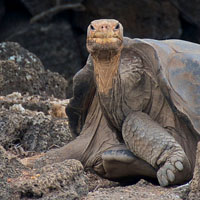
Officials at the Galapagos National Park in Ecuador recently announced the death of Lonesome George, the Galapagos tortoise whose failed efforts to produce offspring made him a symbol of disappearing species. He was found in his pen by his longtime keeper, Fausto Llerena. His death was attributed to unknown causes.

LonesomeGeorge(FlickrCommons-Davey)

He was thought to be 100 years old. Giant tortoises can live well over a century and scientists had expected him to live another few decades.

Attempts were initially made to mate him with two females but the eggs they produced were infertile.

George had become a symbol of the Galapagos Islands, which attracted some 180,000 visitors last year.

The Galapagos’ giant tortoise population was decimated after the arrival of humans but a recovery program run by the park and the Charles Darwin Foundation has increased the overall population from 3,000 in 1974 to 20,000 today.

Bligh Reef

Posted on August 23, 2012

Twenty-three years after the Exxon Valdez ran aground on Bligh Reef outside the port of Valdez, Alaska, and leaked more than 11 million gallons of crude oil into Prince William Sound, polluting 1,300 miles of shoreline, the ship will be dismantled for scrap metal in an Indian ship-breaking yard.

Exxon Valdez (National Oceanic and Atmospheric Administration)

Only about one-fifth of the ship’s cargo seeped into the waters of the sound, but it was enough to kill a quarter-million seabirds, 2,800 sea otters, 247 bald eagles, 22 orcas, 300 harbour seals, and innumerable salmon and herring eggs. The spill reigned as the worst oil spill in national history until the BP Deepwater Horizon oil rig exploded in 2010.

Workers struggle to clean oil off the beach of Big Smith Island. (Photo: Jim Brickett)

The scale of the extractive projects mounted by the oil and gas industries today are simply too large to be safely contained when problems arise. In light of the immense profits made by these companies you’d think the government would recognize that the environment is finite and that penalties should be assessed to send a message that irresponsible behavior of such magnitude will not be tolerated. But decades after the Exxon Valdez spill, a federal court substantially reduced the penalty initially assessed against the company for the tragedy they caused in Alaska.

Oil still coats the beaches of Prince William Sound, disguised beneath layers of sand. Though the Exxon Valdez has run aground for good, the effects of the 1989 disaster will long outlast its namesake.

The legacies of the Exxon Valdez and Gulf oil spills remind us of the continued risk of future catastrophies. Shell Oil will soon start drilling in Alaska’s cold Beaufort Sea, only 15 miles from the Arctic National Wildlife Refuge. Just weeks ago Shell lost control of a drilling ship—the ironically named Noble Discoverer—while it was anchored in the harbor. A stark reminder that, despite the oil industry’s statements that safety is their top concern, accidents happen.

–Sourced from Audubonmagazine.org.

Afghanistan

Posted on August 23, 2012

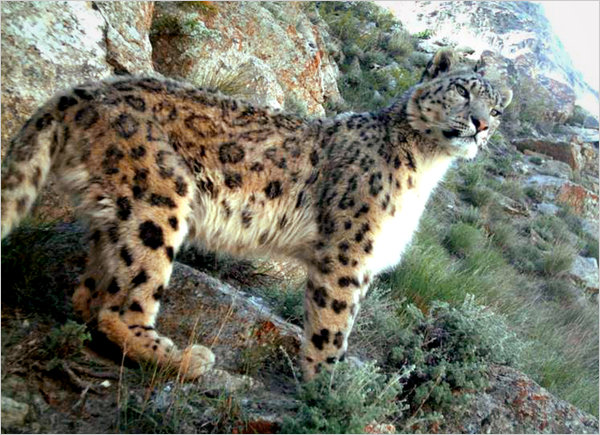
Biologists have discovered a surprisingly healthy population of rare snow leopards living in the mountainous reaches of northeastern Afghanistan’s Wakhan Corridor.

Wildlife Conservation Society


Wildlife Conservation Society-trained community rangers used camera traps to document the presence of snow leopards at 16 different locations across a wide landscape.

The big cats are threatened in the region. Poaching for their pelts, persecution by shepherds, and the capture of live animals for the illegal pet trade have all been documented in the Wakhan Corridor. Between 4,500 and 7,500 snow leopards remain in the wild scattered across a dozen countries in Central Asia.

Snow leopards have declined by as much as 20 percent over the past 16 years and are considered endangered by the International Union for Conservation of Nature (IUCN).

–Reprinted from materials provided by Wildlife Conservation Society.

Hooves & Paws

Posted on August 22, 2012

Reba

Reba lived her life out at Hooves & Paws Rescue of the Heartland. She was a 25 year old mare when she came to the rescue, an Owner Surrender along with six other horses. She was totally blind in her right eye and had almost no sight left in the other. She was very underweight and had not had any vet care for many years.

The vet came out to see Reba because she was struggling to gain weight and had started to get a thick discharge from her nose. He reached in her mouth to look at her teeth and one of them actually broke off at the root. He said her teeth were infected and most of them would need to come out. She had a severe sinus infection that was filling her nasal cavity. She was full of worms and also had parasites.

She was a wonderful, sweet girl, even after all the neglect she had suffered.

Reba crossed over the Rainbow Bridge, April 2nd, 2008.


http://www.hoovespaws.org

Profit Before Animals

Posted on August 21, 2012

August 15, 2012. NIAGARA FALLS, ONT.—Larry lies behind bars in a pen, his eyes red and swollen. The harbour seal with “an amazing little personality” who arrived at Marineland about eight years ago is now a shadow of his former self. After repeated exposure to unhealthy water, he has gone blind.
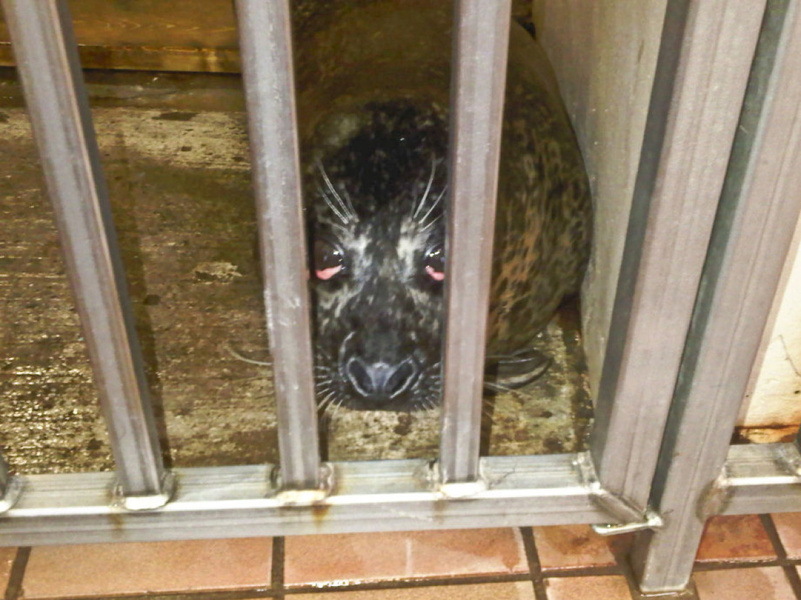
Larry, the harbour seal with “an amazing little personality” who arrived at Marineland about eight years ago is now a shadow of his former self. After repeated exposure to unhealthy water, he has gone blind.

Larry isn’t the only sea mammal living in distress at Marineland, the sprawling attraction in Niagara Falls. In extensive interviews with the Star, eight former Marineland staffers describe a pattern of neglect that has repeatedly resulted in animal suffering.

What the public doesn’t see, they say, is the deterioration of marine mammals that become sick, suffer fur loss, skin damage and even blindness because of recurring water problems.

They also point to chronic staffing shortages that leave trainers unable to provide a minimum standard of care for animals to do well in captivity.

John Holer, owner of the Niagara institution for 51 years, denies there are problems with water quality at the park and that unhealthy water has harmed marine mammals. He says there is more than sufficient staff to look after the animals. “All our facilities are legal,” he said.

There are no government regulations for sea mammal captivity in Canada.

A February 2012 photo shows sea lions Sandy and Baker (left). The pair had to be pulled repeatedly from the water and confined in dry cages, in one case for more than two months, to limit further harm to their already damaged eyes. Videos shot in 2011 and 2012 shows them writhing in pain or plunging their heads into a single bucket of clean water.

Among several troubling incidents at the park between last fall and this spring: Sea lions Baker and Sandy had to be pulled repeatedly from the water and confined in dry cages, in one case for more than two months, to limit further harm to their already damaged eyes. Videos shot in 2011 and 2012 shows them writhing in pain or plunging their heads into a single bucket of clean water. Sandy often sits like a statue, dry as a bone. There’s no lens in Baker’s left eye. When a trainer put him back in the water in April, he barked and it flew out.

Sea lion Baker, shown in an April photo, has no lens in his left eye. Baker had to be pulled repeatedly from the water and confined in a dry cage, in one case for more than two months, to limit further harm to his already damaged eyes.

On May 28, baby beluga Skoot died after a two-hour assault by two adult male belugas in an incident former trainers say points to understaffing at the park. The evening attack unfolded in front of a guide untrained and helpless to intervene. The males bit Skoot’s head and body, spun her around by the tail and bashed her into a rock wall where she stuck. After two trainers finally arrived to pull Skoot out of the pool, she convulsed and died in their arms.

Holer says Skoot was attacked because she had contracted bacterial meningitis, explaining: “If animals see another animal is going to die, they kill it.”

Five female dolphins — Sonar, Lida, Marina, Echo and Tsu — swam almost continuously in bad water in a concrete pool in a facility called the barn. Former employees say they lay at the bottom in murky green water or breeched and thrashed wildly, their reactions changing with the chemicals. Their skin fell off in chunks, their colour darkened and they refused to eat. This lasted intermittently for eight months, from October 2011 until just before show season began in May 2012 when their water was changed.
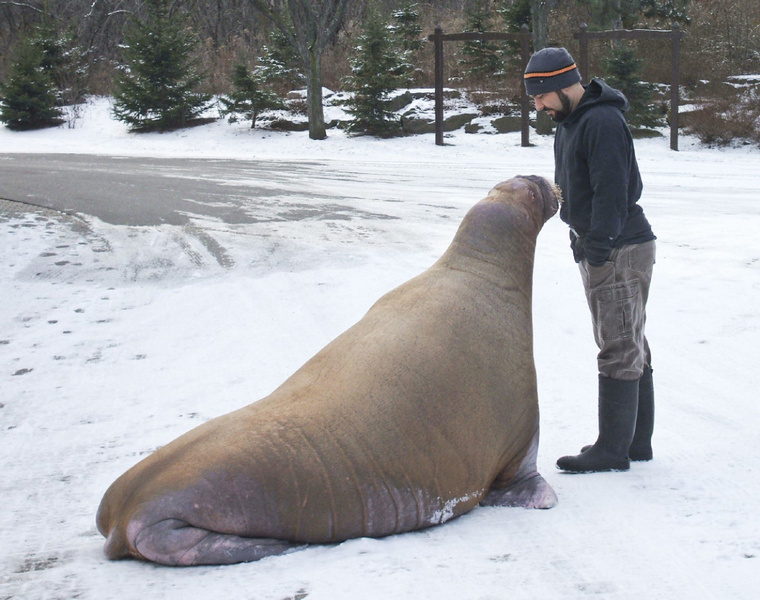
Phil Demers, a former animal trainer at Marineland, is shown with female walrus Smooshi several years ago. Demers left Marineland in May after 12 years, worn down by his inability to help animals in his care.

There are other problems at the facility. Walruses, which crave attention in captivity, are confined sporadically in cramped, waterless pens.

Six of the park’s seven seals are blind, have impaired vision or have had serious eye problems because of exposure to unhealthy water, former trainers say.

Poor conditions drove some of the eight former employees to leave and were a major factor in the departure of others.

Former employee Phil Demers resigned this past spring after 12 years as a senior trainer, worn down and frustrated by his inability to help the animals in his care. “I realized I was no longer part of the solution. I was part of the problem,” he said. “I can’t train animals that are sick and compromised.”

All the animals in the pools suffered over the course of the winter and spring, Demers and the supervisor say.

The Star obtained photos, videos and documents that support the accounts of the former employees. Three made the difficult decision to speak out publicly, despite having signed non-disclosure agreements. Five asked that their names not be used for fear of legal consequences.

Record books from one former supervisor log a history of problems with the various pools from March 2011 to March 2012. He described the water as stagnant and flat in the barn, stadium and Aquarium pools. Although water periodically improved, he and Holer were never able to find a permanent solution to the problems. The effect on the animals, he said, was devastating.

“It got so that I didn’t even have to test the water when I arrived in the morning. I could tell just by looking at how sick the animals were,” the former supervisor said. “If you don’t look at them, there’s no problem. What hurt me most is those animals in those pools. They can’t go anywhere. They can’t get out. They’re stuck.”

Larry, about 10 years old, was pulled from the water for days or weeks at a time and kept in either a waterless pen or a metal box on wheels.

Aging animals may suffer from cataracts, trainers said. But their eyes “are not red, swollen, bulbous and inflamed from age. That is from water quality,” one trainer said.

Records show the barn and stadium pools deteriorated after an ozone generator breakdown on Sept. 4, 2011. The supervisor says the water turned green and serious water problems persisted intermittently over the coming months.

After the first day of green water, “the animals were in hell,” including walruses, Demers said. Smooshi had a wildly inflamed flipper, which a veterinarian said was a “chemical burn,” and Sonja’s ulcerated eye worsened. “All the animals showed signs of damage. This was one of the worst states I’ve ever seen them in.”
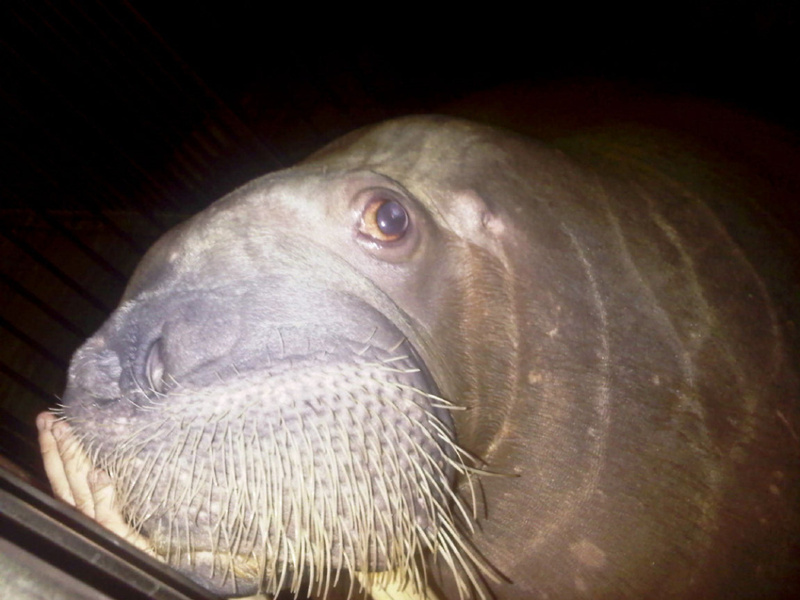
Sonja, a female walrus show in an April photo, has suffered eye damage that former trainers blame on poor water conditions at Marineland.

The situation was particularly acute for the five dolphins, which, unlike sea lions, seals and walruses, are unable to pull themselves from the water. The supervisor recalls many times when the dolphins were so dark and the water so green, they were barely visible. Photos show dolphins with eyes squeezed shut.

In a 2010 memo, Demers blamed poor water quality for ill health among walruses, as well as sea lions and seals. “Health issues arise in every instance, ranging from eye damage, fur loss, weight loss, stress, skin lesions (and more).” A few days after Demers left, Holer changed the water in the barn and stadium pools. The May 10 opening was delayed five days to do it. Water was not changed at the Aquarium.

Former employees say that a shortage of trainers means the animals don’t get the attention they need to do well in captivity. Walruses in captivity crave human attention and yet former trainer Bentivegna says they were left days at a time in their dark barn pens with no stimulation apart from feeding. Walrus vomiting and weight loss is a recurring problem at Marineland.

Bentivegna says the final straw was seeing Zeus, a powerhouse walrus who knew his own strength, disintegrate into the shell of a once intimidating creature. Recent videos and photos show him sitting behind bars in a waterless space barely big enough to turn around in and looking broken-down and miserable. He was being treated for regurgitation issues—exacerbated by bad water—and the lack of trainers meant he often lay unattended in his own excrement.

Baker is a big guy, the only male sea lion swimming mindless laps during the Star’s two recent visits to the Aquarium. He used to be the clown, the funny fellow with the clear eyes, still featured in “Attractions Niagara.” Now his body is scarred and itchy with patches of missing fur. Every time he passes he rubs his head hard against the side, trying to scratch himself over and over. His eyes are squeezed so tightly shut it looks like he doesn’t have any. For all intents and purposes, he doesn’t.

From a report “Marineland animals suffering, former staffers say,” By Linda Diebel.
http://www.thestar.com/news/canada/article/1241961–marineland-animals-suffering-former-staffers-say

Slaughter Bound

Posted on August 20, 2012

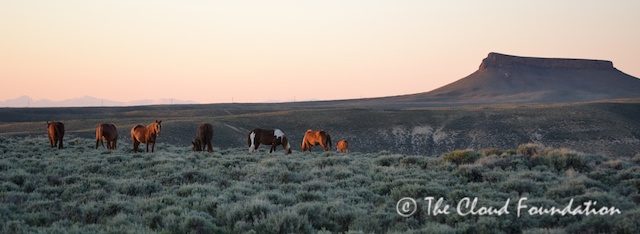
Here is your basic slaughter bound horse. She was surrendered to us last night when the owner decided that Habitat for Horses wasn’t going to leave him alone.

Habitat for Horses

The dysfunctional owner, having placed the horse in a “pasture” smaller than most living rooms, decided that the horse needed to be tied up with a thin, wire normally used as a dog runner. The mare probably started fighting with the wire sometime in the afternoon.

The wire became tangled in the brush, wrapped around stumps and trees and then wrapped tightly around the horse’s back leg. The constant struggles led to foot being nearly severed. There is no telling how much blood was lost by the time we arrived. It was bad – really bad.

His response? “Well, I was gonna’ give the horse to my neighbor. I suppose he can take it now.”

Uh, no. If left alone the horse would have been dead in a few hours.
“Well, can I just give it to you?”

Probably another half gallon of blood drained out of her on the way to the vet clinic. The foot was barely attached. Once unloaded and in the stock, she went down – hard.

I’ve seen that look far too many times. That’s what nightmares are made out of – that haunting scream, ”I don’t want to die!,” from horses starved in pastured, cut to ribbons by barbed wire, horses dying from lack of water. Yes, those are the direct causes, but what caused that problem? Stupidity. Ignorance. Absolute mindlessness. Total idiots breeding horses with piss-poor conformation knowing full well that there is no market for the foals. Not just backyard breeders, either. The same applies to AQHA members, APHA members, even the 10,000 thoroughbreds that are slaughtered ever year. No market for them because there is not a single human brain cell in their wrinkled pea brains that says, “Uh, what are you doing?”

I bet I received 20 emails yesterday screaming such highly intelligent questions as, “What do you intend to do with all the horses?”

My response – why would you think that I need to take responsibility for the results of your mindless breeding program? Do I have to take care of your kids, too? What the hell happened to your level of responsibility for the life you create?

Much as I hate to tell people this, horse slaughter is a business, not a service. If the demand stops, so will the slaughter trucks. And trust me on this one – the EU will finally be forced to face up to the fact that American horsemeat is about as filthy a substance as you could get down your throat without throwing up, absolutely crammed full of poisons.
Do you think maybe we didn’t give this horse any pain medication?

Our crew and the vet crew worked late into the night trying to save this girl. By midnight she was up and munching hay, this morning she was looking out the stall windows, watching her new world.

If she survives, and there is a serious chance she won’t, she will never walk normal again. I guess for a lot of folks, that makes her prime for the slaughter truck. Hell, I bet she’s bring $25 at the auction, and I’m sure someone in France would love to have her for dinner.

But through some small miracle she ended up as Case Number 11-152 on our books and, God willing, someday soon she’ll be standing by the hay stacks with Pete and Tiger and a half dozen “useless” horses, doing what horses do best.

And to the killers, to the heartless, nonthinking, mindless blobs who drool over the possibility of grabbing another cheap horse for the slaughter truck – too bad. You loose, this mare wins.

Did you call the President yet? I did, five times yesterday and twice today so far. Keep it up. Never stop. This is what you are fighting for – the lives of horses that never got a chance to know what love is all about.

–Jerry Finch. December 2, 2011. Habitat for Horses. http://habitatforhorses.org/