First Light Productions

investigative journalism

Posts by Michael Elton McLeod

WHO IS THE PIRATE?

Posted on February 27, 2013

Despite an international ban on commercial whaling in place for 25 years,

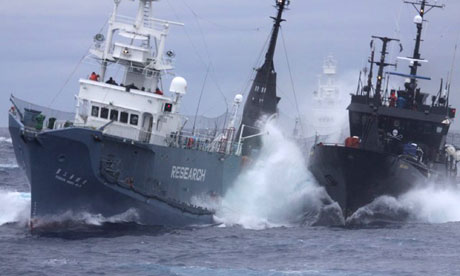
Japan has continued to send its ships to the Antarctic in the autumn or winter each year to catch whales by the hundreds. To prevent the killings, the anti-whaling group Sea Shepherd has been chasing and harassing the Japanese whale fleet in the frigid southern waters for years.
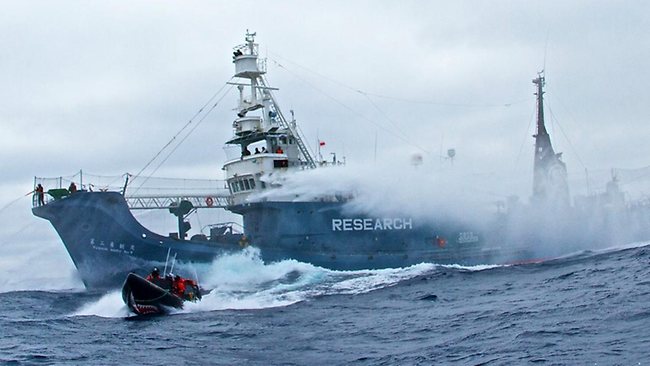
Antarctic whaling confrontation. (Photo: Sea Shepherd)

Breaking news

San Francisco, Monday–a judge of the 9th US Circuit Court of Appeals issued a ruling against Sea Shepherds clearing the way for Japan whaling interests to launch more extensive legal action against the group.

“When you ram ships, hurl glass containers of acid, drag metal-reinforced ropes in the water to damage propellers and rudders, launch smoke bombs and flares with hooks; and point high-powered lasers at other ships, you are, without a doubt, a pirate,” the judge said. “The activities that Cetacean [the Japanese whalers] alleges Sea Shepherd has engaged in are clear instances of violent acts for private ends, the very embodiment of piracy.”
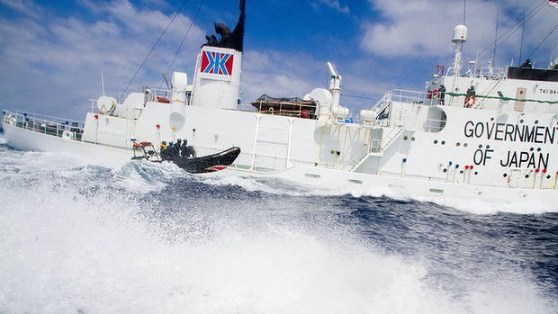
Sea Shepherd boat harassing Japanese whaler. ((Photo: Sea Shepherd)

Sea Shepherd founder Paul Watson

described the judge’s opinion that he is a “pirate” as one-sided and irrelevant, saying the judge had ignored aggression from the Japanese fleet. “He didn’t mention anything in there about the fact that the Japanese have destroyed one of our ships (the Ady Gil in 2010), they’ve thrown concussion grenades at us, hit us with water cannons and laser beams.” As for the judges accusations. “We don’t throw acid. We throw rotten butter. We haven’t rammed a single Japanese whaling vessel down here in the entire nine years. We’ve been rammed multiple times.”


The issue of piracy

Robert F. Kennedy, Jr.

was addressed by Robert Kennedy, Jr., senior attorney for the National Resources Defense Council, and President of the Waterkeeper Alliance, at the National Press Club one week ago:

“The organization that brought this lawsuit (against Sea Shepherds), which is the so-called Institute for Cetacean Research, which is an arm of the Japanese government, is really a private organization masquerading as a scientific research group. For may years they’ve obtained permission to kill thousands of whales every year using as a pretense that they weren’t doing this for businesses reasons, which would have been illegal, but that they were killing the whales for scientific research. Since 1986 when they obtained this scientific research exemption they have killed 20,000 whales and they have not produced a single peer-reviewed article in any scientific publication.
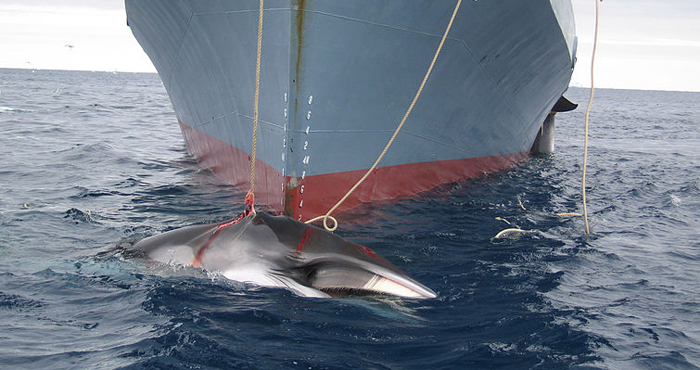
Japanese whaling. (Photo: Sea Shepherd)

“…The Institute for Cetacean Research, (takes) the whale meat back to Japan and they claim that this is a Japanese cultural necessity, but in reality according to a recent study by the International Fund for Animal Welfare, fewer than 2% of people in Japan actually eat that meat, and that number is declining rapidly because of the widespread knowledge now that whale meat is heavily contaminated with neurotoxoic mercury.

“In 2010 (Japanese whalers) sank a Sea Shepherd ship in an act of piracy. The Sea Shepherd ship had the right-of-way, they cut it in two, and almost killed six people, and they sank the ship. Then they arrested the captain of the ship and they charged him, and what was the charge? It was interfering with a business enterprise. Yet they’re telling the world that this is not a business enterprise, it is a scientific enterprise.

“The (whaling) business is completely based upon them receiving enormous subsides from the Japanese government including $30 million in subsidies raised by people in the country and around the world for tsunami relief in Japan, that was handed over last year to the Institute of Cetacean Research.

So…it’s a pirate industry. The International Whaling Commission has recognized that the scientific research claims are dubious and has imposed a moratorium on whaling, an international moratorium, and the Institute of Cetacean Research is violating that moratorium. In other words, they are today in violation, by sending these ships out. The two harpoon boats and their factory processing ship in the Southern Ocean, they are violating not only Australian law—the Australians and Chileans have chased them out of their territorial waters and forbidden them from coming into those waters and their Antarctic waters—they are in violation of international law.

“The term for this is piracy. If you are violating international law on the high seas, you are a pirate.”
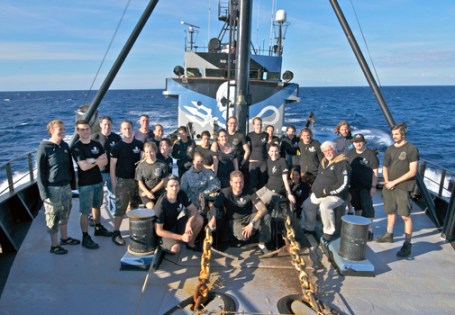
Captain Paul Watson and the crew of the Steve Irwin. (Photo: Sea Shepherd)
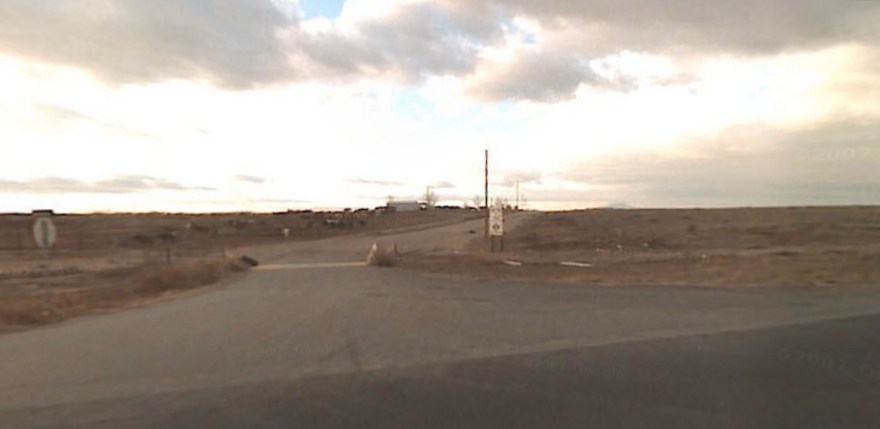
Australia is currently taking international legal action against Japan to stop the whaling.

INVESTIGATION

Posted on February 26, 2013

Location: the Southwest Livestock Auction & Slaughter Horse Feedlot
Date: 3/10/12
Address: 24 Dalies Road Los Lunas, New Mexico 87031
Owner: Dennis Chavez 505-865-4600 505-866-0149 fax
Sale Schedule: Cattle Auction: Saturdays @ 12:00 noon Special Horse Sales 4 times/year.

SW Livestock Auction, NM

Dennis Chavez

is New Mexico’s largest kill buyer. According to USDA records, he uses the export pens at Santa Teresa directly across the border from Ciudad Juarez to transship close to 10,000 horses each year to Mexican slaughter plants. Some of the plants still slaughter horses with the inhumane Puntilla knife method, a barbaric practice that leaves the horse fully conscious during the slaughter process.

The investigation was triggered by numerous complaints Animals’ Angels received about the treatment of the animals at the feedlot. Photographs & reports received from an anonymous source showed multiple incidents of inadequate care & extremely emaciated horses.


Report:

Investigators with Animals Angels arrived at the auction at 7:19am. The large auction consists of a building with office, staff rooms, auction ring, restaurant and an extensive outside pen area with arena. The pens have no shelter. The larger pens have water troughs. A large amount of hay was piled up in the middle of the pen area, but several of the horse pens had only corn husks to eat.

Multiple horses were found in bad condition (emaciated, untreated wounds, open cuts, lame, strangles, eye injuries), too many to be included in this report.

NMkillbuyer.1

One very thin grey has untreated, deep, lacerations to both eyes. He is believed to be blind in his right eye, and has limited vision in his left.
He stayed close to a chestnut, which he used as a “seeing” companion. His entire body was covered with marks. Marked with slaughter tag,
and large “X”, he could have been one of the many rejects. Even with apparent unkind handling, this horse licked the investigator’s hand.

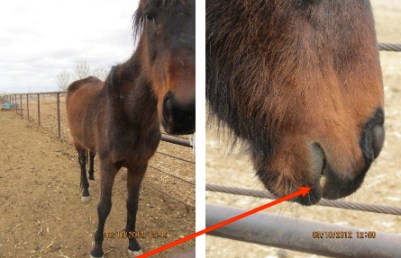
In the same pen, one very emaciated, older thoroughbred (lip tattoo not clear), had teeth so overgrown they protruded from his mouth. It is questionable that he was able to eat at all. He was very weak.

In the last pen on the right hand side of the main alley, 4 horses were down, unable to rise and in obvious distress:

1) A light grey mare was pawing in agony at the ground near water trough.
She had dug deep trenches in the ground. She was lifting her head and biting her tongue.

2) A severely emaciated palomino mare.

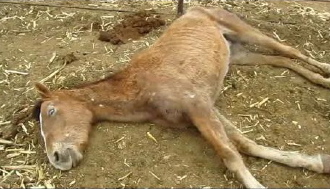
3) A extremely emaciated light bay/buckskin mare with blaze.

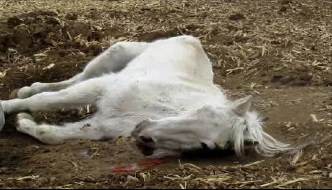
4) A severely emaciated, light grey mare with black spots. The mare attempted to get up numerous times, but was falling back to the ground each time, unable to stand. Open, bleeding wound on hips.

Investigators proceeded

to the office and alerted the office staff about the condition of the horses and requested that they (be) euthanized immediately. They were informed that the veterinarian would not return for another hour.

After approx. 20 minutes,

an older gentleman came out of one of the rooms behind the office and approached the investigators. Without introducing himself, he briefly questioned the investigators and then agreed to join them to check the pen area. While walking, he defiantly defended Dennis Chavez, even stating that he would “rescue” horses and that he was “giving them a chance to live”. Only after being asked to identify himself, he confirmed that he indeed was an inspector for the New Mexico Livestock Board, named “BJ” [Winchester].

After the investigators had informed him about the 4 horses dying and in need of immediate euthanasia, he stated that he was not going to “push Dennis” to stop the sale in order to help the horses. He also stated that the veterinarian would not look at the horses that day. He made it very clear that he was not going to do anything right away and that the sale would not be interrupted. The investigators insisted on immediate euthanasia and argued with the inspector all the way down to the pen.

Meanwhile

the light grey mare next to water trough had died without assistance. BJ briefly looked at her and still did not indicate that he would take any action. Instead, he asked the investigators if they were “animal rights people”.

Suddenly

a pen worker arrived and offered to shoot the remaining horses immediately. Put on the spot by the workers spontaneous offer, BJ finally gave the go-ahead to shoot the remaining 3.

The investigators were told they could not watch the euthanasia, but they observed from a distance that the worker really took care of the horses right away. Afterwards, he removed their bodies and dumped them behind the high stacks of hay bales near the quarantine pen.

New Mexico Law states that:

30-18-1. Cruelty to animals;

  • 1. negligently mistreating, injuring, killing without lawful justification or tormenting an animal; or
  • 2. abandoning or failing to provide necessary sustenance to an animal under that person’s custody.

30-18-14. Livestock crimes; livestock inspectors to enforce;

  • Livestock inspectors who are certified peace officers shall enforce the provisions of Chapter 30, Article 18 NMSA 1978 and other criminal laws relating to livestock.

As such, it is the duty of the Livestock Inspector present at the sale to check the condition of all horses inside the pen area and ensure that dying animals are euthanized in a timely manner. Inspector Winchester was wantonly negligent in allowing the obvious suffering of the horses to continue until an auction employee volunteered to euthanize the suffering horses. Additionally, he should have initiated cruelty charges against Dennis Chavez for negligently mistreating these horses.

Chavez as the owner of the feedlot has the duty of care and needs to ensure that all animals are given at least the minimum standards the law requires. The fact that these horses are slaughter horses does not exclude them from the protection of the law.


Animals’ Angels investigators took video of what they observed and turned it over to the local DA who filed 12 counts of misdemeanor offenses against Dennis Chavez on June 5, 2012. Four of the charges are for animal cruelty, four are for failing to treat an animal that can’t walk and four more are for not having a bill of sale for the horses. The charges could add up to nearly 11 years in prison.

Chavez was charged with 16 counts stemming from another animal cruelty case in 1990; all but one were dismissed by prosecutors. He was acquitted on the remaining charge.

STATUS

Writing yesterday, Animals’ Angels says that the case against Mr. Chavez is still pending. “We are watching this case carefully for a satisfactory outcome. It is not unusual for an animal cruelty case to take over a year to go to trial. We have dealt with several cases like this in the past and unfortunately they can take some time to be resolved. Please know that we are keeping a close eye on the situation. We will not forget what happened and will ensure that he is being held accountable for his actions.”

Southwest Livestock Auction

is one of the 6 largest killer auctions in the country. The others are Sugar Creek Livestock Auction in Ohio, New Holland Sales Stables in Pennsylvania, Billings Livestock Auction in Montana, Shipshewana Horse & Tack Auction in Indiana, and Stephenville, in Texas. Killer auctions can be found throughout the country.
                                                                                                 

DIARY

Posted on February 24, 2013

by Innocent Mburanumwe, Virunga  28 Jul 2007


“I have been thinking

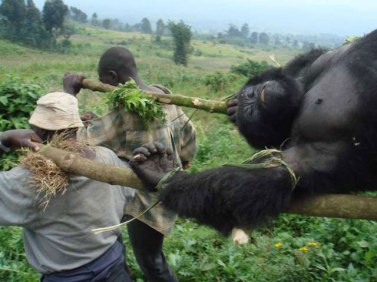
about these images, because we have all found them so upsetting, but as in the past, it is better that people see what is really happening. I will try to recount the events as best I can and I am sorry that the images are so disturbing.

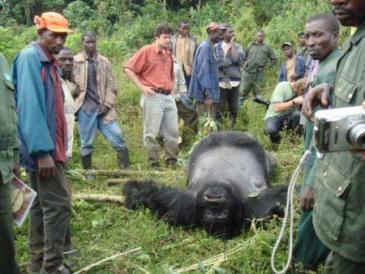
Senkwekwe, the Silverback, is brought out of the forest to be transported to Bukima.. We were all in shock.

I was in Goma on the night of 22 July. Emmanuel de Merode was in Bukima with members of my team, and Scott and Brent of Newsweek.

They heard shots at around 8pm.

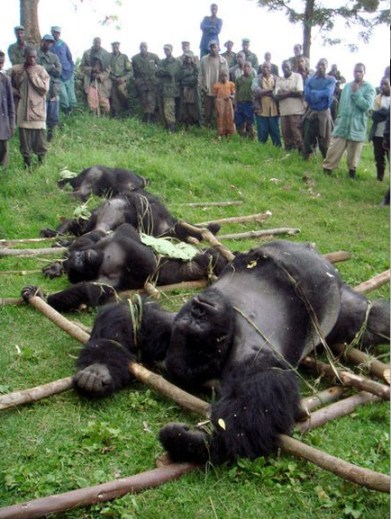
The next day, a patrol went in from the Bikenge patrol post and quickly found the bodies of three females. It was crushing to hear the news. It is the worst thing that can happen, when a whole group is attacked, and when so many are killed.

The team split into two groups, with one team of Rangers going into the forest with trackers to try to find the remaining gorillas, and the other to carry the dead gorillas back to Bukima and then on to Rumangabo for burial.

They searched for other bodies, and within half an hour found the lifeless body of Senkwekwe, the Silverback of the group. This was a moment of great pain for all of us.

img.php

The females were Neza, Safari and Mburanumwe. Safari became famous in the newspapers when she had her baby, Ndeze, back in February. Mburanumwe was a young subadult female, who was pregnant. It is a massive blow to our efforts to protect the gorillas.

It was pouring down with rain

when the Bukima team arrived. Mburanumwe had, for some reason that we couldn’t understand, been badly burned. I think it must have been done to offend us, but I don’t know. It’s difficult to get into the minds of people who can do a crime as terrible as this. It was still late and pouring with rain so the search was called off and the team returned to Bukima.

Our 4 gorillas were tied to stretchers, and then the long march began.

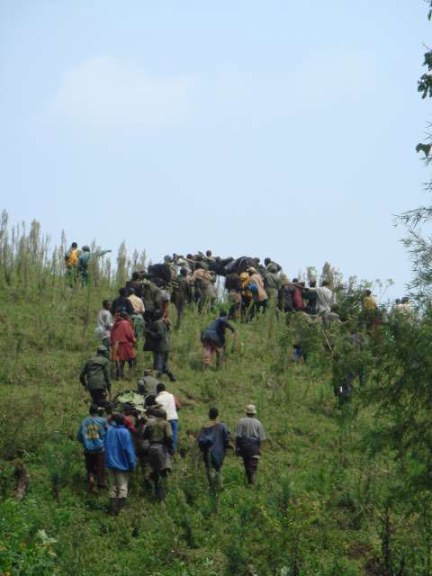
A large number of people had to carry Senkwekwe, because of his enormous size. It was a long long walk that lasted for over three hours.

The following day, people poured in from the surrounding villages.

It was moving to see that our sorrow was shared by so many. They had come to help.

rugendo-massacre-2

VirungaMass5

Eventually the procession arrived in Bukima, and Senkwekwe and his group were take by vehicle to be laid to rest at the graveyard in Rumangabo.”

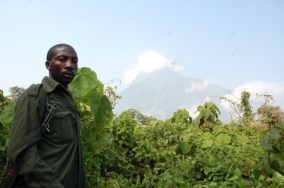
Innocent Mburanumwe in front of the Mikeno volcano, Virunga National Park, DR Congo. About 200 Mountain Gorillas live on the flanks of the volcano.


(Photos: Brent Stirton took the pictures of the July 2007 massacre)

CHIMP HAVEN

Posted on February 23, 2013

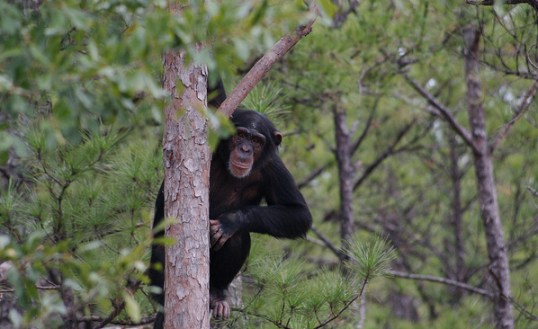
Nine chimpanzees

recently arrived at Chimp Haven, the national chimpanzee sanctuary, from the University of Louisiana’s New Iberia Research Center. Over the next few months New Iberia (which has lost its NIH chimp research contract) will send the sanctuary another 102 chimps.

Valentina playing with Mom at Chimp Haven. (Photo: Chimp Haven)

The NIH

had originally planned to retire only 10 animals to sanctuary, and send New Iberia’s remaining 100 animals to the Texas Biomedical Institute, with the understanding that the animals would be permanently ineligible for further use in biomedical research. The plan was scotched after several animal rights groups objected to sending any of the animals to another research facility.

Last month

an NIH “Working Group” report recommended that 90% of the government’s 451 remaining chimps still in laboratories (282 available for research and 169 considered inactive but not permanently retired) be permanently retired from research and moved to sanctuaries. It recommended keeping a small colony of about 50 chimps for the possibility of new research.

Tracy at Chimp Haven. (Photo: Chimp Haven)

The recommendation is awaiting final agency approval following a 60-day public comment period. If all goes as it should, within the next five years another 300 chimpanzees will be retired to Chimp Haven.

The public comment period runs until March 23.

For more information and to leave a comment, go here.

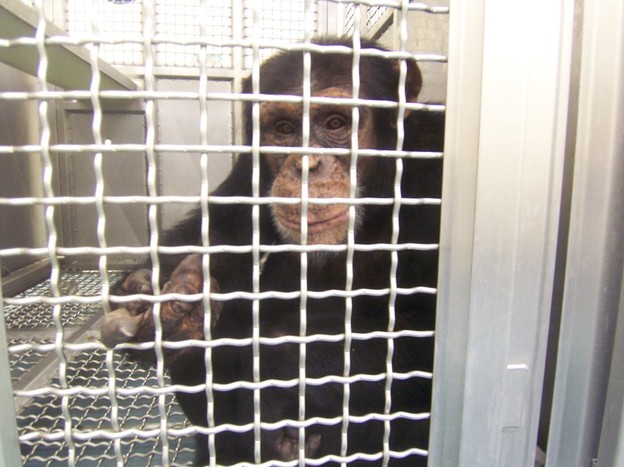
Lab chimp. (Photo: Humane Society of the United States)

It’s a shameful blot on the biomedical industry that these chimps haven’t been moved to sanctuary much sooner. According to a recent study that reviewed autopsy reports on 110 chimpanzees in or from U.S. labs who have died since 2000, 64% suffered from serious chronic illnesses, while 69% had diseases which should have caused them to be retired from research use.

“All chimpanzees suffering chronic or incurable physical or psychological illness should be immediately released to sanctuary,” said study co-author and NEAVS president Theodora Capaldo. “They deserve to spend every minute of their remaining years in the comfort and safety of a healing environment.”

The NIH actions come in the midst of efforts on several fronts to end all experiments on chimps, including a bill to stop experimentation on all great apes, which did not pass in the last Congress, but which proponents hope to reintroduce, and a pending decision by the Fish and Wildlife Service on whether captive chimps should be considered endangered, as wild chimps are.

About 500 chimps remain at private U.S. research facilities.

ARMENIAN LEOPARD

Posted on February 22, 2013

The first hints

of a leopard in the Caucasus Wildlife Refuge date from spring 2012, when rangers found foot prints in the snow. They were later identified by experts as typical for a big cat—most probably a leopard.

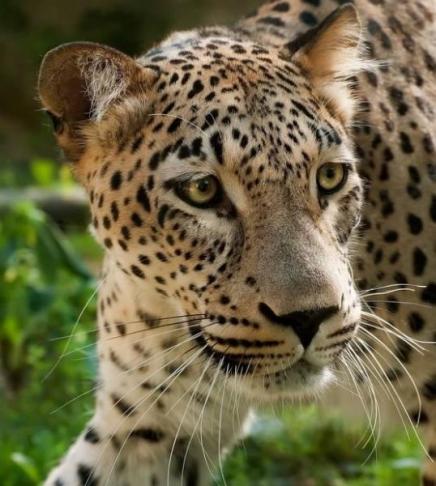
Caucasian/Persian leopard. IUCN Red List status: Endangered. (Photo: World Land Trust)

That summer, experts from the Armenian NGO, Foundation for the Preservation of Wildlife and Cultural Assets (FPWC) started a systematic investigation of all areas of the refuge considered “leopard friendly”. They collected scat and pieces of fur found on thorny shrubs. Though the experts were sure that the samples came from a leopard, final confirmation could only be proved by genetic analysis.

Genetic tests of the samples conducted at the Tisch Family Zoological Gardens in Jerusalem recently confirmed that they are indeed from a rare Caucasian Leopard, also called the Persian Leopard (Panthera pardus saxicolor). The news confirms what field experts have believed but had been unable to prove, that this highly endangered predator still dwells in Armenia.

The Caucasian Leopard

is found across several different countries including Iran, Armenia, Turkmenistan, Afghanistan and Georgia. There are thought to be less than 1,300 Caucasian Leopards left in the wild and fewer than 15 of the cats left in Armenia.

Caucasus, Armenia. (Photo: FPWC)

Caucasus-wildlife-refuge. (Photo: FPWC)

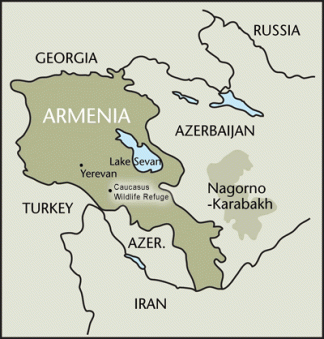
They mainly live in remote, mountainous habitats which can range from dry and arid to forested regions and even extend up into snowy mountain ranges. In recent years, their population has been devastated by uncontrolled hunting and habitat destruction. Leopards don’t know borders. Their migration routes cover not only a corridor through Armenia but also reach out in particular to Iran and Azerbaijan.

Armenia Caucasus Wildlife Refuge. (Map: World Land Trust)

The World Land Trust (WLT)

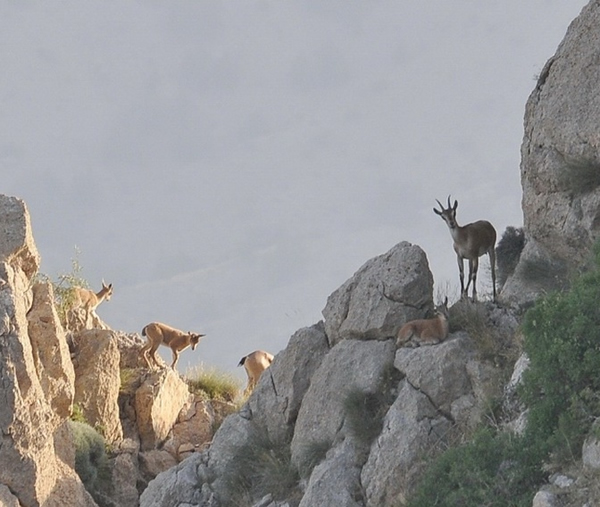
joined with FPWC in 2010 and established the 1,084 acre (439 hectare) Caucasus Wildlife Refuge—next to the 60,000 acre Khosrov National Reserve. A team of rangers stationed in the reserve have successfully reduced illegal hunting in the region, which has increased populations of the leopard’s prey species such as Bezoar goats and Ibex. The confirmed presence of the leopard shows that the refuge is increasingly becoming a safe haven for the big cats.

FPWC’s rangers have increased the number of Bezoar Ibex in the area by reducing hunting, this increase in prey is critical to the survival of Caucasian Leopard. (Photo: FPWC)

Threats and Conservation

The remote and mountainous habitats they inhabit makes the big cats extremely vulnerable to habitat fragmentation and a variety of other threats. These include reduction of prey species through poaching, loss of habitat caused by deforestation and over grazing by livestock, conflict with livestock owners, heavy military presence and fortification of borders, and being hunted as trophies or for the fur trade.

As is happening in the Bafq Protected Area in Iran (“Bafq Cats” ANIMAL POST 1/5/13), efforts are underway to strengthen regional cross-border cooperation in order to establish official wildlife corridors for the cats to roam.

Speaking of big cats in Iran

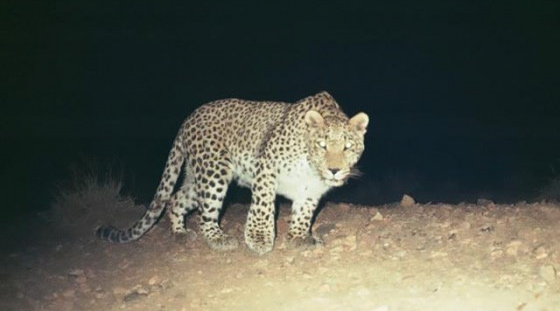
A Persian leopard was just recently photographed for the second time in the Bafq Protected Area.

Recent photograph of the old man. (Photo: Iranian Cheetah Society)

The cat was first photographed by a camera trap in 2004. He’s since been spotted by both game wardens and visitors on numerous occasions.

Most cats in the wild rarely live past ten. This dominant male is thought to be up to 14 years old, making him the oldest leopard ever to roam the desolate plains and valleys of this mountainous park—or anywhere in Iran.

Despite a new study that shows there are a total of only eleven leopards in the park, officials at the Bafq Governor’s Office do not believe that the populations warrant continued protection.


ANOTHER RED WOLF LOST

Posted on February 21, 2013

Another red wolf was found dead of a gunshot wound January 18, 2013, north of the Town of Fairfield, in Tyrrell County, North Carolina.

Male red wolf (Photo: B. Bartel/USFWS)

A recent change of rules by the local Wildlife Commission to allow night hunting of coyotes is being blamed as red wolves are difficult to tell apart from coyotes, especially at night. With only some 100 red wolves living in the wild, each wolf killed represents 1% of the population. This latest death means that some 8% of the population have been shot in the last few months.

Reward

Anyone with information that directly leads to an arrest or a criminal conviction for the suspected unlawful take of this red wolf may be eligible for a reward of up to $2,500. Anyone with information on the death of this red wolf or any others, past or future, is urged to contact Special Agent Sandra Allred at (919) 856-4786, Refuge Officer Frank Simms at (252) 216-7504 or North Carolina Wildlife Resources Commission Officer Robert Wayne at (252) 216-8225.

The red wolf is protected under The Endangered Species Act. The maximum criminal penalties for the unlawful taking of a red wolf are one year imprisonment and $100,000 fine per individual.

WILD

Posted on February 21, 2013

The Amazon as one imagines it as a child.

In just four weeks at a single colpa (or clay lick where mammals and birds gather) on the lower Las Piedras River, in Peru, Paul Rosolie and his team captured footage of 30 Amazonian species. The footage includes appearances by seven species that are imperiled. The short film was assembled from 2,000 clips.

Rosolie says the number of species captured at this colpa surprised even him. “Most people think of the rainforest and they picture animals everywhere, but in reality, even in healthy forest, you could walk all day and see nothing. Seeing such incredible abundance and diversity at a single location in the forest, in so short a time, is something we have never seen before.”

Endangered

The very spot Rosolie and his team filmed is under threat. The headwaters of the Las Piedras River are protected, but the lower Las Piedras River is being infiltrated by loggers, miners, and farmers following the construction of the Trans-Amazon highway.

If protected,

the lower Las Piedras River connected together with Manu National Park and Alto Purus National Park to Bahuaja-Sonene National Park and Madidi National Park in Bolivia, would constitute the single greatest contiguous area of biodiversity on Mother Earth.

Anyone interested in learning more about the Las Piedras River or supporting conservation efforts there can contact Paul Rosolie: Adventure@tamanduajungle.com

Read interview with Rosolie.


Source: mongabay.com

THE EXPERIMENT

Posted on February 20, 2013

Infant monkeys

are removed from their mothers immediately after birth and kept in total isolation. Deprived of their mothers’ protection and comfort, each infant is exposed to multiple frightening experiences, including a live kingsnake. When the infants are about one year old, they are killed and their brains dissected.

page_monkey2_w350_h395

If this sounds like something out of the middle ages, you would be wrong. It is the latest in a long line of similar experiments being conducted at the University of Wisconsin.

The researcher, Ned H. Kalin, MD,

Chair Department of Psychiatry at the University of Wisconsin School of Medicine and Public Health, has coauthored approximately 180 published scientific papers most of which have involved experimentation on animals. Go HERE for a short list of some of his studies.

As regards his newest “maternal deprivation” project, “Effects of early experience on the development of anxiety and its neural substrate,” Kalin says that he has gone as far as he can in his study of anxiety in “normal” monkeys. Now, he must study fearfulness in monkeys taken from their mothers almost at birth and compare it to the fearfulness of monkeys allowed to stay with their mothers for a few months.

Kalin will kill 40 male monkeys in his experiment when they are 61 to 70 weeks old. He will cut out parts of their brain and report on any differences he can identify.

Over the past 18 years, Dr. Kalin’s research using monkeys to study the neurobiology of fear has cost taxpayers many millions of dollars. In the past ten years alone, it has cost us $5,075,798. [National Institutes of Health. Grant R01MH046729. Development and Regulation of Emotion in Primates.]

Kalin’s experiment is all the more macabre because it follows in the horrific tradition of tests conducted years ago by the infamous Harry Harlow, a psychology professor–at the same school–who rose to prominence by physically damaging the brains of rhesus monkeys then testing their learning ability.

Harlow “discovered” that infants removed from their mothers quickly developed abnormal behaviors.

Harlow’s maternal deprivation tests consisted of taking baby monkeys from their mothers at birth and putting them in cages with surrogate mothers made of cloth and wire. He concluded what one would assume without any study at all—that social creatures can be destroyed by destroying their social ties.

Many psychologists continue to hold Harlow in esteem as a major figure in experimental psychology.

When challenged about the value of his work, Harlow stated: “The only thing I care about is whether a monkey will turn out a property I can publish. I don’t have any love for them. I never have. I don’t really like animals. I despise cats. I hate dogs.”

Well of Despair (top removed).

Harlow’s studies became increasingly pathologically disturbed. In the late 1960s he invented a device he called the Well of Despair, a stainless-steel trough with sides that sloped to a rounded bottom and a covered top, equipped with a food box and a water-bottle holder. Into the box he placed monkeys between the ages of three months and three years, who had bonded with their mothers for up to ten weeks, and left them alone. The aim of the research was to produce an animal model of clinical depression. Unsurprisingly it worked. The monkeys would spend the first day or two trying to climb up the slippery sides. After a few days, they gave up. They stopped moving about and spent most of their time huddled in the bottom. They were found to be psychotic when removed. Most did not recover.

Social isolation and maternal deprivation experiments at UW-Madison continued through the 70s and 80s. These types of experiments have not been used at the University for over twenty years. So one wonders: Did the ethical problems raised by Harlow’s experiments not register with the researchers there at all?

There is no justification for doing this to any creature. Conducting such tests in this day and age is morally indefensible.

PLEASE TAKE ACTION.

CONTACT:

The University of Wisconsin’s Institutional Animal Care and Use Committee (IACUC) and ask them to cease these cruel and unethical experiments.

CONTACT UNIVERSITY OFFICIALS DIRECTLY:

COMMENT posted by MAGGIE on January 30th, 2013:

I have aggregated all the vet and primate researchers emails into one place to make it easy to email them, and the first address is for the director of the school. This is sickening. You can copy and paste these into your own email program. sandgren@rarc.wisc.edu; kbrunner@primate.wisc.edu; capuano@primate.wisc.edu; jbacon@primate.wisc.edu; cclark@primate.wisc.edu; mharke@primate.wisc.edu; slarson@primate.wisc.edu; welter@rarc.wisc.edu; gaudio@rarc.wisc.edu; shvs@rarc.wisc.edu; newman@rarc.wisc.edu; riley@rarc.wisc.edu; schiffman@rarc.wisc.edu; sjohnson@rarc.wisc.edu; peter@rarc.wisc.edu; sawall@wisc.edu; duchesneau@rarc.wisc.edu; girard@rarc.wisc.edu; bogdanske@rarc.wisc.edu

FOR ATTENDEES OR ALUMNI OF A UNIVERSITY OF WISCONSIN SCHOOL: 

Add your name to the pledge to withhold all donations to the University of Wisconsin until the institution bans the use of maternal deprivation once and for all.


Source: Animal Legal Defense Fund.

BLOCKADE

Posted on February 17, 2013

Sea Shepherd boats

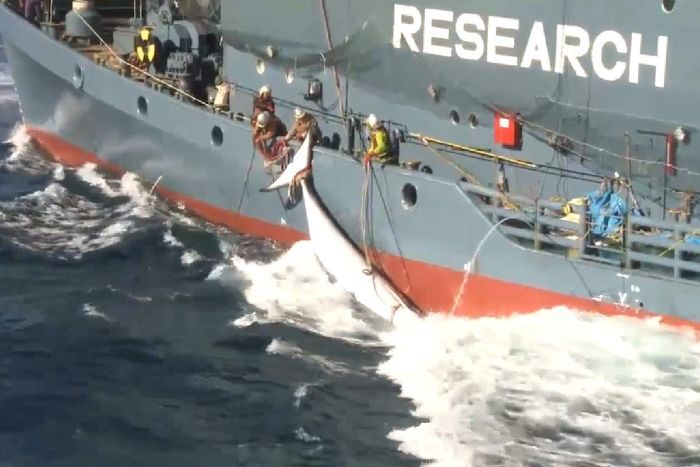
tried unsuccessfully 2 days ago to block the transfer of the carcass of a harpooned female minke whale from one Japanese vessel to another in Australian waters off Antarctica near the country’s Davis Research Base. The irate whalers tried to ram the Sea Shepherd boat.

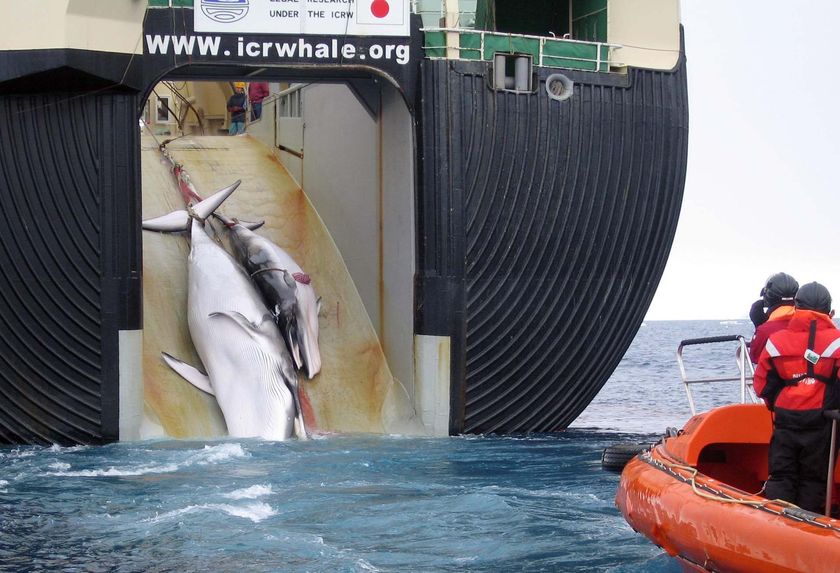
Japanese whaling vessel with carcass of a minke whale (Photo: Sea Shepherd)
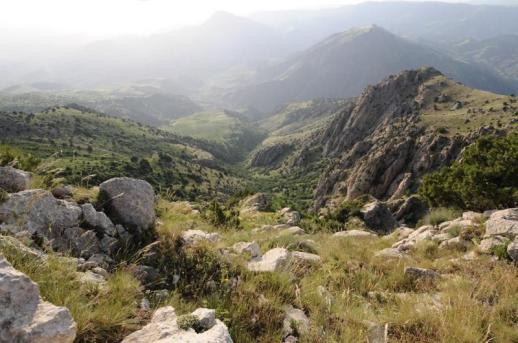
“Through binoculars we could see the whale breaching,”

said a crewman aboard a Sea Shepherd boat. “We saw the harpoon fire, the cable tighten. Then it was several minutes before she stopped thrashing about.”

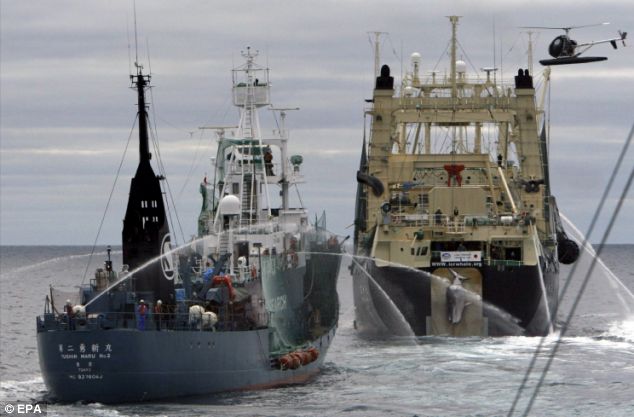
Japanese whaling ship No 3 Yushin Maru (left) and the Sea Shepherd’s vessel Bob Barker collide last year. (Photo: AP)

The harpooning occurred deep inside the Australian Antarctic Exclusive Economic Zone, which is a designated whale sanctuary, but is not recognized by Japan.

(circa 2008) A helicopter from the protesters’ ship hovers over the Japanese factory whaling ship the Nisshin Maru as it hauls a minke whale up its slipway. Meanwhile the Yushin Maru No. 2 sails close behind to protect the catch.

Australia’s Environment Minister Tony Burke

said the country was opposed to whaling wherever it occurred, but particularly in a whale sanctuary. “That’s why we have taken Japan to the International Court of Justice.” Burke has rejected the call to send an Australian vessel to the area. He says the focus should not be just on whether the whale was killed in Australian territorial waters, but on the issue of whaling itself. “It doesn’t matter what part of the ocean it is. In Australia’s view, it is just as illegal,” he said.

Japanese crew from the harpoon vessel blast the protesters with water cannon while watched by the Steve Irwin’s helicopter

Japan uses a loophole

in a 1986 global moratorium on commercial whaling that allows “lethal research” on whales and sets out to kill hundreds each year. The country makes no secret that the meat ends up on dinner plates and has pushed for a resumption of full-fledged commercial whaling, accusing Western nations of insensitivity to its cultural traditions.

Adult minke whale and her calf being towed up the ramp of a Japanese factory processing ship in Antarctic waters in February 2008. (Photo: Australian Customs)

The recent stand-off

came despite a United States court injunction on the Washington state-based Sea Shepherd Conservation Society (SSCS), against attacking the whalers, or approaching within 500 yards.

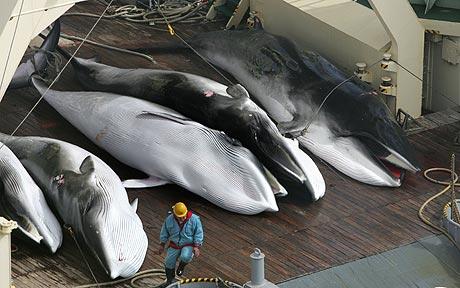
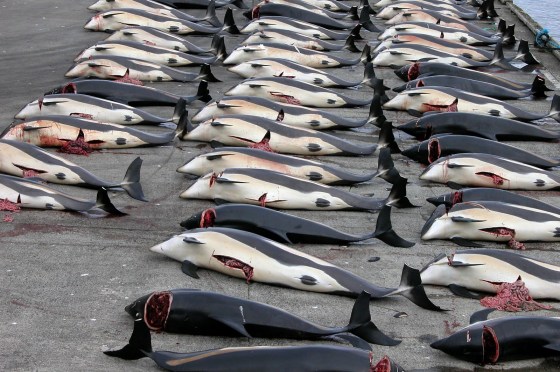
Japanese Whaling catch.

Japanese Whaling catch.

Japan’s Institute of Cetacean Research has begun a contempt action against SSCS over an alleged breach of the injunction. The activists argue that control of the anti-whaling campaign is in the hands of Sea Shepherd Australia, and out of the U.S. court’s jurisdiction.

Japanese whaling in Faroe Islands.

The Japanese whaling industry is struggling

after several years of militant activists scuttling the catch and a lower demand for whale meat. The Japanese government is being forced to prop up its whaling program with taxpayer-funded subsidies.

Sea Shepherd Australia

is a non-profit conservation organization whose mission is to end the destruction of habitat and slaughter of wildlife in the world’s oceans in order to conserve and protect ecosystems and species. SSA uses innovative direct-action tactics to investigate, document and take action when necessary to expose and confront illegal activities on the high seas. By safeguarding the biodiversity of our delicately balanced oceanic ecosystems, SSA works to ensure their survival for future generations.

The Perils of Palm Oil

Posted on February 17, 2013

Tisha Wardlow's avatarFight for Rhinos

How do Nutella, Velveeta, and Colgate toothpaste spell death for elephants and orangutans? They all contain the ingredient palm oil.

Palm oil is derived from the fruit of African oil palm trees. It is utilized in over 50% of todays products on the market. To keep up with the demand, thousands of kilometres of pristine rainforest are slashed and burned in order to make way for more oil palm plantations, almost all of which is produced in, and exported from, Indonesia and Malaysia.

One of the largest worldwide palm oil companies is Wilmar International. They have done illegal logging and set up new plantations, driving peasants off their land as well as finding new subsidiaries and bribing officials to side step the law.

The good news is-we CAN stop this. By being conscientious of  the things we buy, we can send a message to the palm oil companies that we do not want to be willing participants…

View original post 481 more words

ONE FOR THE BEARS

Posted on February 16, 2013

Vietnam has abandoned plans to close a bear sanctuary at the heart of a land dispute in one of its national parks.

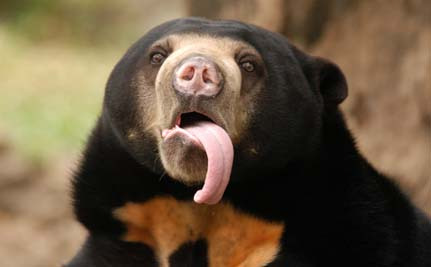
Moon bears at the Vietnam Bear Rescue Centre are no longer at risk for losing their home.

The Vietnam Bear Rescue Centre in Tam Dao National Park which has been facing the possibility of eviction since last October, due to an attempted land grab by a politically connected developer, has gotten a reprieve. Prime Minister Nguyen Tan Dung recently announced that the sanctuary, home to 104 bears saved from the illegal bear bile industry, will remain open.

Animals Asia,

the charity that runs the Rescue Centre, mounted a high-profile campaign to save the sanctuary, recruiting Ricky Gervais and other celebrities to its cause.

Additionally, the second stage of the Centre’s construction can now proceed. The Centre, in which Animals Asia has invested more than $2 million, will give the sanctuary a better opportunity to rehabilitate bears and gather evidence of the damage caused by bile extraction. The reprieve also means that 77 Vietnamese sanctuary staff will keep their jobs.

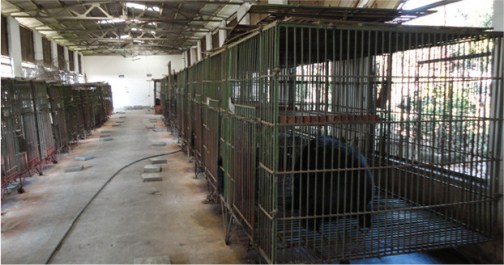
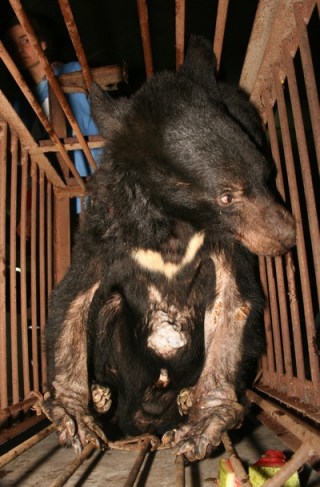
Bile farm.

Bears are locked in cages like these for years.

The continued operation of the rescue center is an essential part of a larger goal set by Animals Asia to increase public awareness about the bear bile industry and ultimately eliminate bear bile farming altogether.

The industry currently uses more than 2,400 moon bears, sun bears and brown bears in Vietnam, while an additional 10,000 live on similar farms in China.

Chinese bear farm.

Founder and CEO of Animals Asia, Jill Robinson MBE, explained that outside activism has played a significant role in Animals Asia’s mission to get these bears to safety: “Our priority has been to rehabilitate these bears after their years of trauma from being locked up in small cages and milked for their bile. If we had been forced to relocate it would have had a terrible impact on their wellbeing. We want to sincerely thank the tens of thousands of supporter from around the world who wrote letters, sent e-mails and signed petitions calling for the eviction to be stopped.”

Animal rights campaigners have long attacked the bile farming industry as barbaric, and it is banned in Vietnam. Digestive bile is forcibly extracted from the gall bladders of bears, to be sold on the black market for use in traditional medicine.

ENDANGERED CANIDS

Posted on February 15, 2013

The Red Wolf

is revered in the south. Arkansas State University Athletic teams call themselves the Red Wolves. People there should step up in its defense. But it doesn’t appear they are.

Male and female Red Wolves.

The few Red Wolves left in the wild, saved from extinction by a breeding program and nearly all located in the state of North Carolina, are being killed by hunters at an alarming rate.

U.S. Fish and Wildlife Service records show that 10 Red Wolves out of total wild population of around 100 were killed by suspected gunshot last year. At least three of these deaths were reported by hunters who claimed they thought they were shooting at a coyote. Okay, the Red Wolf looks a lot like a coyote. But putting aside the notion that any responsible hunter should study their intended prey carefully before pulling the trigger—it’s fair to ask what is humane about spotlighting animals at night from a road, a tactic favored by redneck hunters and drunks, often one and the same.

In an attempt to save the Red Wolf, the Animal Welfare Institute and several other conservation organizations got a temporary injunction last August against spotlight hunting of coyotes at night in a five-county area of eastern North Carolina. Unfortunately, the NC state legislature this month has a rule on the docket that would permanently allow spotlight hunting of coyotes at night.

Canis Rufus

was the subject of an ANIMAL POST November 23, 2012, reporting that a fourth radio-collared Red Wolf had been shot dead in two months in North Carolina, all killed in approximately the same area. There were suspicions that the death of a fourth collared wolf might have been something other than coincidence, including the possibility that the GPS’d wolves were being tracked by someone other than the Wildlife Service.

Canis rufus is one of the world’s most endangered canids. The species was declared endangered in 1967 and the U.S. Fish and Wildlife Service declared them extinct in the wild in 1980. Biologists began a captive breeding program using 14 wolves captured from a remnant population found along the Gulf Coast. Since then, enough wolves have been bred to implement a restoration program on Alligator River National Wildlife Refuge in north-eastern North Carolina.

Human predation

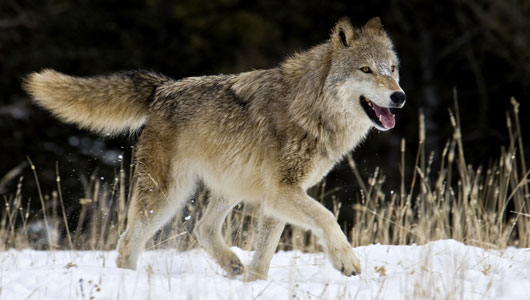
is a constant problem as hunters seem to consider wolves enemy Number One as evidenced by wide open hunting of grey wolves that has commenced in the last year in Alaska, Idaho, Minnesota, Montana, Washington State, Wisconsin and Wyoming since wolves were stripped of their endangered status by the federal government.

(Photo: ZUMA Press)

(Photo: ZUMA Press)

What is it about wolves?

Why the bloodlust to kill them? There may be some truth in a theory espoused by James William Gibson in Earth Island News that beginning in the late 1990s, the northern Rockies became a redoubt for far-right wing paramilitary culture types who saw themselves as “armed warriors facing federal tyranny, ranchers angry that they did not own the lands they leased from the federal government to graze cows, hunters who saw the region’s deer and elk as their private property, and those who hated all forms of environmental regulation.” Together they created a common mythology that demonized the wolf. The demonization spread to the mainstream Republican parties in Idaho, Montana, and Wyoming, eventually capturing Democratic leaders desperate to be elected in these conservative states. Montana Senator John Tester, a Democrat facing a tough re-election bid in 2012, sponsored a legislative “rider” to a federal budget bill that delisted wolves. The bill passed both houses and President Obama signed it. The slaughter began soon after.

Idaho

has 3,000 mountain lions, 20,000 black bears, 50,000 coyotes, 250,000 deer and 100,000 elk. Open season on wolves in Idaho have brought their numbers down to less than 500. Why are they being treated so differently than other wildlife?

The situation is much the same in Montana. More than 170 wolves have been trapped and shot so far in the state’s still ongoing 2012-2013 season. That figures includes the killing of seven radio-collared wolves, including the famous, often photographed 832F, the majestic female alpha of the Lamar Canyon pack that roams Yellowstone National Park.

One hope

for wolves remains open in the short-term. Secretary of Interior Ken Salazar, who oversaw wolf delisting, is resigning. It is possible that another secretary might change policy.

Call your congressman to protest this senseless ethical and ecological disaster.


Source: Animal Connection.

Posted on February 14, 2013

Tisha Wardlow's avatarFight for Rhinos

ZAKOUMA NATIONAL PARK, Chad — Just before dawn, the rangers were hunched over in prayer, facing east. They pressed their foreheads into the dry earth and softly whispered Koranic verses, their lips barely moving. A cool wind bit at their faces.

All of a sudden, Djimet Seid, the cook, said he heard “one war whoop — or maybe it was a scream.”       

And then: “K-k-k-k-k-k-k,” the angry bark of a Kalashnikov assault rifle, opening up on fully automatic. In an instant, an entire Chadian squad of rangers was cut down with alarming precision… (NY Times 12-2012)park rangers

At least 60 Wildlife Rangers worldwide have been killed in 2012. (The exact number is a mystery, as it is believed that many more deaths go unreported)
As the duty of wildlife rangers has shifted from field biologists to military personnel, it is a struggle to catch up. Todays rangers are desperately in need…

View original post 814 more words

YOU BREAK IT, YOU BUY IT

Posted on February 13, 2013

The federal civil trial against BP is scheduled to begin on February 25. A coalition of environmental groups have mounted a letter campaign to urge the government to fine British Petroleum the maximum amount possible for the Gulf Oil Spill. So far more than 100,000 people have sent letters.

Oiled sargassum in the Gulf of Mexico, 2010. [Photo: NOAA]

The federal criminal charges against BP have already been settled. This past November the DOJ ordered BP to pay $4.5 billion dollars in fines.

Under the RESTORE Act, the basis of the civil trial, BP faces from $5 billion to $21 billion in Clean Water Act penalties. 80% of those funds will help restore ecosystems, economies and communities affected by the 2010 oil spill.

The company and government may reach a settlement before the trial, but there’s no word on that yet.

The massive spill killed an untold number of wildlife. Some 7,000-23,000 birds died, and sea turtles, fish, and other marine life were also affected.

Scientists estimate as much as one-third of the oil from the spill may be on the sea floor, mixed with sediment, putting at risk the marine ecosystem and perhaps even causing potential harm to commercial fisheries in the future.

The explosion aboard the Deepwater Horizon drill rig occurred nearly three years ago, but the social, economic, and environmental repercussions will take far longer to understand and address.


SPEAK UP: To send a letter to the DOJ, click here.


Source: AUDUBON.

KUDOS UNITED

Posted on February 12, 2013

United Airlines

has announced it will no longer transport primates for use in experiments anywhere in the world.

http://www.united.com/web/en-US/content/travel/animals/restrictions.aspx#primates.

Primate acceptance policy:

  • United Cargo® ships non-human primates to, from and between zoos and sanctuaries within the 50 United States and Puerto Rico. These primates must have a valid health certificate dated within 10 days of travel.
  • We do not book, accept or transport primates to or from medical research facilities.
  • Primates are not accepted if they are intended for the pet industry. We also do not ship pet primates for individuals.
  • Primate shipments are not accepted if the shipment has an international origin or international destination, unless the primates are service animals.

United was the last North America based commercial airline to do the right thing.

The four major international airlines still willing to transport primates to labs, include:

Air France

China Eastern Airlines

Philippine Airlines

Vietnam Airlines.

BEGGAR

Posted on February 10, 2013

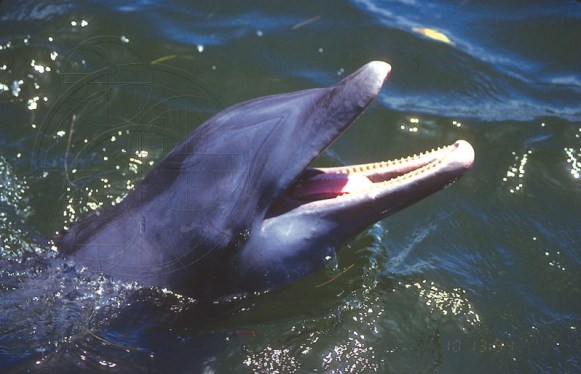
was a wild dolphin with a bad habit.

Beggar at work. (Photo: Sarasota Dolphin Research Program)
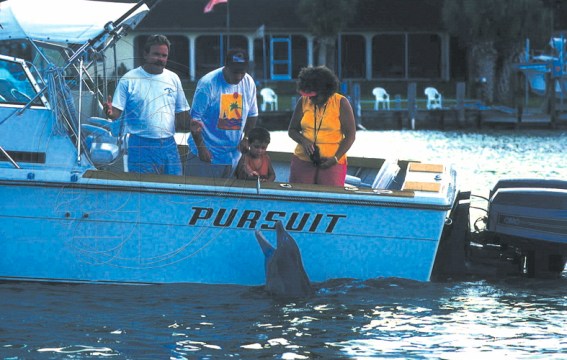
In August 1990, Sarasota Dolphin Research Program (SDRP) researchers encountered an unusual phenomenon in the southern portion of their primary Florida study area. A lone juvenile dolphin approached the research boat and opened his mouth, apparently seeking a food handout. Over the next 22 years the researchers saw him nearly 400 times, in the same area, and nearly always engaged in seeking food from humans. Mostly, he was alone, but on occasion he was seen with other individuals, several of whom were subsequently observed engaging in begging behavior. Beggar was the most predictable member of the resident Sarasota Bay dolphin community–if you went to his range, you had a high probability of finding him, often behaving badly.

Beggar as juvenile 1990. (Photo: Sarasotat Dolphin Research Program)

Because of his bad behavior Beggar became the subject of research projects, town-hall meetings, and class-room visits, television and print stories and the posting of signs in the Intracoastal Waterway warning people to not engage in the illegal activities of feeding or petting wild dolphins—to educate boaters and anglers about the problems of feeding wild dolphins, a growing problem in the southeastern United States.

Dr. Katie McHugh of SDRP spent 100 hours observing his behavior and that of the boaters who encountered him from March to June 2011. She documented these interactions:

  • 3,600 interactions between Beggar and humans—up to 70/hr.
  • 169 attempts to feed him 520 food items—everything from shrimp and squid to beer, hot dogs and fruit.
  • 121 attempts to touch him—resulting in nine bites to the humans doing the petting.

McHugh also found that having law enforcement on hand was the most effective means of getting people to stop interacting with Beggar. When officers were on the water, boaters were much less likely to approach Beggar, and Beggar was much more likely to forage for food when humans stopped giving him handouts.

Boaters feeding Beggar. (Photo: Sarasotat Dolphin Research Program)

Boaters feeding Beggar. (Photo: Sarasotat Dolphin Research Program)

In September 2012, Beggar was found dead. A necropsy showed that his interactions with humans played an overall role in his death:

  • He was covered with propeller wounds and multiple broken ribs and vertebrae consistent with boat strikes.
  • He was markedly underweight and dehydrated—possibly because he was not eating a normal dolphin diet.

There is a common misconception that feeding, touching and swimming with dolphins is not harmful and that they don’t get hit by boats. Beggar is just one of many wild dolphins in the southeast U.S. that have been fed by people and learned to associate people with food. Viewing dolphins responsibly–without feeding–is crucial to their survival.


Source: Sarasota Dolphin Research Program.
Thanks also to: bloggerheadseaturtle.

THE IVORY TRADE

Posted on February 9, 2013

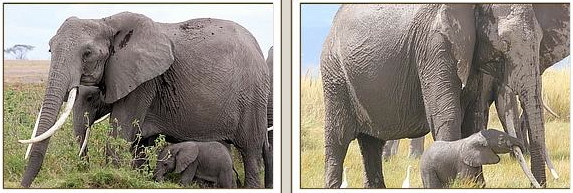
In the general area known as Lemomo near the International Border between Tanzania and Kenya, three of Amboseli’s famous female elephants from the Q Family (Qumquat, her daughter Quantina 13 years old, and another daughter Quaye just 10 years old) were gunned down by Tanzanian gun-toting Poachers on the 28th October 2012. Tanzania is currently one of the main hotspots for poaching in Africa where there is evidence of collusion between armed Tanzanian poachers and tribesmen in neighbouring Kenya who pass on information about the movement of the famous Amboseli elephant herds.

Qumquat and Quanza.

Keepers from the Sheldrick Wildlife Trust were sent out to rescue the orphan.

Source: Sheldrick Wildlife Trust.