First Light Productions

investigative journalism

Posts by Michael Elton McLeod

Ugh

Posted on October 24, 2012

Meghan Mogensen, director of a zoo in Reston, Maryland was recently convicted of animal cruelty and sentenced to 30 days in jail for drowning an injured wallaby named Parmesan in a plastic bucket.

Meghan Mogensen. (photo: Fairfax County Police)

    The zoo is owned by Mogensen’s father who owns several other zoos, which, according to media reports have also come under scrutiny.


    Source: Washington Post

News to me

Posted on October 24, 2012

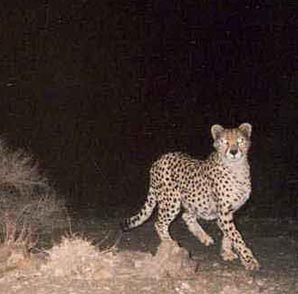
Cheetahs in Iran!

Asiatic Cheetah in the Bafgh Protected Area of Yazd Province in Iran.
(Photo: Wildlife Conservation Society)

    Once distributed from the Indian subcontinent across Afghanistan, Turkmenistan and Iran to the Arabian Peninsula and Syria, the Asiatic cheetah is now on the verge of extinction and one of the most endangered members of the cat family in the world.

    The population of cheetahs in Iran is thought to be about 50-60, restricted to the main desert areas around Dasht-e-Kavir.

    Before World War II, the cheetah numbered around 400, ranging in almost all of the steppes and desert areas of the east of the country and a few habitats near the Iraqi border. The war marked the widespread slaughter of their essential prey species, the gazelle, resulting in a devastating decline in the cheetah population.

    The last cheetahs in India were shot in 1947. Since then, the Asiatic cheetah has disappeared from most of its former range. In the last 20 years Iran has been the final stronghold for the Asiatic cheetah, known in Iran as yuz, although there have been occasional reports of cheetahs in Pakistan.

    In 1956, the gazelle was protected by law and the cheetah followed in 1959. The gazelle and cheetah population recovered in many areas. Cheetah sightings increased in different localities and by the late 1970s cheetah numbers were estimated to be 200-300.

    The 1979 revolution interrupted wildlife conservation for a few years, and many areas were occupied by armed 4WD vehicles and motorbikes that chased desert species, such as gazelles, onager and the cheetah. As gazelle populations declined, the cheetahs moved toward the foothills and mountainous habitats to find new food sources such as wild sheep and goats, and to avoid human predation.

    With their retreat they disappeared from much of their former range and were limited to a few remote areas with a reliable prey population and relative safety from humans

    Iranian Cheetah (Photo: Kavi)

    The Iranian Cheetah Society (ICS), an Iranian, non-profit NGO established in Aug 2001, works to save the last Iranian cheetahs. The society was founded by three young enthusiastic students of natural resources. With their five years experience in studying the cheetah before its official establishment, ICS has made remarkable progress in its activities to save the cheetah in Iran in the past two years. ICS is based in Tehran and has 300 members from all over the country.


    Source: wildlifeextra.com

Raincoats

Posted on October 24, 2012

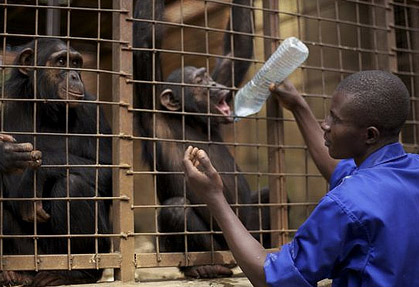
received, thanks to a generous donation. The staff at Centre de Rehabilitation des Primates de Lwiro (CRPL) in the Democratic Republic of Congo says “thank you.”

Centre de Rehabilitation des Primates de Lwiro

    Founded in 2003 with the arrival of its first orphan chimpanzee, CRPL has taken in over 50 chimpanzees and 60 monkeys representing over 10 different species. CRPL plays a vital role in caring for confiscated wildlife and in putting a stop to the illegal animal trade in DRC.


As the only chimpanzee and monkey sanctuary in the kivu region, the CRPL acts as a crucial resource for all conservation organizations working in the area.

    CRPL has experienced tremendous growth over the past several years. With this growth, the Centre has embarked on large scale infrastructure development and creative ways to accommodate the vast influx of animals.


    They could use your help. To donate go to their website.

Autopsies

Posted on October 22, 2012

A Review of Autopsy Reports on Chimpanzees in or from U.S. Laboratories, compiles data from 110 autopsies performed in the last 10 years on chimpanzees who died in or were from laboratories.

    The data show a full 64% of those chimpanzees suffered significant chronic illnesses and 69% had multi-organ diseases that should have rendered them too sick for research use. Yet, despite this knowledge on the part of the laboratories, many of these chimpanzees were held in labs for research despite their poor health and unsuitability for use.

    For more info go to ReleaseChimps.org

For profit torture

Posted on October 22, 2012

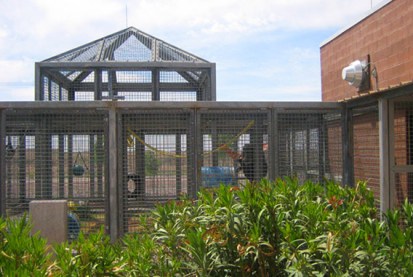
The Shin Nippon Biomedical Laboratories in Everett, Washington, is the third largest importer of primates into the U.S., annually importing 3,000 monkeys.

Shin Nippon Biomedical Laboratory. (Photo: PETA)

    The controversial lab has repeatedly come under fire for cruelty and neglect, including failure to provide safe and adequate housing, veterinary care and proper pain relief. In 2005, 19 monkeys died from extreme weight loss. In 2008, a monkey was accidentally boiled alive.

    Whistleblowers have reported that employees used excessive force in their handling of monkeys, to the extent that monkeys suffered from bloodied noses, broken fingers and toes, and bruises to their bodies. Careless workers frequently injured monkeys by slamming the cage doors onto their tails. Some tails would become bent or deformed, and would be left that way, while other tails were broken so badly that they had to be amputated.

    In one set of experiments, monkeys were attached to their cages with a metal tether which was surgically attached to their bodies, through which ice cold saline solution and test compounds were continuously infused into the monkeys’ veins. They were hooked up this way for months. This can be seen at :50 in on this videoreleased by PETA>

    Use of animals for testing of new drugs and other medical applications is legal in the U.S. but is subject to the strict health and safety provisions of the federal Animal Welfare act, enforced by the Department of Agriculture, which is perennially underfunded to perform its job of protecting research animals.

Justice for Cisco

Posted on October 21, 2012

Police inhabit a dangerous world. But they could use training in areas where restraint may often be needed. Dealing with people with mental health issues is one. Dealing with non-humans is another.

    Michael Paxton was playing fetch with his dog Cisco in his backyard when a police officer pulled into the driveway in response to a 911 call. The officer had the wrong house. When Paxton left the yard to get something from his truck, he said the officer confronted him. Cisco ran around from the back, toward the officer. The officer simultaneously ordered Paxton to put his hands in the air and to restrain his dog. The officer then shot the dog. Read more about the incident on Paxton’s Facebook page, Justice for Cisco.

    Paxton isn’t the first dog owner whose pet has been shot to death by police. A search of news articles from the past year shows many many incidents.

    The sites “Dogs That Cops Killed” and “Dogs Shot by Police” describe new incidents and allow grieving owners to share stories.

Tiger tourism

Posted on October 19, 2012

Effective October 20, the Supreme Court in India has lifted a ban on tiger tourism in Indian reserves that it imposed in July.

Protected parks in India offer the opportunity to spot the elusive cats.

The court also announced harsh penalties against six states who had not introduced ‘buffer zones’ around tiger habitats in their parks. For background on this see ANIMAL POST, August 31, “Sanctuary War.”

New guidelines will now permit tourism in 20 per cent of core areas for ‘regulated low impact tourist visitation’. The court also ruled that no new tourism infrastructure should be developed in and around the reserves.

The rules further prescribe a minimum distance of more than 20 metres from all wildlife for visitors and 50 metres for vehicles.

Stark approach to saving rhinos

Posted on October 19, 2012

Thanks to mythical claims of its medicinal value in traditional Asian remedies, rhino horn has become an incredibly valuable commodity at some $45,000 per pound.

(Photo: Act for Wildlife)

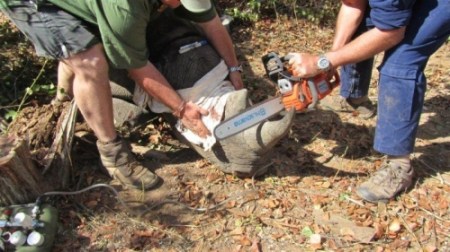
Heightened demand for horn has had stark consequences for the recovering rhino populations of Zimbabwe which has seen 300 dead rhinos because of poaching over the last 5 years. To try and halt the slaughter, conservationists have added de-horning to their toolkit. The following photos were taken on the Chishakwe ranch.

Dehorned rhino. (Photo: LJ Campbell – Chishakwe Ranch)

A spotter plane locates the rhino and passes the location to a ground crew. Once the ground crew is in place a chopper is called in.

Chopper carrying vet. (Photo: LJ Campbell – Chishakwe Ranch)

A vet darts the rhino from the chopper and the ground crew drives to the downed animal. The vet quickly moves in to keep a close watch. Speed is paramount.

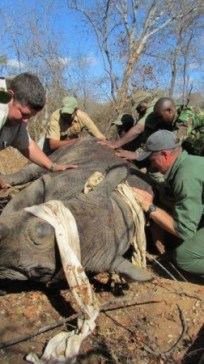
The darted animals are blindfolded to avoid distraction which can stress them, and propped-up so the 8,000 pound beasts are not lying heavily on one side which might affect their circulation. They are sprayed with mist to keep them cool. The upper horn is removed with a chainsaw, leaving a ‘bed of horn’ to ensure that no pain is caused.

Not as painful as it looks. (Photo: LJ Campbell – Chishakwe Ranch)

Lowveld Rhino Trust team at work. (Photo: LJ Campbell – Chishakwe Ranch)

    Grooves are cut in their toe nails to make it easier for trackers to find them in the future to check their condition. The ears are notched and tagged so that individual rhino is unmistakable.

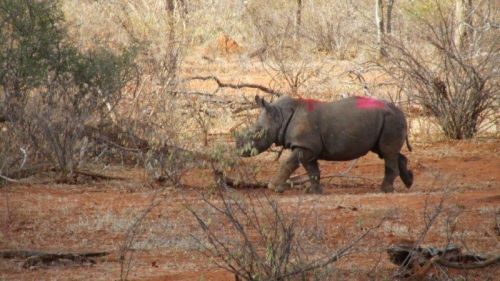
Finally the rhino is marked with paint so that they can be spotted easily from the air during the operations period.

On the go again. (Photo: LJ Campbell – Chishakwe Ranch)

    Dehorning is part of a desperate multi-pronged strategy to conserve the country’s vanishing rhinos that includes scouting patrols on the look-out for poaching activity, a crack anti-poaching unit to confront and arrest poaching gangs, as well as efforts to make the growing of rhino populations more beneficial to local populations.

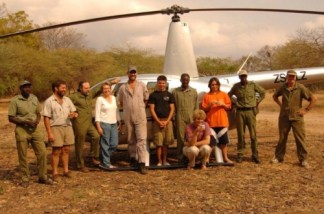
Rhino team (Photo: LJ Campbell – Chishakwe Ranch)

Chishakwe ranch is part of a group of conservation ranches found in the Save Valley Conservancy which has responsibility for conserving rhinos across 1.3 million acres of southern Zimbabwe. The de-horning is done by the LowVeld Rhino Trust.


Source: earthtimes.org

Too many?

Posted on October 19, 2012

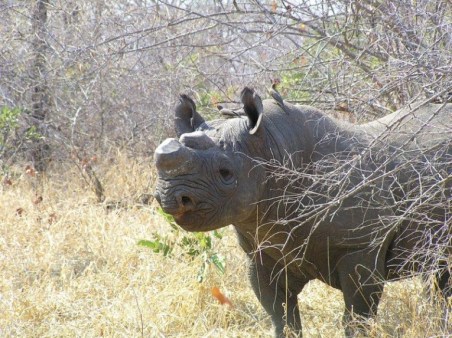
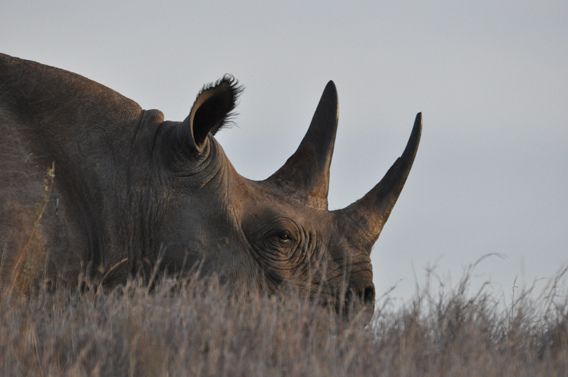
Black rhinoceros in Lewa Wildlife Conservancy. (Photo: LWC)

    Fueled by demand for black-market powdered rhino horn in Vietnam and China, South Africa has lost 430 rhinos to poachers so far this year. The epidemic of poaching is decimating rhino species worldwide.

    Last year saw the official extinction of two rhino subspecies: the Vietnamese rhino, a subspecies of the Javan, and the western black rhino, a subspecies of the black.

    There is one place where rhinos still thrive, however. The Lewa Wildlife Conservancy in Kenya, which has found itself with a unique, but happy, problem: they have so many black rhinos, which are considered Critically Endangered by the IUNC Red List, that LWC needs to move some to stop rhino-fights. In other words, their rhino population has hit its limit for the 25,000 hectare (62,000 acre) nonprofit protected area.


    Source: Mongabay.com

Wolf rally

Posted on October 18, 2012

Josh Fields with wolf he took while elk hunting in the North Fork.

    One year after wolves lost federal protection, over 40% of the wolf population has been killed by trophy hunters and trappers in Idaho and Montana. A total of 545 wolves were killed for fun in these two Northern Rocky states.


    Source: Howling for Justice: Blogging for the Gray Wolf.

Conservation drones

Posted on October 17, 2012

Rhino poaching is big business in Nepal, with hundreds killed every year for their valuable horns. The international demand for these animals is what is keeping the trade and the poachers going. To fight the problem, the country’s national parks have started using drone technology to stop the illegal trade. Al Jazeera’s Subina Shrestha reports from Chitwan National Park in southern Nepal.

    The World Wildlife Fund (WWF) has helped develop this drone technology to help detect poachers that enter Nepal’s national parks to hunt endangered rhinos and tigers.
    Developers of the pilotless aircraft—it’s already been used in Indonesia to track orangutans and other vulnerable species, and to track deforestation—say that the drones are cheap to buy and run and could help conservationists across the developing world.

    Talks are underway to introduce them to Malaysia and Tanzania. Small-scale and remote-controlled, the drones are still being refined. They are light enough to be launched by hand and fly a preprogrammed route of up to 12 miles, filming the ground below with a stills or video camera.

    Drones may also help with another serious problem facing endangered species: habitat destruction by monitoring changes to park boundaries and fight against encroachment.


    Source: Animal Law Blog.

Langur

Posted on October 17, 2012

Another animal from the Wildlife Conservation Society’s “Rarest of the Rare” list of critically endangered species 2010.

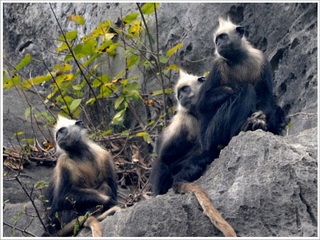
White-headed langur. (Photo: Peking University Chongzuo Biodiversity Research Institute)

    The Asian white headed-Langur, also referred to as the leaf monkey because it only feeds on leaves and fruits. Previously found in 16 areas of the Guangxi Province of southern China this species is now limited to only three or four areas. The steep mountains and the valley below are its natural habitat in the Nongguan Nature Reserve. The outer part of the reserve has been turned into an agricultural land for sugarcane and rice crops.

    (Photo: Peking University Chongzuo Biodiversity Research Institute)

        Dr. Pan Wenshi, a biologist from the Peking University, has been living at the Nongguan Nature Reserve, trying to do everything possible to save this species from extinction. When he first arrived, forest officials were planning to blow up three of the karst mountain cliffs on which they lived, but with persuasion from Wenshi the blasting was stopped. Today with his continued efforts to save this race the Langur population has gone up from 96 in the 1990s to a present 500.

    Source: 10awesome.com/

Rays

Posted on October 17, 2012

Twice a year in the Gulf of Mexico Golden Cow-nose stingrays swim from the Yucatan Peninsula in Mexico to Florida in the spring and back in the fall.

    Their migration is northward in the late spring and southward in the late fall. As they swim, their wingtips often break the surface resembling the dorsal fin of a shark. Occasionally they jump out of the water and land with a loud smack, a behavior thought to be a territorial display.

Wolves redux

Posted on October 16, 2012

Dogs attack sheep, kill 44
Oct 11, 2012 – From staff reports

The Fremont County Sheriff’s Office is investigating the death of 44 sheep that reportedly were killed by dogs running at large north of Riverton. Deputies were notified of the issue at about 10:30 a.m. Wednesday, when the owner of the sheep reported finding 50 to 75 of the animals dead or injured in their corral at 39 Jennings Road.

“It appears the dogs entered into a feed lot and ran the sheep against the outer railings,” Lee said. “Some sheep appeared to have died due to being trampled while others were directly attacked by the dogs.”

He said more may die as the result of injuries. The sheep owners are estimated to have lost more than $6,000 of livestock.

Two dogs have been identified as “responsible” for the killings, Lee said, but he guessed that more were involved.

“We have had this problem in the past in this same area,” Lee said. He warned dog owners to keep their animals at home.

“If you own a dog and fail to keep the dog from running at large, you have committed a criminal offense,” Lee said. “Dog owners are held criminally liable for damages to persons or livestock.”

Fines may be assessed to dog owners, Lee said, and their pets may be put down if the animals are determined to be vicious.


A blogger comments:

Dogs kill 44 sheep in Wyoming. Ho hum, but what if it had been wolves?
Oct 13, 2012
Story is of little interest to Wyoming media-

Dogs running loose have killed 44 sheep north of Riverton, Wyoming. Perhaps a score or more were injured. The incident has received minor attention from the Wyoming media. The story got more attention than a story about a bar fight, but not much, but what if wolves had killed 44 sheep? This is close to the average number of sheep killed in the state as a whole by wolves in the average year. For that, there is no end of complaining about wolf attacks here and there by ranchers who say they can tolerate no more, psychologically or economically.

Not to worry though, the sheriff sternly chided local dog owners.

Rubber dodo award

Posted on October 16, 2012

Established by the Center for Biological Diversity in 2007 as a way to spotlight those who do their very worst to destroy wild places and drive species to extinction.

Montana Senator Jon Tester.

    A person you might want to consider is Montana Senator Jon Tester who stuck a rider on a must-pass budget bill that eliminated federal protections from wolves in Montana, Wyoming, Idaho and parts of three other states.

    The bill marks the first time that politicians, rather than scientists, decided when a species should lose its protections. Since Tester’s bill, more than 600 wolves in the West have been killed by hunters, trappers and government agents. And Tester just added another provision to another bill, aiming to ban the government from saving thousands of eagles, condors, swans and other birds from being lethally poisoned by lead hunting ammunition left in the wild.


      Vote by midnight, October 25!

      Cast your vote here.

A tail

Posted on October 14, 2012

The jaguar is the third-largest feline after the tiger and the lion, and one of the largest found in the wild in the Western Hemisphere. The magnificent cats with their distinctive rosette markings once roamed from South America and Central America through the southern and central United States, but lost habitat and were killed off in the east in the 1700s.
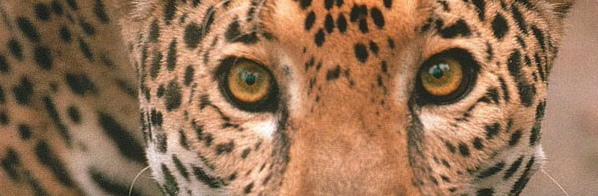
According to recent estimates, there may be as many as 30,000 jaguars total across their range, with between 3,000 and 4,000 in Mexico. Populations thin out toward the northern end of the range to the border with the U.S.

Individuals from Mexico—where the cat is known as el tigre—have reappeared sporadically in the U.S. in the last several decades. While no one knows exactly how many jaguars are here, or how long they hang around before sneaking back to their breeding grounds in Mexico, their presence has set off repercussions on both sides of the border.

In 1915, in response to the general threat of livestock predators in the western U.S., primarily wolves, Congress funded the US Bureau of Biological Survey, previously an agency devoted to scientific research, to implement a program of predator extermination. The Biological Survey killed its first jaguar in the Santa Rita Mountains south of Tucson three years later.
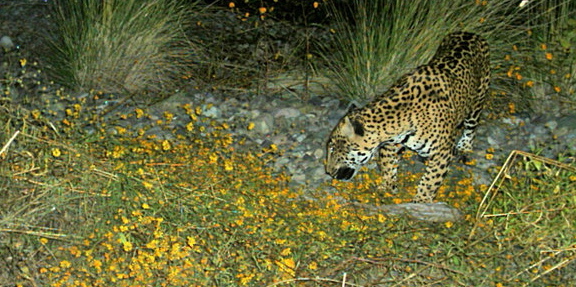
A jaguar along an isolated canyon in Sonora State in Mexico. (Photo: Earth Island Institute)

By 1972, with the jaguar presumed extinct in the US and declining elsewhere in the western hemisphere, the USFWS listed it as endangered, but only south of the border. Fifteen years later, a jaguar was tracked by hounds in the Dos Cabeza Mountains of Arizona and shot by a hunter. The slaying did not violate the Endangered Species Act because U.S. jaguars were still considered extinct rather than endangered.

Whatever they were designated they kept showing up. Ten years later two separate parties of cougar hunters photographed jaguars that their hounds had treed in the Peloncillos Mountains, in New Mexico near the Mexican border.

Using photos of the two cats as evidence, the Center for Biologic Diversity filed a lawsuit that forced the federal government in 1997 to list the jaguar as endangered in the United States, a move the USFWS had long resisted fearing that listing of the jaguar’s range as “critical habitat” could lead to new limits on cattle ranching on public lands and hunting in Arizona and New Mexico.

The cats kept on coming. Trap cameras set by a non-profit conservation group called the Borderlands Jaguar Detection Project captured images of a male that was dubbed Macho A. In 2004, trail cameras set by a biologist named Emil McCain working with the Borderlands Jaguar Project captured images of a second cat in the Coronado National Forest, whom they called Macho B. When McCain analyzed Macho B’s spots, he discovered that this was one of the jaguars that that had been treed and photographed eight years earlier.
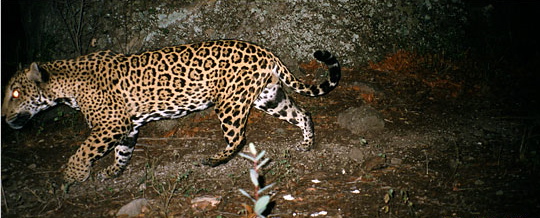
Macho B wandering the border in southern Arizona. (Photo: Emil McCain)

    In February, 2006, in the Animas Mountains, animal guide Warner Glenn photographed a jaguar that his dogs had chased into a big cedar tree. “He did not run,” Glenn said. “He was not afraid of anything.” Later he estimated that the jaguar, by the look of his teeth, was eight or nine years old and weighed nearly 200 pounds. Glenn named the cat Border King.

    Border King in the Animas Mountains, March 7, 1996. (Photo: Warner Glenn)

    USFWS dragged its feet for years failing to develop a recovery plan for the jaguar as required under the EPA. In 1997 it gave this chore to a new inter-agency group, the Jaguar Conservation Team (JCT), that was created by the Arizona Game and Fish Department in order to forestall the jaguar’s listing as endangered in the U.S.. The JCT pledged to “provide long-term commitments to identify and eventually coordinate protection of jaguar habitat.” Dominated by the livestock industry, that resists any attempts to have the federal land where they graze their cattle designated “critical habitat,” the team failed to protect any land, including even failing to meaningfully engage the Department of Homeland Security as it erected a jaguar-proof wall to stop illegal immigration into the U.S..

    In an attempt to appear it was doing something, the Jaguar Conservation Team made plans to capture a jaguar to affix a radio-collar for research. Conservationists warned of the potential risks and questioned the purpose of such a plan and how it fit into protecting the big cat’s future. Non-intrusive methods of research were available, but the Jaguar team swept both objections and suggestions aside. They wanted to capture a jaguar and that was it. Yet, as an endangered species, to make capturing a jaguar legal, USFWS first had to issue a permit authorizing such “take.”
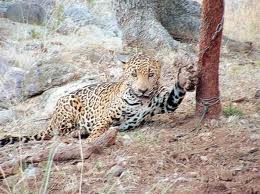
    Macho B.

    On February 18, 2009, Arizona Game and Fish Department biologists found Macho B captured in a wire snare.

    The snare had been set by biologist Emil McCain, who was working as a subcontractor for Arizona Game and Fish Department capturing mountain lions and bears for radio-collaring. Ostensibly, snaring a jaguar was a happy accident. The biologists tranquilized, radio-collared and released the cat.

    Twelve days later, after he did not move as far or as frequently as expected following his capture and after he was observed ailing, Macho B was re-captured, diagnosed as terminally ill from kidney failure, and euthanized.

    Macho B snared, Feb. 18, 2009. (Photo: AZ Dept Fish and Game)

    Game and Fish said the capture was accidental, occurring as part of a bear-lion study. The Center for Biological Diversity called for an independent medical investigation, which revealed that the jaguar’s death was at least in part due to agency mismanagement.

    Investigating Macho B’s death, the Interior Department’s inspector general concluded that Arizona Game and Fish did not have a permit for the capture, and stated that skinning the jaguar to preserve the pelt, undertaken instead of a necropsy because a Fish and Wildlife Service supervisor was unfamiliar with the word “necropsy,” resulted in loss of information and left doubt as to what had ailed Macho B. Although the entire corpse was not made available for a necropsy, some organs were preserved. A veterinary pathologist who examined the jaguar’s kidneys, but whose report was never released, told the Arizona Daily Star that the organs appeared healthy and that Macho B may have just suffered from dehydration.

    In January 2010, the Interior Department’s inspector general released a report concluding that Macho B’s capture had been intentional—and that Game and Fish had no permit to capture jaguars, either intentionally or incidentally.

    In May, 2010, Emil McCain admitted in federal court that he deliberately and without a permit captured Macho B by baiting a snare set in a canyon that he knew Macho B traversed and pleaded guilty to a misdemeanor crime: illegal take of an endangered species. (McCain had convinced a female co-worker to plant the bait, and she was sentenced as well.) McCain said he knew there had been recent evidence a jaguar had appeared in the area of the snares as photographs of the cat had been taken near the capture site months earlier. He was sentenced to five years’ probation and fined $1,000.

    Twelve years after it was created, and with little else to show for its efforts, the Jaguar Conservation Team and its powerbroker the Arizona Game and Fish Department, had killed, for scientific purposes but absent the rigor of real science and outside the constraints of federal law, the last known wild jaguar in the United States.


    Maybe it’s the political climate in Mexico, who knows, but they keep on coming. In June of last year a helicopter pilot working along the border for the federal Department of Homeland Security reported seeing a jaguar in the Santa Rita Mountains southeast of Tucson but the report couldn’t be confirmed.

    In November, Donnie Fenn, a mountain lion guide based in Benson, Ariz. was taking his 10-year-old daughter out on her first lion hunt in a mountain range in Cochise County when his pack of eight hounds treed a jaguar “twice the size of a big mountain lion.” Feen said that his dogs were scratched pretty badly by the cat. He made sure to confirm his run-in with the jaguar with photos and a video. Experts believe it was an adult male about 200 pounds.

    In September of this year a trail camera took this picture.
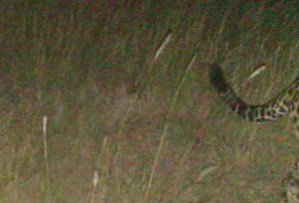
    Trail camera photo taken southeast of Tucson, Arizona in September, 2012, identified by Arizona state game officials as a jaguar. (Photo: Arizona Game and Fish Dept)

    It’s not known if the jaguar tail photographed is of the same animal as the one photographed by Donnie Fenn, since authorities don’t have good enough photos of that jaguar’s tail to make a comparison.

      Part 1 of 2 parts.

Flo

Posted on October 12, 2012

In 2000, the National Institutes of Health (NIH) seized 288 chimps from a failing private laboratory, The Coulston Foundation, and held them as a “research reserve colony” at the Alamogordo Primate Facility (APF) on Holloman Air Force Base, in New Mexico. All of these chimps have spent long and difficult years in laboratories, but since 2001 have been free from invasive tests and have seen their day to day lives slowly improve.

The NIH recently announced plans to move this group of mostly elderly, chronically ill chimpanzees to another lab for use in further research.

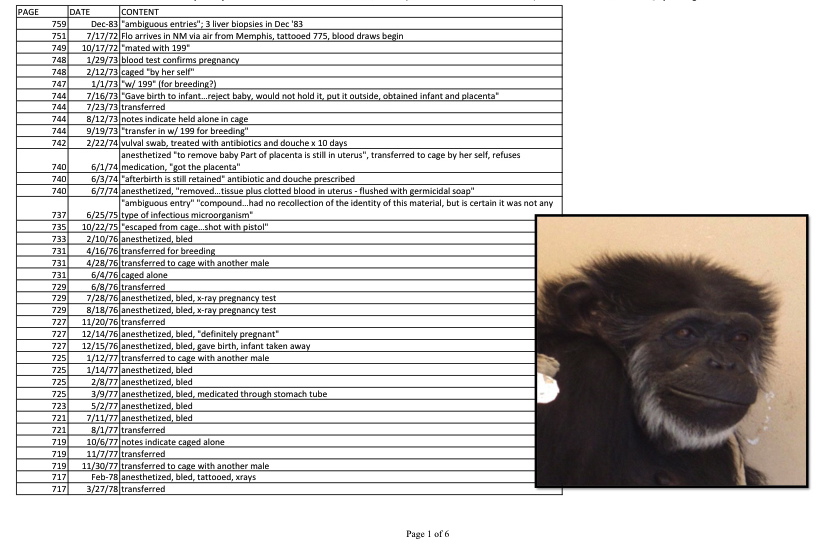
One of the chimps slated for transfer is Flo, currently the eldest surviving chimp in the Alamogordo colony. Flo was acquired from a zoo in Memphis, Tennessee in 1972. Her records (partial notes focusing on potential traumatic or stressful events, received via Freedom of Information Act) hint at what she has been subjected to over the years.

The last few years she has lived at APF with other elder chimpanzees with indoor-outdoor access, fresh fruit, and enrichment. The expected captive chimpanzee lifespan is 50. Flo turned 53 last month. Why subject her to this move? Why put her at risk for further invasive studies? What she deserves is release to sanctuary, where she can roam with other chimps.

According to National Institutes of Health records, the Alamogordo Primate Facility today holds 169 chimpanzees.


Contact Congress today and ask for support of the Great Ape Protection and Cost Savings Act (S. 810/H.R. 1513). This bill would end government testing on chimpanzees and retire federally-owned chimps, like the Alamogordo Primate Facility chimpanzees, to sanctuary at last.