Former hunting ground of the Maharajas of Jaipur.
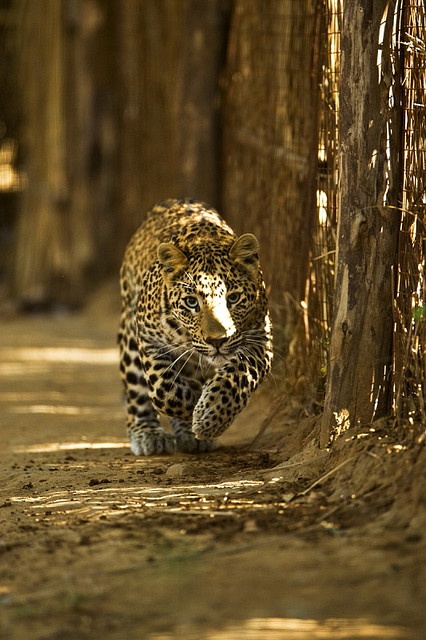
Ranthambore National Park.
Ranthambore National Park.
A small chubby seabird called the Marbled murrelet that nests in coastal old-growth forests in the Pacific Northwest, received a break today when a district court in Washington, D.C., ruled not to eliminate the “critical habitat” designation of the forests in which it lives. A critical habitat designation is required for the bird to remain protected under the Endangered Species Act. It was first listed as endangered 17 years ago.
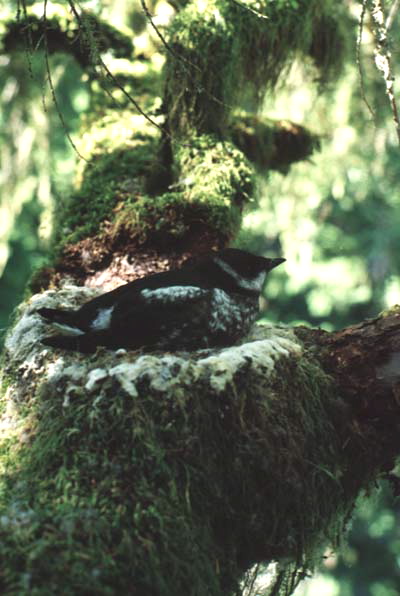
Marbled murrelet. (US Fish & Wildlife Service)
The ruling came from a lawsuit filed by the timber industry which has twice before sued to have murrelet protections eliminated so that it can increase logging of forests more than 100 years old.
Murrelets depend on old-growth forests for habitat and, in particular, use the oldest trees for nests. They seem to prefer larger stands generally within about one mile of the ocean.
Numerous scientific studies have shown that the chief reason murrelets are fast disappearing is loss of habitat from ongoing timber harvesting on the coasts of Washington, Oregon and California.
The U.S. Fish and Wildlife Service, the federal government’s principal wildlife conservation agency, had wanted to withdraw a 16-year old designation of protected habitat for the species in order to resolve an industry lawsuit.
Some of the old-growth forests in the region are managed by the Bureau of Land Management (BLM), which has been under pressure both from Congress and the BLM’s parent agency, the Department of Interior, to increase logging. Years after decades of rapacious clear-cutting—under the guise of “sustained yield,” during which loggers stripped the Pacific Northwest of nearly all its old-growth, thus precipitating the crash of the forest industry—timber companies continue to push for access to the last remaining old trees, no matter the ultimate cost.
Without old-growth forest protection, these beautiful birds will disappear from the Pacific Coast.
Shout out: The Center for Biological Diversity.
Unsustainable and illegal fishing practices are threatening a multi-billion dollar industry that makes a significant contribution to the GDP of many Pacific island states.
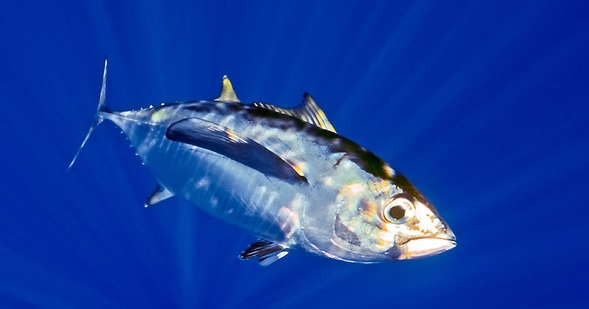
Big eye (ahi) tuna.
Tuna is the economic mainstay of the Western and Central Pacific, with the region’s stock worth $5.5 billion. A combination of unregulated fishing which has collapsed tuna stocks (in early January, scientists released data showing that bluefin tuna in the North Pacific will soon be effectively extinct) and the growth of global demand for tuna has pushed the value of the fish continually higher. A single Pacific bluefin recently sold in Japan for $1.76 million.
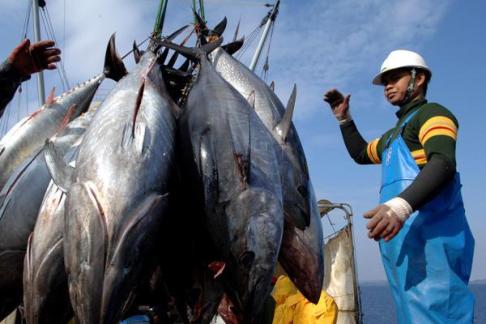
Bluefin tuna. (Photo: PNA)
To protect their tuna economies, eight Pacific neighbors (Micronesia, Kiribati, Nauru, the Marshall Islands, Palau, the Solomon Islands, Papua New Guinea, and Tuvalu) formed a collation called the Parties to the Nauru Agreement (PNA) to sustainably manage tuna fishing in their territorial waters. Together the islands states control 5.5 million square miles of national waters in prime tuna fishing grounds, containing nearly half of the world’s skipjack tuna—America’s favorite fish—and nearly one-third of the world’s total tuna harvest.
The core of PNA’s plan is a “vessel day scheme” (VDS) that limits both the number of boats in their collective waters and the total number of days those boats are allowed to fish. The VDS is based on a limited number of fishing days that are divided among PNA members which auction off fishing days to the highest bidder. When a country reaches its fishing day limit, it is required to trade for additional fishing days from other members to keep their ocean zones open to fishing.
To protect tuna from fishery predation in the ocean regions beyond their control, in 2010, the PNA told the foreign companies that held PNA licenses, that if they wanted to fish in the consortium’s territorial waters, they had to agree to not fish the international waters in between territories. The fishers had little choice but to agree.
The Western and Central Pacific Fisheries Commission (WCPFC) decision to uphold the PNA’s claim that they own their fishing rights is a first. Tuna rights in the Atlantic Ocean have generally gone to powerful fishing countries that claim “historic rights” to fishing grounds far from their own shores. The PNA’s move in the Pacific has got countries off the African coast thinking of banding together to do the same thing.
Despite the coaliton’s new rules, there remains the issue of who controls the high seas and the problem of unregulated boats simply stealing fish.
Fisheries worldwide – particularly tuna fisheries– have long been plagued by rogue fishers who plunder the global commons by catching fish illegally inside territorial waters then escape into the unregulated high-seas where they “launder” their catch by transferring it to refrigerated ships which transport the tuna to port. The result is that nobody knows where or when the fish was caught or if it was caught legally.
With few boats of their own to police the vast ocean, the island states remain vulnerable to these pirate fishers. Palau, for instance, with only a single patrol boat, in 2010, recorded about 850 pirate fishing vessels plundering its waters.
One such vessel is the Heng Xing 1, a refrigerated, or “reefer,” vessel. The Heng Xing 1 and two other ships were recently caught in the act of transferring tuna and boarded by Palau authorities. Tons of frozen skipjack tuna was found in the hold.

Preparing to board the Heng Xing 1. (Photo: Courtesy of Shannon Service)
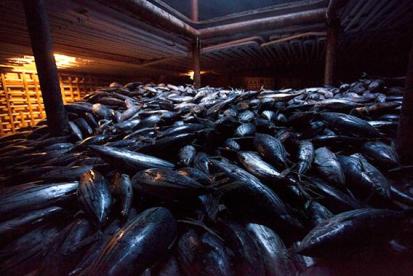
Tons of frozen skipjack tuna in the hold of the Heng Xing 1. (Photo: Courtesy of Shannon Service)
The boat’s captain freely admitted moving the fish from a fisher boat but professed to be unaware that it is illegal to do so. All three vessels broke the law, but since they were stopped in international waters, the inspectors had no authority to impose a penalty.

Palau marine officer Earl Benhart prepares to board the Sal 19, a fishing vessel transiting through Palauan waters. The Sal 19 was one of the three boats caught unlawfully moving tuna. (Photo: Shannon Service)

The Sal 19 painted over both its name and call signs and did not have a log book on board. However, Palau could not detain the vessel since it was on “innocent passage” through their waters. (Photo: Courtesy of Shannon Service)
The biggest challenge for the PNA to achieve its grand vision, is just sticking together. When a cartel artificially restricts supply of a good, there’s a temptation for individual states to break off and sell more. With 1.37 million square miles of ocean holdings, Kiribati, which has a particularly rich fishing zone broke ranks from the PNA in 2012 and oversold its quota. The PNA let Kiribati off the hook after it agreed to commit to enforcing the VDS this year. But with the price of tuna continuing to rise, human nature guarantees that problems will persist despite the best intentions.
Fortunately, the world is beginning to take steps, albeit slowly, to tamp down the illegal fishers. Interpol recently announced plans to create a fleet with actual authority to patrol international waters to enforce high-seas law. How many boats, where they would patrol, and what it means are all being worked out.
Source: Slate.

Flies, Maggots, Rats, and Lots of Poop: What Big Ag Doesn’t Want You To See |
What’s it like inside a factory farm? If the livestock and meat industries have their way, what little view we have inside the walls of these animal-reviewing facilities may soon be obscured. For the second year in a row, the industry is backing bills in various statehouses that would criminalize undercover investigations of livestock farms. The Humane Society of the US, one of the animal-welfare groups most adept at conducting such hidden-camera operations, counts active “ag gag” bills in no fewer than nine states. Many of them are based on a model conjured by the American Legislative Exchange Council (ALEC), a corporate-funded group that generates industry-friendly legislation language for state legislatures, Associated Press reports.
To understand the stakes of this battle, consider this 2010 Food and Drug Administration report on conditions in…
View original post 901 more words
It appears certain U.S. Legislators won’t be satisfied until wolves in America are a thing of the past once again . An article entitled “Hatch, fellow senators petition to end gray wolves’ protected status” in ksl news, Utah, begins:
Led by Utah Sen. Orrin Hatch, 72 senators and representatives formally asked the U.S. Fish and Wildlife Service Monday to delist the gray wolf from the Endangered Species Act. The request in a letter sent to the agency argues that the gray wolf is no longer an endangered species and that uncontrolled gray wolf population growth is a threat to other indigenous wildlife as well as the hunting and ranching industries.
It’s almost laughable that Senator Hatch and his cronies expect us to believe they suddenly care so much about “indigenous wildlife” since—if allowed to hatch—Orrin Hatch’s half-baked, half-witted plan to delist wolves would effectively seal the fate of one the…
View original post 615 more words

noodls2013-03-30: (Source: WWF – World Wildlife Fund) Yangtze finless porpoise population nosedives to 1,000 Posted on 29 March 2013| Wuhan, China — The Yangtze finless porpoise population has declined to a mere 1,000 individuals, making the endangered species even more rare than the wild giant panda, the 2012YangtzeFreshwaterDolphinSurveyReport reveals. The population in the mainstream of the Yangtze River was less than half of what a similar survey found six years ago, with food shortages and human disturbance such as increased shipping traffic major threats to their survival. The study also found that the rare… more »
Photo: Wikipedia

A controversy has erupted over the disclosure of a massive “culling” of long-trailed macaques being conducted by Malaysia’s Department of Wildlife and National Parks (Perhilitan) (NRE).

Long-tailed macaque monkeys (Macaca fascicularis).
Last year the NRE dispatched nearly 100,000 macaques. A ten percent increase over 2011.
The department explains its actions thusly: “The disturbance caused by the monkeys has undermined the tolerance level of the communities to co-exist with them.”
Reminiscent of a recent post concerning the antagonistic attitudes of villagers towards Red colobus monkeys in Africa, what’s happening to the macaques is yet another example of the earth’s swelling populations of homo sapiens pushing the other species on the planet toward extinction.

The total number culled in 2012 was 97,200, up from 87,900 in 2011.
Defending its actions the NRE released a statement stressing that the decision to cull the macaques in peninsular Malaysia “was not done in haste.” “Just imagine,” an official explained, “with the culling of 87,819 (animals) in 2011, we still had 4,913 complaints. With the culling of 97,119 (animals) last year, the complaints still stood at 3,235 cases.
In response to allegations by animal rights groups that the methods used to kill the monkeys were cruel and inhumane (drowning and shooting), officials explained that the primates were exterminated through “an internationally accepted culling method.”
The department characterized macaques as a “pest species” that is prolific, able to reproduce very fast and can easily adapt to any urban habitat, and that any allegation that the culling will push the monkeys into extinction is nonsense. It added that it is only culling the problematic population in urban and sub-urban areas and not the macaques’ population that live in protected forests.
The estimated population of the long-tailed macaques in peninsular Malaysia is estimated at 740,000 and well distributed in the urban areas.
The department viewed alternatives to culling such as relocation of problem macaques to forested areas in the long term as just a temporary transfer of the problem as new conflicts would be created as the animals are extremely territorial.
It claims that the culling practice was discussed in detail with NGOs, experts and scientists but did not release any more specific details. In response to pubic complaints, the NRE has set up a special committee to look into the culling campaign. An official acknowledged that the long-term solution for the problem is sterilization.
The Malaysian government stopped exporting long-tailed macaques for commercial purpose in 1986.
IUCN Red List of Threatened Species 2012 categorized long-tailed macaques as “Least Concern”.
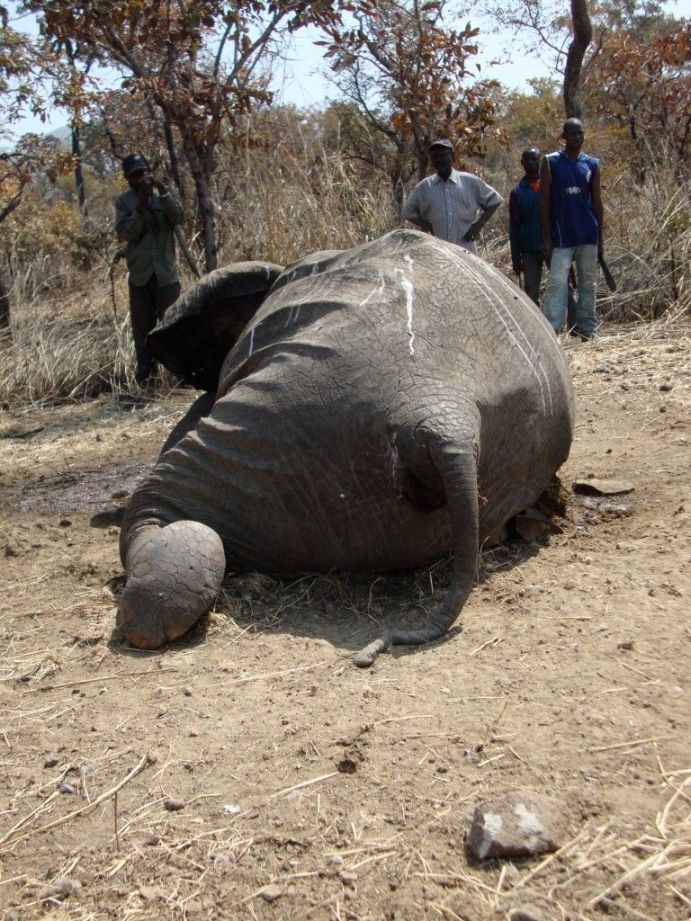
One of hundreds of elephants killed in a single incident in Northern Cameroon
(Photo: WWF/Bouba N’Djida Safari Lodge)
announced on Saturday that they are sending a thousand soldiers and law-enforcement officials to start joint military operations to protect the region’s last remaining savanna elephants, threatened by the Sudanese poachers who are on a killing spree in the region.
The mobilization could be a sign that Central African countries are beginning to take elephant poaching, which has decimated populations across Africa, more seriously.
The World Wide Fund for Nature (WWF) reports that the group of heavily armored, horse-riding poachers are also believed to be responsible for killing some 30 elephants in the Central African Republic earlier in the year as well as 300 elephants in Cameroon’s Bouba N’Djida National Park in early 2012.
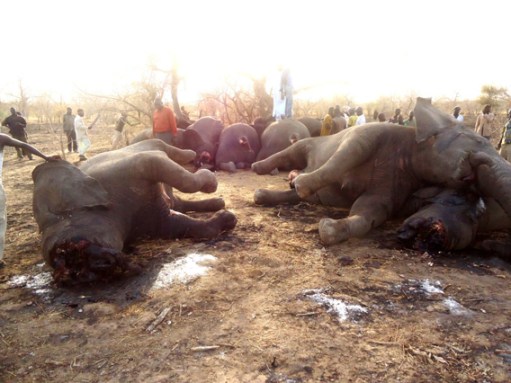
89 elephants massacred in Chad, March 2013. (Photo: SOS Elephants in Chad)
Savanna elephant populations in the Central African Republic – the country with historically the highest numbers of savanna elephants in the region – are believed to have plummeted from around 80,000 thirty years ago to a few hundred today.
Given the increasingly dire elephant poaching crisis, delegates at the 16th meeting of the Conference of the Parties to CITES, recently concluded in Bangkok, essentially sidestepped the issue, choosing to shy away from the controversial topic of elephants and ivory for fear of stressing relationships between countries.
Despite gripping speeches delivered about “the elephant poaching crisis” and the “unsustainable” levels of elephant mortality, and the fact that it is globally accepted that China is the single largest ivory consuming nation in the world, with an extensive and well documented legal and illegal ivory trade, there were no calls for China — or Thailand, also complicit in the ivory trade — to shut down their flourishing legal domestic markets for ivory. Incredibly, the specific roles of the two countries in fomenting the crisis was not even addressed.
The situation has been enabled by CITES parties themselves when they decided in 2008 to allow certain African countries to sell ivory to China in a “one-off” sale. A move which proved disastrous as it sent a strong signal to organized crime and poachers in the field that elephant ivory is a commodity of financial value to be traded.
Acceptance of the ivory trade is endemic in China, Vietnam and Thailand which are filled to the neck with illegal animal parts, with the police just walking by.
China’s illicit ivory trade has steadily grown in the last twenty years as the country’s emerging middle class has grown an appetite for luxury goods and ancient animal-based medicines. There are more tigers in tiger farms in China then there are in the wild. When asked to stop the practice of tiger farming, China legalized it.
It is estimated that 25,000 elephants were killed for their tusks in 2011. Over the next 3 years before the next CITES meeting, it is estimated that another 100,000 elephants will be killed.
The slaughter in Africa is increasingly in the world’s spotlight. Hopefully justice will prevail, the poachers will be caught and the message sent that the wanton slaughter of wildlife will not be tolerated.
Source: World Wildlife Fund
Shout out: Mongabay.com
Nothing says “home” quite like a dead rhino head mounted on the wall, or a lovely bear hide under your feet. You too can redecorate to your liking. For $2,000 you can shoot a zebra, or for $20,000 a lion. Cost isn’t an issue? Well then for $40,000 how about an elephant?
The trophy hunting industry is alive and well in Africa. But with today’s modern hunters, if price is not an issue, neither is convenience. That’s where “canned hunts” or “captive hunts” come in. Shooters pay enormous fees for the guaranteed kill of an animal, some of them endangered species.
Although canned hunts are advertised as rugged, outdoor adventures, in reality they are conducted in an atmosphere of comfort and convenience. The area is usually a fenced enclosure from which there is no escape, ranging from a few square yards to several hundred acres, depending on how “strenuous” you want your hunt to be.
View original post 294 more words
last week, featured photographs taken by Matt Eich at the Sweetwater Rattlesnake Roundup in Sweetwater, Texas.

A young boy learns how to skin a rattlesnake. The handprints on the wall are made with snake blood. (Photo: Matt Eich/New Yorker)
The magazine characterized the event thusly: “At the roundup, held each year since 1958, thousands of wild rattlesnakes are captured, sold, displayed, and, often, killed as part of the week’s events.”

A Sweetwater Jaycee prepares to milk a rattlesnake in front of a captive audience. (Photo: Matt Eich/New Yorker)

A man holds a still-beating rattlesnake heart. The hearts can continue to beat for up to an hour after being removed if kept moist. (Photo: Matt Eich/New Yorker)
Not a word expanding on the the fact that this fabulous Texas tradition might be a disaster for another of nature’s endangered animals. (See: ANIMAL POST/”The Eastern Diamondback,” January 31, 2013.)

Sweetwater Rattlesnake Roundup vendor shows off a stuffed rattlesnake. (Photo: Matt Eich/New Yorker)
Apparently, the magazine figures this is simply another quirky example of homespun Americana.
Somehow, New York, home to America’s major media, often just doesn’t get it. The New York Times, the most influential paper of all, has a long tradition of avoiding environmental reporting whenever possible and would prefer to drop coverage of issues related to the environment and nature altogether, except there are just enough people who do care about these things that the paper can’t just let them go altogether.
There are many ways to destroy a person–or an animal. But the simplest and most devastating might be solitary confinement.
Consider the following testimony from prisoners interviewed by the psychiatrist Stuart Grassian in Block 10 of Walpole Penitentiary in 1982:

Chimpanzee at the San Francisco Zoo. (Photo: Jeff Marquis/Flickr)
Source: nytimes.com.
And there are very few things more seductive than the dirty talk of what historian and writer James McWilliams calls “agricultural pornography.” Words whispered in just the right way, “the idyllic image of farm animals roaming a verdant pasture”—an image promoted by every purveyor of meat products in the U.S.—”can make otherwise enlightened consumers melt, thereby forgetting the cold truth that an owned farm animal is an abused animal.”
does not mean hens are treated humanely. They may still have their beaks cut off in a practice called “debeaking,” because it cuts down on the amount of injuries when they fight each other. They may still be given antibiotics. When they are too old to lay eggs at a profitable rate, they are slaughtered for cheap meat.
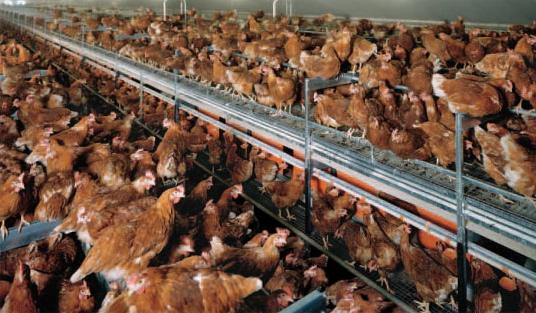
Black Eagle Farm, a typical large-scale “cage-free” operation in Virginia, houses 48,000 hens. (Photo: Poultry Press)
The “platforms” at Black Eagle Farm—that advertises itself as a “traditional family farm” and “animal friendly”—designed to cram as many hens as possible into a single building, turn the concept of “cage free” on its head.
female chicks are sold to become laying hens, but male chicks are killed because they are useless for laying eggs, and they are the wrong breed to be profitable meat chickens. A video taken at the Hy-Line Hatchery in Iowa, the world’s largest hatchery for egg-laying chickens, shows how 150,000 male chicks are ground up of every day while still alive.

Hy-Line hatchery. (Video: Mercy For Animals)
used at Iowa Select Farms in Kamrar, Iowa, subject pigs to a lifetime of virtually immobilized confinement. A Mercy For Animals video shows the operation in horrid detail. Confining mother pigs in such crates is so patently cruel that the practice has been banned by the entire European Union, New Zealand, and the states of Florida, Arizona, Oregon, Colorado, California, Maine, and Michigan.

Iowa Farms Select. (Video: Mercy For Animals)
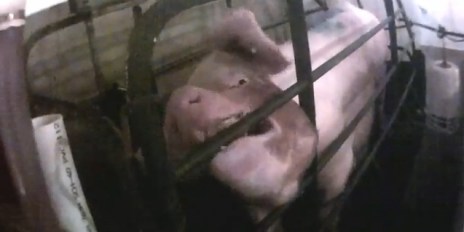
Iowa Farms Select. (Video: Mercy For Animals)
Iowa Farms Select is the nation’s 4th largest pork producer, selling to companies such as Costco, Hy-Vee, Safeway, and Kroger.

Hallmark Meat Company. (Video: HSUS)
those too weak or sick to walk—shown in a video shot at the Hallmark Meat Company in California in 2007, being dragged by chains, rammed by forklifts and sprayed with high-pressure water by employees who wanted them to stand and walk to slaughter—sparked the largest beef recall in U.S. history. The ensuing legal battle cost taxpayers $150 million. Last year the federal government entered a final judgment of $497 million against the company, which was at one time one of the biggest suppliers of ground beef to the National School Lunch Program. The judgment could not be collected because the company went out of business.

Central Valley Meat Company. (Video: Compassion Over Killing)
of cows struggling to walk and even stand on their way to slaughter at the Central Valley Meat Co. in Hanford, California shown on a video released last year by the animal welfare group Compassion Over Killing, prompted Federal regulators to shut the plant down. It was soon reopened.
Legislative attempts to suppress whistleblowers
who expose such abuses are now being shopped to states around the country in the form of “ag-gag” laws.
Last year, Iowa–a major egg-producing state and the largest producer of pork in the nation–despite abuses documented at Iowa Farms Select and Hy-Line hatchery, passed a bill making it illegal to deny being a member of an animal welfare organization on a farm job application.
In February, the Wyoming House passed legislation making it a crime to “interfere” with agriculture. In Indiana, Arkansas and Pennsylvania it would be a crime to make videos at agricultural operations. Arkansas would also prohibit anyone other than law enforcement from investigating animal cases. Utah passed a bill that outlaws photography of agricultural operations.
Ag-gag legislation is spreading with the help of the American Legislative Exchange Council (ALEC), a conservative business advocacy group funded by large corporations, that encourages lawmakers to “exchange” legislative ideas from state to state. So far this year, nine states have current or pending anti-whistle-blower bills before their legislatures.
These bills are troubling not only to animal protection activists, but also to those concerned with food safety, labor issues, free speech, and freedom of the press. The bills would apply equally to journalists, activists and employees. By prohibiting any type of undercover recordings, a farm’s own employees would be prohibited from attempting to record food safety violations, labor violations, sexual harrassment incidents or other illegal activity.
The meat industry’s response to these exposes has not been to try to prevent these abuses, but to prevent Americans from finding out about them in the first place. ALEC has labeled those who interfere with animal operations “terrorists.” The label is more aptly applied the other way around.
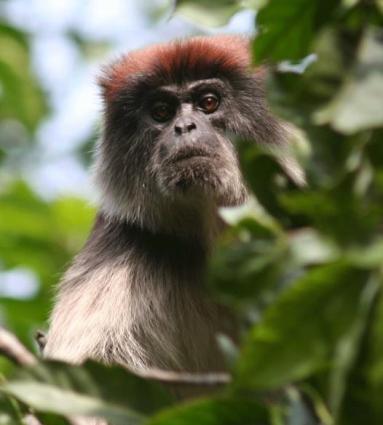
Red colobus monkey (Photo: Tim Holland)
In the Hindu religion, primates are sacred. So in predominantly Hindu areas, namely India and Nepal, killing or otherwise harming a primate is blasphemous, not to mention punishable by law. In other countries, such as China and Japan, primates are whimsical creatures, possessing mystical properties that imbue them with shrewd intelligence and cunning. In most places, however, they’re just crop pests.
This thought provoking piece by Ria Ghai via the Jane Goodall Institute of Canada, talks about supporting alternative farming techniques and sustainable livelihoods for farmers to reduce conflict between humans and wildlife.
This man, photographed in Lijang, a city in The Three Parallel Rivers Region of Yunnan, China, said his eagle caught all of its own food – although, he admitted, it was often rabbits he purchased and released for the bird to catch.

Tibetan cowboy.
The fake cowboy and 4 other men, all dressed in identical outfits, each with a golden eagle, stroll the streets looking for tourists willing to pay10 Yuan, about $1.50, to have their photo taken with an eagle perched on their arm. And business is good.
The eagles are allowed to hunt on their own – but the owners recapture the birds before they can eat their prey. “If it is hungry, it will come back,” one cowboy explained. “But if it eats until it is full, it will fly away forever.”
Source: Audubon


 First Light Productions